Stephen Loynd

60.6K posts

Stephen Loynd banner
Stephen Loynd

Stephen Loynd

@loyndsview

Observer at TrendzOwl Author of THE WIDENING TURN https://t.co/o3L4imQJkc

Arlington, VA, USA Katılım Mayıs 2013
1.7K Takip Edilen1.8K Takipçiler
Sabitlenmiş Tweet
Stephen Loynd
Stephen Loynd@loyndsview·
"A desk is a dangerous place from which to view the world." - John le Carré
Stephen Loynd tweet media
English
5
10
80
0
Stephen Loynd retweetledi
Nick Kapur
Nick Kapur@nick_kapur·
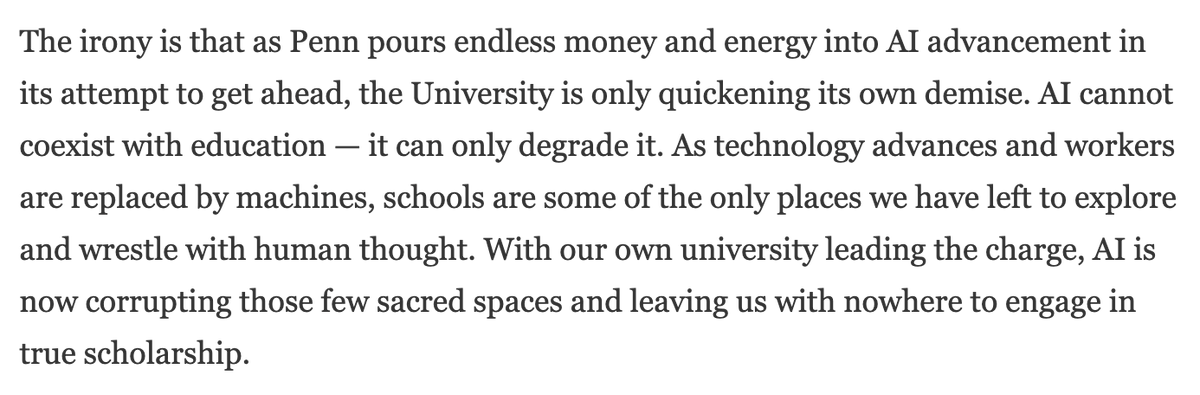
Powerful words from University of Pennsylvania students against their university's headlong rush to embrace of AI:
Nick Kapur tweet media
English
21
1.3K
6.2K
142.1K
Jay Anderson
Jay Anderson@TheProjectUnity·
Every night human beings go to sleep, lose all sense of their known reality, plunge into an abstract hyper-dimensional realm of infinite experience where time collapses, all moments instantly manifest, and then they wake up and just go about their day.
English
482
2.6K
22.9K
510.9K
Stephen Loynd
Stephen Loynd@loyndsview·
4. "But the United States needs to make sure it can build not only today’s chips but tomorrow’s. Meanwhile, America continues to lose its technological edge to its economic and geopolitical rivals."
English
0
0
1
7
Stephen Loynd
Stephen Loynd@loyndsview·
3. "America didn’t have an industry willing or able to invest in the work of finding practical applications for early discoveries—a process that took years and billions of dollars. Today, commercial extreme ultraviolet lithography machines are made by a Dutch company."
English
1
0
1
7
Stephen Loynd
Stephen Loynd@loyndsview·
"Ms. Perrine turned in a winsome performance... as... Lex Luthor’s moll, Eve Teschmacher, who ends up saving not only the Kryptonite-weakened superhero, but also Hackensack, NJ, where Eve’s mother lives, from a missile attack, foiling Luthor’s plot." nytimes.com/2026/03/23/mov…
English
0
0
1
69
Stephen Loynd retweetledi
Handre
Handre@Handre·
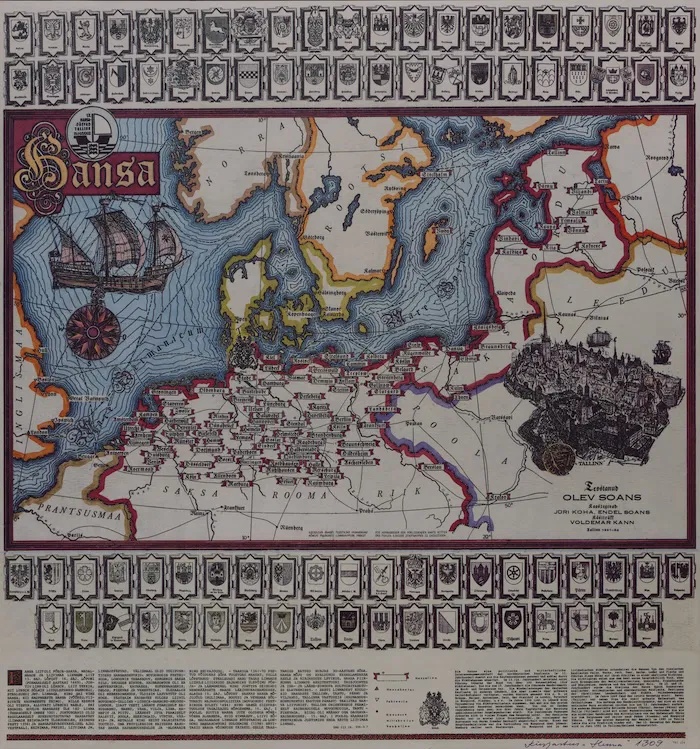
The Hanseatic League solved commercial disputes for 400 years without a single government court, police force, or regulatory agency—and they did it better than any modern state system. From 1159 to 1669, German merchants spanning from London to Novgorod created the most sophisticated private arbitration network in history. When a Hamburg trader accused a Lübeck merchant of breach of contract, they didn't petition some distant king or wait months for bureaucratic tribunals. They brought their dispute before merchant courts staffed by actual businessmen who understood trade, contracts, and reputation. These arbitrators rendered decisions within days, not years. The enforcement mechanism? Pure market discipline. The League maintained detailed records of every merchant's behavior and shared this information across all member cities. Cross a Hanseatic trader in Bergen, and you'd find yourself blacklisted from Riga to Bruges within weeks. No bailiffs, no jackbooted enforcers, no violence—just the inexorable power of reputation and voluntary association. And it worked spectacularly. The League dominated Northern European commerce for half a millennium precisely because merchants trusted their dispute resolution more than royal courts. But here's what modern lawyers and judges will never tell you: the Hanseatic system resolved disputes faster, cheaper, and more accurately than contemporary government courts. Why? Because the arbitrators actually understood commerce and faced real consequences for bad decisions. Screw up a ruling as a Hanseatic arbitrator, and merchants would stop using your services. Screw up as a federal judge today, and you get lifetime tenure. The League died when centralized nation-states crushed private governance with military force, not because their system failed. Every blockchain arbitration platform and private dispute resolution service today merely rediscovers what German merchants perfected 800 years ago.
Handre tweet media
English
157
1.2K
5.3K
288.7K
Stephen Loynd retweetledi
Anish Moonka
Anish Moonka@AnishA_Moonka·
Went down the rabbit hole on this. Your brain treats a physical book like a landscape. It builds a spatial map of the text, the same way it maps trails, rooms, and city blocks. When you scroll on a phone, that map breaks apart. Seven large-scale research reviews and direct brain scans confirm what you already feel. A 2023 study in PLOS ONE attached brain-activity sensors to children’s heads while they read the same text on paper and on screen. Paper reading produced fast brain waves, the pattern linked to focused attention. Screen reading shifted the brain into slow waves, the pattern linked to mind wandering and daydreaming. Same kids. Same words. Measurably different brain states. A separate 2022 study from Showa University in Japan scanned the front of the brain, the area that manages focus and comprehension, during phone versus paper reading. Smartphones sent that region into overdrive, meaning the brain was straining just to keep up with basic processing. Paper reading produced a moderate load that triggered natural deep breathing, which helped regulate brain function and sustain focus. The phone suppressed that breathing pattern entirely. Since 2017, researchers have published seven major reviews combining hundreds of individual studies. Six of seven reached the same conclusion: people understand less on screens. A 2018 review of 54 studies and 170,000+ participants, literally titled “Don’t throw away your printed books,” found paper outperformed screens across the board for non-fiction. A 2024 follow-up with 49 more studies confirmed it. The gap has grown steadily every year since 2001. Being a “digital native” doesn’t help. The best explanation is how your brain tracks where you are. Your short-term memory can only juggle about 7 things at once. A physical book gives you constant location cues: the weight shifting from right hand to left, where a paragraph sits on the page, how thick the remaining pages feel. Your brain hands off the “where am I in this text?” job to those physical signals, leaving more room for actually understanding what you’re reading. On a phone, every screen looks identical. Your brain has to track position and process meaning at the same time, and something gives. A Norwegian eye-tracking study analyzing 25,000+ individual eye movements found screen readers processed text more shallowly. The students had no idea they were reading differently. In 2019, nearly 200 reading scientists from 30+ countries signed an open letter warning that screen reading was degrading deep comprehension. Since then, Scandinavian countries, among the most digitized school systems on Earth, have started putting physical books back in classrooms.
shree🪄@Goldensky0

reading books on a phone and reading paperback books are two different things

English
145
2K
9.5K
1.5M
Stephen Loynd retweetledi
Maury Brown
Maury Brown@BizballMaury·
Welcome to Opening Day week. Here’s maybe the greatest promo ever done.
English
90
1K
9K
583K
Stephen Loynd retweetledi
Natural Philosophy
Natural Philosophy@Naturalphilosy·
Bradbury on Reading
English
20
282
1K
45.6K
Stephen Loynd
Stephen Loynd@loyndsview·
7. "Yet after years being whipsawed by a global pandemic, supply chain breakdowns and painful inflation, governments are limited—by depleted budgets and daunting debt loads—in their ability to respond to another crisis."
English
0
0
0
6
Stephen Loynd
Stephen Loynd@loyndsview·
6. "That also affects the price and availability of critical materials like fertilizer and helium, a byproduct of natural gas that is used to make semiconductor chips."
English
1
0
0
22