
Lucila Berniell

746 posts

Lucila Berniell banner
Lucila Berniell

Lucila Berniell

@luberniell

Economista

Katılım Mayıs 2013
788 Takip Edilen1.1K Takipçiler
Lucila Berniell retweetledi

CEDLAS
CEDLAS@CEDLAS·
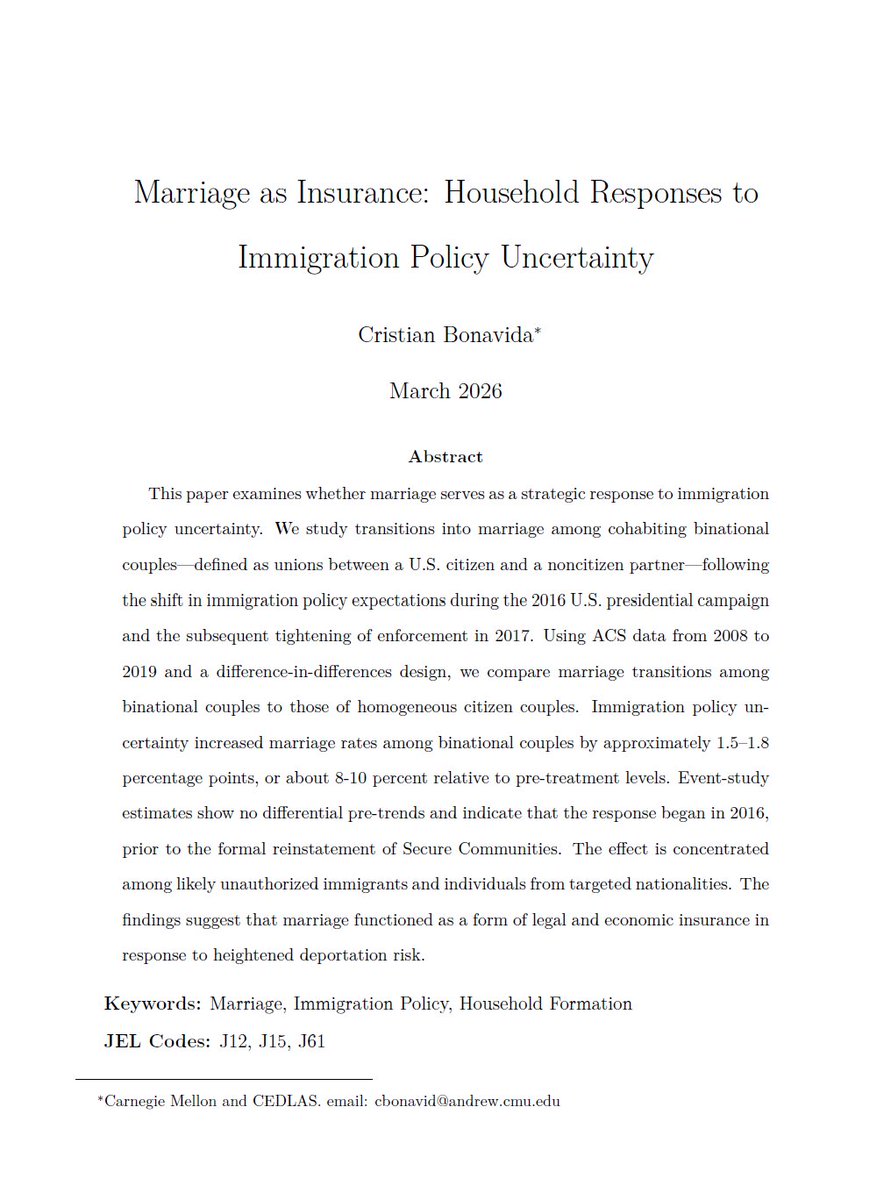
📢 ¡Nuevo documento de trabajo! "Marriage as Insurance", de @crisbonavida (Carnegie Mellon & CEDLAS). La incertidumbre migratoria en EE.UU. vinculada a la campaña y primer mandato de Trump, elevó el matrimonio en parejas mixtas (ciudadano + no-ciudadano) entre un 8-10% 📄👇 1/10
CEDLAS tweet media
Español
1
9
21
2.3K
Lucila Berniell retweetledi
CEDLAS
CEDLAS@CEDLAS·
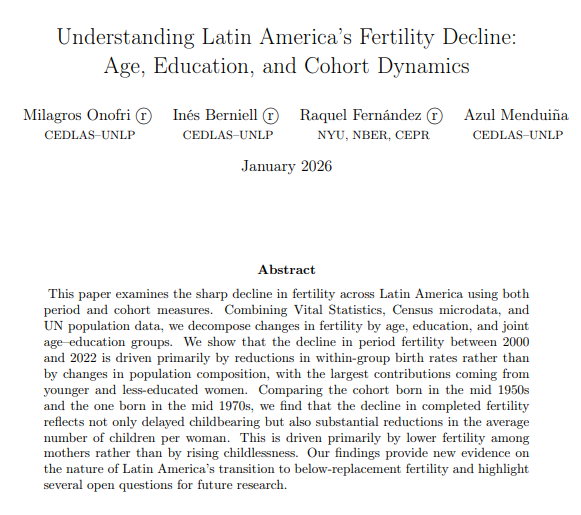
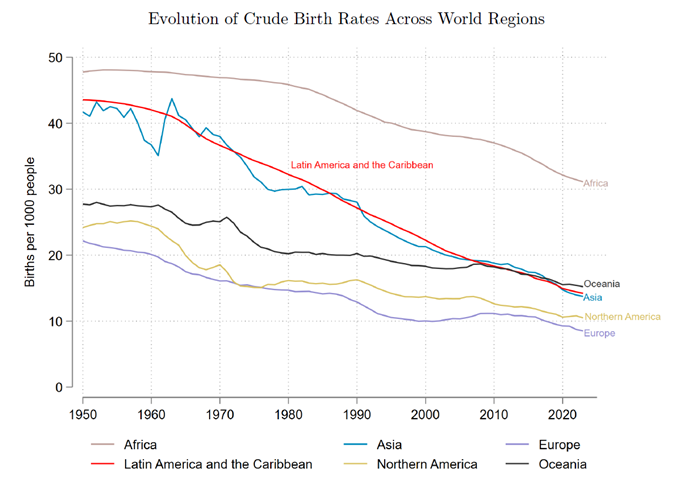
📢 ¡Nuevo documento de trabajo! La fecundidad en América Latina ha caído de manera abrupta en las últimas décadas. ¿Postergación de la maternidad o menos hijos? @InesBerniell, @raquel1fernan, @azulmenduina y @milagrosonofri exploran los patrones detrás de esta tendencia 🧵👇 1/10
CEDLAS tweet mediaCEDLAS tweet media
Español
2
69
184
14.2K
Lucila Berniell retweetledi
CEDLAS
CEDLAS@CEDLAS·
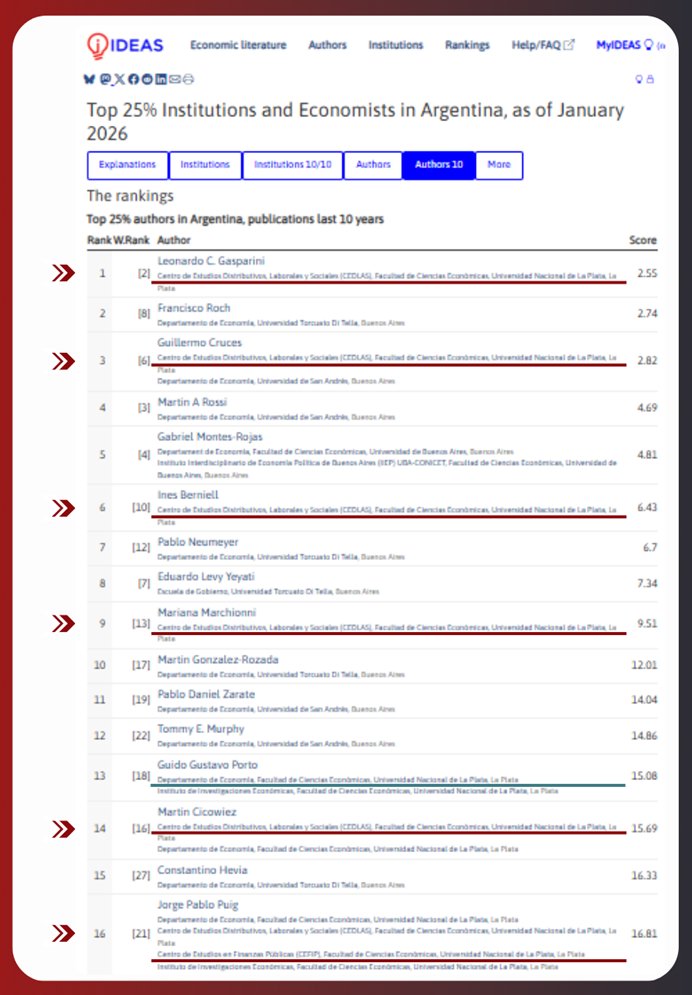
📊 RePEc (Research Papers in Economics) actualizó en enero 2026 sus rankings mundiales. 🇦🇷 En el ranking de autores argentinos según publicaciones de los últimos 10 años, 6 investigadores/as del CEDLAS se ubican entre los primeros 16 puestos. 🔗 #authors10" target="_blank" rel="nofollow noopener">ideas.repec.org/top/top.argent…
CEDLAS tweet media
Español
1
9
37
2.1K
Lucila Berniell retweetledi
Jesús Fernández-Villaverde
Jesús Fernández-Villaverde@JesusFerna7026·
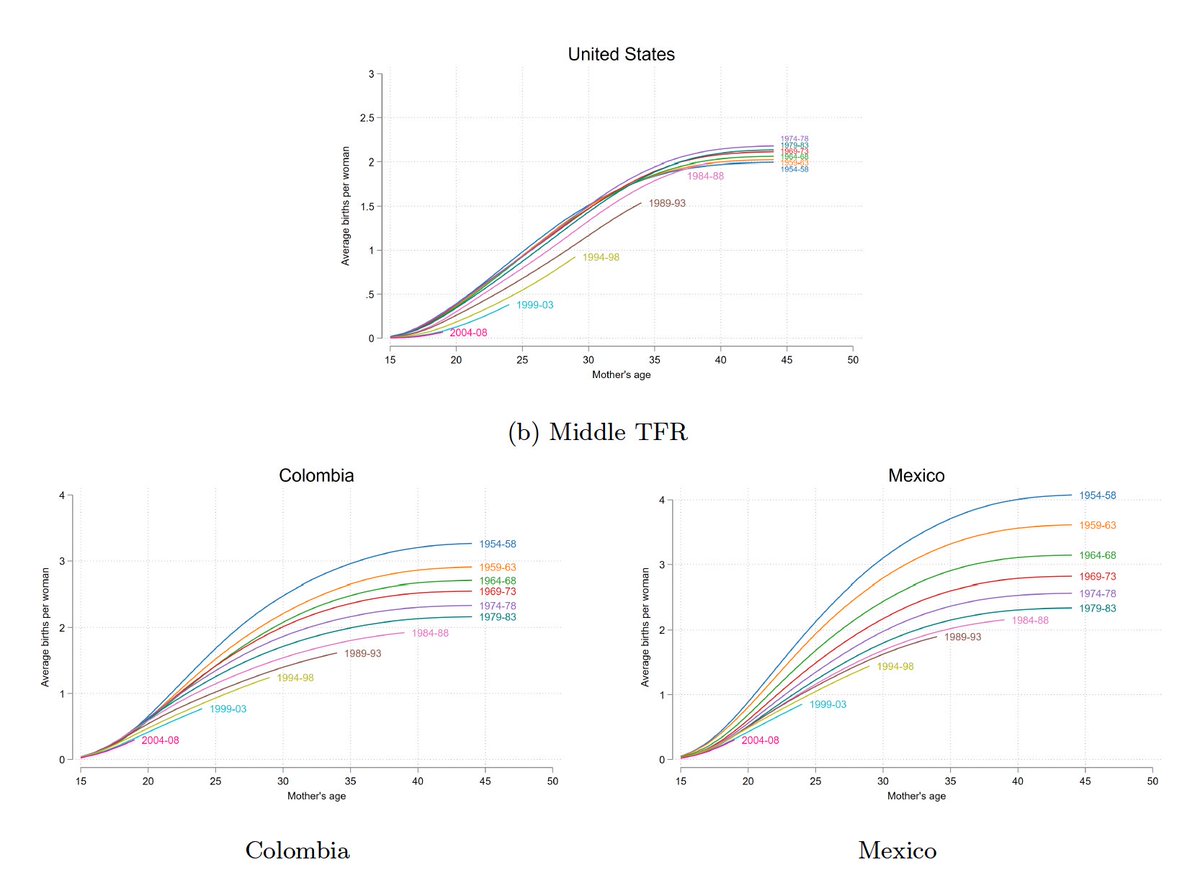
Few facts are more surprising than that, as of early 2026, Latin America has a lower fertility rate than the U.S., reversing a long-standing historical pattern. I was therefore very glad to see this morning a truly fascinating paper by Milagros Onofri, Inés Berniell (@InesBerniell), Raquel Fernández (@raquel1fernan), and Azul Menduiña on Latin America’s recent fertility decline at @nberpubs: Understanding Latin America’s Fertility Decline: Age, Education, and Cohort Dynamics nber.org/papers/w34749 I have not yet had time to fully digest all its findings, but I will be reading it repeatedly over the next few weeks. From a first reading, here are five key results (which align very well with some of my previous posts here on X): 1️⃣ The decline in period fertility between 2000 and 2022 is driven primarily by reductions in within-group birth rates, rather than by changes in population composition. 2️⃣ The largest contributions to the fertility reduction come from younger and less-educated women. 3️⃣ The decline in completed fertility reflects substantial reductions in the average number of children per woman. 4️⃣ This is driven primarily by lower fertility among mothers, rather than by rising childlessness. 5️⃣ There is currently a negative correlation between female labor force participation and the total fertility rate, suggesting that greater engagement of women in market work is not directly driving the fertility decline. Findings 2️⃣ and 5️⃣ contradict some of the overfacile explanations one often reads in the media (or in the comments section): the reduction in fertility in Latin America is not concentrated among “liberated,” highly educated women with jobs in the market. Finding 3️⃣ says the observed reduction in fertility is not mainly about timing. Yes, timing matters, but much less so than reductions in completed fertility. Finding 4️⃣ is interesting, and perhaps different from more advanced economies. My own conjectures (not the authors’!): 1️⃣ Their data end in 2022, since they need to rely on final consolidated sources. Everything I have seen in the provisional data for 2023–2025 fully supports their findings and perhaps even reinforces them. 2️⃣ By looking at the cohort level, I do not see much of a differential effect between cohorts with and without access to cell phones. Instead, I see a constant decline over time. To make this latter point, I include one of the figures from the paper, plotting, for several countries and five-year birth cohorts from 1954–1958 to 2004–2008, the cumulative average number of children a woman has had by each age. The only point where perhaps I diverge somewhat from the authors is in their more optimistic assessment of the WPP data than mine. But that is a very minor quibble. Otherwise, anyone interested in Latin America’s fertility should read this paper with utmost attention. This is social science research at its best.
Jesús Fernández-Villaverde tweet media
English
41
193
773
134.8K
Lucila Berniell retweetledi
Dolores de la Mata
Dolores de la Mata@Dolodelamata·
🚨 New Call for Research Proposals by @AgendaCAF & @el_BID on AI & digitalization for gender equality and inclusion. Deadline: October 07, 2025⏳ 👉 Link: bit.ly/3VAPvp4
English
0
6
11
545
Lucila Berniell retweetledi
CEDLAS
CEDLAS@CEDLAS·
📚 Estas brechas no reflejan menor capacidad: las economistas se gradúan antes, con mejores notas y están publicando en journals de mayor impacto. 🚧 Más bien enfrentan barreras como menor acceso a financiamiento y mayor carga en tareas de menor visibilidad académica. [6/7]
Español
1
1
9
380
Lucila Berniell retweetledi
CEDLAS
CEDLAS@CEDLAS·
📢​Nuevo DT! Qué sucede con las mujeres en la profesión de Economía en Argentina? María Edo, @marumarchionni @mflorenciapinto y @ViollazMariana analizan formación, docencia, investigación, financiamiento y participación en redes académicas. 🔗​ l1nq.com/za2Ak 🧵[1/7]
CEDLAS tweet media
Español
1
20
51
4.1K
Lucila Berniell retweetledi
Dolores de la Mata
Dolores de la Mata@Dolodelamata·
📢 Call for Papers! CAF and WELAC (LACEA) invite submissions for the Workshop on Gender, Households, and Inequality (Dec 16–17, Buenos Aires). 📄 Call: caf.com/media/4677150/… 📅 Deadline: August 3 @voxlacea @AgendaCAF
English
0
27
42
4.3K
Lucila Berniell retweetledi
Dolores de la Mata
Dolores de la Mata@Dolodelamata·
Submit your paper to the 8th LACEA's Health Economics Workshop! May 14-15, 2025 in Lima, Peru, at RIDGE forum @RIDGE_uy Deadline to submit is Jan 31, here: ridge.org.uy
Dolores de la Mata tweet mediaDolores de la Mata tweet media
English
0
31
83
10.8K
Lucila Berniell retweetledi
Mariana Marchionni
Mariana Marchionni@marumarchionni·
Otro año más y un cierre de lujo con el primer Workshop de Alumni de la Maestría en Economía de la UNLP @economicas_unlp @IIEunlp Gracias @lpenalozap por la tremenda organización y a todos los que se sumaron 🙌 Felicidades y nos vemos en el 2025!!!
Mariana Marchionni tweet media
Español
0
14
69
4.5K
Lucila Berniell retweetledi
IIE - Instituto de Investigaciones Económicas
En el marco de la LIX Reunión Anual de la AAEP, en el panel 4 titulado "Avances en el estudio de brechas de género", @marumarchionni, investigadora de @CEDLAS (IIE-FCE-UNLP), presenta su trabajo "Efectos maternidad: un obstáculo persistente para la igualdad de género" #AAEP
IIE - Instituto de Investigaciones Económicas tweet media
Asociación Argentina de Economía Política@AAEPoficial

PANEL 4: Avances en el estudio de brechas de género 💪 ¡Por comenzar! Mariana Marchionni, Marcela Perticará y Camila Navajas discuten los desafíos y avances en la equidad de género. Un panel imperdible. #ReunionAnual #AAEP2024

Español
0
5
39
4.4K
Lucila Berniell retweetledi
CEDLAS
CEDLAS@CEDLAS·
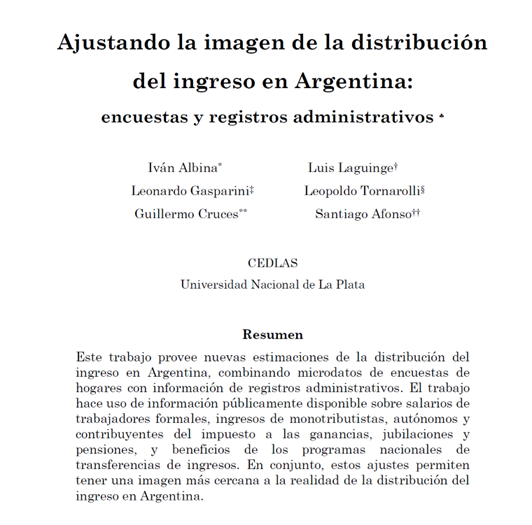
🚨 Nuevo documento de trabajo que estudia la subdeclaración en la EPH y brinda nuevas estimaciones de ingresos y desigualdad en Argentina. Además, provee herramientas para ajustar ingresos para quienes trabajan con la EPH! 🧵👇 [1/10]
CEDLAS tweet media
Español
8
79
341
82.5K
Lucila Berniell retweetledi
Dani Rodrik
Dani Rodrik@rodrikdani·
The IEA is funding research on interventions to advance women in economics in developing nations. If you have a project that is relevant, see details at iea-world.org/research-paper…
English
2
30
45
26.7K
Lucila Berniell retweetledi
Guillermo Alves
Guillermo Alves@guillermo_alves·
The call for papers is out for the 3rd meeting of the Urban Economics Network of LACEA. Location: Banco de México, México City. Date: Dec 5th and & 6th. Deadline for submissions: Aug, 31.
Guillermo Alves tweet media
English
0
16
43
9.9K
Lucila Berniell retweetledi
Dolores de la Mata
Dolores de la Mata@Dolodelamata·
Excelente entrevista a @BancalariA, @papiteide y Samuel Berlinski, sobre desigualdades en salud en América Latina y el Caribe, donde resumen dos capítulos que preparamos para LACIR lacir.lse.ac.uk/en-gb/publicat… lacir.lse.ac.uk/en-gb/publicat…
Banco Interamericano de Desarrollo@el_BID

En LAC hay 25 muertes por cada 1000 niños nacidos, cinco veces el promedio de los países de la OCDE @ocdeenespanol ¿Cuáles son las causas? Escucha un nuevo episodio de “Pensar la Igualdad”, la serie del pódcast Voces en Acción. @BancalariA @anamibanez 🔊 spoti.fi/3xSeego

Español
0
2
13
856