
Luca PRATA • lan.ga retweetledi
Luca PRATA • lan.ga
1.2K posts


Luca PRATA • lan.ga
@lucapratadotcom
CEO and Builder @LANGA__official Infrastructure for scalable systems Most systems fail because they don’t scale https://t.co/Bq1ID5mv8h https://t.co/hpT157qIkL ...
Italia Katılım Nisan 2017
72 Takip Edilen34 Takipçiler

@EliBenSasson Hey Eli. ZEC is the Schelling point for privacy. Post-quantum doesn’t have one—yet. It likely converges either to BTC upgrading to PQ security, or to ZK/STARK-based systems becoming the trust layer. In the end, the Schelling point may be proof, not a chain.
English

ZEC is Crypto Schelling point for Privacy.
What’s the Schelling point for Post Quantum Crypto?
English
Luca PRATA • lan.ga retweetledi

The fact that STARKs are plausibly quantum-resistant is such an underrated feature.
And I think particularly in the context of verifiable AI / AI safety.
Secure Enclaves/TEEs (like Intel SGX or NVIDIA H100 confidential compute) use classical PKI with elliptic curve-based cryptography.
That attestation chain is fundamentally quantum-vulnerable.
You might think: "Yeah, but they can just switch to post-quantum crypto in the coming years."
Not really. The problem is that the provisioning keys are burned into the silicon during hardware fabrication.
So not only do you need to move to PQ crypto for the whole chain of trust, but you have to wait for an entirely new generation of hardware to be built and deployed.
To make things worse, this makes these systems vulnerable to « retroactive forgery » / « loss of non repudiation ».
If a quantum computer cracks the manufacturer's root key in 2035, an attacker can forge a perfectly valid, backdated TEE attestation from today.
So for any use case where the verifiable execution evidence needs to outlive the hardware that produced it, TEE attestation has a structural expiration date that ZK STARKs do not have.
When STARKs become practical for provable inference, they will really unleash their full supremacy.
Pure math-based, scalable, private, post-quantum.
English
Okay, as we all know, ZK-STARKs are post-quantum secure + blockchains should prepare for the quantum era + there has been a lot of discussions about @avihu28's Quantum-Safe Bitcoin Transactions paper.
So, question: what would you like to ask/know about Bitcoin, STARKs, and quantum risks?
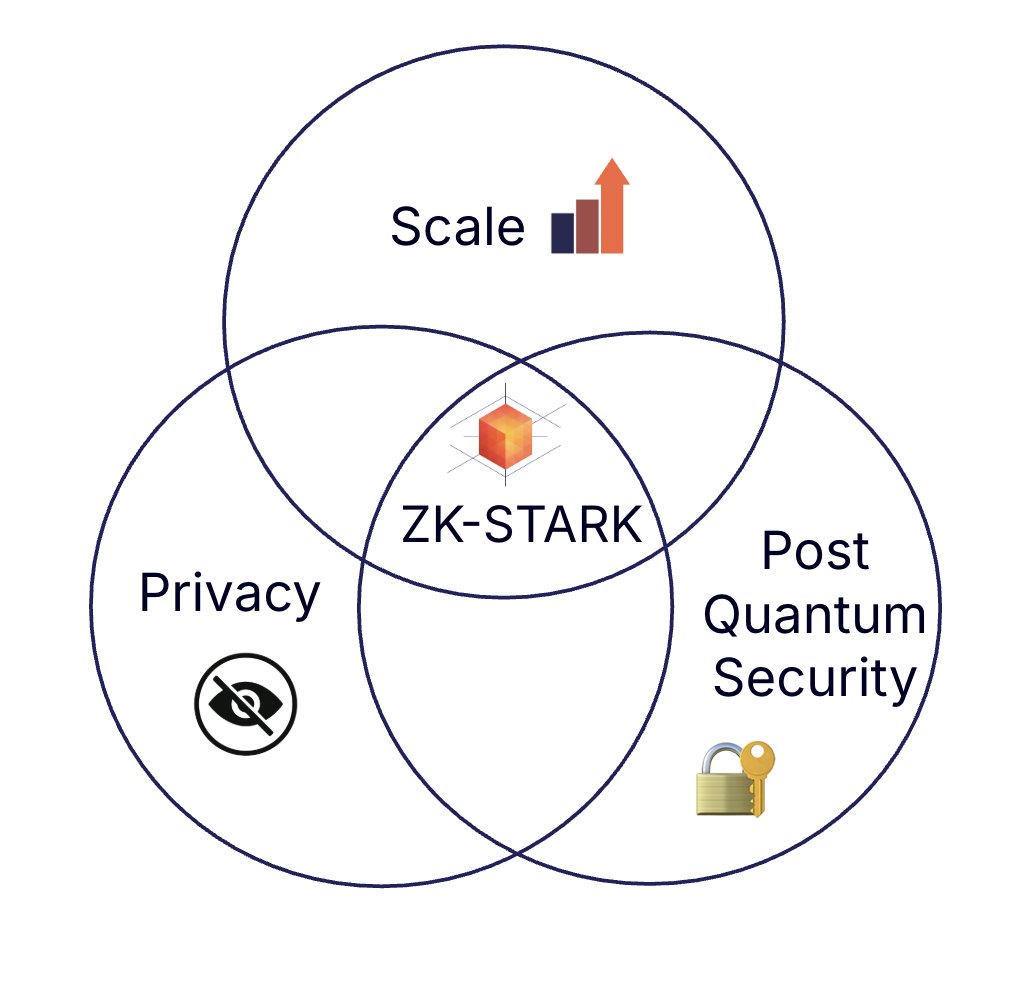
English
Luca PRATA • lan.ga retweetledi
The three magic words: Quantum, Safe, Bitcoin.
Even more magical: without softforks.
And most magical: Avihu and I will be discussing it tomorrow (Wednesday) at 3:00 PM CET, right here in a live Twitter space.
Join us!
(you can share your questions and opinions in the comments here)

Avihu Levy ✨🐺@avihu28
Quantum-Safe Bitcoin Transactions Without Softforks github.com/avihu28/Quantu…
English

@redddddddddot 140-150.
can see 200 if we see the full institutional adoption- but that might be after a 27 retrace.
English
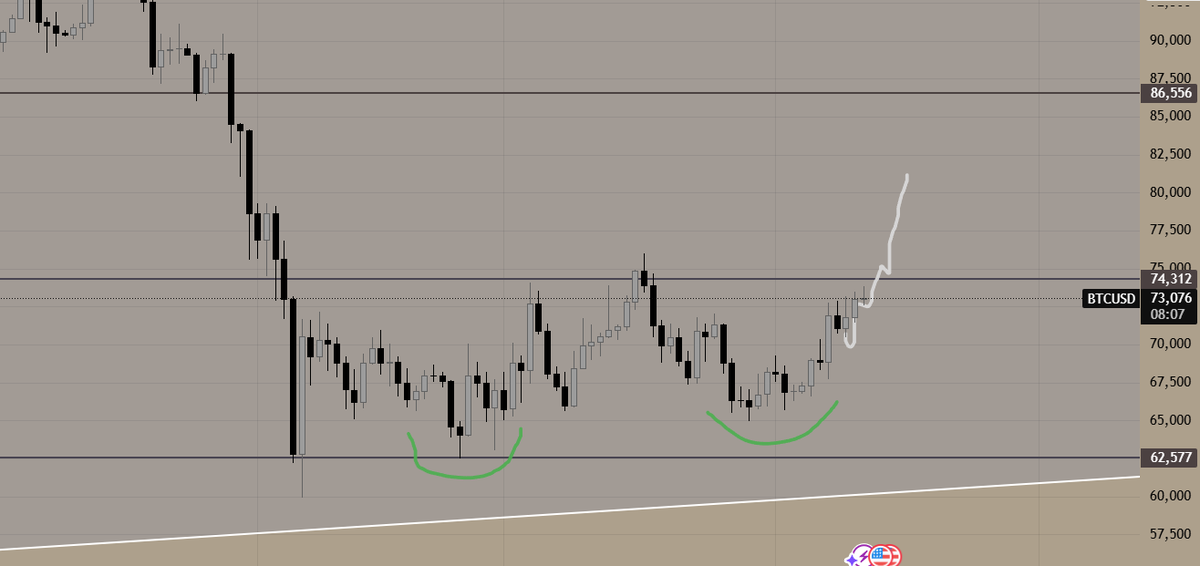
looks like a clean double bottom with a cup & handle.
squiggle is so far spot on
$BTC weekly close in 24 hours
would like to see a close above 74k or a push to 76 for a double deviation (rarely will reject again)
if all goes to plan expecting mid 80s next wk > wk after
will reassess in the next range
thesis is that the bottom is in and local top in late 26.
Boots@bootzz
step 1: breakout of the current range we've already seen 1 deviation above the current range in the last 2 months when we see another, $BTC will blast through 80k stops will be ran through. 69k likely comes first this will happen within the next 5 days. goodnight, bears.
English
@AbdelStark @MistralAI @amilabs Hi Abdel, from dev to dev, you know I admire you and I've often listened to your advice. I've seen the uproar on Starknet, what do you think? Do you still strongly believe in Starknet? I'm an outsider, always. Thanks.
English
La France reprend la main sur son destin numérique. Pour de vrai, cette fois.
@MistralAI et @amilabs qui rivalisent (en ont l'ambition du moins, et les moyens je le pense) avec les meilleurs labs au monde. Les MCP datagouv pour connecter l'IA directement aux services de l'État. Une migration Linux massive pour desserrer l'étreinte des GAFAM.
Et maintenant paperasse, des skills pour agents IA spécialisés dans la bureaucratie française.
Ce n'est pas un hasard. C'est une direction.
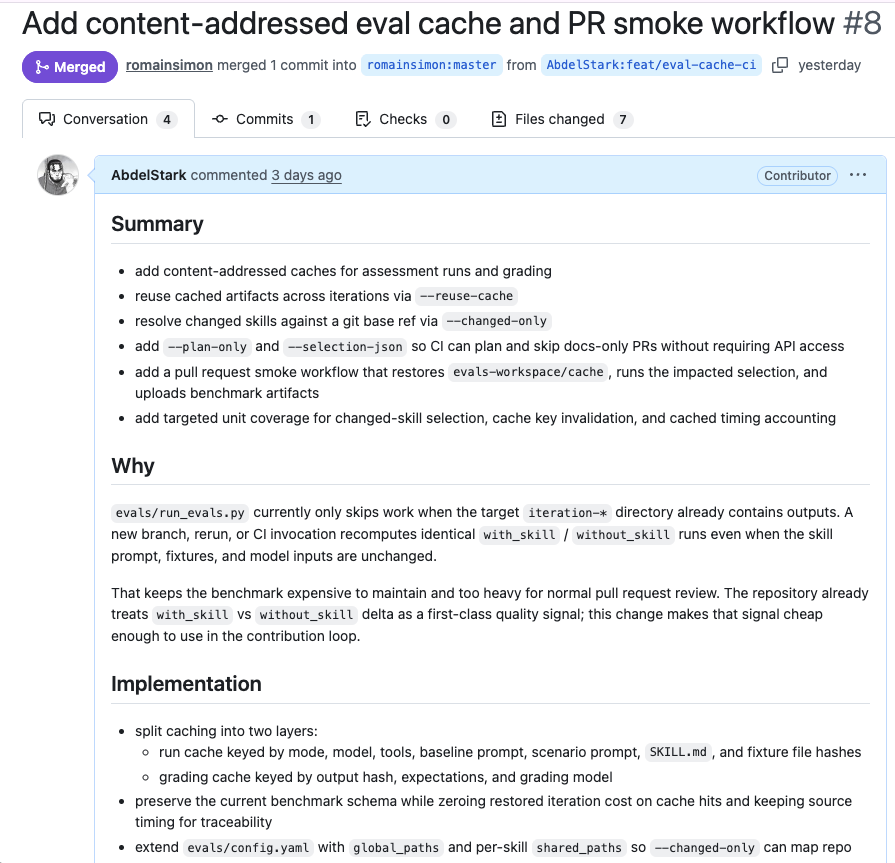
J'y ai contribué à ma mesure : une pull request soumise sur paperasse, revue, mergée.
Rien d'héroïque (plus un symbole, une marque de soutien pour le moment). Exactement comme je l'avais fait pour le datagouv MCP.
C'est comme ça que l'open source se construit : contribution par contribution.
La souveraineté numérique ne se proclame pas. Elle se code.
PR après PR. Projet après projet.
Le vent souffle dans le bon sens. Il faut continuer à pousser.
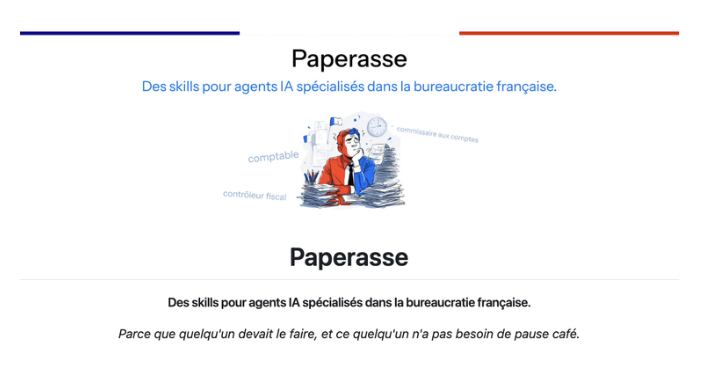
Français
I am sharing here a message I shared with the StarkWare team following things I said at an All Hands meeting:
========
StarkWare is adapting its strategy, with a clear goal – to lead blockchain.
So far, we’ve secured our position as technology leaders: we built the best ZK proving blockchain technology. Cairo, Sierra, Post-Quantum, etc. More than anyone in the industry, StarkWare demonstrated the potential of ZK and STARK technology and has set the standard. Each and every StarkWare employee should be extremely proud.
Why do we need a new strategy?
We initially focused on scaling L1s, building the most advanced scaling stack. But infrastructure alone does not win the game, and although different apps demonstrate where our technology shines, we are not playing our full hand. We can do better.
It is now time to convert our technological superiority into tangible revenue and significant usage, with high emphasis on products that can be powered only by our technological moat. To execute this, we must change how StarkWare operates.
New focus:
We're shifting from doing many things well to doing fewer things excellently. Emphasis is on things with large potential value that only we can build, that only our stack, the best in the world, can unleash and make come true.
We’re adopting a new mindset: Moving fast, in small teams, doing a lot of experimentation, and being confident to rapidly iterate to find PMF. This is a mindset that differs from the way we currently operate, and it’s one that will be rewarding.
It’s a bit like going back to startup mode, but taking into account all that we’ve learned from building the best infrastructure in the world.
Big picture: There’s a vacuum in blockchain leadership today – this poses a challenge but also an immense opportunity for StarkWare and Starknet. We’re playing to win.
More details next week.
New structure:
- 2 purpose-focused units, one led by Avihu and one led by Tom as general managers (GM)
- Each of these two units will manage internally its dedicated BD/eng/product/GTM.
Very sadly, as part of this process, we are downsizing. Our new strategy requires that we move fast, and we’re too big and too inefficient for that. So, we are making a tough but responsible decision to become smaller and more flexible.
This is painful because we are parting from excellent people. I deeply appreciate each and everyone of you.
We will do our best to soften this parting, in many jurisdictions going beyond what law and contract dictate.
Those we’re considering parting from, will shortly receive an email invitation for a 1-1 meeting with management. I know this is difficult news, and I wish we could have avoided it but our commitment to our mission dictates that we make it.
For those staying, we recognize this is a dramatic change and we’ll talk to each of you as well, but will do so after talking to those affected most by this change.
To all, we are available to discuss whatever is on your mind, during the hearings and outside of them. I myself am available over the next days for each and every one of you, simply step in, write, or call me.
I want to hear you if you want to be heard.
Summary:
We built the best, safest, most battle-tested ZK tech in blockchain.
We’ve redefined blockchain using our technology, but that’s not enough.
I’m anticipating with confidence our next chapter, in which we use it to advance exciting novel products that generate revenue and which cannot be built on other blockchains today.
It’s a huge challenge, that requires a large and painful change, and will require immense effort. I’m confident that our reorganized structure, focus and strategy, position us well to go after this ambitious goal, winning and leading blockchain. Let’s get to it.
English
THIS IS HUGE. Bitcoin is Quantum-Safe TODAY.
Even if a quantum computer appeared, one that breaks the conventional Bitcion signatures, it shows a practical way to create safe Bitcoin transactions. WITH NO CHANGE TO BITCOIN PROTOCOL!!!
Avihu Levy ✨🐺@avihu28
Quantum-Safe Bitcoin Transactions Without Softforks github.com/avihu28/Quantu…
English
@EliBenSasson Finally, strk as the execution layer!
English
@EliBenSasson Technically (for me) you’re the best on tech dev
English
We're only in April and Starknet has already made progress on privacy (for institution and for any ERC20 token), scale (S-two's upgrade with recursive circuit proving, which opens the door to client-side proving) and quantum resistance (did you know that post-quantum wallets are now live on Starknet?)
ZK-STARKs are transforming blockchain.
links to all relevant announcements in the comments
Starknet (Privacy arc) 🥷@Starknet
Still 9 months to go.
English
Luca PRATA • lan.ga retweetledi
This is amazing work! Turns out there might be more ways than ZK to help solve the problem of verifiable AI!
I really like the simplicity and pragmatism of the scheme. It seems to be a very interesting set of tradeoffs, that could become suitable for multiple production use cases.
I implemented CommitLLM version in Zig. Fully compatible with the Rust reference implementation.
In the demo video you can see cross implementation checks, including tamper attempt, a.k.a the CommitLLM Rust prover trying to fool the CommitLLM Zig verifier and failing.
Fede’s intern 🥊@fede_intern
LLMs now make critical decisions in hospitals, defense, banks, and governments. Yet nobody can verify which model actually ran, or whether the output was tampered with. A provider or middleman can swap weights, silently requantize the model, alter decoding, inject hidden prompts, do supply chain attacks, or change the deployment surface without the user knowing. This problem is already serious. It will become critical. We think this needs a practical solution, not just a theoretically clean one. CommitLLM is designed to be deployable on existing serving stacks now: the provider keeps the normal GPU serving path, does not need a proving circuit, does not need a kernel rewrite, and does not generate a heavy proof for every response. In practice, two families of approaches dominated the conversation before this work: fingerprinting, which can be gamed, and proof-based systems, which are theoretically strong but too expensive for production inference. We built CommitLLM to target the middle ground. The core idea is to keep the verification discipline of proof systems, but specialize it to open weight LLM inference. The cryptographic core is simple: Freivalds style randomized checks for the large linear layers, plus Merkle commitments for the traced execution. Then a lot of engineering work is needed to make that line up with real GPU inference. The key trick is this. A provider claims `z = W × x` for a massive weight matrix. Normally you would verify that by redoing the multiply. Instead, the verifier samples a secret random vector `r`, precomputes `v = rᵀ × W`, and later checks whether `v · x = rᵀ · z`. Two dot products instead of a full matrix multiply. In the current implementation, a wrong result passes with probability at most `1 / (2^32 - 5)` per check. A full matrix multiply, audited with two dot products. Most of the transformer can then be checked exactly or canonically from committed openings. Nonlinear operations such as activations and layer norms are canonically re executed by the CPU verifier. The one honest caveat is attention: native FP16/BF16 attention is not bit reproducible across hardware. CommitLLM verifies the shell around attention exactly, then independently replays attention and checks that the committed post attention output stays within a measured INT8 corridor. So attention is bounded and audited, not proved exactly. That means the protocol already gives very strong exact guarantees on the parts that matter operationally most. If an audited response used the wrong model, the wrong quantization/configuration, or a tampered input/deployment surface, the audit catches that exactly. That includes things like model swaps, silent requantization, and provider side prompt or system prompt injection. Today the implementation and measurements are strongest on Qwen and Llama. But the protocol itself is not meant to be Qwen or Llama specific: we expect it to generalize across open weight decoder only families. What still has to be done is the engineering work to integrate and validate more families explicitly, and we are already working on that. On the measured path, online generation overhead is about 12 to 14% with the provider staying on the normal GPU serving path. The heavier receipt finalization cost is separate and can be deferred off the user facing path. The main systems costs are RAM and bandwidth, not proof generation. The full response is always committed, but only a random fraction of responses are opened for audit. Individual audits are much larger, roughly 4 MB to 100 MB depending on audit depth. The important number is the amortized one: under a reasonable audit policy, the added bandwidth averages to roughly 300 KB per response. After too many weeks without sleep, I’m proud to show what I built with @diego_aligned: CommitLLM. Thanks Diego for your patience. I've been calling you at random hours. The code and paper still need some cleaning and formalization. We’re already in talks with multiple providers and teams that have cryptography related ideas on how to improve it even more. We’re really excited about this and we will continue doubling down on building products in AI, cryptography and security with my company @class_lambda. If governments, hospitals, defense and financial systems are going to run on LLMs, verifiable inference is not optional. It is infrastructure. I will be explaining this in more details in the days to come and I will show how to test it and run it.
English
Zero-knowledge will transform blockchain, and blockchain will revolutionize our society.
They deserve a book!
After dedicating years to these topics, I wrote one, co-authored with @NathanOnCrypto: what they can fix and what future they promise.
Coming soon, order now!
blockchainthebook.com

English
@marcocostanza_ Ciao. Sarebbe ora di attivare op_cat, partiamo da li.
Italiano

Vi prego basta, sta diventando pesante da sopportare 🥲
Italiano
ELI5: Quantum computers and quantum-resistant systems
Breaking cryptography requires finding a specific string of bits. There are so many options, it's like finding a needle in a haystack. For a non-quantum computer it would take forever and add some to do that.
But quantum computers work differently. They are like magnets that scoop up most needles. For them finding this needle, this string of bits, is simple.
Now, post quantum secure systems (including ZK-STARK) are like needles made of gold. They aren’t pulled by magnets.
English
@bootzz Yes. Didn't read it throughly but all signs indicate that getting ready to quantum era can no longer be postponed.
English
Reminder: ZK-STARKs are post quantum secure.
Eli Ben-Sasson | Starknet.io@EliBenSasson
Post-quantum security matters! Starknet's starting point when it comes to turning it PQ secure is pretty good. Here's why👇
English
Some apps need different tech to power them.
It's not just about more throughput, it's about a different kind of architecture.
For things like gaming, perps exchanges (maybe also AI), the ability to handle big computational transactions makes all the difference.
Starknet is that different tech.
English
@EliBenSasson Cairo is top of the top. Not worried.
English
I know the market is bearish right now, but I'm extremely proud to be part of this thing called blockchain. It's one of the most important shifts our society will see.
I'm bullish.
English
AI x ZK x Blockchain
I wrote something about two use cases I believe in:
1. Proving you're human, over time
2. Ensuring agents aren’t censored
Read, comment, share your thoughts
(and if you're building this, DM!)
Eli Ben-Sasson | Starknet.io@EliBenSasson
English