Luther Napitululu

4.7K posts

Luther Napitululu banner
Luther Napitululu

Luther Napitululu

@lutherpool

Katılım Mart 2011
425 Takip Edilen502 Takipçiler
Luther Napitululu
Luther Napitululu@lutherpool·
Career can wait when your inner world is thriving. Time to reconnect
English
0
0
0
5
Luther Napitululu retweetledi
Updates in Medicine
Updates in Medicine@medic_updates·
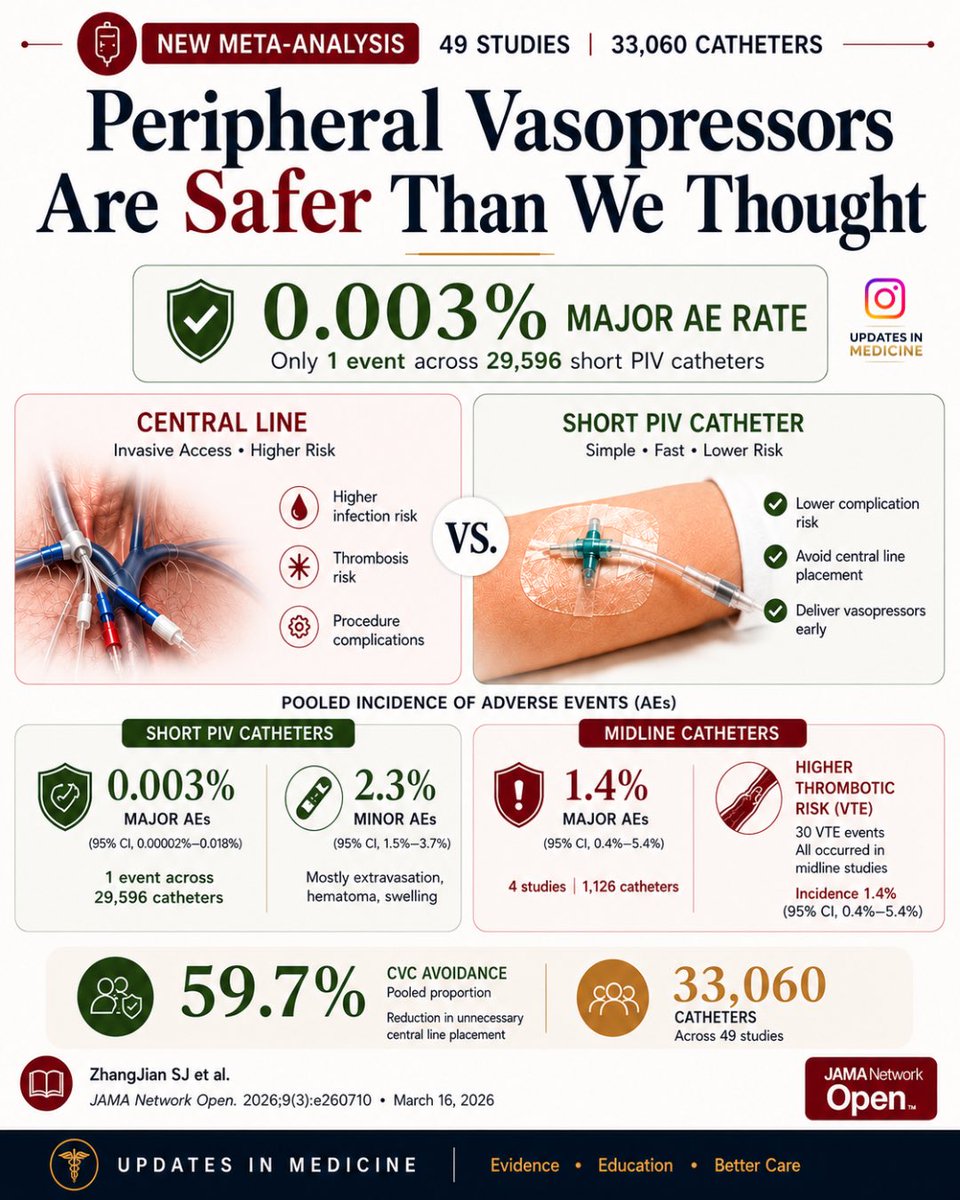
Peripheral vasopressors may be safer than we thought — only 1 major adverse event across 29,596 short PIV catheters in this meta-analysis of 49 studies.
Updates in Medicine tweet media
English
1
55
198
10.8K
Luther Napitululu retweetledi
Dr. Chacón-Lozsán F .'.
Dr. Chacón-Lozsán F .'.@franciscojlk·
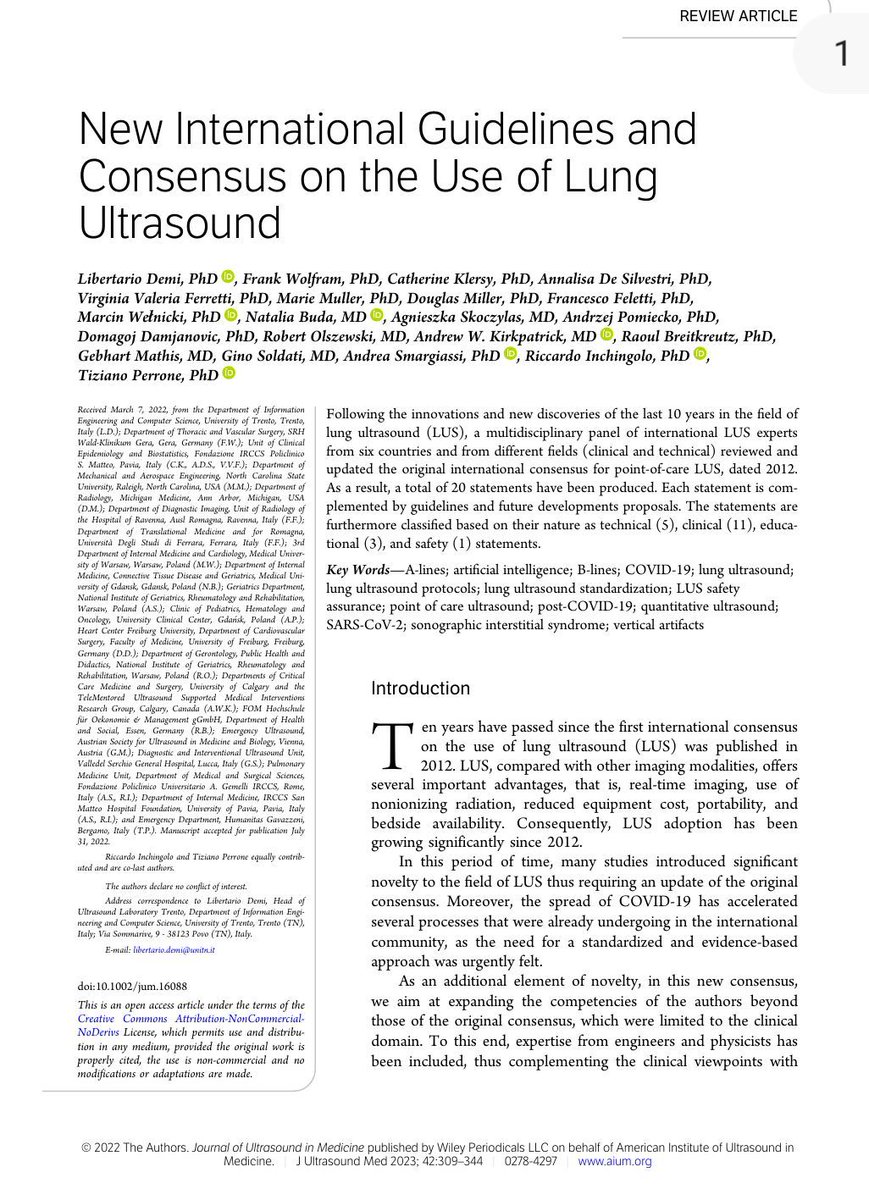
🫁 Lung Ultrasound 2.0, From Art to Science The new international consensus on lung ultrasound marks a clear transition: 👉 From qualitative interpretation ➡️ To standardized, reproducible, and quantitative medicine ⚠️ What is truly NEW in this update 🔴 1. Standardization is now mandatory, not optional LUS is highly operator- and machine-dependent 👉 The same patient can generate different findings depending on settings New recommendation: • Always report probe, frequency, MI, depth, protocol • Move toward reproducible imaging frameworks 🧠 2. B-lines are no longer “simple artifacts” They are: • Frequency-dependent • Physically complex • Linked to lung microstructure 👉 Counting B-lines is semi-quantitative at best ➡️ Future: quantitative ultrasound spectroscopy 🤖 3. AI enters LUS, but with caution AI is emerging in: • Image segmentation • Severity scoring • Pattern recognition BUT: 👉 Strong warning against overinterpretation and poor methodology Key requirement: • Proper dataset splitting • Standardized acquisition • Clinical validation ⚙️ 4. Multidisciplinary shift This is not just a clinical update 👉 Engineers + physicists are now part of the consensus Why? • Ultrasound physics matters • Signal processing matters • Image formation matters ➡️ LUS is now a true bioengineering field 📊 5. From subjective to objective metrics Major gap identified: • Pleural line abnormalities • Subpleural consolidations • Artifact interpretation 👉 Need for: • Measurable parameters (mm, not “small/large”) • Quantitative imaging endpoints 🛑 6. Safety is finally addressed New concern: 👉 Potential pulmonary capillary hemorrhage (animal data) Recommendation: • Apply ALARA principle • Monitor Mechanical Index (MI) • Limit exposure time ➡️ LUS is safe, but not risk-free 📚 7. Education becomes a core pillar Clear statement: 👉 LUS must be formally taught and standardized Including: • Medical curriculum integration • Structured training • Remote mentoring 🎯 Take-home message Lung ultrasound is evolving from: ❌ Operator-dependent bedside tool ✅ Standardized, physics-driven, AI-supported diagnostic modality ⚖️ My reflection We are entering a phase where: 👉 Understanding how ultrasound interacts with lung tissue is as important as interpreting the image itself This is where critical care, cardiology, and engineering finally meet 📖 Libertario D et al J Ultrasound Med 2023 doi:10.1002/jum.16088 #LungUltrasound #CriticalCare #POCUS #MedicalAI #ICU #Ultrasound #PrecisionMedicine #ACVC
Dr. Chacón-Lozsán F .'. tweet media
English
2
52
165
6.9K
Luther Napitululu
Luther Napitululu@lutherpool·
"Go to Him because it’s not the size of your faith that matters. What matters is the object of your faith: Jesus and Jesus alone."
English
0
0
0
16
Luther Napitululu
Luther Napitululu@lutherpool·
No remontada this weekend, but I still believe in remontada—perhaps in the future, for us
English
0
0
0
61
Luther Napitululu retweetledi
kara
kara@sloansavery·
we’ve only had dr crus henderson for one episode but he’s already one of my favorite characters he really showed up to the er and started running that shit like the navy i have no choice but to be obsessed #thepitt
kara tweet mediakara tweet mediakara tweet mediakara tweet media
English
9
398
4.4K
52.2K
Luther Napitululu retweetledi
the pitt med student⚕️
the pitt med student⚕️@robbys_toupee·
As a med student, this scene was a punch to the gut. No matter how confident you are, no matter how much you’ve studied, death rattles us to the bone. Nothing can prepare you to witness someone’s final breath.
English
8
295
6.2K
90.9K
Luther Napitululu
Luther Napitululu@lutherpool·
I had a discussion about this. I stated clearly that classic RSI no longer exists. So why do we still use that term sometimes? They say “modified.” What’s the point if every step of the sequence is modified? I think that makes it a new sequence, not a “modified” one
Dr. Chacón-Lozsán F .'.@franciscojlk

💉🩺Rapid sequence intubation in 2026: we are no longer “protecting the airway.” We are managing physiology under extreme stress. The latest evidence challenges one of the oldest dogmas in critical care. RSI was designed to prevent aspiration. But today, the real enemy is often hypoxemia and cardiovascular collapse. 1. Aspiration is no longer the central problem For decades, RSI was built around one fear: aspiration. But emerging data suggest: RSI may not significantly reduce aspiration It may increase hypoxemia and hemodynamic instability The paradigm is shifting: 👉 From aspiration avoidance → to physiologic optimization 2. First-pass success is everything Every additional attempt increases: Hypoxia Hemodynamic collapse Mortality Modern RSI is built around one goal: Get it right the first time. That means: Videolaryngoscopy first-line Stylet routinely Team choreography, not improvisation 3. Preoxygenation is now a therapeutic intervention Not just a step—a determinant of survival NIV > face mask HFNO as adjunct Semi-upright positioning And one key shift: 👉 Gentle ventilation is no longer taboo Done correctly, it reduces hypoxemia without increasing aspiration risk. 4. Hemodynamics matter more than ever Up to 40–50% of patients experience peri-intubation instability. The modern approach: Avoid propofol in unstable patients Favor etomidate or ketamine Consider prophylactic vasopressors Fluid loading? Not routinely beneficial. 5. Cricoid pressure: from dogma to doubt No clear benefit in preventing aspiration May worsen laryngoscopy and ventilation Current thinking: 👉 Use selectively, or not at all 6. RSI is no longer a rigid protocol It is now: Patient-specific Physiology-driven Team-dependent With tools like: Gastric ultrasound POCUS-guided decisions Structured airway protocols 7. The real determinant of success: human factors Preparation, communication, and coordination matter as much as drugs. Because in critical care: The airway is not just anatomy. It is a moment of systemic vulnerability. 🤓Final message RSI has evolved: From speed → to precision From protocol → to physiology From individual skill → to team performance And ultimately: The goal is no longer just to intubate. It is to intubate without killing the patient. 📃Reference Boulos NM et al. Anaesth Crit Care Pain Med. 2026. doi.org/10.1016/j.accp…

English
0
0
0
69
Luther Napitululu retweetledi
Dr. Chacón-Lozsán F .'.
Dr. Chacón-Lozsán F .'.@franciscojlk·
💉🩺Rapid sequence intubation in 2026: we are no longer “protecting the airway.” We are managing physiology under extreme stress. The latest evidence challenges one of the oldest dogmas in critical care. RSI was designed to prevent aspiration. But today, the real enemy is often hypoxemia and cardiovascular collapse. 1. Aspiration is no longer the central problem For decades, RSI was built around one fear: aspiration. But emerging data suggest: RSI may not significantly reduce aspiration It may increase hypoxemia and hemodynamic instability The paradigm is shifting: 👉 From aspiration avoidance → to physiologic optimization 2. First-pass success is everything Every additional attempt increases: Hypoxia Hemodynamic collapse Mortality Modern RSI is built around one goal: Get it right the first time. That means: Videolaryngoscopy first-line Stylet routinely Team choreography, not improvisation 3. Preoxygenation is now a therapeutic intervention Not just a step—a determinant of survival NIV > face mask HFNO as adjunct Semi-upright positioning And one key shift: 👉 Gentle ventilation is no longer taboo Done correctly, it reduces hypoxemia without increasing aspiration risk. 4. Hemodynamics matter more than ever Up to 40–50% of patients experience peri-intubation instability. The modern approach: Avoid propofol in unstable patients Favor etomidate or ketamine Consider prophylactic vasopressors Fluid loading? Not routinely beneficial. 5. Cricoid pressure: from dogma to doubt No clear benefit in preventing aspiration May worsen laryngoscopy and ventilation Current thinking: 👉 Use selectively, or not at all 6. RSI is no longer a rigid protocol It is now: Patient-specific Physiology-driven Team-dependent With tools like: Gastric ultrasound POCUS-guided decisions Structured airway protocols 7. The real determinant of success: human factors Preparation, communication, and coordination matter as much as drugs. Because in critical care: The airway is not just anatomy. It is a moment of systemic vulnerability. 🤓Final message RSI has evolved: From speed → to precision From protocol → to physiology From individual skill → to team performance And ultimately: The goal is no longer just to intubate. It is to intubate without killing the patient. 📃Reference Boulos NM et al. Anaesth Crit Care Pain Med. 2026. doi.org/10.1016/j.accp…
Dr. Chacón-Lozsán F .'. tweet media
English
13
257
843
62K