PULK!T

42 posts

PULK!T

PULK!T

@m_pulkit

Research @QCOMResearch, MSc @Mila_quebec / UdeM 🇨🇦

Toronto, Ontario Katılım Ekim 2018
854 Takip Edilen380 Takipçiler
PULK!T retweetledi
Apratim Bhattacharyya
Apratim Bhattacharyya@apratimbh·
🚨 Check out our new #ECCV paper that answers the question why out of distribution generalization is so hard for SOTA LLMs, although they have been trained on the "entire" internet.
PULK!T@m_pulkit

Your eyes don't see a whole scene at once — they dart around in a sequence of foveated glimpses. Modern vision models take in the whole image in one shot. That difference decides if a model can generalize to scenarios that are out-of-distribution. 🧵:

English
0
2
9
1.9K
PULK!T
PULK!T@m_pulkit·
8/ Big picture: Modern vision language models mostly use global visual processing but we show that biologically inspired local attention and sequential processing may be an essential overlooked ingredient for out-of-distribution visual generalization. 📄 ECCV paper (typeset in ICLR format): arxiv.org/abs/2607.09061 Work w/: @SanjayHaresh , @rzebrahimi , Sunny Panchal, @apratimbh , @RolandMemisevic .
English
0
1
26
905
PULK!T
PULK!T@m_pulkit·
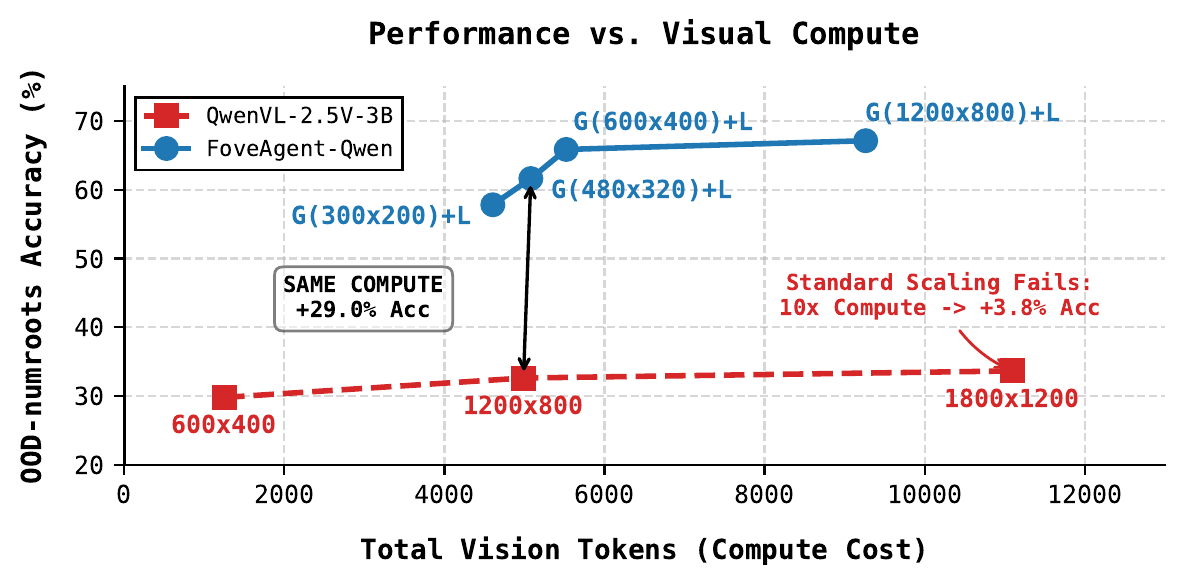
7/ The synthetic tasks isolate the mechanism. Does it carry over to a real task? We tested reasoning over math plots — finding a function's roots. At the **same visual-compute budget**, a foveated Qwen adds **+29 pts (~100%)** of accuracy over the global baseline. Uniformly cranking resolution 10× buys almost nothing (+3.8 pts). Same lesson as the synthetic tasks: locality + recurrence beats brute-force scaling. How you spend visual compute > how much visual compute you throw at it.
PULK!T tweet media
English
1
0
10
813
PULK!T
PULK!T@m_pulkit·
Your eyes don't see a whole scene at once — they dart around in a sequence of foveated glimpses. Modern vision models take in the whole image in one shot. That difference decides if a model can generalize to scenarios that are out-of-distribution. 🧵:
English
9
29
292
46.6K
PULK!T retweetledi
sahil dhull
sahil dhull@_sahildhull·
the input interface has been the same for decades. with ai, software can now reason and act on your behalf but the interface is the bottleneck. why do i have to check sushi on 10 restaurants across 3 apps? why can't i just do it with a flick of a finger?! the world's about to get a new interface @agi_interfaces
English
94
76
295
85.1K
PULK!T retweetledi
Reza Ebrahimi
Reza Ebrahimi@rzebrahimi·
Transformers are data‑hungry in sequential tasks because they lack the right inductive bias. It’s well known that for many sequential problems (from adding numbers to step‑by‑step agentic execution and multi‑hop reasoning), transformers fail to generalize to longer sequences than they were trained on. “Train short, test long” often fails. The usual workaround is to "just train on whatever length you’ll need at test time". --------- 📉 But we show the consequence of this is data inefficiency: • Transformers can learn tasks for a single fixed sequence length fairly efficiently, but learning across multiple lengths requires much more data. • More importantly, transformers tend not to share mechanisms across tasks of different lengths; instead, they often learn isolated, length‑specific solutions. --------- 🧪 A simple way to test this: Consider modular addition (with and without CoT). Train a model to add 2, 3, …, L numbers at once and measure the data needed. Then train separate models for each length (2, 3, …, L) and sum their data requirements. 💡The intuition: If a model truly shares mechanisms across lengths, learning a distribution of lengths should require far fewer samples than learning each length separately. This comes from amortizing the learning cost: data for length n also helps the model learn length n+k. --------- 📊 Results: Sharing Factor κ = (sum of samples to learn each length separately) ÷ (samples to learn all lengths jointly) - κ > 1: mechanism sharing and amortized learning. - κ ≈ 1: learning length-specific solutions in isolation. - κ < 1: destructive interference; length-specific solutions compete for model capacity. Transformers showed low sharing factors, and even destructive interference with CoT. --------- ✨ Implications: This suggests that end-to-end learning in applied agentic settings, like robotics or GUI control, could be even more challenging. If data requirements grow unfavorably with sequence length, that might also help explain the persistent issues we see at large context lengths (e.g., context rot). Standard attention mechanism appears inefficient for step-by-step tasks, and we may ultimately be better off with recurrent agents.
Reza Ebrahimi tweet mediaReza Ebrahimi tweet media
English
1
5
9
586
PULK!T retweetledi
Apratim Bhattacharyya
Apratim Bhattacharyya@apratimbh·
🚨 “Can Multi-Modal LLMs Provide Live Step-by-Step Task Guidance?” #NeurIPS2025 🚨 We explore three core capabilities for step-by-step task guidance: delivering correct instructions, recognizing successful completions, and providing corrective feedback when errors occur. 1/5
English
3
7
8
1.5K
PULK!T retweetledi
Kinjal Nandy
Kinjal Nandy@itsKinjalNandy·
an interface that works while you live @sonaticHQ is out!
English
150
71
593
134.1K
PULK!T retweetledi
Reza Ebrahimi
Reza Ebrahimi@rzebrahimi·
1/N. Modern linear RNNs miss one crucial capability from classic RNNs: state-tracking. State-tracking is the ability to dynamically maintain an internal state of a system. It's essential for complex reasoning tasks, such as: - Updating a chessboard state after a sequence of moves. - Tracking variable values while executing code line-by-line. - Following an algorithm sequentially by keeping track of its intermediate state. These tasks demand more than pattern recognition; they require a persistent, updatable internal state. Our new paper investigates the architectural properties that enable this in linear RNNs. We introduce a taxonomy of these models, creating a hierarchy based on their fundamental state-tracking capabilities:
Reza Ebrahimi tweet media
Roland Memisevic@RolandMemisevic

Binary parity ("count the number of 1s in a bit-string") is a common task to show that transformers cannot generalize. Turns out, a random(!) RNN (train only readout) can learn the task easily, and it can do so with as few as 2 (two) training examples...: arxiv.org/pdf/2505.21749

English
1
4
12
831
PULK!T retweetledi
Roland Memisevic
Roland Memisevic@RolandMemisevic·
Binary parity ("count the number of 1s in a bit-string") is a common task to show that transformers cannot generalize. Turns out, a random(!) RNN (train only readout) can learn the task easily, and it can do so with as few as 2 (two) training examples...: arxiv.org/pdf/2505.21749
English
0
1
9
1.1K
PULK!T retweetledi
VAR@CVPR2025
VAR@CVPR2025@VARCVPR2025·
Call for Papers and Demos #CVPR2025: on topics such as streaming vision-language models, real-time activity understanding, grounding, ego-centric video understanding, language and robot learning. Contributions are encouraged to include a demo! Link: varworkshop.github.io/calls/
VAR@CVPR2025 tweet media
English
0
7
6
645