

Mach33 Financial Group
19 posts

Mach33 Financial Group
@mach33
We research and invest in companies developing expansion technologies shaping the future of humanity, including space, AI, robotics, and advanced infrastructure
Florida Katılım Mayıs 2026
3 Takip Edilen469 Takipçiler
72 GPUs per satellite. A 750-meter speed-of-light fence. A containment tax that starts at 1.8x and shrinks toward 10%.
The Mach33 team breaks down what it actually costs to serve a frontier AI model from orbit. Plus China's first booster catch and real Starlink V3s on Starship 13.
Full episode below.
English
Mach33 Financial Group retweetledi

A lot can happen in a year. Here is a brief timeline of some of my 1 year highlights...
13 months ago: we released the SpaceX open source model with Ark invest. Months of work with @VladSaigau @skorusARK @DMaguireARK and @wintonARK to conclude SpaceX had a decent shot at being worth $2.5T by 2030 (just launch and telco business then). @CathieDWood deserves a ton of credit for recognizing SpaceX needed public company level of coverage before anyone else and for trusting us to help.
11 months ago: our first article to go viral (for us) after getting picked up by TL;DR newsletter - Starship 50x Bandwidth reduction. (I didn't know what TLDR was at the time).
8 months ago: my first X engagement from Elon, on an observation that the Overton Window seemed to opening for Orbital Data Centers. that post also got featured on TBPN. we double down on publishing ODC research publicly. x.com/aaronburnett/s…
7.5 month ago: first rumors on SpaceX going public emerge, catches the entire world off guard. along with valuation bump from 400B to 800B, which the Mach33 model released a month earlier by @VladSaigau called within 5% (we were equally shocked as everyone).
7 months ago: David Sacks and Chamath quote post my observation on 'red lines and blue lines' and later that week bring it up on All-In podcast.
x.com/aaronburnett/s…
6 months ago: I share several weeks of ODC analysis publicly begging MSM to do some diligence before publishing dumb articles. Elon calls the analysis 'excellent' for people who don't actually fly sats.
10 days later SpaceX files for their 1M SSO AI sat application with the FCC. @TeslaLarry tells his audience my account is the most important SpaceX follow behind Elon (i gain 10k followers in 24 hours). can't thank you enough for that, Larry!
x.com/aaronburnett/s…
2 months ago: we release our spacex gigamodel monte carlo where 96% of all simulations clear the 1.75T IPO price, some as high as 30T. Elon say's these numbers fall far below his goals.
x.com/aaronburnett/s…
1 month ago: SpaceX IPOs.
SpaceX over that same time: filed for 1M AI sat constellation, merged with xAI, announced Terafab, signed 2B+ per month in AI compute contracs, bought cursor, announced AI1 sat specs, rebuilt Grok from the ground up, Filed for 100,000 V3 Starlinks, broke the Pareto frontier with both Composer and Grok.
My personal X analytics over that time: sub 1k followers to 25k, 98.6M impressions, countless opportunities and relationships built with like-minded folks.
thank you to everyone who's supported me and Mach33 along the way. So many who've gone out of their way to help and provide encouragement.
It's been incredible to see the acceptance of our physics first (first principles) research. @jbarseneau and I are excited to continue building the next generation of truth-seeking research and playing a small role in accelerating human expansion.
I truly believe this is just getting started and the next two decades will be the best decades humanity has ever scene.


Aaron Burnett@aaronburnett
There has been a lot of hand wringing on the appropriate valuation of SpaceX. Some large institutions believe SpaceX can only be valued at half what the market seems to be willing to pay for it. Others are claiming it has 15X appreciation ahead of it. Almost all of this difference of opinion comes down to how comfortable you are modeling beyond 2030 and what valuation method you use. 2030 valuation using a traditional Gordan DCF produces a very different result than a 2040 EV/EBITDA Multiple. Both have pros and cons. Most analysts don’t really discuss this and lead with a headline number. We are very comfortable modeling out to 2040, as large portions of what SpaceX is proposing is real world infrastructure, which provides modelable physics constraints to anchor against. The analysis we released today explores this in-depth, its open to the public all the way through IPO. I highly encourage you check it out prior to then. research.33fg.com/analysis/space… We’ve run 5,000 monte carlo runs across 500 variables (real number, even though it sounds fake) and three valuation methods. This video is of a 3D cloud chart showing every simulation outcome expected in valuation output across two of the most impactful variables to the model when using an EV/EBITDA multiple from 2026 to 2040. The horizontal axis is the steepness of the orbital data center demand S-curve. The vertical axis is the rate at which chip compute efficiency becomes cheaper. Each of the 5,000 dots is one simulated future; green dots are the ones where SpaceX's 2040 value clears the $1.77T IPO line, over time. Under EV/EBITDA valuation through 2040, 96% of our simulated futures clear the expected IPO price once the bell rings Friday. We aren’t publishing this publicly to tell investors what the stock is worth, we’re publishing this to help investors understand the world of outcomes, what the fundamentals suggest through 2040, and what frankly most analysis simply won’t share. SpaceX is a generational company working on long term infrastructure harnessing a domain no one has been able to tap in so far: space. It deserves doing the work as an investor. because this in not financial advice. The cleanest way to hold SpaceX is a bond stapled to a call option (AI-Compute); Starlink is the bond, the near term SatCom annuity that funds the next flywheel. Understand the world of outcomes and take your position accordingly. Comparables and P/E won't take you far enough.
English
Mach33 Financial Group retweetledi
Honestly, if you read our public research and Elon’s public critique of them you’re already in the .1% alpha club…
It’s dumbfounding how much technical information about the future is sitting in plain view and just dismissed by the general public.
Orbital AI Inference is getting very real (more so everyday). It’s dumbfounding to see how few people truly act like it is.
Elon Musk@elonmusk
GPU average power consumption if it’s doing inference over the course of 24 hours is ~2/3 of its peak power, even if you’re super efficient. SpaceX AI Sat V1 peak power spec has been raised to ~250kW (battery-assisted), with average power of ~160kW. Will be able to handle an NVL72 Ruben rack. This is just version 1.
English
Mach33 Financial Group retweetledi
orbital data centers have one glaring constraint few are discussing publicly: inference network coherence. We tackled it this week in our analysis "The Orbital Inference Containment Tax"
tbf we mostly hand-waved coherence in our early ODC models (other things to learn first), but went deep after encouragement from someone who's worked on this problem for years.
Fair warning: this is the easily the densest analysis we've ever done, because we're modeling at the edge of both AI and spacecraft.
If you have the time to dive in, it's really f*ing interesting and insightful for what I expect will happen with orbital architecture over the next few years.
If this isn't your day job, share the link with your AI of choice and have it get you up to speed.
research.33fg.com/analysis/the-o…
core learnings this week:
- Frontier LLMs are mixture-of-experts models. Ground operators spread hundreds of experts across big GPU pools down to about 1 expert per GPU. NVIDIA's benchmark shows that spreading is worth up to 1.8x more tokens/second per GPU. and tokens/second is $/second in inference.
- A self contained satellite today can't spread that wide. GPUs computing one answer must sync every ~5 microseconds, and light only covers a ~750m round trip in that window. consequently a coherent GPU team ends at the edge.
- Your options to address this are formation-fly sats ~150m apart (Google's Suncatcher bet, orders of magnitude closer than Starlinks fly today) or eat the penalty of containing the model inside one sat.
- An AI1 sat's power spec ≈ one rack of GB300s (NVL72) 72 GPUs. if you force a 256 expert model into that box then each GPU has to juggle 3.56 experts vs ~1 on the ground.
- We conservatively stacked every assumption against orbit and worst case, a sat is 44% less efficient at processing tokens than on the ground.
That's what we call 'the containment tax' 1.8 sats worth of GPUs to do the work of 1
note,we used max conservative assumptions as I believe it's important to stress test the orbital compute thesis when reasonable.
That said the tax decays, when modeled the levers become pretty clear...
1) SpaceXAI's C-rewrite captures up to half the tax consistent with the token/second uplift we modeled last week.
2) Co-design the model to fit the sat's 72 GPUs. The largest single lever, and it's a training decision, not a hardware program.
and
3) add more GPUs per sat via power density. The next node class (assuming a 200kw-240kw class sat) cuts the baseline to 1.44x before software improvements even runs
1 and 3 are already underway at SpaceX.
2 is the cheap, logical next step given their compute advantage and ~3.5-week model release cadence
nothing stops them offering co-design as a service to neocloud customers.
what we expect? Grok and Composer are the first two models co-designed for orbital inference sats and any external customer co-design comes later.
Scoping note: the containment tax hits the revenue and payback side of the equation, not the cost side, so it's not in our orbital-vs-terrestrial cost work yet.
These learnings will roll into future iterations of AI compute and the SpaceX Gigamodels.
Thanks for reading and happy modeling!


English
Where does the case for space start? The Sun's energy that misses Earth outweighs what hits us ~2 billion to one. Capture a thousandth of it and 16 trillion people live like billionaires.
English
Decent chance that the Flight 12 booster loss wasn't a raptor problem . The flip sloshes propellant, and a turbo pump that swallows a gas bubble dies. Similar physics challenges as orbital refueling. Flight 13 tries again mid-month.
English
Incredible Mach33 podcast this week with special guest, pro-solar system colonization, optimistic astrophysics PhD @peterrhague on Orbital Refueling, the Case for Mars, and a C Rewrite That Shrinks Grok's Release Cycle.
Make sure to check out Peter's Writing at planetocracy.org
English
Mach33 Financial Group retweetledi
Grok 4.5 is looking like a success with help from Cursor data but underneath the surface we expect future Grok/Cursor model training is likely to speed up in the coming months.
We've spent several months getting up to speed on the SpaceXAI business, especially the tech underneath it.
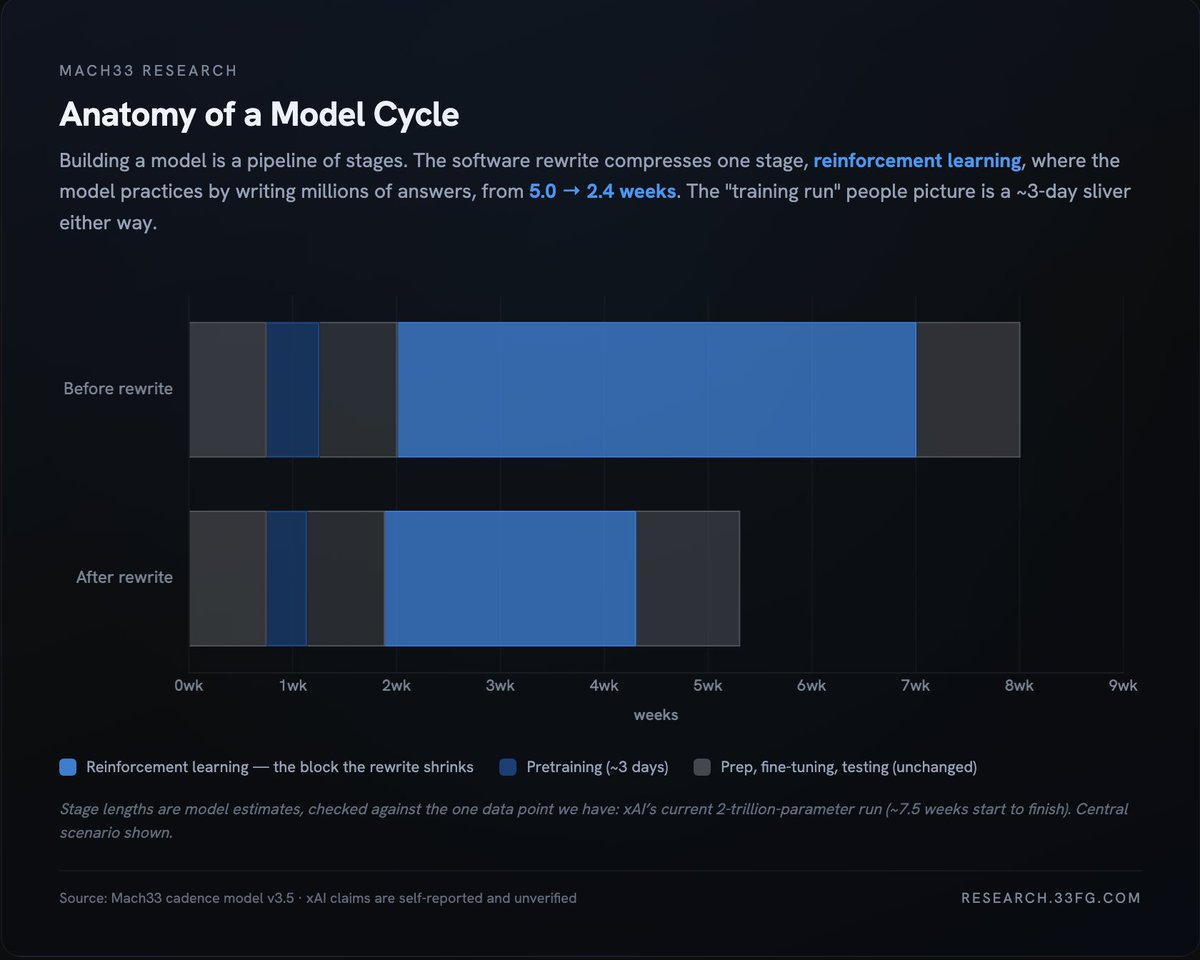
The C rewrite was under appreciated by the investor community so we dug in to quantify its impact. including building a physics first model that functions as a stopwatch for the SpaceXAI model factory.
Bottomline: C-rewrite gets SpaceXAI faster model cycles, leveraging 33% more tokens/second/GPU against SOTA competition resulting in the potential to shipping new models every ~3.5 weeks.
two core learnings from this modeling exercise:
1: the training cycle speed up is primarily coming from RL (not pretraining) where the increased tokens/second/GPU advantage can shave up 2+ weeks off full model training cycle.
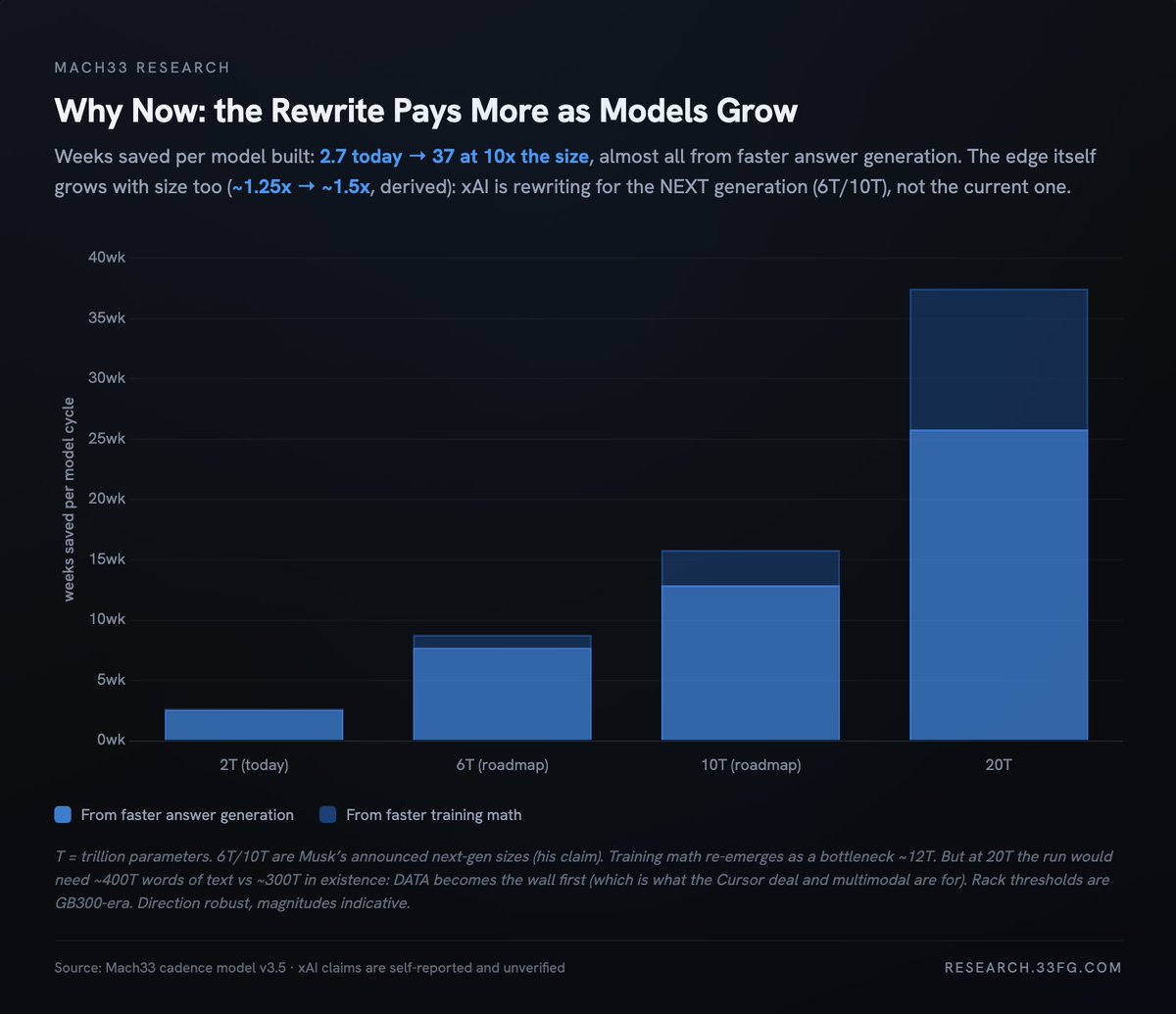
2: the rewrite itself should compound the time savings as model sizes grow. at ~2T shaving off 2-3 weeks, ~8 weeks at 6T, and 15 weeks at 10T.
Note: a 20T parameter model likely runs into a data bottleneck prior to a training speed bottleneck but the directional advantage stands. Also we assume tokens/second/gpu advantage will melt over time as competitors try to match it.
when you do the math, in true SpaceX and Elon fashion, it looks like they are attempting to build a SOTA model factory that can pump out bigger models faster than anyone else.
Full analysis here for the public:
research.33fg.com/analysis/what-…

English
Starfall conversation: If it's $100/kg to go up, it could be $120/kg to come back, maybe a 2x premium. You get to that range and totally new markets open up.
English
Mach33 Financial Group retweetledi
Given all the surprise around the Starlink Mobile rumors it's pretty clear many investors are modeling Starlink incorrectly. To help get analysts up to speed, i've opened up all of our Starlink Mobile related research for public viewing for a limited time.
we've published 7 highly relevant articles on starlink and starlink mobile in the last 10 months. If you'd read these you would not be surprised...
Starlink Mobile bundling unit economics (May 19):
research.33fg.com/analysis/starl…
7x power increase from new FCC ruling (May 6th):
research.33fg.com/analysis/fcc-e…
What End to End Connectivity Means (Jan 28th):
research.33fg.com/analysis/what-…
Starlink's Deflationary Path (Sept 17th):
research.33fg.com/analysis/3x-ch…
Echostar Deal - Full Stack Connectivity path (Sept 10):
research.33fg.com/analysis/starl…
Starship reduce bandwidth launch cost by 50x (Aug 27th) :
research.33fg.com/analysis/stars…
Fiber vs Starlink (Aug 13th):
research.33fg.com/analysis/fiber…
I hope this helps professional analysts and individual investors understand why our SpaceX Gigamodel has such a strong Starlink revenue projection.
feel free to ask your LLM of choice to read these links and digest. We're working on our MCP to make this easier in the future.


English
Mach33 Financial Group retweetledi
I find binary spacex takes unhelpful and uninteresting. if you're actually trying to understand where spacex value could ultimately land in the coming years, you should run simulations anchored on the physics constraints of their stated infrastructure plans.
SpaceX engineers at the edge of physics, so forecasting those constraints are actually instructive.
This isn't a fintech or consumer play where market dynamics swing wildly from week to week and are truly unpredictable.
This is hard science and engineering, where truth (in the form of physics) and a little optimism (eg - we won't blow ourselves up in 5 years) can give you a decent view into the future.
in this video, I gave a sneak peak at the assumptions page (500 bottoms up variables) of our model and then walked through our value cloud, explaining some of the most important variables.
It should provide helpful color commentary beyond the article itself but ou can play with the value cloud yourself here. research.33fg.com/analysis/space…
It's worth noting, that despite these big numbers, we have made many conservative choices like minimal to no AI Enterprise market forecast (so far), no P2P logistics, no in-space manufacturing, terminal multiples anchored against peers, 10% WACC (even though Elon has proven lower cost of capital).
As such we feel its reasonable to consider our overall numbers conservative, even if we have a lens of optimism.
It's possible to get lower numbers of course, but in most cases these are done by handwaving future plans to zero or CAGR based cashflow forecasts based on comparables that don't actually exist.
hope it's helpful.
English
"Every watt of sun light you absorb is a watt of GPU you can't run with that radiator"
English
We rendered the SpaceX AI1 ~2t satellite to show how mass balance shifts between thermal and solar given your assumed subsystem mass efficiency
Article goes into implications, only publicly available for next 33 hours: research.33fg.com/analysis/space…
English
Where do trillions in compute demand come from? Not chatbots. A paragraph is hundreds of tokens; a humanoid robot's live video is millions, and ~30% has to run off-board.
English
5,000 simulations. 350 assumptions. One model for what SpaceX is worth.
The Mach 33 team walks through its full SpaceX valuation framework ahead of the IPO, from Starlink's cash engine to the orbital compute opportunity.
Full episode below.
English
