Marc Bee
1.3K posts




Jensen here is frustrating and wrong. The man wrote off billions so of course he opposes controls. 1. Mythos is a ~10T parameter model trained on Nvidia Blackwell. Despite Jensen's best efforts, China doesn't have Blackwell chips thanks to export controls. Huawei's best chip delivers 1/3 the per-chip performance, at 2.5x the power cost, with yields >12x worse. Jensen calling Mythos "fairly mundane capacity" that's "abundantly available in China" is just plainly false. 2. Dwarkesh is right that the compute ratio matters geopolitically. Maintaining a capability lead during the critical window — even 12-18 months — is the whole point of controls. The difference between China running a thousand vs. a million offensive AI agents is huge. Jensen dodges this entirely. 3. Jensen can't simultaneously argue "controls failed because China innovated anyway" (DeepSeek) AND "we must sell to China or they'll leave our ecosystem." If they'll innovate regardless, selling chips doesn't buy the loyalty he claims. 4. Jensen's ecosystem stickiness point (x86, Arm) is his strongest argument, but it cuts against him: the world is already locked into CUDA. Selling Nvidia chips to China doesn't deepen that - it just gives China better hardware while they build Huawei alternatives regardless.


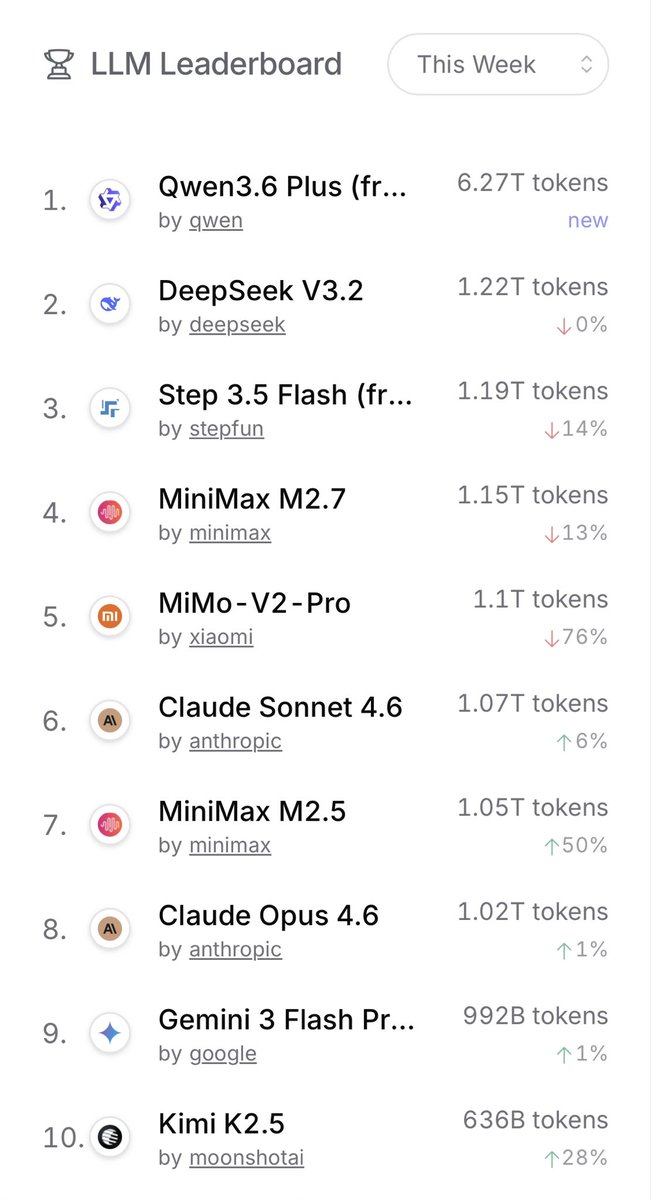
Silicon Valley is quietly running on Chinese open source AI models. Here are the receipts: → Cursor confirmed last month that Composer 2 is built on Moonshot's Kimi K2.5 → Cognition's SWE-1.6 model is likely post-trained on Zhipu's GLM → Shopify saved $5M a year by switching to Alibaba’s Qwen model. Airbnb CEO Brian Chesky has also said: "We rely a lot on Qwen. It's very good, fast, and cheap." And now Zhipu dropped GLM-5.1, an open source model that performs almost as well as Opus on coding benchmarks. 📌 More on the Anthropic + OpenClaw drama and what I'm learning about AI on the ground in China in my new post: creatoreconomy.so/p/the-all-you-…

Both societies exist simultaneously. really incredible to think about


🚨 This viral bionic humanoid robot company just raised hundreds of millions RMB in funding ,and it may have finally crossed the Uncanny Valley AheadForm, the startup behind those ultra-realistic face robots that have racked up hundreds of millions of views across social media, just closed a massive A1 round. This new funding will accelerate bringing these wildly popular humanoid robots into everyday life. Worth noting: Founder Yuhang Hu's latest paper on realistic lip motions for humanoid face robots has landed on the cover of Science Robotics (Jan 2026 issue). Using self-supervised AI, their robots now generate incredibly natural, continuous lip sync,supporting multiple languages, different speaking speeds, emotions, and even singing. Powered by soft silicone skin and 10+ DoF actuators, gone are the stiff puppet faces. This marks a major leap toward truly empathetic, “alive” human-robot interaction. While factories and warehouses will be filled with heavy duty, rugged humanoids for labor, Companies like AheadForm is building the warm, emotionally intelligent ones for people,the kind that can smile, make eye contact, and create real connection. The future isn’t just efficient. It’s getting warmer.


Introducing Project Glasswing: an urgent initiative to help secure the world’s most critical software. It’s powered by our newest frontier model, Claude Mythos Preview, which can find software vulnerabilities better than all but the most skilled humans. anthropic.com/glasswing



Vibe coders debugging an app they built with Claude Code:

"During a NATO exercise in Estonia last year, 10 Ukrainian drone operators role-playing as the enemy mock-destroyed 17 armored vehicles and disabled two allied battalions in a day. NATO forces couldn’t even locate the operators." washingtonpost.com/opinions/2026/…