unclmarc

215 posts

unclmarc banner
unclmarc

unclmarc

@marcotiora

Helping tech career coaches scale their programs above $100K/m | Cybersecurity | Data | Cloud | GovTech | Immigrations

Katılım Kasım 2025
92 Takip Edilen26 Takipçiler
unclmarc
unclmarc@marcotiora·
PS: Ever wondered why some prospects hesitate after a call? It’s not rejection. They might just be stuck at a different stage. How are you helping them move forward?
English
0
0
1
2
unclmarc
unclmarc@marcotiora·
This is what we install in every Outcomeflo client’s sales system. Most coaches argue with their prospects. Outcomeflo coaches walk them home. DM STAGES for the buyer journey diagnostic worksheet.
English
1
0
1
3
unclmarc
unclmarc@marcotiora·
I’ve worked with over 23 tech career coaches. Every single  one of them thinks the problem is enrolment… (that is, getting their ICP to book a call with them at least). It’s not. Here’s what the main problem…
English
1
0
1
9
unclmarc
unclmarc@marcotiora·
@Cathykingz You got that right, @Cathykingz It’s mostly in the head and that’s not a good way to run a business.
English
0
0
1
1
Catherine Igwe
Catherine Igwe@Cathykingz·
@marcotiora Where’s the lie?🥹 And most times. The thought of feeling the market is too “saturated” is all in out heads not really backed up with real data. Good morning, @marcotiora
English
1
0
1
13
unclmarc
unclmarc@marcotiora·
Most people quit the thing that was about to work because they got bored before the market got saturated. Repetition is part of scaling, too. Good morning..
English
1
0
2
7
unclmarc
unclmarc@marcotiora·
A lot of founders do not have a scaling problem. They have a focus problem. More channels will not save a weak core.
unclmarc@marcotiora

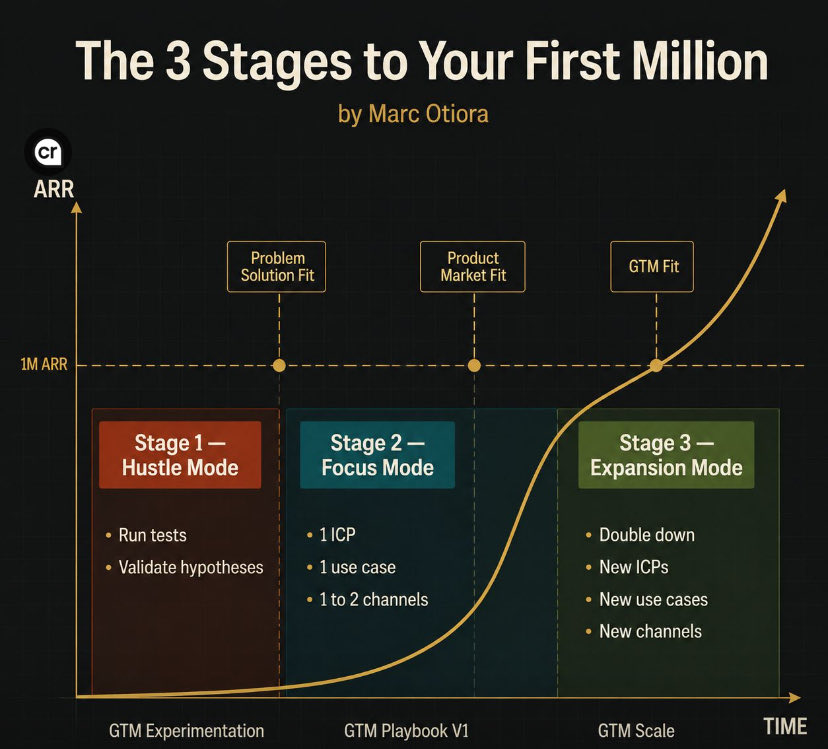
Most founders try to scale too early. That is usually the problem. Alexander Estner explained this in a very simple way. There are three stages to getting to $1M ARR. 𝗦𝘁𝗮𝗴𝗲 𝗼𝗻𝗲 𝗶𝘀 𝗛𝘂𝘀𝘁𝗹𝗲 𝗠𝗼𝗱𝗲. Zero to 100K. You are testing ideas. Trying things. Seeing if the problem you are solving is painful enough for people to pay for. This is not the stage to hire a big team. This is not the stage to build complicated systems. This is the stage to fail fast and learn fast. 𝗦𝘁𝗮𝗴𝗲 𝘁𝘄𝗼 𝗶𝘀 𝗙𝗼𝗰𝘂𝘀 𝗠𝗼𝗱𝗲. 100K to 1M. Now you have found something that works. One ICP. One use case. One or two channels bringing customers. Your job now is not to go wider. Your job is to go deeper. Stay on the thing that is working until you fully understand why it works. 𝗦𝘁𝗮𝗴𝗲 𝘁𝗵𝗿𝗲𝗲 𝗶𝘀 𝗘𝘅𝗽𝗮𝗻𝘀𝗶𝗼𝗻 𝗠𝗼𝗱𝗲. Past 1M. Now you can add more ICPs. More channels. More use cases. You earned the right to expand because the core machine already works. The mistake most founders make is mixing stage one thinking with stage three behaviour. They find one thing that works and immediately ask: “How do we take this into five new markets?” “How do we target four different audiences?” “How do we add seven more channels?” The answer is usually: You do not. Not yet. You go deeper first. Outcomeflo is in stage two right now. One ICP. Tech career coaches in cybersecurity, cloud, and network engineering. One use case. Installing the operating system that helps them scale past the founder bottleneck. Two channels. Marc’s content. Direct outreach. That is it. Not because we think small. Because focus scales faster than distraction. Most businesses do not fail because they lack opportunity. They fail because they expanded before they understood what was already working. Where are you trying to expand before you have gone deep enough? Marc Otiora 𝑼𝒏𝒄𝒍𝑴𝒂𝒓𝒄… PS: The fastest-growing companies are usually boring for longer than people expect. Same customer. Same offer. Same channel. Repeated until the machine becomes impossible to ignore. Do you concur?

English
0
0
2
11
unclmarc
unclmarc@marcotiora·
Most founders try to scale too early. That is usually the problem. Alexander Estner explained this in a very simple way. There are three stages to getting to $1M ARR. 𝗦𝘁𝗮𝗴𝗲 𝗼𝗻𝗲 𝗶𝘀 𝗛𝘂𝘀𝘁𝗹𝗲 𝗠𝗼𝗱𝗲. Zero to 100K. You are testing ideas. Trying things. Seeing if the problem you are solving is painful enough for people to pay for. This is not the stage to hire a big team. This is not the stage to build complicated systems. This is the stage to fail fast and learn fast. 𝗦𝘁𝗮𝗴𝗲 𝘁𝘄𝗼 𝗶𝘀 𝗙𝗼𝗰𝘂𝘀 𝗠𝗼𝗱𝗲. 100K to 1M. Now you have found something that works. One ICP. One use case. One or two channels bringing customers. Your job now is not to go wider. Your job is to go deeper. Stay on the thing that is working until you fully understand why it works. 𝗦𝘁𝗮𝗴𝗲 𝘁𝗵𝗿𝗲𝗲 𝗶𝘀 𝗘𝘅𝗽𝗮𝗻𝘀𝗶𝗼𝗻 𝗠𝗼𝗱𝗲. Past 1M. Now you can add more ICPs. More channels. More use cases. You earned the right to expand because the core machine already works. The mistake most founders make is mixing stage one thinking with stage three behaviour. They find one thing that works and immediately ask: “How do we take this into five new markets?” “How do we target four different audiences?” “How do we add seven more channels?” The answer is usually: You do not. Not yet. You go deeper first. Outcomeflo is in stage two right now. One ICP. Tech career coaches in cybersecurity, cloud, and network engineering. One use case. Installing the operating system that helps them scale past the founder bottleneck. Two channels. Marc’s content. Direct outreach. That is it. Not because we think small. Because focus scales faster than distraction. Most businesses do not fail because they lack opportunity. They fail because they expanded before they understood what was already working. Where are you trying to expand before you have gone deep enough? Marc Otiora 𝑼𝒏𝒄𝒍𝑴𝒂𝒓𝒄… PS: The fastest-growing companies are usually boring for longer than people expect. Same customer. Same offer. Same channel. Repeated until the machine becomes impossible to ignore. Do you concur?
unclmarc tweet media
English
0
1
3
22
unclmarc
unclmarc@marcotiora·
What it looks like to run four businesses with ADHD. Last Monday, actually. The unpolished version. 8:47am. Wake up. Yes, almost 9. But I'm not ashamed. 9:15am. Sit with coffee for 40 minutes. No phone. Just looking out the window. This is where most of my best ideas show up. Most founders skip this hour. For me, it is the most valuable hour of the week. 10am. Open Slack. My EA has flagged six things that need decisions. I make five decisions in eleven minutes. The sixth needs more work. “This isn’t ready. Give me better options.” 10:15am. 30 minutes on Outcomeflo. That is the growth operating system I build for tech career coaches who are doing good numbers but stuck because everything runs through them personally. Review a client’s pre-call sequence the team built. Four comments. Approved. Move on. 11am. Flokage problem. Flokage is the creator distribution platform I run. Brands pay creators to make content that actually converts, matched by how well their content performs, not how many followers they have. A creator on the platform is underdelivering. 90 second voice note to the Flokage manager. “Here is the conversation we need to have with them. Run it. Loop me in if it goes south.” 11:30am. 45 minutes thinking about a problem nobody asked me to think about. This is where the next business usually comes from. 12:30pm. Lunch. Walk. No phone. 2pm. Interview a candidate. Use the four test filter. They pass. We move forward. 3pm. Stuck. Can’t focus. I don’t fight it. Watch a documentary about Roman aqueducts for 90 minutes. Yes, really. 5pm. Suddenly understand a pricing problem that has been bothering me for six weeks. Twelve minutes of notes. Done. 5:30pm. One sales call. 22 minutes. Closed. 6pm. Stop working. Hard stop. Now, that was a full day. Not a morning routine day. Just a how my brain actually works day. About four hours of focused work across eleven hours of being awake. Some of those hours probably look lazy from the outside. But the businesses run. The team gets paid. Clients are happy. Stop apologising for working the way your brain works. Build something that works with it, not against it. 𝑼𝒏𝒄𝒍𝑴𝒂𝒓𝒄… PS: Some of the smartest people I know stopped trying to work like everybody else. That was when things finally started working.​​​​​​​​​​​​​​​​ Are you one of them or like everyone else?
unclmarc tweet media
English
1
0
2
8
unclmarc
unclmarc@marcotiora·
I spent three days on a train across South Africa. No agenda. No meetings. In fact, no phone signal half the time. By day two, I solved a problem I had been stuck on for four months. Outcomeflo’s pricing felt off. Clients hesitated on calls. Closing felt harder than it should. Then the answer came from a man pouring tea for his family. Slow. Specific. Patient. Each cup got exactly what the person wanted. That was the moment it clicked. I had been pricing like a vending machine. He was serving like a tea ceremony. So I rewrote the pricing on the back of a train ticket. Three tiers. Custom options. Each one built to make the buyer feel: “This was made for me.” First call after I got back, we closed the highest tier. $25K. Second call that week, same thing. The month after, we added $40K in revenue. From a three-day train trip. People ask why I disappear for days at a time. This is why. The best ideas do not always come from working harder. Sometimes they come from creating enough space for the obvious to finally land. Most founders never stop long enough to see what is right in front of them. When was the last time you sat with nothing to do? That space might be where the work actually happens. Marc Otiora 𝑼𝒏𝒄𝒍𝑴𝒂𝒓𝒄… PS: If every answer only comes when you are busy, you will keep solving problems with tired thinking. Step away long enough for the real answer to catch up with you. PPS: Hope you had a refreshing weekend.
unclmarc tweet media
English
0
0
2
7
unclmarc
unclmarc@marcotiora·
Discipline is just a band-aid. Systems are the real cure. Every productivity guru tells you to become more disciplined. That is like telling someone with a leaking roof to “try harder to stay dry.” Discipline is what you rely on when the system is broken. A real system does not ask you to wake up motivated every day. It keeps producing even when you are tired, distracted, overwhelmed, or gone for a week. Some examples from my own life: => I do not force myself to post content daily. => Every Sunday, I record 15 voice notes. => The team turns them into the week’s posts. => I do not force myself to work out. => I pay a trainer who shows up at my door. At that point, working out becomes easier than cancelling. => I do not remind myself to invoice clients. => Stripe sends invoices automatically on the 1st. Late reminders go out without me touching anything. Even when I am asleep. I have ADHD. I could be quite inconsistent. I disappear for days sometimes. The business still runs. Because I stopped trying to fight myself. And started building systems around how I naturally work. If you keep “failing” at discipline, maybe you are not lazy. Maybe your life depends too much on motivation. Build systems that carry you on the days your mind cannot. That changes everything. Comment SYSTEMS if you want the three systems I run that work without me. PS: The people who look the most disciplined usually just have the best systems. Do you agree?
unclmarc tweet media
English
0
0
1
6
unclmarc
unclmarc@marcotiora·
In markets where trust is low, proof sells faster than hype. Show the payout. Show the process. Show the real user. Let that sink…
English
0
1
3
15
unclmarc
unclmarc@marcotiora·
So let’s quickly look at option B today. Here is how to use the Hudson Method in a betting or gaming product. First, let me be direct. Most betting brands are loud. But loud does not mean trusted. They depend on celebrity faces, promo codes, and big promises. Big name. Big discount. Weak trust. The Hudson Method fixes that. It replaces borrowed attention with real community trust. Here is the system. => Step one. Find 60 to 80 small creators inside the community your platform already serves. For betting, look for sports fans who already talk about games, scores, odds, and match predictions. For gaming, look for players who stream, review games, and share wins and losses with their audience. These people already have trust in the exact community you want to reach. You are not buying their audience. You are working with the trust they already built. => Step two. Pay them per video plus a commission on every verified deposit or signup. The brief is simple: Be yourself. Show how you use the platform. Share your real experience. => Step three. Let the content fall into five formats. 1. The pre-game prediction. The creator talks about an upcoming match, shares their thinking, and places a bet on camera. 2. The live reaction. The creator watches the game while their bet is live. The emotion is the content. 3. The big win moment. Simple. Fast. Easy to share. 4. The honest review. What they like. What could be better. Why they keep using the platform. 5. The tutorial. How to sign up. How to place your first bet. How withdrawal works. This answers doubts before they stop the signup. => Step four. Put each video in the right place. Pre-game predictions and live reactions go before sports content. The viewer is already in the right mood. Big win moments and reviews go to people who visited your app but did not sign up. Tutorials go to people who have never heard of the platform. Each video has one job. That is why the system works. => Step five. Keep commission live even when organic videos become paid ads. The creator keeps sharing. Your content library keeps growing. Your best videos become easier to spot. Your cost per signup starts dropping over time. But here is the most important part for African betting and gaming brands: The biggest trust problem is not winning. It is withdrawal. People have seen platforms delay payouts, change terms, or disappear. So the strongest creator content is not always the win. A creator showing a real withdrawal on their real phone into their real account will convert better than most celebrity ads. Because it answers the one question every user is secretly asking: “If I win, will they pay me?” So keep the order so simple: - Commission the withdrawal video first. - Build the content library second. - Scale the ads third. That is how betting and gaming brands stop paying for empty attention. And start building trust people can see. Hope this helps. 𝑼𝒏𝒄𝒍𝑴𝒂𝒓𝒄…
unclmarc tweet media
unclmarc@marcotiora

6 brands went from $5M to $100M a year using a creator method I had never heard of until last year. It is called the Hudson Method. Named after Hudson Leogrande, founder of Comfrt. The man people now call the UGC king.  Most brands think creator marketing means finding someone famous and paying them to pretend they like your product. Hudson figured out something different. Seed small creators. Nobody famous. New accounts. Real people. Pay per video plus commission. Bonus them for volume, not vain like and reactions. Take everything they post and run it as ads across every channel. Now you have unlimited content, lower CPMs, and a distribution machine that gets cheaper the longer it runs. We tested a version of this for an immigration law software in the US. Not a consumer app. B2B software. The type most people assume creator marketing cannot touch. We did not use influencers. We used immigrants. People who had actually sat across from an immigration lawyer. Filled the forms. Waited for the decision. They posted their real experience with the product. The signups that came in already trusted the software before they ever clicked the landing page. Because someone they identified with had already vouched for it. That is the whole game. For fintech infrastructure in Africa, the same logic applies differently. Your buyers are developers and CTOs. They do not trust ads. They trust other builders. Seed 30 developers already building in public. Pay them to document their real integration experience. Load it into LinkedIn and YouTube targeting fintech decision makers. The content does not look like marketing. Because it isn’t. It is one builder talking to another. That is why it converts. Tomorrow I am going to show you how to apply this inside one of two products: A. A cross-border payment and travel app. B. A betting or gaming platform. 𝗖𝗼𝗺𝗺𝗲𝗻𝘁 𝗔 𝗼𝗿 𝗕 𝗯𝗲𝗹𝗼𝘄. Follow and turn on your notification bell so you catch it when it drops. Repost to help a struggling brand or founder. 𝑼𝒏𝒄𝒍𝑴𝒂𝒓𝒄… PS: The future of creator marketing is not fame. It is proof.

English
0
0
2
4
unclmarc
unclmarc@marcotiora·
Having the right creators can be so crucial to building your brand's community. When you give people a reason to share their experience, they not only create content, they help build your brand.
English
0
0
2
9
unclmarc
unclmarc@marcotiora·
Yesterday, I asked you to choose. Option A won. Here’s how you apply the Hudson Method in a cross-border payments and travel fintech app. 1. Know What You’re Selling You’re not just selling a currency converter. You’re selling the feeling of seamless travel and payments. This emotional story is what creators can tell better than any ad team. 2. Find the Right Creators Target 80-100 micro-creators already living the life your product enables. Nigerian professionals sending money home. Africans working across multiple currencies. Diaspora families managing money in different countries. These creators are on TikTok and Instagram. Give them a reason to show your product. 3. Pay for Real Content Pay creators $40–$60 per video, plus commission for every signup their content drives. The brief is simple: Show how the app made life easier. Think airport, market, last-minute bank transfer. Pay for real moments not jut scripts. 4. Content That Converts The content naturally falls into four types: - The Send: First-time remittance reactions. - The Travel Moment: Paying without stress in a new country. - The Comparison: Old vs new ways of handling money. - The Tutorial: Organic walkthroughs from real users. These types of content feel like genuine recommendations, not ads. 5. Run Ads on Multiple Platforms Use Meta, TikTok, and YouTube to run ads. Target different stages of your audience: - The Send; goes to diaspora audiences. - The Travel Moment; targets frequent travellers. - The Comparison; goes to people still using old methods. - The Tutorial; retargets people who’ve seen the app but haven’t downloaded. 6. Keep Creators Engaged Creators stay on commission even after their organic content becomes a paid ad.   This means they keep creating and sharing, building your content library without extra costs. The Result? Not just lower cost per acquisition. It’s a brand built by the community it serves. Because it was. Marc Otiora 𝑼𝒏𝒄𝒍𝑴𝒂𝒓𝒄… PS: Should we do option B tomorrow? (A betting or gaming platform.) Let me know in the comments.
unclmarc tweet media
unclmarc@marcotiora

6 brands went from $5M to $100M a year using a creator method I had never heard of until last year. It is called the Hudson Method. Named after Hudson Leogrande, founder of Comfrt. The man people now call the UGC king.  Most brands think creator marketing means finding someone famous and paying them to pretend they like your product. Hudson figured out something different. Seed small creators. Nobody famous. New accounts. Real people. Pay per video plus commission. Bonus them for volume, not vain like and reactions. Take everything they post and run it as ads across every channel. Now you have unlimited content, lower CPMs, and a distribution machine that gets cheaper the longer it runs. We tested a version of this for an immigration law software in the US. Not a consumer app. B2B software. The type most people assume creator marketing cannot touch. We did not use influencers. We used immigrants. People who had actually sat across from an immigration lawyer. Filled the forms. Waited for the decision. They posted their real experience with the product. The signups that came in already trusted the software before they ever clicked the landing page. Because someone they identified with had already vouched for it. That is the whole game. For fintech infrastructure in Africa, the same logic applies differently. Your buyers are developers and CTOs. They do not trust ads. They trust other builders. Seed 30 developers already building in public. Pay them to document their real integration experience. Load it into LinkedIn and YouTube targeting fintech decision makers. The content does not look like marketing. Because it isn’t. It is one builder talking to another. That is why it converts. Tomorrow I am going to show you how to apply this inside one of two products: A. A cross-border payment and travel app. B. A betting or gaming platform. 𝗖𝗼𝗺𝗺𝗲𝗻𝘁 𝗔 𝗼𝗿 𝗕 𝗯𝗲𝗹𝗼𝘄. Follow and turn on your notification bell so you catch it when it drops. Repost to help a struggling brand or founder. 𝑼𝒏𝒄𝒍𝑴𝒂𝒓𝒄… PS: The future of creator marketing is not fame. It is proof.

English
0
0
2
12
unclmarc
unclmarc@marcotiora·
Get paid to share your opinions and reviews. EDA is recruiting everyday creators for brand tasks starting this week. $5–$50 per task. No large following required. Join the Experience Distribution Army now >>> chat.whatsapp.com/JzZLbj91S8f10P…
English
0
0
1
14
unclmarc
unclmarc@marcotiora·
The brands that win will not be the ones with the biggest influencers. They will be the ones with the most believable users telling the truth at scale.
unclmarc@marcotiora

6 brands went from $5M to $100M a year using a creator method I had never heard of until last year. It is called the Hudson Method. Named after Hudson Leogrande, founder of Comfrt. The man people now call the UGC king.  Most brands think creator marketing means finding someone famous and paying them to pretend they like your product. Hudson figured out something different. Seed small creators. Nobody famous. New accounts. Real people. Pay per video plus commission. Bonus them for volume, not vain like and reactions. Take everything they post and run it as ads across every channel. Now you have unlimited content, lower CPMs, and a distribution machine that gets cheaper the longer it runs. We tested a version of this for an immigration law software in the US. Not a consumer app. B2B software. The type most people assume creator marketing cannot touch. We did not use influencers. We used immigrants. People who had actually sat across from an immigration lawyer. Filled the forms. Waited for the decision. They posted their real experience with the product. The signups that came in already trusted the software before they ever clicked the landing page. Because someone they identified with had already vouched for it. That is the whole game. For fintech infrastructure in Africa, the same logic applies differently. Your buyers are developers and CTOs. They do not trust ads. They trust other builders. Seed 30 developers already building in public. Pay them to document their real integration experience. Load it into LinkedIn and YouTube targeting fintech decision makers. The content does not look like marketing. Because it isn’t. It is one builder talking to another. That is why it converts. Tomorrow I am going to show you how to apply this inside one of two products: A. A cross-border payment and travel app. B. A betting or gaming platform. 𝗖𝗼𝗺𝗺𝗲𝗻𝘁 𝗔 𝗼𝗿 𝗕 𝗯𝗲𝗹𝗼𝘄. Follow and turn on your notification bell so you catch it when it drops. Repost to help a struggling brand or founder. 𝑼𝒏𝒄𝒍𝑴𝒂𝒓𝒄… PS: The future of creator marketing is not fame. It is proof.

English
0
0
2
14