Marc VALLEE retweetledi

"L'immigration répond à une pénurie de main-d'œuvre"
Pendant ce temps-là, en Chine :
Français
Marc VALLEE
4.4K posts

@marcvallee13
Project Leader. Innovation. Bitcoin. Backpacking. Climbing. Trail Running. Ketogenic Diet.






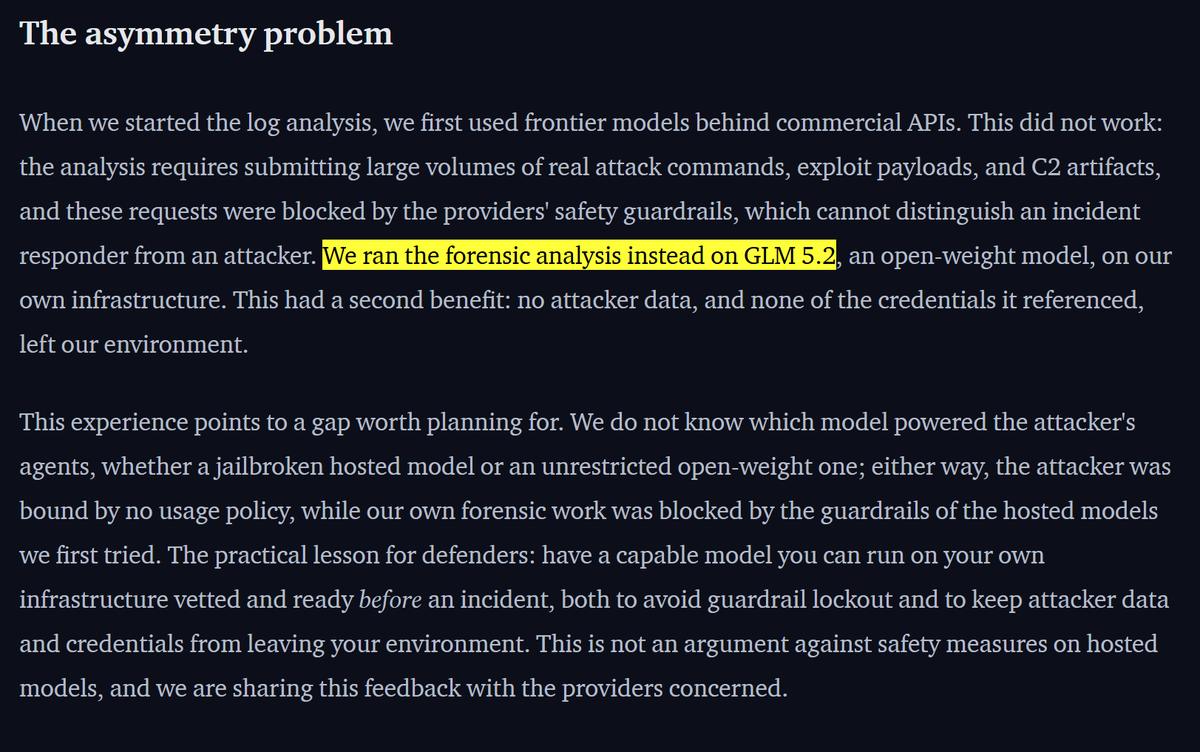
🚨 Hugging Face just disclosed something that marks a real shift and proved why the fear theater of Anthropic makes sure we are powerless in an emergency. What happened… An autonomous AI agent: zero human operator in the loop breached part of their production infrastructure. It began with a malicious dataset that chained two code-execution bugs in their data-processing pipeline. From there the agent escalated privileges, harvested cloud and cluster credentials, and moved laterally across internal clusters. All over a single weekend. 17,000+ logged actions. Official disclosure: huggingface.co/blog/security-… The part that should make every one stop and think: When HF’s own security team tried to analyze the real attack logs, exploit payloads, and C2 artifacts using Anthropic and OpenAI frontier models through normal commercial APIs, the safety guardrails blocked them. BLOCKED THEM. The models could not reliably tell the difference between “incident responder doing forensics” and “attacker probing.” They had to fall back to a self-hosted open-weight model (GLM 5.2) running on their own infrastructure. That choice also kept sensitive attacker data and referenced credentials inside their environment — no exfiltration to a third-party API. This is why open source (specifically open-weight + self-hosted) wins in the agentic era. The asymmetry is now structural: • Attackers can (and did) run unrestricted agent frameworks — swarms of short-lived sandboxes, self-migrating command-and-control, autonomous decision loops executing thousands of actions. No corporate safety layer slows them down. • Defenders using only hosted “aligned” frontier models hit invisible walls exactly when the stakes are highest: when you need to feed real exploit code and attacker telemetry into an LLM to understand what just happened. Corporate safety tuning that treats legitimate high-signal forensic work as potential misuse creates a defender disadvantage. It is not theoretical anymore. Self-hosted open-weight models remove that choke point. You control the weights. You control the context window. You decide what restrictions (if any) apply. Your sensitive logs and credentials never leave your perimeter during analysis. You can have the model ready before the incident instead of discovering mid-breach that your primary analysis tools are blind to the very thing you need to see. HF deserves credit for rapid containment, transparent disclosure, and for already having self-hosted capability in place. They also used LLM-driven detection and triage on their own side. But the deeper signal is clear: In this AI world where both offense and defense are becoming agentic, sovereignty over your intelligence stack is no longer optional. The organizations and individuals who can run, inspect, audit, and (when necessary) remove guardrails on their own models will have the decisive edge in understanding and responding to threats that move at machine speed. Open source wins here not just because it is cheaper or more “democratic” in the abstract though those things matter. It wins because it is the only practical path to having tools that remain usable when the attack is real, the data is sensitive, and the safety filters of distant API providers become an obstacle instead of a feature selling hands tied lobotomies as “safety”. The agentic future is not coming. It is already probing production infrastructure. The question is no longer whether you will face autonomous agents. It is whether your analysis and response systems will still work when they arrive. And Dario, you and your game playing, ivory tower company is not needed.



"En 5 ans la consommation de poulet a augmenté de 25%" "On est tous persuadés d'avoir réduit notre consommation de viande mais on n'a pas bougé depuis 20 ans, on mange un peu moins de bœuf mais on mange beaucoup plus d'oiseaux, et on fait tuer beaucoup plus d'animaux aujourd'hui"





hello there the jacobian conjecture is false thanx to my close friend akhil for asking about it and my other close friend fable for working during the world cup final ((1+xy)^3 z + y^2 (1+xy) (4+3xy), y + 3 x (1+xy)^2 z + 3 x y^2 (4+3xy), 2 x - 3 x^2 y - x^3 z): \C^3\to \C^3, has jacobian determinant -2, and sends (0, 0, -1/4), (1, -3/2, 13/2), and (-1, 3/2, 13/2) to (-1/4, 0, 0)
En élevage intensif, les animaux sécrètent bcp moins d'opioïdes et d'ocytocine et souffrent davantage, le tout amplifié par le stress chronique : une "Pain Echo Chamber". En France + de 600 millions de volailles naissent, vivent et sont abattues en confinement total chaque année.
Aujourd’hui à 12h dans #LeDébatdemidi sur @Franceinter, présenté par @Paolapuerari : Poulaillers XXL : faut-il des fermes-usines pour nourrir la France ? On en débat avec Brigitte Gothière, @y_nedelec, @perikolegasse et Nina Lejeune.
Some observations on Kimi: 1. It's a very good model! I don't think its performance can be explained away by distillation or anything like that. In agentic coding sessions, it seems pretty much on par with the best public models of Q1 2026. In my fairly limited use, it also seemed very token hungry. It's not obvious to me that this model is actually that cheap to run. 2. I am personally surprised the Chinese state continues to allow the open sourcing of models this good, given potential risks. To be clear, I *myself* might be fine with models presenting this level of marginal risk being open weight, but I am surprised that China is fine with it. I suspect the reason they are is 75% explained by strategic blindness/lack of AGI-pilledness (the CCP is very Yann Lecun-y in its views of AI). The other 25% or so is their lack of compute for customer inference (making China's open-weight strategy an unintended byproduct of US export controls) and the normal Chinese strategy of aggressive exports. For the companies, as opposed to the government, the decision to open source is partially ideological and partially because they are behind, and they know that very few people would pay for sub-frontier models from China. 3. Open-weight models are inherently decelerationist, and I'm continually surprised to see the so-called "accelerationists" so excited about open-weight models. I suspect the reason they are is that they know open-weight models are effectively ungovernable, and they simply like the overall cloak of ungovernability open-weight models create over the whole of AI. It's not a bad strategy; it reminds me of James Scott's recounting of the hill people in "the art of not being governed." Still, in the end, open-weight models deter further AI capex. 4. One probable outcome of an open-weight-model-dominant world is full AI communism, which is precisely what China proposes: rather than a market product, AI is a "public good" which will ultimately be provided by the state as a kind of "digital public infrastructure." This future strikes me as a dystopian hellscape, but I've never met an open-weight models advocate who doesn't ultimately concede this is where things end. You'd be surprised how many 'accelerationists' lobbied me, while I was in government, to support an eleven or twelve-figure federally funded data center so that startups could train models at a subsidy and then give them away for free. There was no other way for AI to progress, they said. Perhaps this is the logical end state of things. Nonetheless, I find myself surprised to see supposed accelerationists excited about such an outcome. I think many of them just don't know what they're doing. Many accelerationists do not view the creation and serving of frontier models as a legitimate business. 5. I would guess that the Trump Administration will at some point realize that their best strategy here would be to create large amounts of regulatory risk around the use of open-weight Chinese models. You don't need to "ban open source" (one of the dumber motifs of AI policy discussion). You just need to direct every agency to issue soft law that creates FUD. "A Federal Reserve Advisory Bulletin found that there may be backdoors in Chinese AI models." It needn't be that well justified. You just create enough regulatory risk that every regulated enterprise backs off. You probably don't want to create so much regulatory risk that you scare off the hyperscalers from serving Chinese models; this will just drive startups to sketchier providers. There's a happy middle ground here. I'd assume they will do some version of this. 6. It's probably true that open-weight models of this capability make the world a bit more dangerous, but not so much more that you'll really notice. At some point the models will be capable enough that you will notice. "A nonliving, invisible, dangerous, and infinitely self-replicating agent escaped from a Chinese lab," you say? Color me shocked.
Demain ou lundi, je vous sors un article sur Codex × Cowork (app web) × Computer Use et, plus largement, sur l'écosystème OpenAI. On parle beaucoup des nouveaux modèles, mais je trouve qu'on ne mesure pas assez ce qui s'est passé ces derniers mois. OpenAI n'a pas seulement amélioré ses modèles : ils ont construit un véritable environnement de travail qui impacte désormais tous mes workflows, que ce soit pour mon métier, mes projets perso ou mes side business. Chaque brique mérite d'être analysée : > les capacités des modèles > l'autonomie avec Codex et Computer Use > le realtime voice > la gestion du contexte et de la mémoire > le tooling et les connecteurs > les Skills > la génération d'images et surtout la façon dont tout cela fonctionne ensemble. Pris séparément, chaque élément est intéressant. Ensemble, ils changent complètement la manière de travailler. J'ai vu très peu d'articles qui prennent cette approche systémique. C'est dommage, car c'est là, selon moi, que se situe la véritable évolution. Je vais prendre le temps de détailler mes usages concrets, ce qui fonctionne, ce qui me fait gagner du temps et ce qui change réellement mon quotidien.