marcvanderkamp@bluesky.social banner
marcvanderkamp@bluesky.social

@marcvanderkamp

Computational biochemist (he/him), PI of the https://t.co/PMujXHtpIQ. Likes #enzymes & #compchem, #diversity #inclusion.

Bristol, England Katılım Temmuz 2009
723 Takip Edilen1.6K Takipçiler
marcvanderkamp@bluesky.social
[email protected]@marcvanderkamp·
Fees are now reduced! Early-bird student fee: 100 Early-bird fee: 150 Register by 15/05 for these; prices will rise £50 thereafter. (For those without funding, we may be able to offer bursaries soon - check back on website in a couple of weeks)
English
0
0
0
4
marcvanderkamp@bluesky.social
[email protected]@marcvanderkamp·
NB We have just heard that we can reduce all levels of conference fees by £100! Bear with us while we adjust the registration process.
English
1
0
0
27
Max Jaderberg
Max Jaderberg@maxjaderberg·
The Iso team has cooked something incredible: our new technical report unveils the latest results from our drug design engine, the IsoDDE, progressing far beyond AlphaFold 3. This breaks new ground compared to AF and other similar methods by a significant degree across all key benchmarks. 1/7
Max Jaderberg tweet media
English
33
119
691
164.3K
marcvanderkamp@bluesky.social
[email protected]@marcvanderkamp·
@DdelAlamo Totally agree with that! I was just imagining an rxiv preprint *with* all methods and validation.
English
0
0
1
642
Diego del Alamo
Diego del Alamo@DdelAlamo·
@marcvanderkamp The methods aren't divulged in full and therefore aren't reproducible. It's an advertisement, not a scientific document. Biorxiv and every other rxiv are meant to share and advance science ahead of peer review, not go fishing for customers and investors
English
1
6
66
9.4K
Diego del Alamo
Diego del Alamo@DdelAlamo·
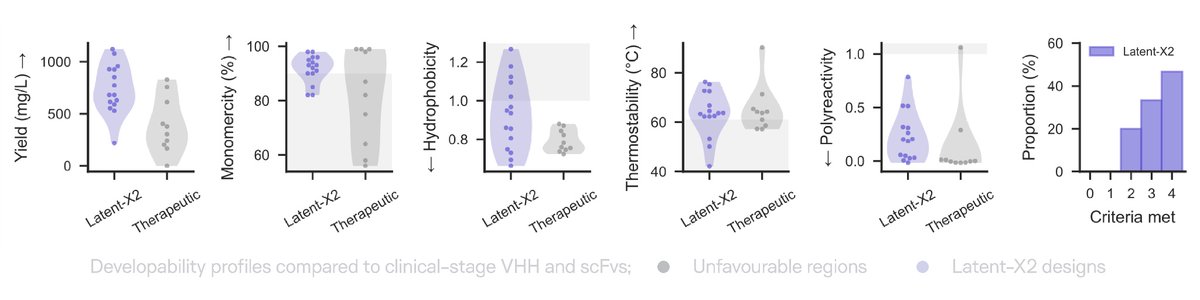
New latent labs report on de novo antibody design closely follows what we’ve seen from Chai and Nabla. Promising results, and I respect that they admit that half of the targets were unsuccessful with their approach
Diego del Alamo tweet media
English
2
9
78
6.6K
marcvanderkamp@bluesky.social
[email protected]@marcvanderkamp·
@DdelAlamo Why do you hope it stays off biorxiv? (Genuine question, sorry if naive)
English
1
0
0
2.2K
Sanju Sinha
Sanju Sinha@Sanjusinha7·
Most current drug discovery efforts is structure-based eg. create small molecules or antibodies that best binds X. However, a drug may not drive its efficacy from its strongest binder. Taking a step away from structure-paradigm, we reason that if a CRISPR knockout of a gene mimics a drug's effects across cancer cell lines, that gene is likely the drug's target. This was done in @EytanRuppin in collaboration with @anideshpandelab and @BenDavidLab Using this principle, we integrated drug and crispr profiles from 1000s of drugs to find their context specific targets (different cancers or when known target is not expressed but drug is yet killing cancer cells). We call this tool DeepTarget. We show that this approach outperforms current structure based methods (AF3, RF, Chai) to find drug's target in a genome-wide search, when we had no information on what the target might be. We benchmarked in eight gold-standard drug-target pairs. It took us months to get this benchmarks (we hope this benchmark helps the field) We present two experimentally validated cases and pls see the paper for this (link at the end). An intriguing observation is that we had many cases where we have many small molecules targeting the same gene (eg. EGFR) and we found that small molecules with higher predicted target specificity show greater clinical advancement. Very happy to hear your feedback. Here's the free access link: nature.com/articles/s4169…
Sanju Sinha tweet mediaSanju Sinha tweet mediaSanju Sinha tweet mediaSanju Sinha tweet media
English
9
52
204
46.8K
[email protected] retweetledi
Prof. Nikolai Slavov
Prof. Nikolai Slavov@slavov_n·
bioRxiv has a dedicated section for negative results. Use it. Share negative results. Your colleagues will appreciate it.
Prof. Nikolai Slavov tweet media
English
19
394
1.9K
186.4K
marcvanderkamp@bluesky.social
[email protected]@marcvanderkamp·
PhD project with GW4 BioMed DTP available (Sept '26)! Use #compchem multiscale reaction simulations & experiment to understand and combat antimicrobial resistance by Class C beta-lactamase #enzymes. More info: gw4biomed.ac.uk/overcoming-%ce… Deadline Oct 20th, but contact me by Oct 5th.
English
0
7
7
849
[email protected] retweetledi
Biology+AI Daily
Biology+AI Daily@BiologyAIDaily·
From QM/MM to ML/MM: A New Era in Multiscale Modeling 1. This review article explores the evolution from Quantum Mechanics/Molecular Mechanics (QM/MM) to Machine Learning/Molecular Mechanics (ML/MM) methods, highlighting how ML potentials offer a faster alternative to QM while maintaining accuracy. This transition is crucial for simulating complex biological and condensed-phase environments with reduced computational costs. 2. The article emphasizes the key challenge of coupling ML and MM regions, addressing this through three main strategies: Mechanical Embedding (ME), Polarization-Corrected Mechanical Embedding (PCME), and Environment-Integrated Embedding (EIE). Each strategy offers different trade-offs between accuracy and computational efficiency. 3. Mechanical Embedding (ME) is highlighted as the simplest approach, where the ML region interacts with fixed MM charges via classical electrostatics. This method is computationally efficient but neglects polarization effects, which can be critical in some systems. 4. Polarization-Corrected Mechanical Embedding (PCME) supplements a vacuum-trained ML potential with post-hoc electrostatic corrections. This approach preserves transferability while approximating environment effects, making it suitable for systems where polarization plays a significant role. 5. Environment-Integrated Embedding (EIE) involves training ML potentials with explicit inclusion of MM-derived fields. While this enhances accuracy, it requires specialized data and is more computationally intensive, making it ideal for applications where high fidelity is essential. 6. The review surveys existing ML/MM frameworks, categorizing them based on the embedding strategies used. It also highlights key applications, such as protein-ligand binding and solvation studies, demonstrating the practical utility of ML/MM methods. 7. The article concludes by discussing the current state-of-the-art in ML/MM and outlining future challenges, including the need for more transferable and general-purpose ML potentials, as well as the development of larger and more diverse training datasets. 📜Paper: doi.org/10.26434/chemr… #MultiscaleModeling #MLMM #QM_MM #ComputationalChemistry #MachineLearning #Biophysics
Biology+AI Daily tweet media
English
2
17
63
3.5K
[email protected] retweetledi
UN Women
UN Women@UN_Women·
It's #IndigenousPeoplesDay! Indigenous women and girls are keepers of invaluable scientific, environmental, and cultural knowledge. Yet, #AI systems often exclude or misrepresent them, reflecting colonial biases. To ensure inclusive AI governance, Indigenous women and girls must be empowered not only as users, but also as co-creators and regulators. #WeAreIndigenous
UN Women tweet media
English
66
175
376
21K
[email protected] retweetledi
Prof. Natalie Fey
Prof. Natalie Fey@NatalieFey_NLS·
Paging the #ChemEd and #CompChem communities: Could you please help my MSc student with an education project, exploring how gen AI shapes the way we think, solve problems, and build confidence.
English
1
3
5
838
[email protected] retweetledi
Diana Veselu
Diana Veselu@VeseluDiana·
I’m really happy to share that I’ve passed my PhD viva in Computational Biochemistry! It’s been an exciting journey and I’m profoundly grateful to my supervisors Dr @marcvanderkamp and Dr Deb Shoemark, and my collaborator Dr Richard Sessions for all their support and guidance.
Diana Veselu tweet media
English
3
1
5
490