Marshall Perrin
1.2K posts

Marshall Perrin
@marshallperrin
Astronomer at STScI. Exoplanets, mirrors, systems, software. Specialist in synthetic starlight. Deputy Telescope Scientist for JWST; tweets my own. (He/him)
Katılım Ocak 2010
85 Takip Edilen2.1K Takipçiler

@ayjreen There’s even an automated plugin for Photoshop, for instance: skyatnightmagazine.com/astrophotograp…
(Not science research grade, but a neat application of machine learning for image processing!)
English

@ayjreen Plus, there’s a general preference for showing data that’s minimally processed, “what the telescope really sees”. Less image manipulation, less like “photoshopping.” But in fact there’s widely available software which is great at subtracting these out if you want it.
English

I love this blinking comparison of gorgeous Hubble and JWST data for several reasons, but one is that it helps illustrate beautifully something about JWST’s six-sided snowflake PSFs which I’ve mentioned before. Take a close look at the stars in this image, and I’ll explain…
NASA Webb Telescope@NASAWebb
Hubble had observed galaxy MACS0647-JD, but where Hubble saw one object, Webb saw TWO! Are they two galaxies merging? Or two clumps of stars within a galaxy? We don’t know yet, but Webb could help figure it out. *Data is from Webb science in progress, not yet been peer reviewed.

English

@fringetracker Talk to Laurent Pueyo - he’s been updating the JHU astro Fourier optics class (formerly taught by Ron Allen & Anand) with more computer exercises etc. Still not as broad in subject matter as you’re thinking, but in any case there might be some potential for shared ideas etc.
English

@wikkit *Lots* of factors to balance including slew time, observation timing and position angle constraints, data volumes, micrometeor avoidance potentially, & more. The scheduling is an ongoing heroic effort in very complex multi-objective optimization.
English

@wikkit Yes, absolutely! In fact we did that during commissioning for months, alternating wavefront sensing target stars between north and south sides of the sky to balance out momentum and fuel-efficiently avoid the need for unloads. But it’s more complicated during science obs…
English

@marshallperrin I was reading about momentum dumping here:
jwst-docs.stsci.edu/jwst-observato…. Is it possible (or already done) to sort observations in opposite directions so that each observation removes momentum from the previous one? Or would the slew time make that not worthwhile?
English

@markmccaughrean @gblasco78 Usage instructions and example code at webbpsf.readthedocs.io/en/latest/ !
English

@gblasco78 Beyond my immediate knowledge, I'm afraid: we don't have any call for WebbPSF in our programmes (yet). Others here, including @marshallperrin will know far better.
English

You may have seen the thread below about the very bright gamma ray burst GRB221009A & its study by @ESA_Integral & @ESA_XMM, including the lovely light echo image 👍
But how do light echoes work? Here’s a GIF I made earlier to help explain, along with some words below 🙂
1/
GIF
ESA Science@esascience
@esa @ESA_Integral 2/ The aftermath of #GRB221009A as seen by @ESA_XMM reveals multiple dust rings scattering X-rays 👉esa.int/ESA_Multimedia…
Noordwijk, Nederland 🇳🇱 English

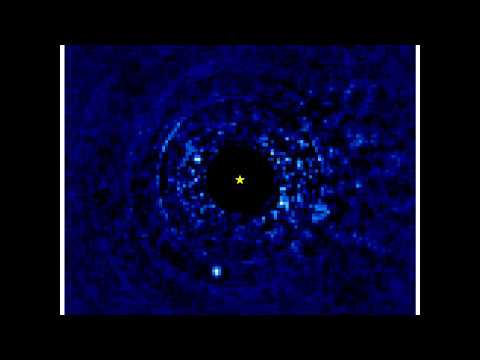
I’ll close with this wonderful animation by @semaphore_P, showing 51 Eri moving in its orbit.
Of course the JW data should show it quite a bit further along in its orbit by now, along with 3x longer wavelength out into the IR.
youtu.be/yodAmnlFT7U

YouTube
English

Fun day: Gorgeous #JWST images of the Pillars of Creation shared with the world, and meanwhile the first of my team’s cycle 1 exoplanet imaging observations are ongoing right now! Let’s go.
English