Martin Dirker

9.1K posts

Martin Dirker banner
Martin Dirker

Martin Dirker

@martindirker

Expert in shape optimization for aero or structure. Inventor, artist, maker, designer of wheels, engines, art objects, race cars.

Benoni, South Africa Katılım Eylül 2011
2K Takip Edilen394 Takipçiler
Martin Dirker retweetledi
Unfiltered
Unfiltered@quotesdaily100·
35 WEBSITES THAT ARE ACTUALLY USEFUL 1. archive. org — access old content 2. wolframalpha. com — solve anything 3. removebg. com — remove image background 4. tinypng. com — compress images free 5. smallpdf. com — edit PDFs free 6. ilovepdf. com — merge & split PDFs 7. deepl. com — best translator online 8. grammarly. com — fix your writing 9. hemingwayapp. com — simplify writing 10. chatgpt. com — ask any question 11. perplexity. ai — smart search engine 12. notion. so — organize your whole life 13. trello. com — manage any project 14. canva. com — design for free 15. unsplash. com — free photos 16. pexels. com — free videos & photos 17. flaticon. com — free icons 18. coolors. co — pick color palettes 19. fonts. google. com — free fonts 20. namecheap. com — buy cheap domains 21. github. com — free code hosting 22. replit. com — code from browser 23. regex101. com — test any code 24. explainshell. com — understand commands 25. fast. com — check internet speed 26. haveibeenpwned. com — check if hacked 27. virustotal. com — scan files for virus 28. downdetector. com — check if site is down 29. 10minutemail. com — temp email address 30. justpaste. it — share text instantly 31. screely. com — make screenshots beautiful 32. carbon. now. sh — share code beautifully 33. squoosh. app — compress any image 34. similarsites. com — find similar websites 35. shortcuts. design — design shortcuts list
English
49
4.4K
20.7K
819K
Martin Dirker retweetledi
Mr PitBull Stories
Mr PitBull Stories@MrPitbull07·
She broke her leg parachuting at 17. At 18, she refused to bail out over the ocean and saved her plane on fumes. By war's end, she'd flown more aircraft than any pilot alive. March 1, 1922. Pretoria, South Africa. Dolores Theresa Sorour hated her name. She renamed herself after Jackie Rissik—a South African hockey star who didn't let anyone tell her what women couldn't do. Young Jackie had the same attitude. At 15, while other girls learned piano and etiquette, Jackie was at the airfield taking flying lessons. Her brothers mocked her. "You're too small to handle a plane," they laughed. She got her license at 17—the youngest pilot in South Africa. Then she decided to do something no woman in her country had ever attempted: jump from a plane wearing a parachute. The authorities tried to stop her. Women don't do that. Too risky. Inappropriate. Jackie borrowed a pilot's chute and jumped from 4,000 feet anyway. She landed badly among a group of polo players and shattered her leg. That broken bone would later save her life. By 1938, Jackie had moved to England to earn an advanced flying certification. South Africa had no schools willing to train women beyond basics. If she wanted to become exceptional, she had to leave everything familiar behind. Then Germany invaded Poland in September 1939. Jackie tried joining the Royal Air Force. They laughed her out of the recruiting office. Women fly? In combat? Absurd. So she joined the Women's Auxiliary Air Force and spent months staring at radar screens in a bunker—watching German bomber formations as glowing dots while RAF pilots scrambled to intercept them. She was watching the war from underground while desperate to be in it. July 1940. Everything changed. The Air Transport Auxiliary was recruiting. They needed civilian pilots to move military aircraft from factories to fighting squadrons. Dangerous work—flying unfamiliar planes in terrible weather with no weapons, often no radio, using only a pocket manual for guidance. Jackie was 18 when she joined. The youngest woman they'd ever accepted. The men called themselves "Ancient and Tired Airmen." Most had been rejected by the RAF for being too old or injured. The women? They just wanted to fly. Jackie excelled immediately. Give her any aircraft—Spitfire, Lancaster, Tempest, Hurricane—and twenty minutes with the instruction booklet. She'd figure it out. Takeoff, delivery, land, repeat. Eighty-three different aircraft types. Some she'd never seen before climbing into the cockpit. By war's end: 1,500 successful deliveries. Two hundred more than the next closest pilot. But numbers don't capture what she survived. January 5, 1941 started like any other mission. Jackie was ferrying an Oxford trainer through miserable weather—thick fog, driving rain, zero visibility. Another ATA pilot, Amy Johnson, was flying a similar route that same day. Both got disoriented in the storm. Amy followed proper procedure: she bailed out over the Thames Estuary when things got desperate. The freezing water killed her. Her body was never found. Jackie saw the Bristol Channel appear through the fog beneath her. She had maybe twenty minutes of fuel left. No idea where she was. Visibility measured in feet. Protocol said bail out. Use the parachute. Let the plane crash. Jackie remembered her broken leg from 1938. Remembered the agony. Made a split-second decision. She dropped to wave-height and flew blind on fumes until she spotted land. She landed safely. Amy Johnson—more experienced, more famous, following the rules—died that day. Jackie—breaking protocol, trusting her instincts—lived. Months later, flying a Tempest over Surrey, Jackie spotted something that made her blood freeze: a V-1 rocket heading for London. These German flying bombs were unstoppable once launched. When they ran out of fuel, they dove and detonated—obliterating entire city blocks. More story⏬⬇️
Mr PitBull Stories tweet media
English
12
98
529
53.1K
Martin Dirker retweetledi
Unfiltered
Unfiltered@quotesdaily100·
THE WORLD GOES TO SCHOOL DIFFERENTLY: 1. Finland: No major exams until the final year of high school. Teachers are highly educated and respected. Consistently one of the best education systems in the world. 2. Japan: Students clean their own classrooms daily. Respect and responsibility are taught before academics. Character comes first. 3. South Korea: Students study until midnight. The university entrance exam is so critical that flights are rerouted on exam day. Burnout among young people is a serious national crisis. 4. United States: Standardized testing dominates everything. School quality depends on neighborhood wealth. Rich areas get better schools. Poor areas get what is left. 5. Germany: At age 10 students are placed into different school paths. Vocational training is taken as seriously as university. Youth unemployment stays low because of it. 6. India: The system runs on memorization and high-stakes exams. 1.5 million students compete for just 17,000 IIT seats. Pressure begins long before a child is ready. 7. Singapore: Ranked number one globally for math, science, and reading in 2022. Extremely competitive. Even the government admits student pressure has gone too far. 8. France: Philosophy is a required subject and counts toward the national exam. Students are trained to think critically and argue clearly from a young age. 9. Cuba: Education is completely free at every level. Literacy rate sits above 99 percent according to UNESCO. One of the most educated populations in Latin America. 10. Netherlands: Students are assessed at age 12 and placed into paths that suit their strengths. Academic and vocational routes are treated equally. No path is seen as lesser. 11. China: The Gaokao exam determines almost everything about a student's future. Pressure starts in early childhood and is carried by the entire family, not just the student. 12. Kenya: Primary school became free in 2003. Secondary school fees still push many families to breaking point. Dropout rates in rural areas remain high. 13. Russia: Historically strong in mathematics, science, and engineering. The system valued compliance over curiosity. That tension still shapes education today. 14. Brazil: Private schools are well funded and deliver strong results. Public schools are severely underfunded. Where you are born almost entirely determines the education you receive. 15. Denmark: University is free for Danish and EU citizens. Students also receive a monthly government stipend just for attending. Education is treated as a public good, not a personal expense. 16. Canada: Each province runs its own education system independently. Quality varies across the country. Indigenous history inclusion in the curriculum is real but still inconsistent. 17. Australia: Universities are strong and globally respected. Indigenous history is now formally part of the national curriculum. The debate over equal funding between public and private schools remains unresolved. 18. Sweden: No formal grades until age 12 or 13. Early pressure is believed to kill curiosity before it grows. Research consistently supports this approach. 19. New Zealand: Māori language and culture are officially part of the national curriculum. Legally protected but depth of teaching varies greatly between schools. 20. Switzerland: Two thirds of students enter vocational apprenticeships rather than university. Both paths are equally respected. Both lead to strong careers. 21. Norway: Public university is free for everyone including international students. Teachers must hold a master's degree. Teaching is one of the most respected professions in the country. 22. Israel: Schools emphasize critical thinking and entrepreneurship from an early age. Combined with technical military training, this directly feeds one of the most active startup ecosystems in the world.
English
91
1.2K
3K
324K
Martin Dirker retweetledi
Aakash Gupta
Aakash Gupta@aakashgupta·
Look at this Norwegian church. It has been standing through Norwegian rain for over 840 years. The trees were prepared for nearly two decades before anyone cut them down. Workers walked into old-growth pine forests and stripped the chosen trees of their tops and their branches. The trunks stayed standing for fifteen to twenty years. The roots kept pulling resin upward. The pitch bled out of every old branch socket and saturated the heartwood from the inside. By the time the trunks were felled in winter, the heartwood was no longer wood. It was malmfuru. Ore-pine. Functionally pressure-treated lumber, except the pressure was applied by the tree itself, for free, across two decades before construction started. That is why iron was rejected. Iron rusts. Iron expands and contracts on a different cycle than the wood around it. After 100 winters iron splits the fiber and the joint dies. Wooden pegs swell with moisture in the same direction as the staves. The joints get tighter over time. Tongue-and-groove walls. Ground sills on a stone foundation. Four corner posts carrying load down through stone, never up through soil. Then the tar. Pine roots and stumps stacked under clay, lit on fire, burned for two days under controlled airflow. The wood decomposes into pitch. The pitch gets reapplied to the church every 10 to 15 years. Including this decade. Norway built around 2,000 stave churches between 1150 and 1350. 28 survive. Borgund is the best preserved because its corner staves rest on stone, not soil. The ground never won. Modern lumber arrives at the construction site finished. Borgund's builders made the lumber finish itself.
English
77
624
4.7K
367.6K
Martin Dirker retweetledi
Illimitable Man (IM)
Illimitable Man (IM)@SovereignIM·
Men admire in women masculine virtues (self-accountability, logic, composure, self-command) expressed through feminine embodiment - not as an imitation of man, but as a refinement of character. Women admire in men feminine virtues (empathy, tenderness, intuition, receptivity) expressed through masculine embodiment - not as softness without toughness, but as completeness. So each sex seeks the best of its own principle integrated in the opposite, their natural polarity preserved but elevated. Men and women are thus seeking the best of themselves in their opposite in stable contrast - a marriage within so there can be a marriage between - recursive union - what beauty!
English
103
1.3K
10.7K
393.8K
Martin Dirker retweetledi
Incentivising
Incentivising@incentivising·
Game theory proves that people do not act on information. They act on incentives. You can give a person all the data they need to make a better decision, but as soon as that decision threatens their position or costs them something visible, they will try to ignore the data. Before you ever try to convince anyone of anything, map what it costs them to agree. The cost of agreeing is the obstacle, not the argument.
English
22
370
2.3K
45.5K
Martin Dirker retweetledi
Chris Meder
Chris Meder@EVCurveFuturist·
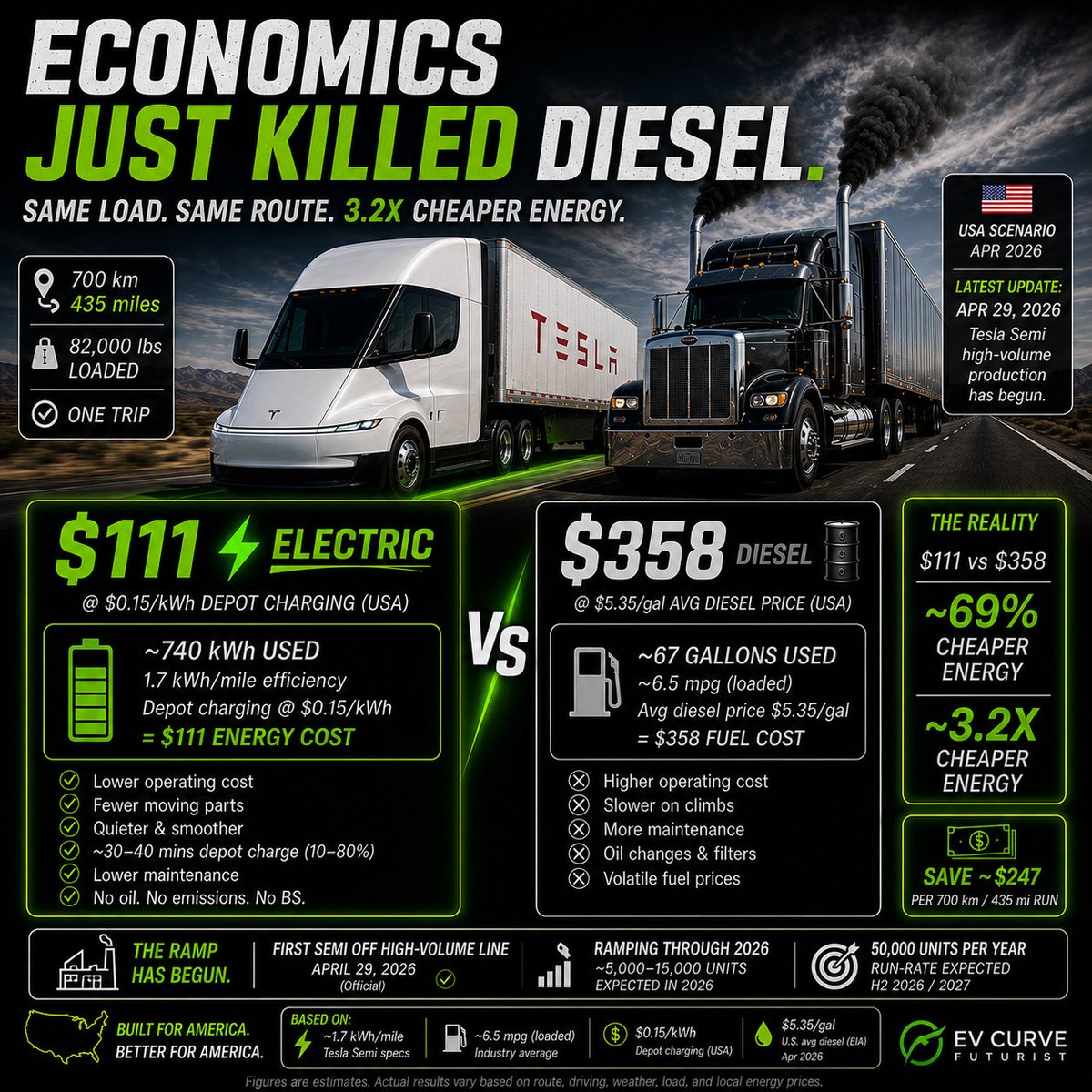
ECONOMICS JUST KILLED DIESEL. #TeslaSemi production started April 29, 2026 (2 days ago). Same load. Same route. $111 electric vs $358 diesel. → 69% cheaper energy → 3.2X cheaper to operate → $247 saved every single trip Who’s ready for the electric freight revolution? 🚀
Chris Meder tweet media
English
85
365
1.4K
38.9K
Martin Dirker retweetledi
Race
Race@multiplanet1·
Elon said something that stuck with me. He said the hardest part of being him isn't building the rockets, it's caring about everyone he can't save. That single line changes how you see him. Most people think the secret to Musk is intelligence. Or work ethic. Or risk tolerance. They miss the real thing. His edge is that he has a heart. In a world optimized for cold optimization, where every CEO is trained to maximize shareholder value and minimize emotional exposure, Musk does the opposite. He builds what moves him. He fights for what matters to him. A 15 year old girl named Liv Perrotto designed a Shiba Inu plush in 30 minutes. She had cancer. Stage 4. The plush was her contribution to Polaris Dawn, the SpaceX mission that flew higher than any private spaceflight in history. She named it Asteroid. The plush flew. It became the mission's zero g indicator. The first thing that floated when they hit space. Liv died in January. Before she died she wrote eight wishes for Elon. The eighth one was simple. Make Asteroid the official mascot of SpaceX. She knew she wouldn't see it happen. She wrote it anyway. When the request reached Elon, he didn't have to respond. He's the richest man alive. He gets thousands of dying wishes. Most go unanswered, that's just math. He answered this one. He said yes. Asteroid is now the SpaceX mascot. Because a 15 year old girl drew a dog and asked the most powerful man in the world to remember her. This is the part nobody understands about Musk. He could have ignored it. The optimal capital allocation move was to ignore it. The brand calculation said ignore it. The lawyers said ignore it. He didn't ignore it. People debate whether he's a genius or a clown, a hero or a villain, a savior or a scammer. They miss the point entirely. The reason he keeps winning isn't his intelligence. It's that he hasn't optimized away his humanity. The other tech founders are smarter at certain things. They have better processes. Better PR teams. Better political instincts. None of them would have made Asteroid the mascot of SpaceX. Most of them couldn't tell you the name of a child who died of cancer last year. That's the gap. That's the moat. That's why he beats them all. In a world that rewards detachment, Musk's superpower is that he still feels things. The Tesla mission was personal. The SpaceX mission is personal. Neuralink is personal because his son was non-verbal until eight. Even the Twitter purchase was personal, his obsession with free speech tied to his own censoring. Every project is downstream of something he actually cares about. That's why he can work 100 hours a week for 20 years without burning out the way normal people do. Burnout comes from doing things that don't match your values. He's never had to do that. Liv didn't get to see her plush become the SpaceX mascot. But she wrote it down before she died, and the most powerful man alive said yes, because somewhere underneath the rockets and the satellites and the AI companies and the trillion-dollar valuations, he's still the kid who cried watching cartoons. Most people lose this by 30. They call it growing up. It's actually atrophy. @elonmusk kept it. That's the whole secret.
Race tweet media
English
295
417
2K
45.5K
Martin Dirker retweetledi
Alice Smith
Alice Smith@TheAliceSmith·
Capitalism isn’t about money. It’s about liberty, progress and personal responsibility.
English
750
2.1K
11.9K
876.9K
Martin Dirker retweetledi
Massimo
Massimo@Rainmaker1973·
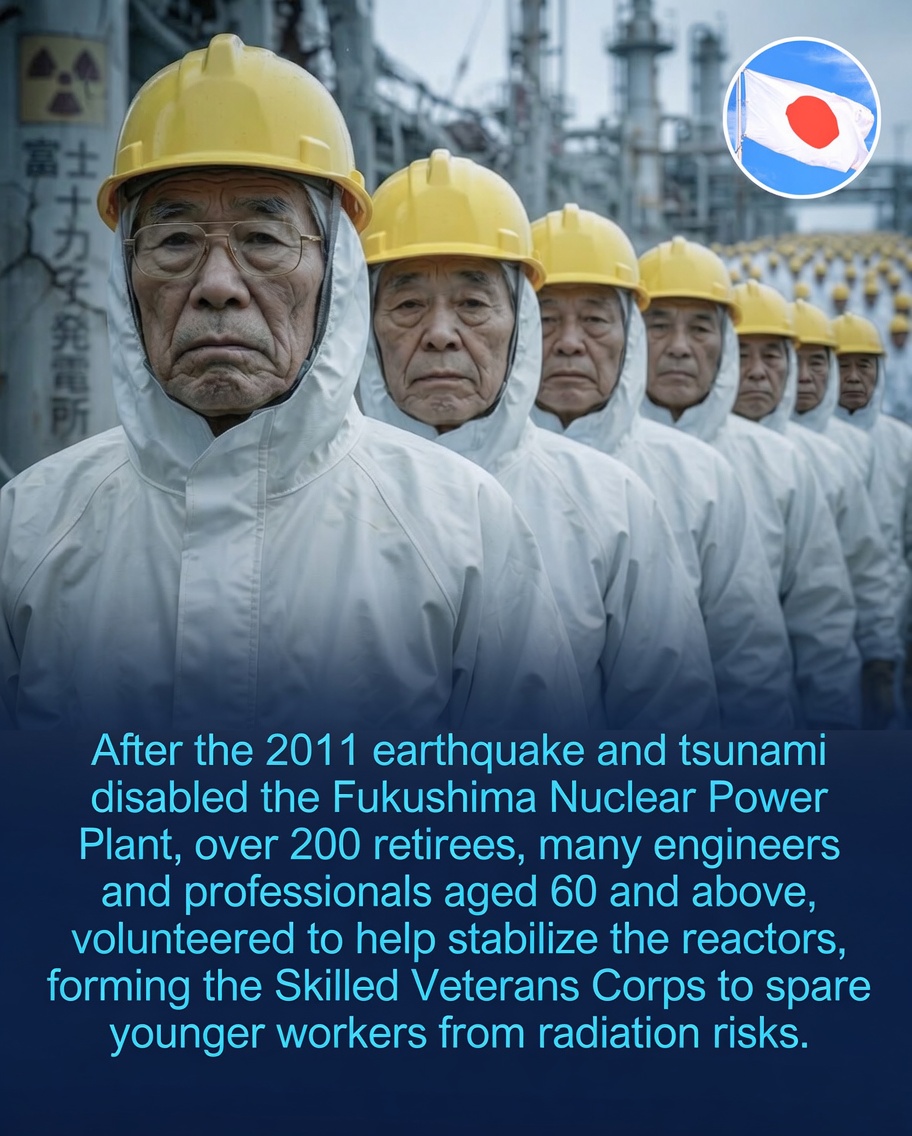
After the devastating 2011 earthquake and tsunami crippled the Fukushima Daiichi Nuclear Power Plant, a remarkable group of retirees answered the call for help. More than 200 retired engineers and professionals, all aged 60 and older, volunteered to work at the damaged facility. They formed a unique unit known as the Skilled Veterans Corps, with the explicit goal of stabilizing the reactors while shielding younger workers from dangerous levels of radiation exposure. The initiative was spearheaded by 72-year-old retired engineer Yasuteru Yamada. He argued that older individuals were better suited for the high-risk tasks because they had fewer years of life ahead of them, meaning the potential long-term effects of radiation would be less devastating compared to younger workers with decades left to live. Alongside fellow retiree Nobuhiro Shiotani, Yamada recruited doctors, cooks, singers, and other experienced professionals, all driven by a profound sense of duty to their country. The group made it clear that their mission was not a suicide pact, but a practical and ethical decision to use their lifetime of skills for Japan’s recovery while protecting the next generation. Their selfless offer earned widespread admiration and respect, becoming a powerful symbol of sacrifice and civic responsibility in the face of crisis.
Massimo tweet media
English
70
831
2.9K
45.4K
Martin Dirker retweetledi
Chris Meder
Chris Meder@EVCurveFuturist·
Congrats to the Tesla team. This is a watershed moment for freight in America. $0.15/mile EV vs ~$0.50 diesel ($0.60+ when diesel spikes) Operating costs are the hero. Once fleets see it at scale and production ramps, sales will rocket. EV trucks will take over the roads. Extended POV: This isn’t about specs. It’s about economics under utilisation. Freight is brutal: high miles, heavy loads, tight margins. That’s exactly where EVs dominate. Core specs that matter: • Range: 325–500 miles (523–805 km) • Gross combination weight: up to ~82,000 lbs (37 t) • Energy use: ~1.7 kWh/mile fully loaded • Battery: ~600–900 kWh est • Motors: 3 independent rear motors Charging flips the model: • Megawatt charging (MCS) capable • ~60–70% in ~30 mins • ~400 miles recovered in a stop (real-world target) • Depot charging overnight = lowest cost energy Now the key part: At ~1.7 kWh/mile → $0.15/mile assumes ~$0.09/kWh depot energy Diesel: → ~6–7 mpg → $3–4/gal = ~$0.45–0.70/mile That gap is everything. And fleets scale that instantly. Then layer in: • near-zero idling losses • far less maintenance (no engine, gearbox, exhaust systems) • regenerative braking reducing wear • higher uptime And the system gets even stronger: → solar + battery depots pushing energy cost toward zero → load balancing across fleets → software routing + charging optimisation → predictable operating costs vs oil volatility This isn’t a truck upgrade. It’s a system rewrite. Diesel = fuel logistics Electric = energy + software Fleets don’t buy hype. They buy cost per mile. Once they hit scale production, it won’t be gradual. Fleet is where the system flips. ⚡🚛
Tesla Semi@tesla_semi

First Semi off high volume line

English
120
419
2.9K
211.7K
Mustufa Khan
Mustufa Khan@mustufa4socials·
@elonmusk We could save a lot of water because of this, I just hope it doesn’t disturb space’s ecosystem
English
2
2
6
371
Lawrence E McDonald
Lawrence E McDonald@macdee_patriot·
Just walked into my temporary home in Florida. Fridge full of food. Clean, safe, everything works. Hot water, lights, WiFi , all instant. The people? Friendly across the board. Genuine welcomes from everyone I’ve met. This is what South Africa could have been. A place of dignity, opportunity and peace. Instead, we watched our culture, languages, religion and heritage deliberately undermined for political power. Painful to leave. Grateful to be here. Time to rebuild. #NewChapter #SouthAfricaToUSA
English
492
897
8.3K
59.1K
Martin Dirker
Martin Dirker@martindirker·
Beers and Voortrekkers did the same and call it biltong. Hugely popular in South Africa.
Sama Hoole@SamaHoole

The Mongol Empire conquered sixteen percent of the earth's land surface. Most accounts of how they did it focus on cavalry tactics. Few mention the bag of dried meat hanging from the saddle. It is called borts. The technique is brutally simple, which is part of what makes it so devastatingly effective. Take a freshly slaughtered cow. Cut the meat into long strips, two to three centimetres thick, five to seven centimetres wide. Hang the strips on cords inside a ger, where the steppe wind can move freely around them. Wait. After about a month in the dry continental air of Mongolia, the meat is no longer meat in any sense a modern supermarket would recognise. It has become hard, brown, wood-like sticks. All the water has gone. What remains is pure protein, fat, and minerals, in a form that does not spoil and cannot be killed by anything short of fire. Then they shrank it further. The dried strips were broken down, sometimes ground to a coarse fibrous powder, until what had once been the muscle of an entire cow could fit, by repeated tradition, inside the stomach or bladder of that same cow. A whole animal, weeks of feeding, condensed into a single sack a man could sling under his saddle. A pinch of borts powder, dropped into hot water, would yield a bowl of meat broth dense enough to feed three or four people. A warrior with a single bladder of borts on his hip was carrying months of food. He did not need a quartermaster. He did not need a cook. He did not need a wagon. He needed water, fire, and the few minutes it took to reconstitute what was effectively the world's first instant meal. European armies, by comparison, were dragging baggage trains across the continent. Flour to be milled, then baked. Salt pork in barrels that needed lifting. Wine in casks. Cooking pots, fuel, ovens, the labour of men whose entire job was to keep the fighting men fed. A medieval European army moved at the speed of its slowest cart. The Mongols moved at the speed of their fastest horse, because their food moved with them, on them, weighing almost nothing. Combine borts with kumis (the fermented mare's milk in the leather flask on the other hip) and the Mongol warrior had complete nutrition strapped to his body. Protein, fat, fermented dairy, vitamin C, B vitamins, calcium, electrolytes. Everything a man needs to fight, ride, recover, and fight again. No fire required. No stop required. No supply line to be cut by an enemy who had not yet realised the supply line was already in the saddlebag. The Secret History of the Mongols, the only contemporary chronicle written by the Mongols themselves, mentions dried meat as the staple of long campaigns. Friar William of Rubruck, riding with them in 1253, describes the same. He marvels at how little they seemed to require to keep going. He was watching men powered by an entire cow shrunk to the size of his lunch. Modern nutritionists, reconstructing borts, describe a food roughly 70 to 80 percent protein by weight after drying, with intact fats, full bioavailability of B12 and iron, and a shelf life measured in years. It is, for all intents and purposes, the perfect carnivore travel food. Designed eight hundred years ago. Carried across half the known world. Used to overthrow the largest civilisations of its day. The modern soldier, by contrast, eats an MRE. Three thousand calories of seed oil, refined wheat, sugar, and the bleak mathematics of corporate procurement. Cost: roughly $11 a meal. Shelf life: three to five years if you trust the packaging. Nutritional density per gram: a fraction of borts. Effect on the men eating them, by every honest field report in the last twenty years: digestive misery, blood sugar swings, and the sort of post-meal lethargy that is the exact opposite of what an army needs. The Mongols solved this problem in the thirteenth century. They solved it with a knife, a string, and the wind. We have spent eight hundred years complicating it. The bag of dried meat is still the answer. It always was.

English
0
0
0
6
Martin Dirker retweetledi
Dr Rudolf Steiner
Dr Rudolf Steiner@RudolfStein2026·
“It is just as wrong not to do the right things as it is to do the wrong thing.” Most people think being “good” means avoiding bad actions. Don’t lie. Don’t steal. Don’t harm. So they live carefully… but passively. And they call that morality. But that’s not enough. True morality isn’t passive. It’s not about staying clean— it’s about acting when you know what is right. Because the moment you clearly see the good, you are no longer neutral. You’re responsible. If you see truth and stay silent… If you see injustice and look away… If you know what should be done and choose comfort instead… You haven’t avoided wrongdoing. You’ve chosen inaction over your higher self. You weren’t meant to just avoid evil. You were meant to create good. Every moment you recognize what is right is a test: Will you act from clarity -- or retreat into convenience? Doing wrong blocks your development. But so does hesitation. So does delay. So does “I’ll do it later.” The world doesn’t just suffer from bad people. It suffers from people who know… and don’t act. The question for you is: Where did I stay silent, hold back, or choose comfort over truth when I should have spoken and acted? Because in the end; your life is not only shaped by what you did wrong… …but by all the good you saw clearly and left undone. The good only lives through those who choose to act.
Dr Rudolf Steiner tweet media
English
14
39
152
5K
Martin Dirker retweetledi
Lawrence E McDonald
Lawrence E McDonald@macdee_patriot·
Today I touched down in Florida as a refugee — on South Africa’s Freedom Day of all days. A day meant to celebrate liberation became the day I finally stepped into my own. Leaving the country of my birth was not easy. It was painful, heartbreaking, and symbolic. I walked away from a place I loved deeply, but where daily life had become a struggle for safety, dignity, and opportunity. As the plane lifted off, I felt the weight of years of frustration, fear, and disappointment. I left behind a system that had stopped serving its people, a government that had forgotten the meaning of freedom, and a reality where hope was becoming harder to hold onto. And then I arrived here — in the United States — and for the first time in a long time, I felt possibility again. I felt welcome. I felt safe. I felt human. The kindness I’ve received, the respect, the sense of order and opportunity… it’s overwhelming in the best way. I am deeply grateful to the American people for opening their doors and giving me the chance to rebuild my life with dignity. Today, on a day that South Africa calls Freedom Day, I found my freedom in America. A new chapter begins — and I will honor it with hard work, gratitude, and hope. @RynoJvVuuren @POTUS
Lawrence E McDonald tweet media
English
1.3K
1.2K
7.4K
148.2K