matharium

44 posts

matharium banner
matharium

matharium

@matharium

Math was never the problem. The explanation was.

Katılım Aralık 2021
1.3K Takip Edilen963 Takipçiler
matharium
matharium@matharium·
Finger painting, except the paint hangs in the air. Every stroke stays pinned in 3D where the fingertip left it. A few passes of the hand and a woven net floats over the floor.
English
0
1
1
53
matharium
matharium@matharium·
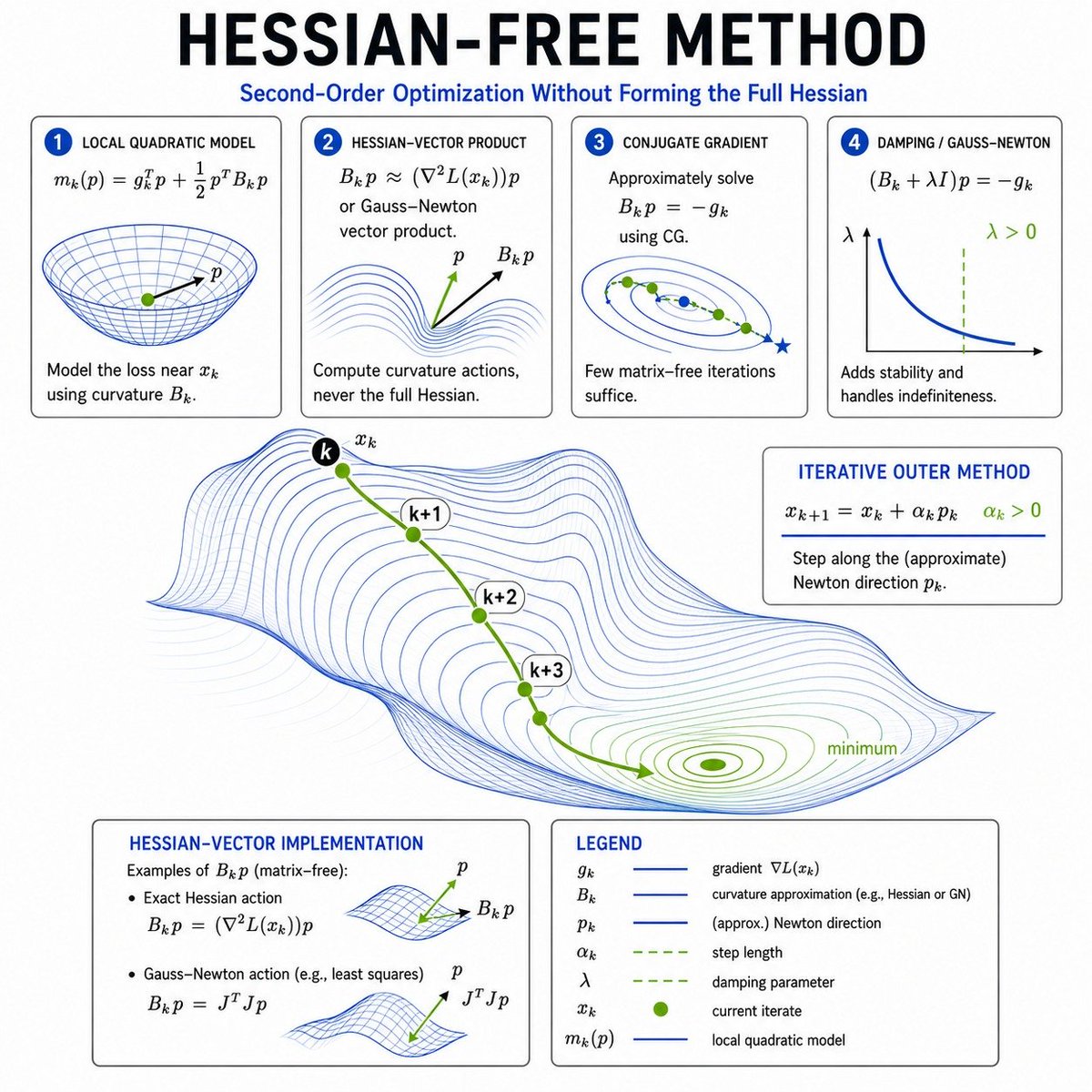
The Hessian-Free method provides second-order optimization without the massive memory cost of forming a full Hessian matrix. Instead of computing the entire matrix, it calculates the Hessian-vector product directly: B_k p = (∇²L(x_k)) p. It builds a local quadratic model and uses a conjugate gradient with a damping parameter to stabilize the step direction: (B_k + λI)p = -g_k. The model then updates its position along the approximated Newton direction: x_k+1 = x_k + α_k p_k. This approach bypasses extreme computational bottlenecks while still navigating complex loss landscapes efficiently.
matharium tweet media
English
0
1
4
257
matharium
matharium@matharium·
A Pringle slides through a letterbox. That is geometry, not luck. The crisp is a hyperbolic paraboloid, z = x^2 - y^2, and through every point run two straight lines. Turn it until one family lies flat and the saddle posts straight through.
English
1
2
18
2.9K
matharium
matharium@matharium·
2/ The faint squares are snapshots of the bugs' positions at equal time steps. In theory each bug spirals around the center infinitely many times before the collision yet the total path length stays finite.
English
0
0
2
79
matharium
matharium@matharium·
1/ Why exactly one side-length: by symmetry the bugs always sit at the corners of a shrinking, rotating square, so each bug's target moves at right angles to the line of sight. Running toward it closes the gap at full speed the whole way as if the target never moved at all.
English
1
0
1
95
matharium
matharium@matharium·
Four bugs start at the corners of a square. Each walk at constant speed, always aiming directly at the next. The paths they trace are logarithmic spirals and each bug walks exactly one side-length of the square before they all collide at the center.
English
1
1
34
4.3K
matharium
matharium@matharium·
Is this maze solvable? Hang it by the top corners and find out. The walls are all that holds the sheet together. A path from top to bottom cuts them in two, so the maze falls open. If it stays whole, no path exists. Connectivity, answered by gravity.
English
1
0
10
2K
matharium
matharium@matharium·
2/ Ernst Chladni toured Europe drawing these figures with a violin bow in the 1780s. Napoleon put up a prize for a theory to explain them; it was won by Sophie Germain in 1816.
English
0
0
1
75
matharium
matharium@matharium·
1/ Each resonance shakes the plate in a standing wave like cos(mπx) cos(nπy) ± cos(nπx) cos(mπy). The sand settles on the nodal lines, where this expression equals zero, the only places that never move.
English
1
0
1
86
matharium
matharium@matharium·
Sprinkle sand on a vibrating plate and it is thrown off the loud regions, gathering along the lines where the plate stays perfectly still. As the tone climbs through the resonances, the silent lines rearrange and the sand redraws the pattern by itself.
English
3
2
24
2.3K
matharium
matharium@matharium·
A Pringle slides through a letterbox. That is geometry, not luck. The crisp is a hyperbolic paraboloid, z = x^2 - y^2, and through every point run two straight lines. Turn it until one family lies flat and the saddle posts straight through.
English
1
2
18
1.9K
matharium
matharium@matharium·
Four ink screens, slightly rotated, and the page turns. Cyan, magenta, yellow and black each print as a grid of dots. Overlay two at a small angle and the beat draws a pattern larger than either, one nobody printed. Print shops fight this.
English
5
7
64
9.7K
matharium
matharium@matharium·
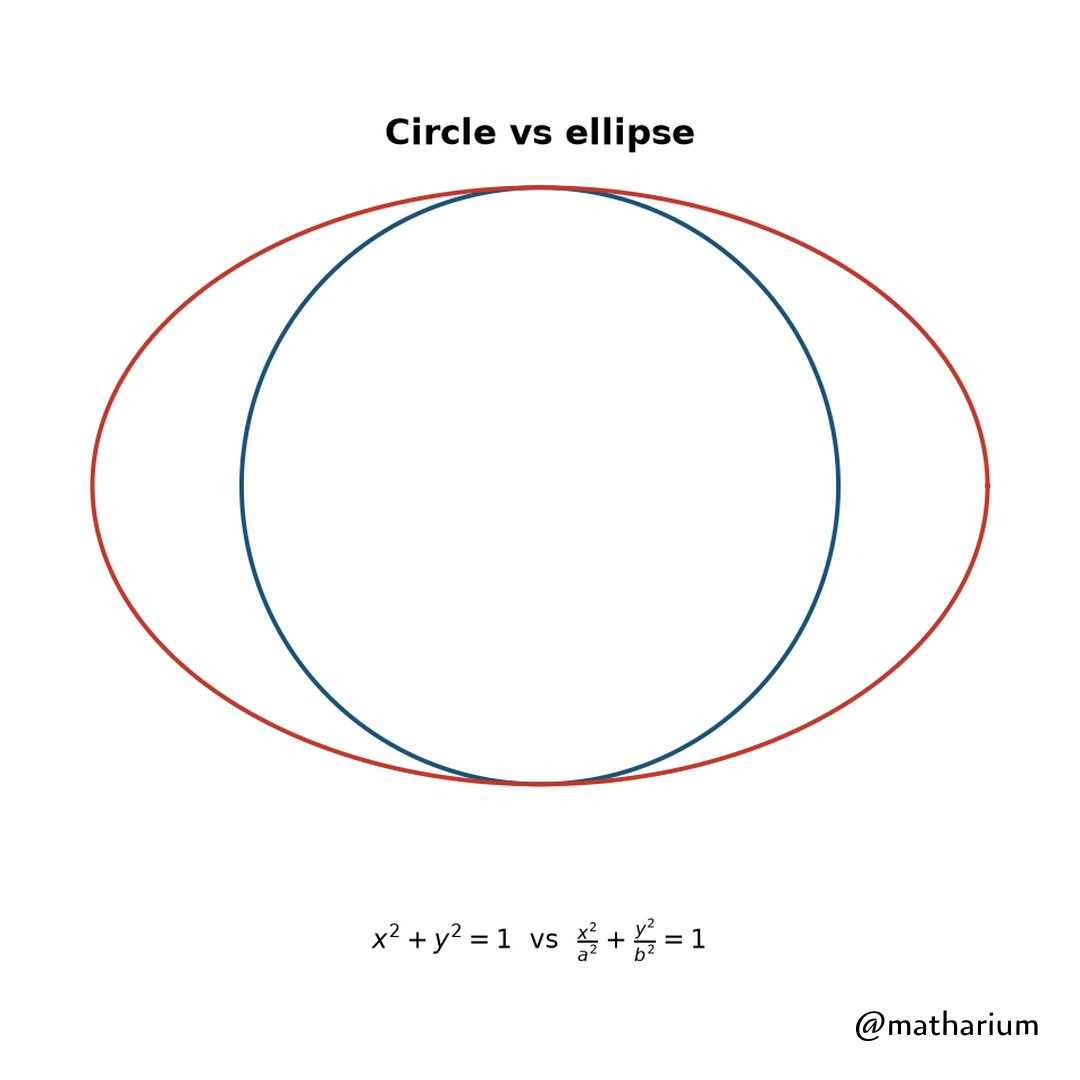
A circle is the special ellipse with equal semi-axes. Standard form: x²/a² + y²/b² = 1. If a = b you recover a circle. Eccentricity measures the flattening. Planetary orbits (approx. ellipses) and elliptical gears.
matharium tweet media
English
1
1
4
1.1K
matharium
matharium@matharium·
In 1963 Stanislaw Ulam sat through a dull talk, doodled the integers in a square spiral, and circled the primes. They gathered along diagonal lines, and they still do. Every diagonal corresponds to a quadratic polynomial, and some, like Euler's n squared plus n plus 41, are astonishingly rich in primes. Nobody has fully explained why. Here the spiral rebuilds itself out to 62,500 numbers.
English
0
1
11
1.4K
Dale
Dale@Conscious_Quark·
@matharium Very cool! Fascinating such a complex structure starts with a simple quadratic: Zn+1=Zn^2+C The Mandelbrot set is all values of c where the sequence remains bounded.
English
1
0
1
51
matharium
matharium@matharium·
Every value of c owns a private fractal called a Julia set: the starting points z where iterating z squared plus c never escapes. Here c travels once around a circle of radius 0.7885 and the fractal reshapes itself the whole way. While c sits inside the Mandelbrot set, its Julia set is one connected piece. The moment c steps outside; it shatters into disconnected dust.
English
2
2
23
3.2K
matharium
matharium@matharium·
Algebra symbols provide a universal way to express mathematical concepts clearly. Common ones shown include: ≜ for equivalence by definition, ≡ for equivalence, ∝ for proportional to, ⌊ ⌋ and ⌈ ⌉ for floor and ceiling, f(x) and f ∘ g for functions, (a,b) and [a,b] for intervals, Δ for the discriminant, ∑ and ∏ for sums and products, ∞ for infinity, constants e, γ, φ and π, { } for sets, ∀ and ∃ for quantifiers, and powers and roots. These symbols are used to formulate equations in scientific research and software development for accurate computations.
matharium tweet media
English
0
1
10
2K
matharium
matharium@matharium·
The dumbest way to solve a maze, and it works every time. Release thousands of particles at the entrance and let each random walk. The first to stumble out has traced a legal path. Retrace its steps and the answer is there. Diffusion, not thinking.
English
158
184
2.1K
720.5K
matharium
matharium@matharium·
Give every pixel a Pokemon type, then let it fight its neighbours. Fire beats grass, grass beats water, water beats fire. That loop has no winner, so no colour ever owns the grid. Domains swell, collide, and get eaten from behind.
English
151
596
8.1K
1.7M
matharium
matharium@matharium·
Five balls, five notes of the Hirajoshi scale, one hidden clock. Each sphere bounces at its own rate: C, D, Eb, G, Ab. The rhythms drift into scatter, then every phase lines up and the trails snap into one pattern. Ratios keep time.
English
0
4
32
2.4K