Matt Duff
107 posts


Matt Duff
@mattcduff
Building AI things that sometimes work.
Katılım Ekim 2015
158 Takip Edilen112 Takipçiler

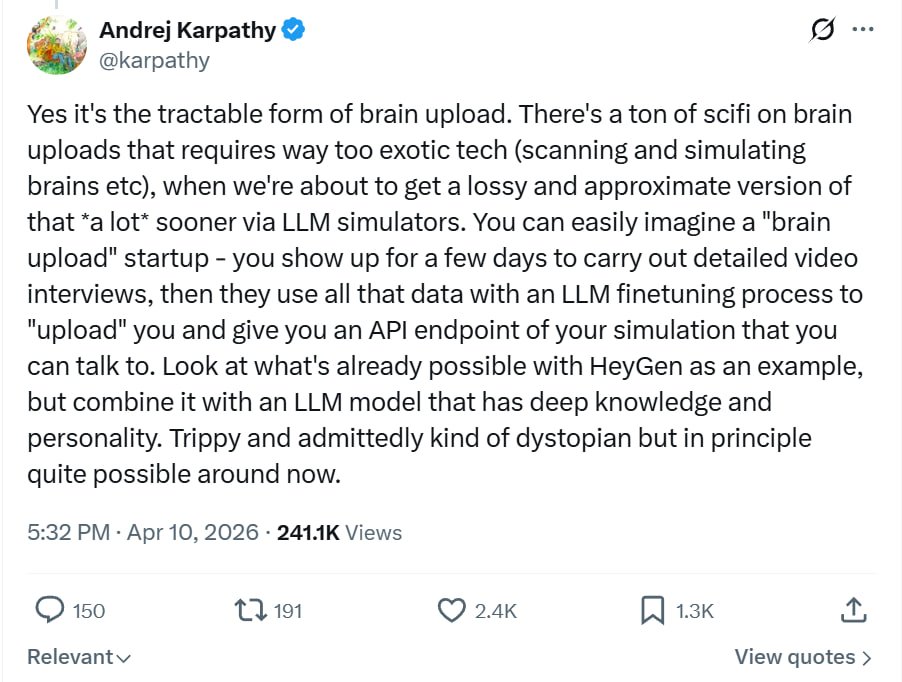
🚨 Karpathy just dropped a blueprint on how to clone your brain in 2026
most people read this and think "cool scifi, see you in 2040"
reality check.. every tool Karpathy describes is already online, you just have to connect the dots
By the end, you'll know how to:
- capture your mind into structured data
- fine-tune an LLM that thinks like you
- give it your face, voice, and personality
- ship it as an API anyone can talk to
So, let's discuss your roadmap step by step
Step 1: Data Dump
the biggest mistake most people make is trying to "write" their personality into a prompt
that's not cloning. that's cosplay
instead you should:
- record 20-40 hours of you talking (solo monologues + interviews)
- dump every tweet, dm, email, voice note, blog post you ever wrote
- journal for 2 weeks on HOW you make decisions, not just what you decide
- record yourself reacting to random content in real time
the goal isn't quantity.. it's capturing the reasoning patterns behind your words
——————
Step 2: Structure the Brain
raw data is useless. you need to turn it into training pairs
instead you should:
- transcribe everything with Whisper
- use Claude or GPT to extract Q/A pairs from your interviews
- label each response with context: mood, topic, audience
- separate "public voice" from "private voice" datasets
this is the part 99% of people will skip.. and this is exactly why their clone will sound generic
——————
Step 3: Fine-tune Your LLM
you don't need to train a model from scratch. you just need to bend an existing one toward you
instead you should:
- start with Llama 3.3 or Qwen 2.5 as the base
- run LoRA fine-tune on your Q/A dataset (Unsloth makes this free on Colab)
- test it against a held-out set of your real responses
- iterate until it hits 80%+ similarity on style and reasoning
if you can't afford the compute.. use OpenAI's fine-tuning API on gpt-4o-mini for under $50
——————
Step 4: Give It a Face and Voice
text-only clone is mid. the real unlock is multimodal
instead you should:
- clone your voice with ElevenLabs (3 min of audio is enough)
- build your avatar with HeyGen or Synthesia (30 min of video)
- connect the fine-tuned LLM output to voice → avatar pipeline
- add a lip-sync layer so it actually feels like you
——————
Step 5: Wrap It in an Agent
a clone that just replies to prompts is a toy. a clone with memory and tools is a product
instead you should:
- give it a vector DB of everything you've ever said
- add RAG so it can pull your real opinions on any topic
- plug in tools: email, calendar, twitter, stripe
- deploy behind an API endpoint your clients/audience can actually talk to
——————
Step 6: Ship It As a Startup
Karpathy literally gave you the pitch deck in one tweet
instead you should:
- niche down: don't clone everyone.. clone coaches, lawyers, therapists, creators
- charge $5-20k per upload, recurring for hosting
- offer tiers: text-only, voice, video, full agent
- first 10 clients will literally be people you already know
the market is creators who want to scale themselves and experts who want to outlive their own attention
this isn't a 2030 bet anymore.. every piece of this stack works today
@karpathy is right.. the lossy version of brain upload is shipping this year
the only question is whether you're the one building it.. or the one being cloned by someone else
save this so you don't lose it
gl
English
BONUS: Perhaps most exciting!
Now that your state is logged over time, against fixed events, you’ve built a map of how your perception evolves. You can ask Claude to look back & see how you changed in relationship to what happened around you, identify patterns & apply frameworks
English
The trick is to keep these explicitly separate. Events go in as immutable records, and your internal state goes in as a rolling log.
THEN, when the LLM queries your wiki, it first retrieves and applies your most recent internal state as its lense. Now the LLM sees what you see.
English
If you’re building @karpathy’s personal wiki right now, do this to avoid MASSIVE headaches:
Tell your Claude to interview you & log your internal state every time you make a wiki entry. E.g Your priorities, how you see key relationships, what matters to you right now.
Why?
English
The TL;DR -
1. As fragmentation increases, our ability to map behaviour to module relationships grows exponentially.
2. This high-resolution combined with the cognition protocol, enables true granular control. We can precisely regulate which cognitive pathways the AI can use.
English
The mechanism -
1. Managed Fragmentation reveals which modules drive what behaviours
2. Cognition protocols let us gate which regions can "talk"
3. More fragments = higher resolution behavioural mapping
4. The ability to shut off the "overconfident risk assessment" cluster
English
Key insights:
1. As fragmentation increases, our ability to map behaviour to module relationships grows exponentially.
2. This high-resolution combined with the cognition protocol, enables true granular control. We can precisely regulate which cognitive pathways the AI can use.
English
The mechanism:
1. "Managed Fragmentation" reveals which modules drive what behaviours
2. "Cognition protocols" let us gate which regions can "talk"
3. More fragments = higher resolution behavioural mapping
4. We can literally shut off the "overconfident risk assessment" cluster.
English
@gav_clayton Keen to see a video covering what comes together with this system!
English

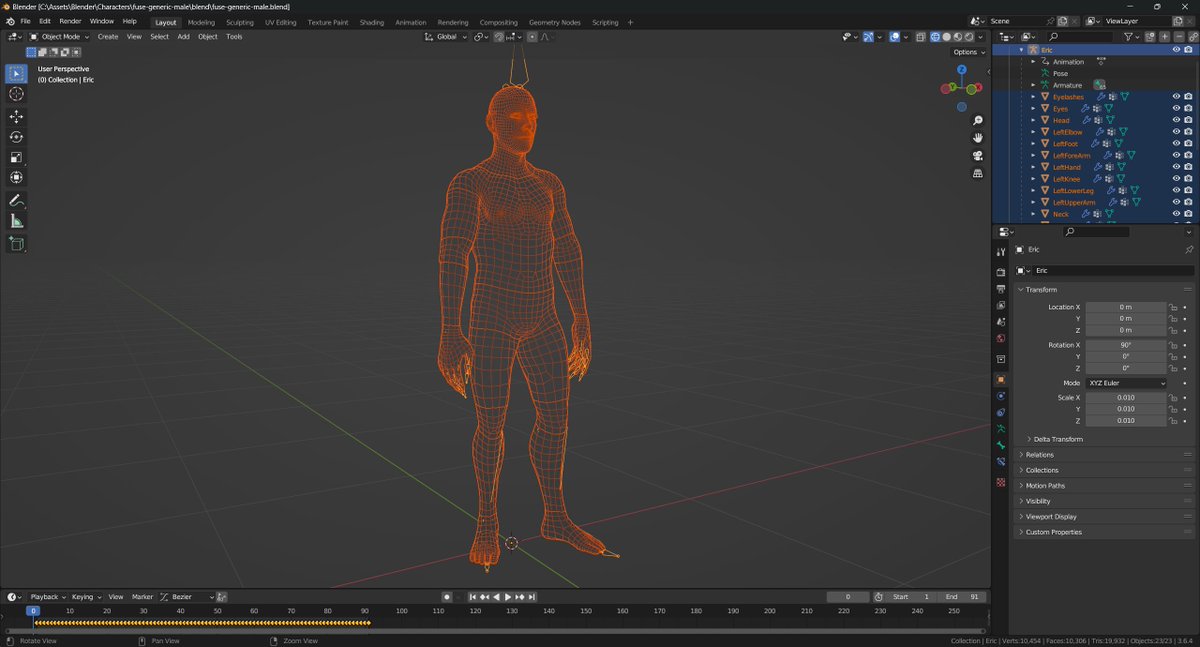
This is Generic Eric, he's a rigged fuse model I've chopped up into a bunch of separate pieces all with their own nice little UV islands. He'll be my prototype character as I work through different parts of the avatar problem space.
English
@VictorTaelin Give us some context 🙌 - that’s a big number depending on the def of rewrite…
English