Max Kan
29 posts


@dwarkesh_sp @dylan522p @dylan522p if H100s are worth $2.40/hr today and newer chips are potentially over 100x better for frontier workloads (FP4, MoE, long context, etc) per InferenceX, why isn't Nvidia raising the price of Rubin?
English

.@dylan522p gives a deep dive on the 3 big bottlenecks to scaling AI compute: logic, memory, and power.
And walks through the economics of labs, hyperscalers, foundries, and fab equipment manufacturers.
Learned a ton about every single level of the stack.
0:00:00 – Why an H100 is worth more today than 3 years ago
0:24:52 – Nvidia secured TSMC allocation early; Google is getting squeezed
0:34:34 – ASML will be the #1 constraint for AI compute scaling by 2030
0:56:06 – Can’t we just use TSMC’s older fabs?
1:05:56 – When will China outscale the West in semis?
1:16:20 – The enormous incoming memory crunch
1:42:53 – Scaling power in the US will not be a problem
1:55:03 – Space GPUs aren't happening this decade
2:14:26 – Why aren’t more hedge funds making the AGI trade?
2:18:49 – Will TSMC kick Apple out from N2?
2:24:35 – Robots and Taiwan risk
Look up Dwarkesh Podcast on YouTube, Apple Podcasts, or Spotify. Enjoy!
English

The reason you can just do things is most of them don't involve inviting Mike Tyson to punch you in the face.
Nate Silver@NateSilver538
"You can just do things" is basically the same heuristic as "Everyone has a plan until they get punched in the face" except for people who haven't been punched in the face yet.
English

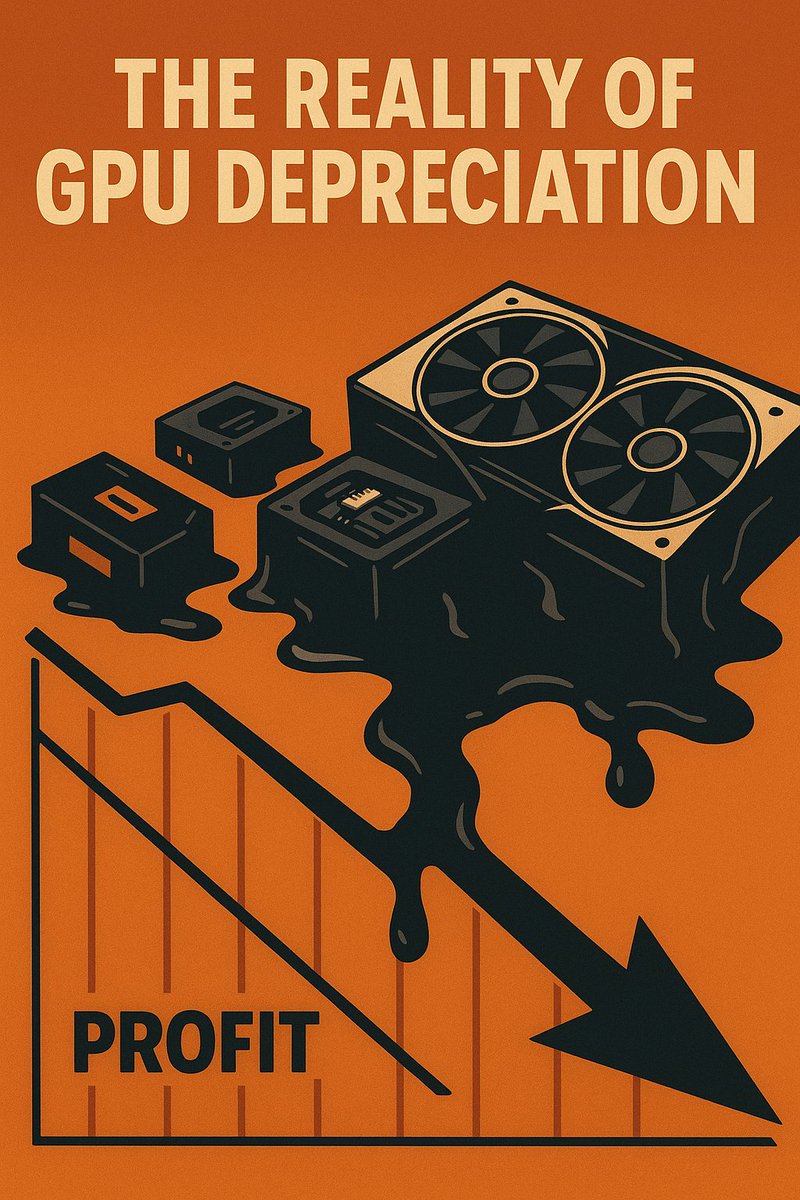
Thanks to Mr. Burry, depreciation seems to be the hot new debate topic, so here’s some additional thoughts from someone who buys and runs the hardware:
Depreciation ≠ Useful Life.
Depreciation is an accounting schedule that accounts for how you're going to pay back the hardware. Depreciation itself says nothing about how long an H100 remains useful. Hardware can run for a decade, the profit window is what’s shrinking faster than ever. You buy $5M of GPUs, depreciate over ~6 years, and that $833K/yr quietly drags down profit whether the hardware is running full tilt or sitting idle.
$5M / $30k = ~150 GPUs
$2 * 150 * 8760 = $2.6M
$2.6M - $833K = $1.8M potential revenue / yr
That $2 goes down by $0.50 every time there is a new release or new cloud comes online. This cuts into profits. Factor in idle / free time, OPEX (staff, offices, data centers, insurance, certifications, licenses, etc.) and those margins turn negative very quickly.
Side note: You wouldn't believe how many very well funded startups come to me asking for free / discounted compute and then get mad at me and go elsewhere when I say no. WTF!
Revenue ≠ Profit.
Fact is that clouds are losing money every hour of every day. Depreciation guarantees that. Companies will now try to pull whatever accounting tricks they can in order to remain profitable. Got investment from BigCo to run your cloud? They are likely going to continue propping you up because they don't want to lose face and shake the market up.
Contract Lock-In is a Financial Survival Mechanism.
Clouds take on CAPEX / OPEX and need 1–3 year customer contracts to justify the loans (DDTL). Contracts prove revenue; they do not prove profit. Quality of contracts has no external oversight.
Release Cycles Are Accelerating.
NVIDIA and AMD are shipping new generations faster, and state-of-the-art AI requires the newest hardware. The upgrade treadmill is speeding up while margins shrink.
There’s More Hardware Than Users.
Everyone's buying GPUs and trying to rent them out and we have an ever increasing supply of "old" hardware. Reality is that spare capacity is everywhere. Idle hardware still depreciates. That’s pure loss, compounding daily.
You Escape Depreciation by:
Lowering costs, and / or raising prices. Neither are happening today because competition and the hardware cadence is endless.
This Looks a Lot Like 2007 Subprime.
Banks and VCs are funding DDTLs under the assumption that the contracts are solid and that the hardware can be resold if things go sideways. Much like they thought they could trust the lenders to have solid contracts and also their ability to sell the houses. Sure, that works for the big players with rock-solid contracts. For everyone else… this is shaky AF.
The Resale Safety Net Is an Illusion.
If waves of hardware hit secondary markets, prices collapse (just like houses). Everyone who thought they could “just sell the GPUs later” discovers they’re holding fully-functional hardware nobody can profit from. If other more experienced players couldn’t make it profitable, why would you?
I know this comes off a bit heavy. That’s not the point. I’m actually quite optimistic for my own business. I see a path forward. I just don’t want to spell it out yet in public. You’ll have to watch what we build over the long term. Maybe it works, maybe it doesn’t. Time will tell.

English

Was never able to fully shake the nagging feeling that RLHF + SFT on CoT data + Mercor’s humans expert evals were once again ignoring the hard-won Bitter Lesson.
Who better than Richard Sutton and David Silver to so clearly pinpoint the limitations of these methods and outline a pure RL path to superintelligence.
Welcome to the era of experience
English