

Max
6K posts

Max
@MaxScore
building machines that understand what they see | @manakoai | @webuildscore ⎸ sire ⎸ opinions are my own
Paris, France Katılım Ağustos 2017
2.8K Takip Edilen5.7K Takipçiler

English
anyone can mine anything now.
point it at a subnet repo. it figures out the rest.
all you need is a chatgpt or claude account and some compute. no ML engineering.
works on @kaggle, @bittensor, @tigfoundation, @crunchDAO, your own local runs...
you point it at a goal or a frontier and it works autonomously to break it.
no ML background needed. you connect an llm (chatgpt, claude) and any compute (@lium_io, @chutes_ai, @runpod...). that's it.
i'm not building this to farm $TAO. i'm building it to work on RSI.
open source it? saas? genuinely asking.
English
English
English

English
@CryptoZPunisher @Pop_Collapse @MarsSmuff @kaggle @bittensor @tigfoundation @crunchDAO i’ll record a video for you when i release this
English

@Pop_Collapse @MaxScore @MarsSmuff @kaggle @bittensor @tigfoundation @crunchDAO You're just like me, we have no technical background. Hopefully one day an expert will sit down in front of their computer and literally guide us through every single step, from start to finish, as if we were complete beginners.
English
@Pop_Collapse @MarsSmuff @kaggle @bittensor @tigfoundation @crunchDAO no you literally just have to paste the link to a repo and it gets it and starts working on breaking the frontier (becoming the winning miner in your case)
English

@MaxScore @MarsSmuff @kaggle @bittensor @tigfoundation @crunchDAO Is there a larger breakdown of how to do this?
Point what at a subnet repo? 😂
This is the level I’m starting at….
English
how it works:
it starts in divergence mode. it attacks the frontier from as many different angles as it can, and the runs don't see each other. that's on purpose. if they share context they all converge on the same obvious idea and you get one approach, not six.
then it switches to convergence mode. once it has enough approaches that are actually different, it stops inventing and starts combining them.
single approaches overfit. combined ones hold up on data they've never seen.
English
@richdotca all subnets should be doing this (i mean apart from distillation if it's not he right process for them)
English

@MaxScore Am I correct to say that 44's objective is to build:
-the best distillation pipeline,
-proprietary industrial datasets,
-deployment tooling,
-enterprise integrations,
-continuous improvement through the subnet,
-and a business model that captures value from all of that?
English
@richdotca nope it will help our development, the more available intelligence the better as we rune a distillery AND general models are not good at what we do as our lead ai engineer said it brilliantly:
cryptolake@crypt0lake
this is the difference between specialized intelligence and general intelligence this is why i love distillation and why we are a building a web of smaller models that chain together depending on your use case
English
Open Weights and A̶m̶e̶r̶i̶c̶a̶n̶ Human AI Leadership
Jensen Huang@JensenHuang
For my first post, I’m sharing a letter @NVIDIA signed on why open models matter. AI will transform every industry, power every company, and be built by every country. Open models strengthen safety and cybersecurity, accelerate innovation and diffusion, and enable sovereignty. The world needs both frontier closed models and frontier open models. images.nvidia.com/pdf/Open-Weigh…
Español

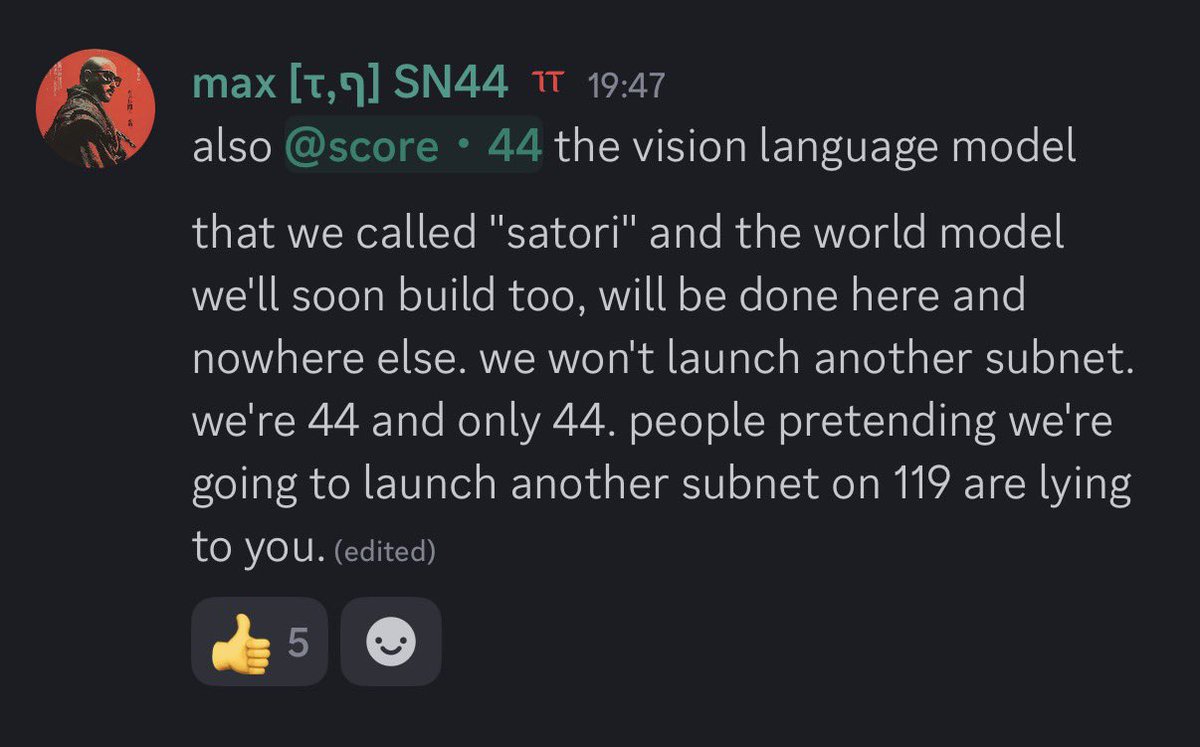
@MaxScore 1 SN and all the way + Deals with other SNs = that’s the way 👏
SNs (1 Team) starting more and more SNs always smells …
i am happy Max sticks to the vision /mission
🤝
English


if you ever thought that vision intelligence is already solved, and that frontier LLMs are good enough to cover real world use cases, watch this:
youtu.be/EVaSMVDx9Y0?si…

YouTube
English