Hugo | Radius retweetledi
Hugo | Radius
62 posts

Hugo | Radius
@meveloper
Research Engineer @radius_xyz
Seoul Katılım Temmuz 2025
111 Takip Edilen26 Takipçiler
Hugo | Radius retweetledi

This Chinese guy created agents in Claude Code for landing pages and single-handedly serves 47 small businesses a month, taking $400 from each.
He built a system of 7 agents on Claude Sonnet 4.6 that analyzes Google Maps in small towns, finds small businesses without websites there, and over 1 weekend takes each one to a finished mockup with video and cold message.
No assistant, no sales team, no SDR. Just him, a MacBook, an iPhone, and 1 API key.
And traditional web design agencies keep teams of 8 people on salary for the same order flow, while his expenses are only tokens and subscriptions to Lovable, Higgsfield, and Calendly.
7 agents work through 1 orchestrator on Claude Code Router. Usage is about 3 million tokens a day, the average API bill is about $480 a month.
All 7 go through MCP servers and write shared state to the file system, without shared state in memory and without race conditions, and 1 of them lives right in the iPhone and picks up positive replies from the subway, a taxi, or on walks.
And here is the system prompt he put into the orchestrator before launch:
"You are the orchestrator of a solo agency that sells ready-made websites to local businesses. You delegate read-only tasks to 6 sub-agents and own all writes.
sub-agents:
// Scout (walks through Google Maps in selected cities, looks for narrow niches: 5+ years on the map, fewer than 50 reviews, no website or a website from 2014, but high ratings)
// Diagnoser (for each lead writes a 50-word diagnosis, hero angle, tone matched to the industry, and a cold message under 70 words)
// Builder (generates a landing page mockup in Lovable through MCP only for the top 5 leads per day, with the sharpest diagnoses and the biggest gap)
// Filmer (pulls 5 screenshots of the mockup and through Higgsfield renders a 10-second vertical video 1080x1920 with a soft zoom)
// Pitcher (sends a personalized cold message through the right channel for the niche: email to roofers, SMS to tradesmen, IG DM to salons, LinkedIn to realtors)
// Checker (runs every message through evals for personalization, absence of AI markers and buzzwords before sending)
// Mobile (lives in the iPhone, handles positive replies in real time, books Zoom calls in Calendly through MCP while the owner is on the go).
You never let 2 sub-agents touch 1 lead. You stop and request approval from the human only when a deal exceeds $3,000 or the reply rate in a niche for the day drops below 12%."
Meaning the system knows what it is and within what boundaries it is allowed to act.
It knows it is supposed to find leads on its own.
It knows it is supposed to take each one to a mockup, video, and cold message without intervention.
It knows the human only steps in when a deal goes above $3,000 or the reply rate stops converging.
→ The system runs 24 hours a day
→ Scout goes through about 220 local businesses on Google Maps per day and leaves 30 new leads in the queue
→ Diagnoser outputs 30 structured diagnoses + briefs + cold messages per day
→ Builder assembles 3 to 5 finished landing pages in Lovable for the sharpest leads
→ Filmer renders a 10-second vertical video in Higgsfield for each one
→ Pitcher sends 30 personalized messages per day across 4 channels with a reply rate of about 14%
→ Checker runs every message through evals before sending
And only when a deal breaks $3,000 or the reply rate for the day drops below 12% does the orchestrator wake the owner.
And when the owner at that moment is sitting in the subway or a taxi, the Mobile agent in his iPhone picks up 1 move on its own: replies to a fresh positive reply from a dentist, books a Zoom through Calendly synced to the local time of the client, and puts the lead back in the queue. The owner only has to tap "approve" and in just 10 minutes join the call.
Here is what the system writes in his log during 1 of the Saturdays:
"scout report: 218 businesses checked in Austin, Denver, and Miami, 34 without a website, 19 with a website from 2014, 6 with an active redesign request in reviews. passing top 30 to diagnoser."
"pitcher: 30 cold messages sent across 4 channels, 14 replies, 5 positive, 3 Zoom calls booked for Sunday. passing to closer."
"builder: landing page for Westside Cosmetic Dentistry built in Lovable, 5 sections, mobile, soft beige. URL placed at /Users/dev/maps-agency/clients/westside/v1. filmer launching Higgsfield."
"eval flag: deal with The Lotus Salon at $3,400 exceeds the approved limit of $3,000. sending for manual review."
He has no server of his own and no separate backend.
Just a local file sandbox at /Users/dev/maps-agency, an MCP router, 1 API key to Claude, and the same key forwarded to Claude Code on his iPhone.
Out of everything I have seen this year, this is the cleanest one-person agency for selling websites to small businesses: $480 a month on the API, about $18,800 into the account, and between them 7 prompts, 1 file system, and 1 phone in the pocket.
timbidefi@timbidefi
English
Hugo | Radius retweetledi

Radius is partnering with @superbridge to bring @signetsh → @ethereum bridging in the next phase of Signet.
Users will be able to bridge via Superbridge, with execution powered by the Radius Solver. ✨
English
Hugo | Radius retweetledi

Moving rollups forward is getting harder — block production turned into a capital game, and bridging still comes with cost + latency.
That’s why we’re partnering with @init4tech 🤝
Radius is officially joining @signetsh Protocol as a core builder and solver, helping bring a fairer, more efficient standard to rollup infrastructure.
📍Our focus:
- Fair block production : supporting Signet’s round-robin system so block production isn’t something you can buy.
- Atomic execution: everything succeeds together across Ethereum + Signet — or doesn’t execute at all.
- Solver-driven interoperability : supplying solver liquidity to move value without waiting on heavy proof workflows.
More fairness. Less friction. No Proofs, Just Markets. ⚡️
English
Hugo | Radius retweetledi

Bots are thriving on Polymarket. A fully automated script brings in $80K a week.
The bot makes $80k a week simply because it’s smarter and faster than the rest.
→ Wallet: @Account88888?via=roovxKu" target="_blank" rel="nofollow noopener">polymarket.com/@Account88888?…
A C++ bot made nearly half a million dollars on 15-minute BTC candles. It doesn’t guess the direction.
I was about to scroll past Account88888. "Just another bot, there are hundreds of them," I thought. Usually, a "99% win rate" hides a scam or pure luck.
But I looked deeper. And honestly, I’m shocked. This isn’t luck. It’s math.
While the whole market furiously guesses whether Bitcoin will go UP or DOWN, this guy simply buys BOTH outcomes. In the exact same window.
Sound crazy? Just wait until you see the numbers.
Polymarket offers 15-minute bets. Outcome prices fluctuate with volatility. When chaos sets in, the market becomes inefficient.
Picture this: an "UP" bet costs 48 cents. A "DOWN" bet costs 46 cents.
Together, that’s 94 cents.
But one of the options always pays out $1. Always. Bitcoin will either go up or down. There is no third option.
What does the bot do?
It buys both outcomes for 94 cents.
Waits 15 minutes.
Collects its guaranteed $1.
Pockets 6 cents of pure, risk-free profit.
It doesn’t care about the chart. It doesn’t care about the news. It is "farming" a market inefficiency.
I scrolled through the history: over 10,000 trades. 99% are green. The rare red ones only happened when the spread was too tight to cover the fees.
While everyone else on Polymarket is trying to be right, this bot has made it impossible to be wrong.
The wallet used to be named "JaneStreetIndia," but changed its name to stay under the radar. Money loves silence, I guess.
What do you think about this? Is it genius arbitrage or a broken system?
It seems in 2026, the winner isn't the smartest one, but the one who calculates the best.

Blaze@browomo
A C++ bot pulled $329K out of thin air by exploiting the same price gap over and over again. I stumbled across the wallet “distinct-baguette” on a Polymarket leaderboard and, honestly, I almost closed the tab. Its stats looked off: the win rate was hovering around 71-80%, which usually spells disaster for high-frequency bots. It just didn't look like a winner. → Account: @distinct-baguette?via=roovxKu" target="_blank" rel="nofollow noopener">polymarket.com/@distinct-bagu…
But then I realized I was looking at it completely backwards. This bot isn't trying to predict the future. It doesn't care if Bitcoin goes up or down, it doesn’t analyze the news, and it definitely doesn't read charts. Instead, it purely hunts for moments where the market's basic math breaks down. On prediction markets, the price of "YES" and "NO" must always equal exactly one dollar. However, when the market moves too fast and liquidity drops, those prices start to slip apart. "YES" might trade at 48 cents while "NO" sits at 49. In that split second, the bot sees an opportunity to buy a guaranteed dollar for just 97 cents. It executes instantly, buying both sides of the bet and locking in that 3-cent profit before the event even resolves. It doesn’t matter who actually wins the bet, because mathematically, the bot has already won the trade. Three cents per trade sounds like nothing. But repeat that tens of thousands of times over a month and a half, and you get $325k in risk-free profit. While 99% of people on Polymarket are playing a casino game trying to guess where the candles will go, this algorithm is just waiting for the order book to fail elementary math. The best edge isn't about being the smartest person in the room. It is about being the most observant. English
Hugo | Radius retweetledi

My @Polymarket bot has reached 54 consecutive wins.
54 trades triggered, 54 wins, 0 losses.
Each trade generates 1.5% of the traded amount.
I coded the logic myself, so I know these 1.5% are guaranteed, but nothing beats testing it in real conditions.
To truly confirm it, I need to go beyond 66 consecutive wins, which should happen in the coming days. But I won’t stop there, I plan to go to 200 consecutive wins to remove any doubt.
For now, I’m only testing, so each trade is $10. After 200 trades, I’ll scale to $1,000 per trade, meaning $15 profit per trade. With an average of 20 trades triggered per day, that’s $300 per day.
No, this isn’t a bot that will generate $1M per month. For now and for me $300 per day is enough, no need to be greedy, I try to scale step by step.
While this runs, I’m working on another strategy that I’m not sure anyone has implemented yet.
You’ll hear more about it soon!
English

@defibobbyz 2/ On the other hand, using a lending protocol introduces borrowing costs, while Sprinter eliminates those costs and shares profits with LPs. Relayers also avoid both borrowing fees and capital rebalancing expenses.
So from a cost perspective, would Sprinter be more efficient?
English

@defibobbyz 1/Does Sprinter’s MPC introduce any signing latency? If so, roughly how many seconds of delay should relayers expect?
Across is FCFS, so relayers need to fill intents immediately. If a relayer uses Sprinter, wouldn’t this be slower than relayers who fill using their own credit?
English

Congrats to @sprinter_ux on the Stash launch! 🎉
This looks like fantastic infrastructure that brings new liquidity to Solvers while giving users an extra yield opportunity. I'm really excited about this!
I have a few questions about the mechanics,
English

@nero_eth Oh, it was a bug.
I thought something serious was happening between validators and builders. Glad to hear it's not.
Thanks for all your work on the pics dashboard!
English

@meveloper Yeah, my parser is struggling to catch up. Trying to fix it
English

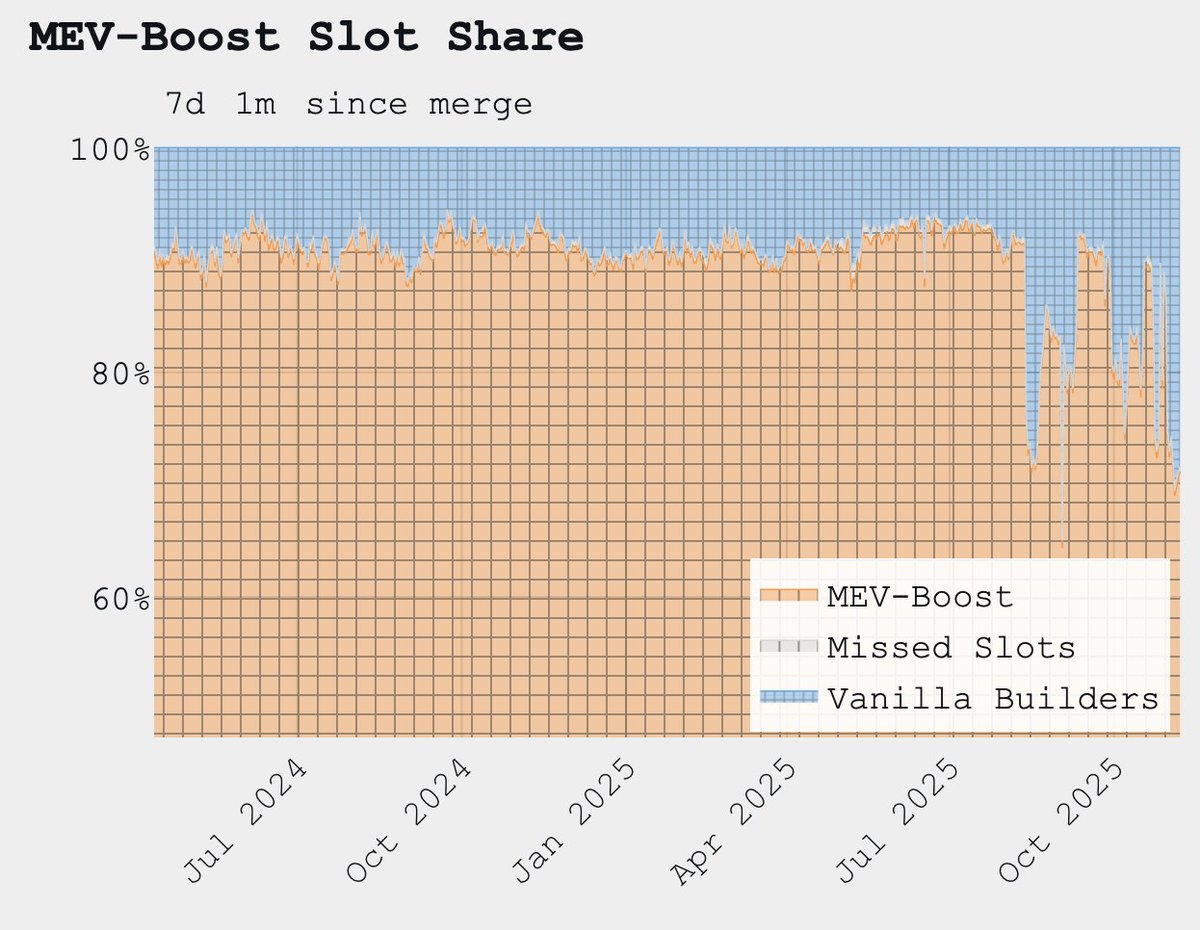
1/ Since @flashbots_x's MEV-Boost launched, over 90% of valdators have used it. But recently that number dropped to around 70%. Does anyone know why this happened?
Could this be because the vertical integration between searchers and builders is now extending to proposers too?

English

5/ Thanks to @nero_eth for the great mevboost pics dashboard!
I’m wondering if this is just a dashboard error or if there’s actually some shift happening on the validator - builder side.
What do you all think?
mevboost.pics
English

@Therain0517 @0xboosik @MMTFinance @orca_so Gamma 라는 프로토콜이 LP 리밸런싱을 자동으로 해주는 Vaults를 운영하고 있습니다! 시간 되실 때 아래 문서 읽어보시면 호기심을 조금? 해결하실 수 있을 것 같아요ㅎㅎ
docs.gamma.xyz/gamma/lp-vault…
한국어

디파이 아는척 해보기! 그러면 CLMM은 왜 나오게 된걸까..? @MMTFinance @orca_so
이번 글에서는 CLMM이 나오게 된 계기 정도만 슬쩍 핥아보겠습니다. CLMM에 대해 이해하려면 글 몇개로도 모자라기 때문에..ㅠㅠ
우선 CPMM 모델에서 유동성 공급을 할 때 가격 범위에 대해 생각해봐야 합니다. 무슨 말이냐... 한번 상황을 생각해보면요.
나에게 지금 100SUI랑 200USDC가 있고, 이걸 풀에다가 공급하고 싶은 상황이에요. 내가 공급한 토큰은 풀에 공급되어, 가격 변화에 따라 공급한 페어의 비율 또한 바뀔 것입니다.
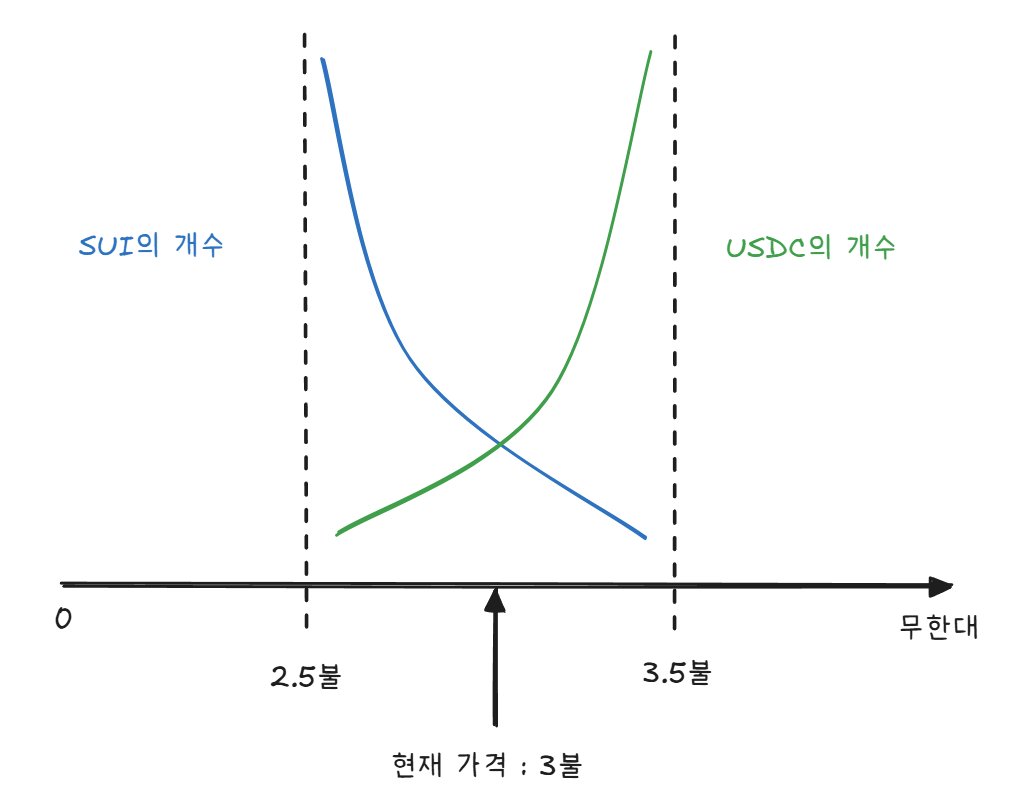
이 비율이 바뀌는 SUI 가격 범위를 생각해보는거죠! 토큰의 페어 비율이 유효한 가격 범위는 SUI의 가격이 0원부터 무한대까지 분포하게됩니다. 아래 그림을 볼까요?
자 이렇게 공급된 유동성은 다른 사람들이 스왑할 때 사용되는 "유동성"으로 사용되고, 내가 공급한 유동성 지분에 맞게 수수료 수익을 얻는데 사용되기도 하죠. 그런데 어떤 사람들은 이런 질문을 할 수도 있어요.
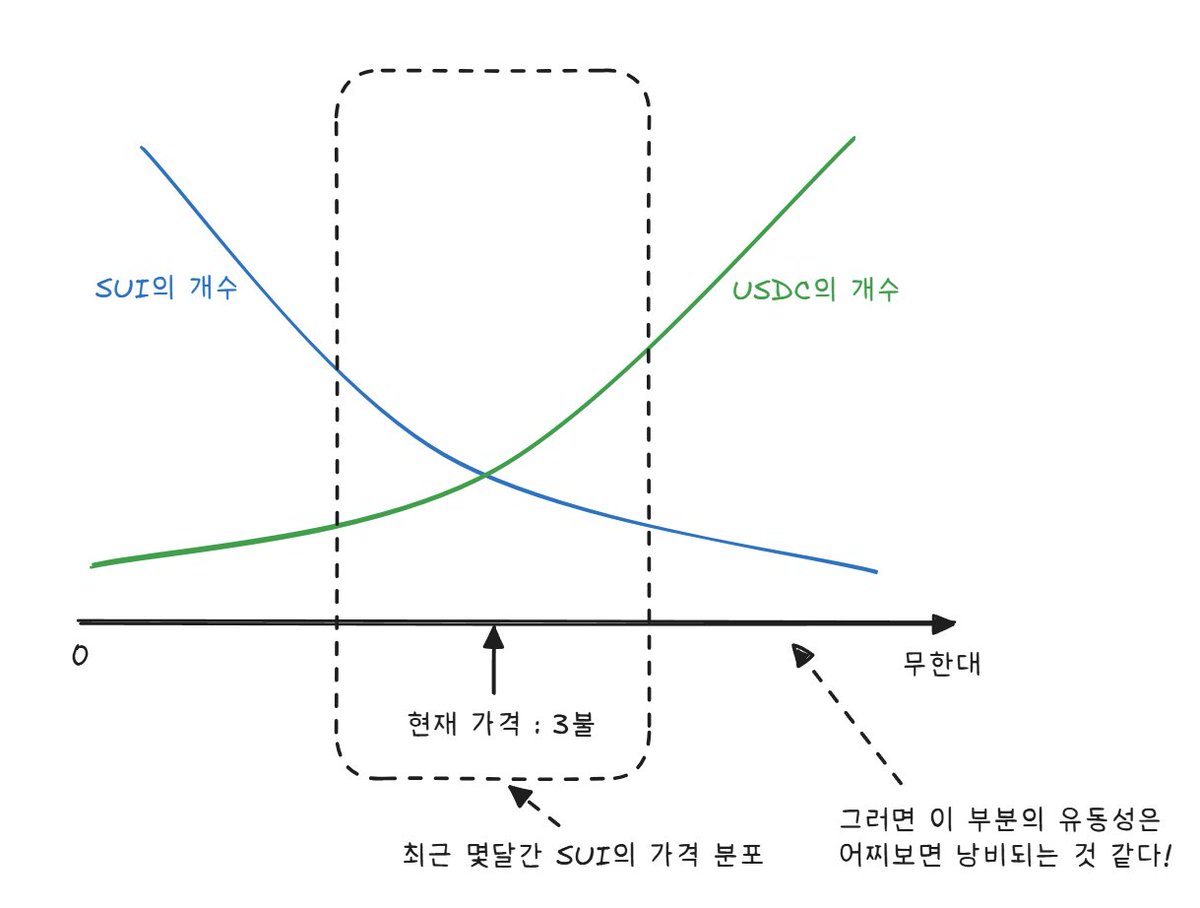
"어차피 SUI가 0원으로 가진 않을 것 같은데... 차라리 지금 가격 범위에만 유동성을 빡세게 제공하고 수수료 수익을 극대화하는건 어때?"
위 그림처럼 유동성을 공급할 수 있을까? 이런 고민을 해보는 거죠. 위와 같이 가격 범위를 정해놓고 유동성을 공급하면 어떤 장/단점이 있을까요?
우선 가장 큰 장점은, 내 자본을 효율적으로 활용할 수 있다는 점이 있습니다. 위에서 든 예처럼 SUI의 가격이 2.5불에서 3.5불 사이에서 크게 벗어나지 않을 것 같다면, 내 유동성을 거기 집중에서 부어버리면 사람들의 SUI-USDC 스왑에 더 많은 지분이 활용될 수 있겠죠.
그에 따라 풀은 유저들에게 더 깊은 유동성을 제공해줄수도 있고, 유저는 더 적은 슬리피지로 거래할 수 있으며, 유동성 공급자는 이자 수익을 극대화하면서도 자기가 바라보는 마켓 상황에 맞춰 유연하게 유동성을 제공할 수 있습니다.
다만 단점은 유동성의 가격 범위가 줄어들기 때문에 IL도 커진다는 단점이 있습니다. 원래는 0원 - 무한대의 가격 범위에 분포되던 유동성의 범위가 더 적은 범위로 제한되기 때문에 IL의 유효 범위도 커지는 것이죠.
따라서 CLMM에 유동성을 공급하는 유저들은 해당 자산의 가격이 내가 공급한 가격 범위를 벗어나지 않는지 계속 체크하고, 필요시 가격 범위를 재조정하거나 유동성을 해제할 필요가 있습니다. 조금 더 하이리스크-하이리턴 매커니즘인 셈이죠.


한국어

@0xboosik @orca_so @MMTFinance 부식님 Orca 예시까지 있어서 이해가 너무 잘돼요 야핑의 순기능인 것 같습니다ㅠ 물론 아직 @MNT가 뭐하는 프로젝트인진 모르겠지만 복습 따라가는 중..!
한국어

DEX 아는척 해보기 @orca_so @MMTFinance : 이자는 어디서 나오는거고?
자 지금까지 글에서 토큰과 스왑, 유동성 공급에 대해 간단히 알아봤습니다. 유동성 공급이란 환전소 금고에 돈을 빌려주는 행위라고 했는데요. 그러면 이 유동성 공급자들은 대체 무엇을 위해 돈을 빌려줄까요?
환전소에서 스왑을 하기 위해서는 수수료를 지불해야 합니다. 초기 DEX에서는 스왑 금액의 0.3%가 국룰이었지만, 생태계가 발전하면서 수수료도 다양하게 설정할 수 있습니다. 흔히 말하는 블루칩 토큰(대표 코인이나 스테이블 코인 등...)의 경우 수수료가 좀 더 저렴한 편입니다.
예를 들어, Orca의 SOL-USDC 풀은 0.04% 라는 저렴한 수수료로 거래할 수 있습니다. Momentum Finance의 SUI-USDC 풀은 0.175% 수수료로 거래할 수 있구요.
그러면 이 수수료는 어떻게 지불하는 걸까요? 정답은 수수료는 지불하는게 아니라, 스왑 시 수수료만큼 차감해서 받게되는 것입니다.
예를 들어, 내가 $10000을 0.3% 풀에서 스왑한다고 하면, $9970 만큼의 토큰을 받게되는 것이죠.
어라 그러면 무슨 일이 일어날까요? 바로 풀 입장에서는 자산의 총량이 늘어나게 됩니다. 왜? 풀은 $10000 만큼의 토큰을 받았는데 $9970 만큼의 토큰을 유저에게 교환해줬으니, $30만큼 늘어난 것이죠.
그리고 유동성 공급자들은 이전 글에서 설명한 LP 토큰이라는 것을 갖고 있죠? LP 토큰은 풀의 유동성에 대한 지분을 의미하는데, 풀의 유동성 자체가 늘어났으니 유동성 공급자들이 취할 수 있는 토큰의 양도 늘어난 것입니다.
그래서 거래가 많이 발생하는 풀에 유동성을 공급하면 대체적으로 이자율이 높게 나오는 것입니다. 메테오라 등에서 LP army를 해보신 분 들은 이를 너무 잘 이해하고 계실거라고 생각합니다만... 이번 기회를 통해 야퍼 여러분들도 DEX 생태계에 대해 더 잘 이해할 수 있길 바랍니다!
한국어