Emeka Chimezie retweetledi

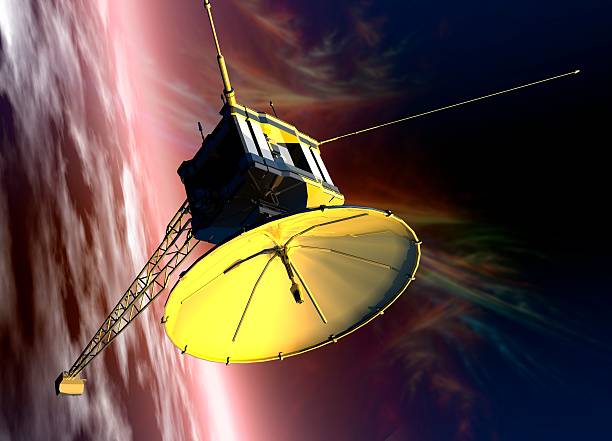
This is Voyager 1, it was launched on Sept 5, 1977 at a speed of 17km/secs (16 days after it's twin, Voyager 2 was launched). It's launch date was specifically selected in order to take advantage of the very rare Syzygy where the planets aligned themselves making it easier to explore them and also for the spacecraft to take advantage of the gravity of the massive planets to sling itself further into space.
It arrived Jupiter on the 5th of March, 1979, providing spectacular images and improving our knowledge of the giant planet. By Nov 1980 it got to Saturn exploring its rings and discovering new moons belonging the planet.
The Voyager 1 is powered by radio-isotope thermoelectric generators. These batteries 🔋built in 1974 are just about enough to power a laptop and charge a phone but has been in use for almost 5 decades now with its power at less than 30% left.
On Aug 25, 2012 Voyager 1 crossed the Heliopause and entered the interstellar space making it the first space craft (and indeed human endeavor) to leave our solar system.
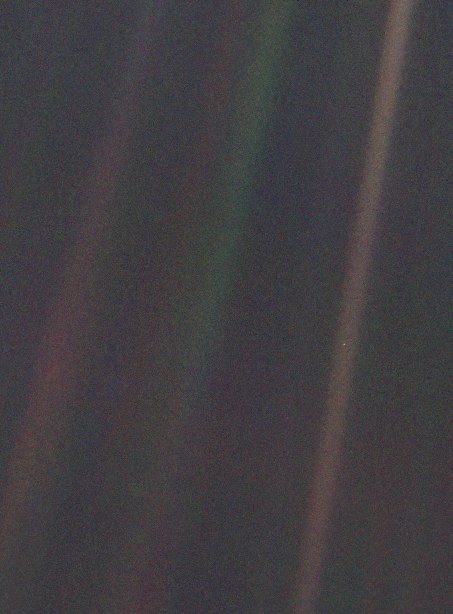
Voyager 1 carries on it, the golden record which is a compilation of a few picture, videos and sounds from different human cultures as a time capsule and message to be picked up by any intelligent organisms out there, telling them about life on earth. As it was about to leave, it was decided that some of its functions be turned off in order to conserve it's battery life but just before turning off it's camera, the operators decided to turn it's lens towards earth for one last selfie, taken at over 6billion kilometers from earth. Frame 2 shows a picture of the earth as that 'pale blue dot'. And as Carl Sagan brilliantly put it, From this distant vantage point, the Earth might not seem of any particular interest. But for us, it's different. Consider again that dot. That's here. That's home. That's us. On it everyone you love, everyone you know, everyone you ever heard of, every human being who ever was, lived out their lives. The aggregate of our joy and suffering, thousands of confident religions, ideologies, and economic doctrines, every hunter and forager, every hero and coward, every creator and destroyer of civilization, every king and peasant, every young couple in love, every mother and father, hopeful child, inventor and explorer, every teacher of morals, every corrupt politician, every "superstar", every "supreme leader", every saint and sinner in the history of our species lived there – on a mote of dust suspended in a sunbeam.
The Earth is a very small stage in a vast cosmic arena. Think of the rivers of blood spilled by all those generals and emperors so that, in glory and triumph, they could become the momentary masters of a fraction of a dot. Think of the endless cruelties visited by the inhabitants of one corner of this pixel on the scarcely distinguishable inhabitants of some other corner, how frequent their misunderstandings, how eager they are to kill one another, how fervent their hatreds. It has been said that astronomy is a humbling and character-building experience. There is perhaps no better demonstration of the folly of human conceits than this distant image of our tiny world. To me, it underscores our responsibility to deal more kindly with one another, and to preserve and cherish the pale blue dot, the only home we've ever known"


English