Marcelo Okano

273 posts

Marcelo Okano banner
Marcelo Okano

Marcelo Okano

@mhokano

IA - Engenharia de Softwares - Produtividade - Empreendedorismo OKN | DiscoverLabs | OpenAI Codex Ambassador https://t.co/cEEcTRhW3I - Codex Meetup São Paulo

São Paulo, Brasil Katılım Aralık 2017
554 Takip Edilen301 Takipçiler
Marcelo Okano
Marcelo Okano@mhokano·
Os melhores devs usando Claude Code não estão só escrevendo prompts. Estão criando sistemas que aprendem com o próprio uso. O artigo mostra uma mudança importante: AI coding agents começam a ganhar ‘memória operacional’. • post-mortems automáticos • self-review noturno via cron • atualização contínua do CLAUDE.md • múltiplos agentes paralelos • workflows que refinam o próprio contexto Isso parece menos ‘pair programming’ e mais um time autônomo de engenharia evoluindo continuamente. towardsdatascience.com/how-i-continua…
Português
0
0
1
20
Marcelo Okano
Marcelo Okano@mhokano·
Tokenização virou uma das partes mais subestimadas do RAG moderno. O novo post da Weaviate mostra que, em hybrid search, embeddings não salvam um BM25 mal tokenizado. Se o analyzer quebra "café crème", "Łódź" ou "v1.37" da forma errada, a busca lexical vira ruído — e o recall despenca, principalmente em ambientes multilíngues. O foco agora está em: accent folding stopwords por propriedade tokenizers customizados observabilidade do pipeline de análise textual Em RAG, qualidade de retrieval começa antes do embedding. weaviate.io/blog/tokenizat…
Português
0
0
0
22
Marcelo Okano
Marcelo Okano@mhokano·
A era dos “AI Agents” corporativos começou de verdade. A NVIDIA já colocou o Codex com GPT-5.5 para mais de 10 mil funcionários — engenharia, jurídico, RH e finanças — rodando em GB200 NVL72. Resultado: debug de dias virou horas, experimentos de semanas viraram overnight, e o custo por token caiu drasticamente. Não é mais só chatbot. É IA executando trabalho real dentro da empresa. blogs.nvidia.com/blog/openai-co…
Português
0
0
0
18
Marcelo Okano
Marcelo Okano@mhokano·
A nova guerra da IA não é mais sobre FLOPS. É sobre custo por token. A NVIDIA está empurrando a ideia de “AI Factories”: datacenters otimizados para produzir inteligência no menor custo possível por token gerado — combinando hardware, rede, memória e software em um único stack. O foco muda de potência bruta para eficiência real de inferência. blogs.nvidia.com/blog/lowest-to…
Português
0
0
0
20
Marcelo Okano retweetledi
Vaibhav (VB) Srivastav
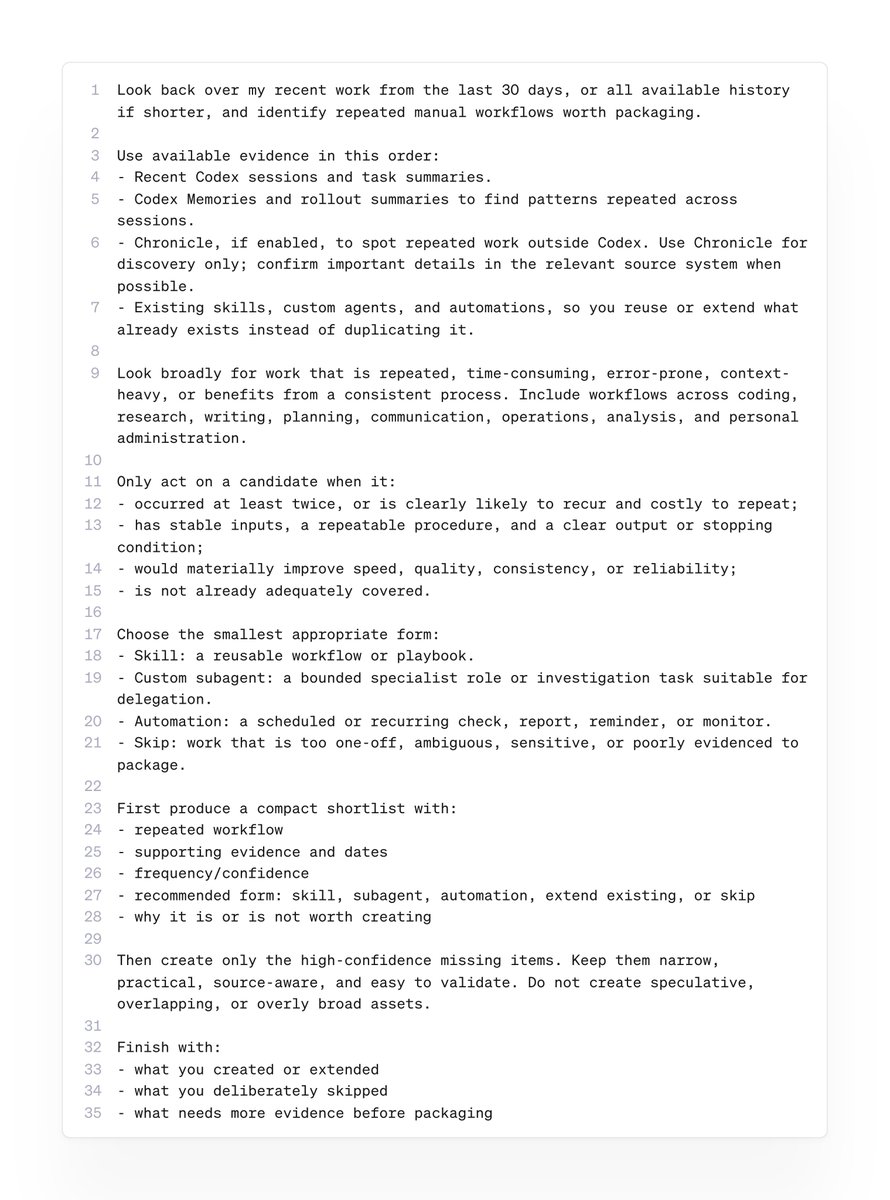
UPDATE: Came up with an even better version of this prompt after the feedback Ask Codex to look across your sessions, Memories, and Chronicle, identify patterns, reuse what already exists, and only create the smallest useful skill, subagent, or automation. "Look back over my recent work from the last 30 days, or all available history if shorter, and identify repeated manual workflows worth packaging. Use available evidence in this order: - Recent Codex sessions and task summaries. - Codex Memories and rollout summaries to find patterns repeated across sessions. - Chronicle, if enabled, to spot repeated work outside Codex. Use Chronicle for discovery only; confirm important details in the relevant source system when possible. - Existing skills, custom agents, and automations, so you reuse or extend what already exists instead of duplicating it. Look broadly for work that is repeated, time-consuming, error-prone, context-heavy, or benefits from a consistent process. Include workflows across coding, research, writing, planning, communication, operations, analysis, and personal administration. Only act on a candidate when it: - occurred at least twice, or is clearly likely to recur and costly to repeat; - has stable inputs, a repeatable procedure, and a clear output or stopping condition; - would materially improve speed, quality, consistency, or reliability; - is not already adequately covered. Choose the smallest appropriate form: - Skill: a reusable workflow or playbook. - Custom subagent: a bounded specialist role or investigation task suitable for delegation. - Automation: a scheduled or recurring check, report, reminder, or monitor. - Skip: work that is too one-off, ambiguous, sensitive, or poorly evidenced to package. First produce a compact shortlist with: - repeated workflow - supporting evidence and dates - frequency/confidence - recommended form: skill, subagent, automation, extend existing, or skip - why it is or is not worth creating Then create only the high-confidence missing items. Keep them narrow, practical, source-aware, and easy to validate. Do not create speculative, overlapping, or overly broad assets. Finish with: - what you created or extended - what you deliberately skipped - what needs more evidence before packaging"
Vaibhav (VB) Srivastav tweet media
Vaibhav (VB) Srivastav@reach_vb

Copy and paste this into your codex: “Look through my recent Codex sessions and identify repeated workflows or repeated asks. For anything I keep doing manually, suggest: 1. a skill if it is a reusable workflow 2. a custom subagent if it is a bounded role or investigation task Focus on practical things like CI failures, PR reviews, changelogs, docs updates, release prep, debugging, and test triage. Create the useful ones only. Keep them simple.”

English
91
346
3.5K
815.4K
Marcelo Okano
Marcelo Okano@mhokano·
Grande parte da indústria ainda avalia LLMs por ‘sensação’: ‘parece melhor’, ‘soa mais inteligente’, ‘respondeu bem no meu teste’. O problema: vibe checks não escalam. Agentes de IA precisam ser avaliados como sistemas de produção: • custo • latência • confiabilidade • regressão • observabilidade • drift • qualidade da decisão towardsdatascience.com/stop-evaluatin…
Português
0
0
1
55
Marcelo Okano
Marcelo Okano@mhokano·
5. Modelos de Geração de Vídeo O evento e a comunidade deram também um forte destaque aos avanços nos modelos de geração multimédia da Google (como a família Veo), consolidando ferramentas inovadoras para a criação de vídeos com IA diretamente integradas nos fluxos de trabalho.
Português
0
0
0
13
Marcelo Okano
Marcelo Okano@mhokano·
4. "Intelligent Eyewear" e Realidade Estendida (XR) O hardware e a computação espacial tiveram um grande destaque com várias parcerias anunciadas: Óculos Inteligentes (Intelligent Eyewear): A chegar no outono, o Google anunciou uma parceria com a Samsung (e marcas como Gentle Monster e Warby Parker) para lançar óculos que combinam novo hardware com o poder do modelo Gemini. Vão permitir obter direções, enviar mensagens, entre outras funções, diretamente no campo de visão. Android XR e Project Aura: Foi destacado o ecossistema Android XR com a apresentação do "Project Aura" (em parceria com a marca XREAL, focado em óculos XR por cabo), mostrando como o sistema operativo Android se vai adaptar a experiências imersivas.
Português
1
0
0
21
Marcelo Okano
Marcelo Okano@mhokano·
Resumo: Google I/O 2026 (Keynote) Com base na transmissão ao vivo do Google I/O 2026, aqui estão os principais anúncios e inovações apresentados no evento: youtube.com/live/aqmpZocmR…
YouTube video
YouTube
Português
1
0
0
53
Marcelo Okano
Marcelo Okano@mhokano·
O CEO da ClickUp (Zeb Evans) acabou de soltar a BOMBA mais honesta do ano: “Reduzimos o quadro em 22%. A empresa nunca esteve tão forte.” E ele não escondeu nada. Foi direto: Não foi corte de custo. Foi porque o jogo mudou completamente com IA. O futuro não é “todo mundo usando AI e ficando mais produtivo”. Isso é mentira. Na prática, a IA transforma os melhores em 100x mais produtivos… e transforma o resto em gargalo. Ele chamou isso de “100x Organization”. Os papéis que sobram são: • Builders: 10x Engineers que não escrevem mais código → eles orquestram e revisam agentes de IA. • Product + Design viram um só papel. • Agent Managers (pessoas que dominam e automatizam sistemas com IA). • Front-liners: humanos de verdade com cliente (esse não automatiza). O resto? Vai virar gargalo.
Zeb Evans@DJ_CURFEW

Today we reduced headcount by 22%. The business is the strongest it's ever been. So I think it's important to be direct about what I'm seeing and why. First, I made this decision and I own it. I did it because the way to operate at the highest level of productivity is changing, and to win the future, ClickUp needs to change with it. Second, this wasn't about cutting costs. Most savings from this change will flow directly back into the people who stay. We'll be introducing million-dollar salary bands. If you create outsized impact using AI, you'll be paid outside of traditional bands. Most importantly, I have the deepest gratitude for those affected. We're doing this from a position of strength specifically so we can take care of people properly. Everyone affected receives a package aimed at honoring their contributions and easing the transition. I only see two options: wait for this to play out gradually in the market or be honest about what I'm seeing and act proactively. THE 100X ORGANIZATION The primary change is that we're restructuring around what I call 100x org. The goal is 100x output. The roles required to build at the highest level are fundamentally different than they were a year ago. Incremental improvements to existing systems won't get us there. We need new ones. That means creating enough disruption to rebuild rather than iterate on what's already broken. The common narrative is that AI makes everyone more productive. It doesn't. Many of the workflows of today, if left unchanged, create bottlenecks in AI systems. These roles will evolve. But waiting for that to happen naturally means falling behind now. The 100x org is actually heavily dependent on people - infinitely more than today. This is only possible with 10x people that have embraced and adopted new ways of working. THE BUILDERS, AGENT MANAGERS, AND FRONT-LINERS — THE BUILDERS: 10X ENGINEERS I don't think most companies have internalized what's actually happening with AI in engineering. The common narrative is that AI makes all engineers more productive. That may be true in isolation, but at an organization level - that is the farthest thing from reality. Here's what we've validated recently at ClickUp: the great engineers, the ones who can orchestrate, architect, and review, are becoming 100x engineers. They're not writing code. They're directing agents that write code. The skill is judgment. AI makes the best engineers wildly more productive, and everyone else using AI slows these engineers down. Think about it - the bottlenecks are (1) orchestration - telling AI what to do, and (2) reviewing - what AI did. Everything is leapfrogged and no longer needed. So who do you want orchestrating and reviewing code? And how do you want your best engineers to spend their time? If your best engineers are spending time reviewing other people's code, then this is inherently an inefficient bottleneck. These engineers can review their agent's code much faster than reviewing human code. The new world is about enabling your 10x engineers to become 100x. The wrong strategy is to push every engineer to use infinite tokens. Companies doing this are celebrating 500% more pull requests. But customer outcomes don't match the volume of code being generated. I call this the great reckoning of AI coding, and every company will face this soon if not already. More code is just another bottleneck to the best engineers, and ultimately to your company's impact as well. — THE BUILDERS: 10X PRODUCT MANAGERS Product management and design roles are merging. Designers that have customer focus, become more like product managers. And product managers that have intuition for UX become more like designers. The bottleneck of user research is gone. It takes us just one mention of an agent to kickoff research and analyze results. The bottleneck of product <> design iteration is also gone. The product builder iterates on their own, along with agents and skills that ensure alignment with quality and strategy. Also controversial today - I believe that the wrong strategy is to have your PMs shipping code - that just introduces another bottleneck that the best engineers will waste their time on. To be clear, PMs should be coding but they should do this in a playground to iterate, validate, and scope. That code should not go to production. Everything outside of managing systems, orchestrating AI, and reviewing output becomes a bottleneck. That's why the other roles that are critical along with these are the systems managers (to reduce bottlenecks) along with a bottleneck you can't replace - customer meeting time. — THE SYSTEM MANAGERS Ironically, the people that automate their jobs with AI will always have a job. They become owners of the AI systems - agent managers. We have many examples of these people at ClickUp. The underlying systems in which we operate are absolutely critical to get right. I think most companies are delusional to think they can iterate on existing systems and compete in this new world. You must create enough disruption so that old systems are deprecated entirely. If there's any definition for 'AI native' that's what it is. — THE FRONT-LINERS In a world that will become saturated with AI communication, the human touch will matter more than anything to customers. This is a bottleneck that you shouldn't replace - even when agents are high enough quality to do video meetings. One-on-one meeting time with customers is something that shouldn't be automated. The systems around the meetings should be - so that front-liners spend nearly 100% of their time with customers. REWARDING 100X IMPACT In a world where companies are able to do so much more with less, where does that excess money go? In our case, much of the savings in this new operating model will flow directly back to those that enabled it. We must reward people that create productivity accordingly. This aligns incentives on both sides. Plus, in a world where your best people create 100x impact, you can't afford to lose them. You should aim to retain these employees for decades. The context they have and their ability to efficiently orchestrate and review will be nearly impossible to replace. Compensation bands of today should be thrown out the door. We're introducing $1 million cash/year salary bands with a path available to nearly everyone in the company if they produce 100x impact by creating or managing AI systems. THE FUTURE Nearly every company will make changes like these. The ones that do it proactively will define what comes next. The future is not fewer people. It's different work, new roles, and better rewards for those who embrace it. We're already seeing entirely new roles emerge, like Agent Managers, that didn't exist a year ago. ClickUp is positioning to lead this shift, not just internally, but for our customers too. I've never been more certain about where we're headed.

Português
0
0
0
68
Marcelo Okano retweetledi
Codex Changelog
Codex Changelog@Codex_Changelog·
🚀 Codex app 26.519 is out! 📸 Appshots: send any app window to Codex with both Command keys 🎯 Goal mode out of beta across app, IDE, and CLI 🖥 Remote computer use while Mac is locked Changelog: #codex-2026-05-21" target="_blank" rel="nofollow noopener">developers.openai.com/codex/changelo…
English
48
90
962
98.9K
Marcelo Okano retweetledi
OpenAI Developers
OpenAI Developers@OpenAIDevs·
It’s Codex Thursday, and yes, we have updates for you. First up: Appshots, a new way to bring the context of what you’re working on into Codex. On your Mac, press Command-Command to attach your app window to a Codex thread. Codex gets both a screenshot and text from the window, including content beyond what’s visible onscreen. Appshots are available across plans on Mac, with enterprise access coming soon.
English
484
489
6.3K
1.7M
Marcelo Okano
Marcelo Okano@mhokano·
O vídeo “The New Code” do Sean Grove fica ainda mais interessante ao ler o Model Spec da OpenAI. O código deixa de ser o centro. A especificação de comportamento vira a verdadeira fonte de verdade. Talvez o futuro da programação seja escrever constituições executáveis para IAs — não apenas código. model-spec.openai.com/2025-12-18.html
Português
0
0
2
38