Michael Scharf

984 posts

Michael Scharf banner
Michael Scharf

Michael Scharf

@michael_scharf

freelancer, interested in patterns, modeling and writing excellent software. I like to understand both sides of political debates...

Heidelberg, Germany Katılım Mart 2009
3.6K Takip Edilen670 Takipçiler
Michael Scharf
Michael Scharf@michael_scharf·
TERAFAB sends 80% of its chips to space. Smart. But the 20% that stays on Earth? There might be a better thermodynamic path than data centers. One where the waste heat heats your home and a thousand competing models search for truth. I wrote up why. Four AIs disagreed on everything. I picked what made sense. x.com/michael_scharf…
English
0
0
0
40
Carlos E. Perez
Carlos E. Perez@IntuitMachine·
I spent the evening reading a Google Research paper that completely broke my understanding of why AI models like ChatGPT can't learn new things. I thought it was a software problem we could just patch. It's not. It's a fundamental design flaw. We all know the feeling. You ask an LLM about a major event that happened yesterday, and it has no idea. It feels like it has amnesia. It can't form new memories. The common belief is we just need bigger context windows or more frequent retraining. But that's like treating amnesia with a bigger notepad. The paper ("Nested Learning") has a better explanation, and it clicked for me instantly. The problem isn't the size of the AI's memory. It's the speed. Our brains have multiple memory speeds. A fast, fleeting speed for what's happening now (short-term), and a slow, deliberate speed for consolidating important stuff into permanent knowledge (long-term). Current AI models have only ONE speed. Imagine a brain where every single neuron, from the ones processing sight to the ones storing your childhood memories, all tried to update at the exact same time, for every single new experience. It would be chaos. Nothing would ever stick. That's basically what today's LLMs are. This is where the idea of "Nested Learning" comes in. Instead of a flat architecture where everything learns at once during a "training phase," you build the AI in levels, or nests. Each level has its own clock speed. The fastest levels react to new information instantly, like an attention mechanism processing a sentence. This is the AI's "present moment." Slower levels don't update on every new piece of data. They wake up periodically to compress and integrate the important patterns from the faster levels. (I had to read this part a few times, but this is the core idea. It’s an architecture for memory consolidation.) This reframes everything. Even the optimizer (the thing that helps the model learn) isn't just a tool anymore. In this model, its internal state (the 'momentum') is treated as its own memory module that learns to remember past updates. It's memory systems all the way down. The paper introduces a new architecture called HOPE based on this, and it shows promising results in continual learning. This completely changes how I see AI. The goal isn't just to build a bigger brain, but a brain with more temporal depth—more clock speeds. The "pre-train, then deploy" model suddenly seems incredibly primitive. It's like building a human that stops learning at age 5. So, next time you notice an AI is "stuck in time," you're not just seeing a knowledge cutoff date. You're seeing the limitation of a single-speed architecture. You're seeing a system that has no way to move experiences from its temporary notepad into its long-term memory. The whole thing reduces to this: An AI's ability to learn isn't a software patch. It's a question of architecture. The future of AI probably isn't just about scale, but about building models with a rich hierarchy of learning speeds, just like the brain they're inspired by.
Carlos E. Perez tweet media
English
35
79
374
28K
Michael Scharf
Michael Scharf@michael_scharf·
#codex behaves like an over-eager junior developer: you point out an issue and instead of discussing it, it runs off and implements it. I wish it had a planning mode like #claudecode
English
1
0
1
50
Michael Scharf
Michael Scharf@michael_scharf·
#AICoding is hard because I cannot really get into the same #FlowState as with normal programming. It is not like #PairProgramming because there is no real continuous dialogue, yet it requires lots of attention and waiting...
English
0
0
0
54
Michael Scharf
Michael Scharf@michael_scharf·
Deep dive with #claudecode: hours of design work, problem almost solved, that perfect shared understanding just within reach... then /compact wipes everything. Like training a junior who finally gets it—gone. Docs can't capture that tacit knowledge. #AI #DevLife #claude
English
1
0
1
102
Michael Scharf retweetledi
warmwind
warmwind@warmwind_OS·
How warmwind OS Works: AI Model, Architecture and Design
English
11
9
95
6.6K
Elon Musk
Elon Musk@elonmusk·
I saw this coming tbh 😂
Elon Musk tweet media
English
20K
32.5K
340.7K
80.5M
Michael Scharf
Michael Scharf@michael_scharf·
@Culture_Crit It is fascinating how much more difficult it is to navigate in modern colorless UIs. In the old days IDEs used color icons and now everything is colorless. Looking for a 3d purple icon was so much easier than interpreting those svg line drawings….
English
0
0
0
32
The Culturist
The Culturist@the_culturist_·
Every aspect of life is being stripped of color. Many have noticed this trend — but why exactly is it happening? Something deeper is going on… (thread) 🧵
The Culturist tweet media
English
2.2K
9.6K
79.8K
11.6M
Michael Scharf
Michael Scharf@michael_scharf·
@DaveShapi …and future generations will judge how this approach compares to the European bureaucracy….
English
0
0
0
48
David Shapiro (L/0)
David Shapiro (L/0)@DaveShapi·
On Day 1: Trump deregulates crypto and AI. This is huge. Let me break down this seismic shift in America's technological landscape, and why it's exactly what we needed right now. Creative destruction isn't just some fancy economic term - it's the fundamental force that drives human progress forward. And what we're seeing with Trump's sweeping deregulation of AI and crypto is creative destruction on steroids. Now, the pearl-clutchers and naysayers are wringing their hands about concentration of power. Sure, in the immediate term, some players are going to get bigger. That's how markets work. But here's what they're missing: this isn't about making the current giants stronger - it's about unleashing a tsunami of innovation that's going to reshape the entire playing field. Think about what happens when you suddenly remove the regulatory handcuffs from crypto, blockchain, and AI development. You get a gold rush. And I mean a proper, all-out, everybody-and-their-mother-wants-in gold rush. Capital flows where opportunity exists - that's a rule as old as the pyramids. When pharaohs wanted monuments that would last millennia, they put their empire's resources behind it. When America wanted to reach the moon, we funded NASA. And now that we're unleashing the full potential of these transformative technologies, the smart money is going to pour in. The real magic happens when crypto and blockchain finally get to spread their wings. We're talking about a complete revolution in how business gets done. Tokenomics, on-chain property rights, transparent triple-entry bookkeeping - these aren't just buzzwords. They're the building blocks of a new economic operating system. One where you don't need Big Brother looking over your shoulder because everything's transparent and automated through smart contracts. But here's the beautiful part - this isn't just about making business more efficient. This is about fundamentally redistributing power. When everything's on-chain, you don't need to trust corporations or government bureaucrats to keep honest records. The blockchain does that automatically. Every transaction, every contract, every ownership transfer - all of it becomes transparent and immutable. The status quo hates this kind of disruption. The old guard would rather keep their little kingdom intact than let it evolve into something bigger and better. That's exactly why the Democratic clean sweep loss was necessary - they'd become the party of regulatory stagnation, of protecting established interests at the expense of innovation. The current administration's house-cleaning isn't just political theater - it's clearing the way for the next wave of American innovation. Make no mistake - we're not just talking about making a few billionaires richer. We're talking about restructuring the fundamental relationship between citizens, businesses, and government. And while it might look messy in the short term, this is exactly the kind of creative destruction that America needs to maintain its position at the forefront of technological progress. The future isn't about centralized control - it's about distributed systems, transparent operations, and letting innovation flourish without bureaucratic brake pedals. And from where I'm sitting, we're finally taking the steps needed to get there.
English
15
19
154
8.5K
Michael Scharf
Michael Scharf@michael_scharf·
@DaveShapi I think Europe and Germany will become irrelevant unless something drastic happens… I am afraid more regulations is not the answer…
English
0
0
0
35
David Shapiro (L/0)
David Shapiro (L/0)@DaveShapi·
America just won geopolitics for the next 50 years with Project Stargate. Let me explain why. This is where things get interesting - actually, scratch that, this is where things get revolutionary. We're about to witness something that happens maybe once in a generation: the full might of American innovation, capital, and willpower focused like a laser on a single, world-changing goal. Think about what the Manhattan Project gave us, or what NASA achieved when Kennedy threw down that moonshot challenge. When America decides something matters and backs it with this kind of money? It happens. Period. End of story. And this time we're not just shooting for the moon - we're reaching for something that will fundamentally reshape human civilization as we know it. The target couldn't be clearer: Build and deploy AGI. Simple, elegant, and absolutely transformative. But here's what everyone's missing - this isn't just about building the most powerful AI system in history. This is about ensuring American technological dominance for the next half century. Those ten data centers we're building? They're not just hardware - they're the new Manhattan Project labs, the new Cape Canaveral, and they're being built right here in the good old USA. Now, $500 billion might sound like a lot of money, but let me tell you what it's really buying us: imagine a billion Einsteins working around the clock on every problem humanity has ever faced. One Einstein gave us relativity and fundamentally changed our understanding of the universe. What happens when you multiply that by a billion? Every single doctor gets unlimited cognitive resources for diagnosis and treatment. Every scientist gets an Einstein-level partner working on their research. Every economic challenge gets solved by superintelligent analysis. We're not just removing the intelligence bottleneck - we're shattering it completely. But here's the real kicker, and pay attention because this is important: World War 3 just became obsolete before it even started. The first world wars were won with steel and manufacturing. The Cold War was all about nukes and economics. But this war? It's already over, and America won it with silicon and algorithms. China's entire IT infrastructure is about to look like a pocket calculator compared to what we're building in Texas. And speaking of Texas - there's a reason we're starting there. Everything's bigger in Texas, including our ambitions for the future. This isn't just acceleration - this is America taking the fast lane into a future where we write the rules. And let me tell you, it's going to be one hell of a ride.
English
167
146
1.1K
127.3K
Michael Scharf retweetledi
Oliver Kenyon
Oliver Kenyon@oliverkenyon·
The AIDA model is no longer the best layout for your website. We've created a new model that converts way better. Steal it to boost your conversion rates: (Save this)
Oliver Kenyon tweet media
English
25
58
631
117.4K
Michael Scharf retweetledi
Alex Xu
Alex Xu@alexxubyte·
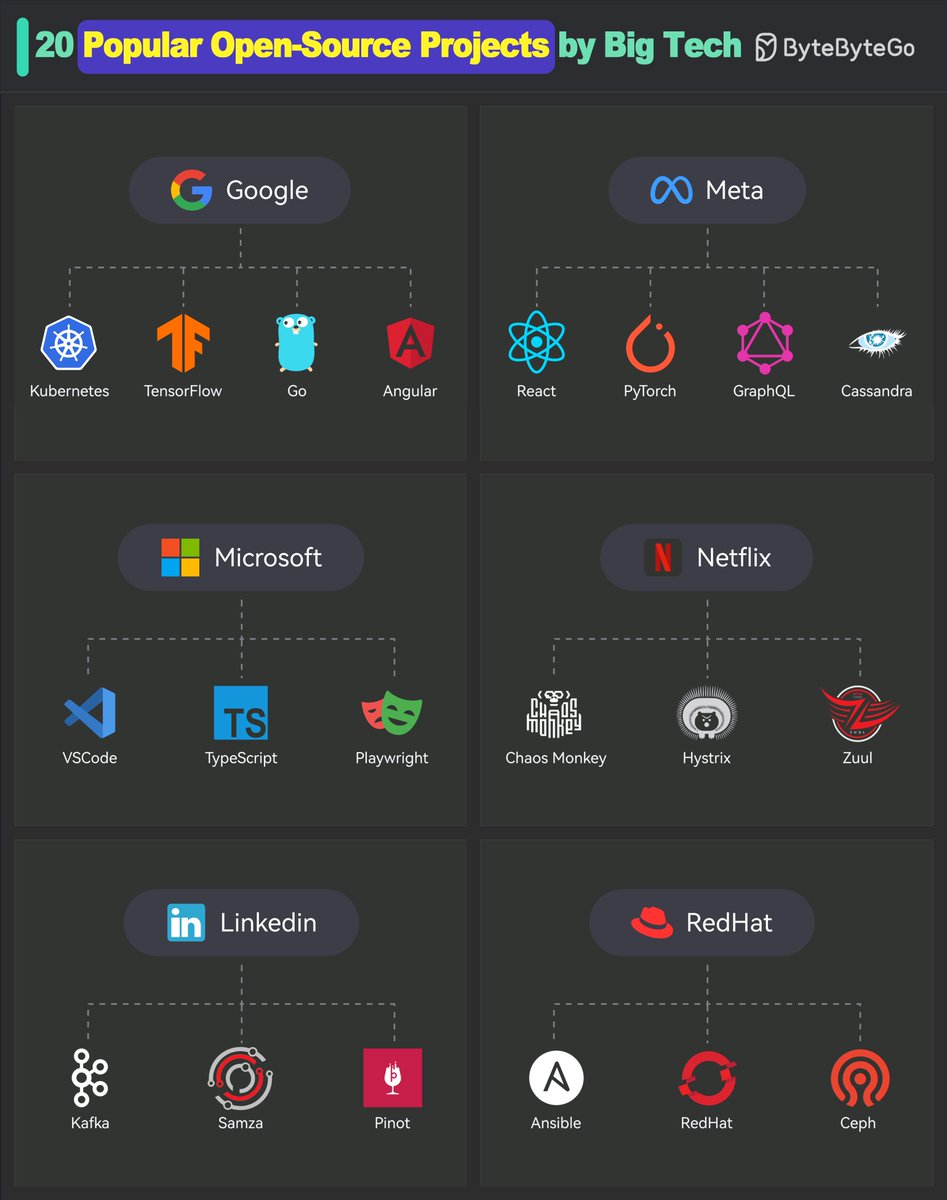
20 Popular Open Source Projects Started or Supported By Big Companies
Alex Xu tweet media
English
17
254
1.6K
155.3K