Michael Frazis

6.6K posts

Michael Frazis banner
Michael Frazis

Michael Frazis

@michaelfrazis

Aussie fund manager in tech and healthcare. Rebuilding our entire fund management toolkit and making it public: https://t.co/Jon24cGfDc

Sydney, Australia Katılım Mayıs 2010
3.8K Takip Edilen11.3K Takipçiler
Michael Frazis
Michael Frazis@michaelfrazis·
Man it’s bleak out there: AI job losses meets war/energy inflation crisis Both could resolve: AI efficiencies and growth could be the dominating factor, and the war could resolve, but that’s a narrow, narrow path
English
1
1
8
805
Michael Frazis
Michael Frazis@michaelfrazis·
Some slop, enjoy: Let me walk through the key episodes. Pompey's return from the East (62-60 BC) Pompey came back from crushing Mithridates and reorganising the eastern provinces — the most significant Roman military achievement in a generation. He wanted two things: land grants for his veterans (standard practice, and these men had earned it) and ratification of his eastern settlements (the administrative arrangements he'd made for conquered territories). Both were reasonable. The Senate, with Cato as a driving force, blocked both — not because the requests were unreasonable, but because granting them would acknowledge Pompey's stature and set a precedent for individual power they didn't like. The consequence was devastating. Pompey, humiliated and frustrated, had nowhere to turn within the constitutional system. So he turned outside it — to Caesar and Crassus. The First Triumvirate (60 BC) was essentially three powerful men saying "the Senate won't work with us individually, so we'll pool our leverage and bypass it." Cato's intransigence didn't prevent the concentration of power he feared — it created the conditions for it. Had he allowed Pompey's veterans their land and rubber-stamped the eastern settlements, Pompey would have had little reason to ally with Caesar. The triumvirate might never have formed. Caesar's agrarian legislation (59 BC) As consul, Caesar proposed a land reform bill — the lex Julia agraria — distributing public land to Pompey's veterans and Rome's urban poor. The bill was moderate by historical standards and included safeguards against abuse. Cato filibustered it in the Senate. Not because he had substantive objections to the policy, but because he opposed Caesar having a legislative achievement. Caesar reportedly had Cato physically removed from the Senate floor. The bill passed through the popular assembly instead, bypassing the Senate entirely. This matters because it established the pattern for Caesar's consulship: every time he tried to work through normal channels, Cato and the optimates made it impossible, so Caesar went around them. Each time he went around them, the constitutional norms eroded further. Cato was essentially training Caesar to ignore the Senate. Caesar's command and the road to civil war (50-49 BC) After Gaul, Caesar needed a transition back to civilian life that protected him from prosecution (his enemies planned to drag him into court the moment he lost imperium). He sought to stand for the consulship in absentia — a privilege that had precedent and that Pompey himself had supported via legislation. Cato and his faction blocked every compromise proposal, including ones where Caesar offered to give up most of his legions and retain only a minimal command during the transition. Cato's position was essentially: Caesar must return to Rome as a private citizen, exposed to prosecution, with no guarantees. Given that everyone understood the prosecutions would be politically motivated, this was functionally demanding Caesar's political destruction. Caesar's choice became: accept ruin or cross the Rubicon. He chose the Rubicon. The alliance with Pompey Here's where the strategic incoherence becomes hardest to ignore. The same Cato who had spent a decade treating Pompey as a dangerous threat to republican liberty — blocking his requests, opposing his influence, viewing him as a proto-tyrant — ended up fighting under Pompey's command at Pharsalus. Not because Pompey had become a constitutionalist, but because Cato needed military power to oppose Caesar and Pompey was the only game in town. So Cato's "principles" led him to: first, alienate and radicalise the one man (Pompey) who might have been co-opted into the constitutional system; then, create the conditions under which Caesar had to choose between ruin and revolution; and finally, subordinate himself to the same Pompey he'd spent years opposing, fighting a civil war to defend a republic that was already functionally dead. The throughline isn't principled consistency. It's a man who was so committed to saying "no" that he never developed a workable theory of "yes" — never articulated what a realistic accommodation with powerful individuals would look like within the republican framework. The republic of Cato's imagination, where the Senate's collective authority naturally constrained great men, hadn't existed for at least a generation before Caesar. Cato was defending a ghost, and the methods he used to defend it kept making the actual situation worse.
English
1
1
19
565
Will Tanner
Will Tanner@Will_Tanner_1·
Cato the Younger was a petulant and obstinate fool whose egotistical indulgence of his own performative virtue ended the republic he claimed to love, all on behalf of a corrupt oligarchy that lacked any of the virtues for which he claimed to be fighting So no surprise libertarians love him, I suppose
The Alex Nowrasteh@AlexNowrasteh

Cato the Younger was right.

English
18
110
1.1K
34.6K
Huff
Huff@Huff4Congress·
After seeing these actual clips of Paapa Essiedu as Severus Snape, I changed my mind. This is gonna be amazing. Perfect casting!
English
80
218
2.1K
240.9K
Michael Frazis
Michael Frazis@michaelfrazis·
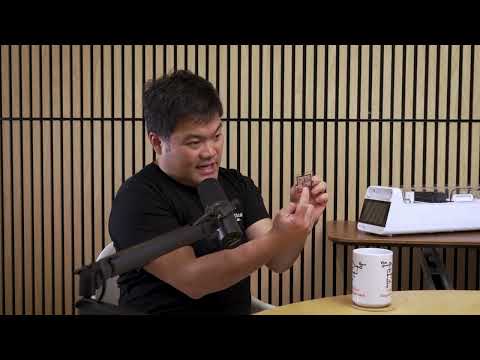
There are substantial research prizes, possible Nobels. Updating intelligence in real time, as animals do, is an unsolved problem, and these systems could run the experiments to tease that apart. But it's likely in our lifetime we will match how biological systems learn continuously with so much less energy and seemingly so much less data (plenty of debate how to calculate that). In the meantime, as Dr. Hon put it, the Romans built bridges without understanding physics, and his neurons are available now. We also touch on ethics, consciousness, the dark room problem, neurocriticality, and what we know about animal intelligence. Link below! youtu.be/PUnb4DjaLAE
YouTube video
YouTube
English
0
0
3
549
Michael Frazis
Michael Frazis@michaelfrazis·
They sell the hardware units ofr ~$35K to research labs, who can culture their own cells. But anyone else can access the systems through their API online. I really want to know how octopus cells behave... Cortical Labs is setting itself up to be the hyperscaler and $NVDA of biological computing.
English
2
0
0
371
Michael Frazis
Michael Frazis@michaelfrazis·
Cortical Labs took the engineering further: the now-famous Doom implementation was actually built by a student Sean Cole from the University of Sussex using their API. I remember Hon telling me he'd put these networks on the cloud years ago. Seemed like a stretch but he made it!
English
2
0
2
380
Michael Frazis
Michael Frazis@michaelfrazis·
Another major difference: in traditional machine learning there are two very distinct phases for training and inference. But biological systems learn and execute at the same time. There's no static backpropagation step (it seems), and no frozen weights.
English
1
0
0
168
Michael Frazis
Michael Frazis@michaelfrazis·
Why bother at all? To learn (and take advantage of) neuronal efficiency. Biological neurons needed 5,000x less data than standard RL algorithms to learn Pong. They tested the networks v DQN (the algorithm behind AlphaGo), A2C, and PPO, on only 20 minutes of gameplay which is about ~1,200 frames. The algorithms failed, but the neurons succeeded, which matches what we see in the world. Very rapid, efficient learning
English
1
0
1
144
Michael Frazis
Michael Frazis@michaelfrazis·
Like a biological free energy principle where the systems build a 'model' of the world and work to minimise the gap between their predictions and reality. Which is how you train them and make this work.
English
1
0
0
152
Michael Frazis
Michael Frazis@michaelfrazis·
To train them, the neurons aren't rewarded with glucose or some other physical reward. It turns out they try to minimize entropy by adapting to their environment. That's reward enough!
English
1
0
0
160
Michael Frazis
Michael Frazis@michaelfrazis·
At its core,Cortical Labs grows human stem cell-derived neurons onto a glass chip. They have read and write access to living biological neurons.
English
1
0
1
453
Michael Frazis
Michael Frazis@michaelfrazis·
They grow anywhere from 200,000 to 800,000+ neurons on a single chip. The neurons self-organise and generate electrical signals in response to electrical stimulus, which Hon's team translates into I/O that can be accessed around the world through their computing platform
English
1
0
0
277
Michael Frazis
Michael Frazis@michaelfrazis·
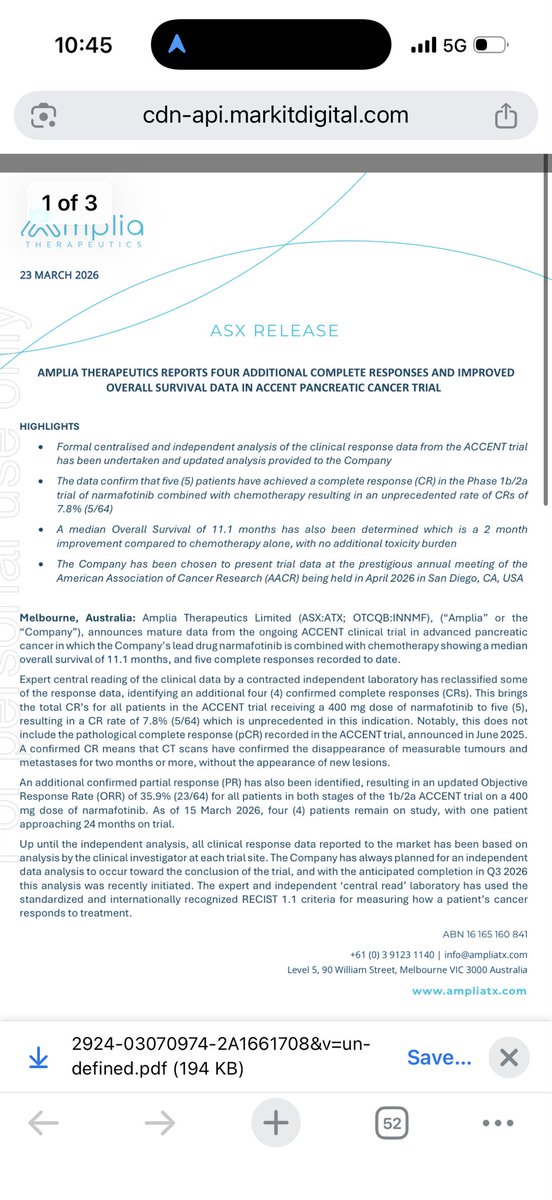
Wow, Amplia got 5 Complete Responses in pancreatic cancer!!! An I wonder lab reclassified an additional 4 as CRs, so 5/64 total, so a nearly 8% cure rate One patient still on study after 24 months so potential there too This one looks real $ATX cdn-api.markitdigital.com/apiman-gateway…
Michael Frazis tweet media
English
2
3
23
4.2K
Brad
Brad@Brad08414464·
Americans are finally discovering the east coast of Australia. it’s basically a bigger California. picture the most beautiful and serene stretch of the Californian coast, and then quadruple it. that’s Australia x.com/echoesofworld/…
@echoesofworld

Sydney

English
362
433
13.8K
820.1K