Lucy M. McCully Espinosa, PhD

8.1K posts

Lucy M. McCully Espinosa, PhD banner
Lucy M. McCully Espinosa, PhD

Lucy M. McCully Espinosa, PhD

@microMcCully

(she/they) Bisexual binational bicyclist 🇲🇽 🏳️‍🌈 Microbiologist. Post-doc in Baym Lab finding lil phage friends. PhD work on 🦠 bacterial interactions 🧫

Katılım Şubat 2013
1.1K Takip Edilen625 Takipçiler
Lucy M. McCully Espinosa, PhD retweetledi
Kepler Mears
Kepler Mears@KeplerMears·
My scientific career changed the day I met Fernando and my faith in science restored. In a world dominated by sequencing and LLMs, this project shows how much biology is hidden in plain sight waiting for the right person to make the connection, a must read!
Fernando Rossine@fernpizza

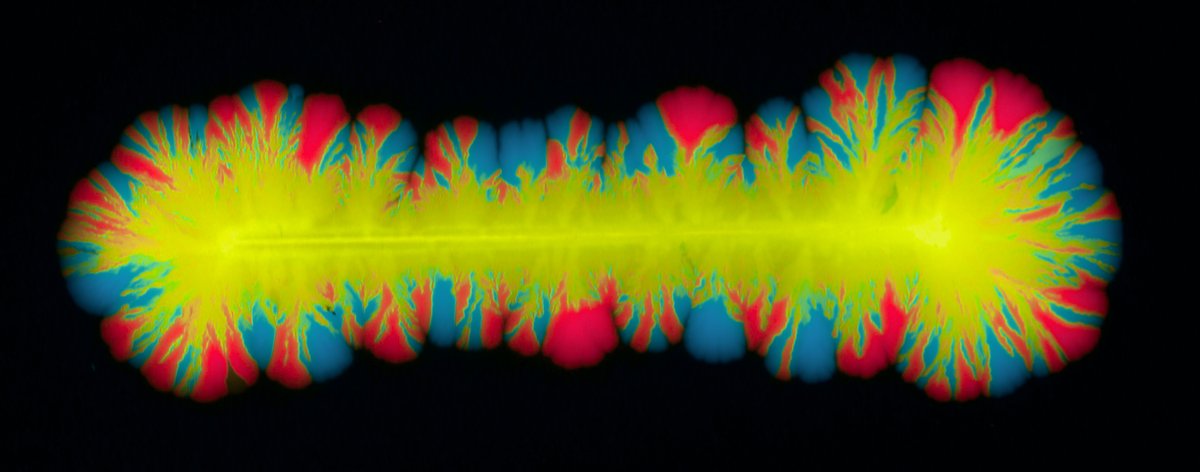
So happy that I can finally share the results of my first postdoc paper with @baym!! Turns out plasmids are an amazing system to study multi-scale evolution and we can track within-cell and between-cell dynamics! Here’s a photo of plasmids competing inside cells in a colony (1/n)

English

0
6
39
4.8K
Lucy M. McCully Espinosa, PhD retweetledi
Akos Nyerges
Akos Nyerges@AkosNyerges·
Interested in microbial evolution and plasmid population dynamics? Check out this fantastic preprint from Fernando @fernpizza & Michael @baym!
Fernando Rossine@fernpizza

So happy that I can finally share the results of my first postdoc paper with @baym!! Turns out plasmids are an amazing system to study multi-scale evolution and we can track within-cell and between-cell dynamics! Here’s a photo of plasmids competing inside cells in a colony (1/n)

English

0
4
7
1.5K
Lucy M. McCully Espinosa, PhD retweetledi
Marc Lipsitch
Marc Lipsitch@mlipsitch·
Excited to share a new preprint led by Indra Gonzalez Ojeda on a new tool to improve pangenome calling in bacteria, CLARC. biorxiv.org/content/10.110… . Passing output of Roary for S. pneumoniae populations through this tool reduces accessory genome > 30%, resolves other puzzles
English
0
4
15
6.6K
Lucy M. McCully Espinosa, PhD retweetledi
Fernando Rossine
Fernando Rossine@fernpizza·
Side quest: We needed precise control on the activation of the recombinase. We hypothesized that the FLP recombinase from the patagonian ancestor of the lager yeast would be thermosensitive (Lagers are cold brewed). It worked on the first attempt! (6/n)
Fernando Rossine tweet media
English
1
3
22
2.2K
Lucy M. McCully Espinosa, PhD retweetledi
Fernando Rossine
Fernando Rossine@fernpizza·
So happy that I can finally share the results of my first postdoc paper with @baym!! Turns out plasmids are an amazing system to study multi-scale evolution and we can track within-cell and between-cell dynamics! Here’s a photo of plasmids competing inside cells in a colony (1/n)
Fernando Rossine tweet media
English
13
96
515
60.7K
Lucy M. McCully Espinosa, PhD retweetledi
Siân Owen
Siân Owen@implosian·
Delighted to finally release this preprint into the universe! This project has been a true labour of love the past few years for Natalia and me. I'm so excited to continue exploring the exciting world of phages that depend on conjugative plasmids!
Natalia Quinones-Olvera@nquinoneso

Exciting news! The pre-print for our paper, “Diverse and abundant viruses exploit conjugative plasmids” is finally out! Join me on this thread to hear more about this mysterious group of phages with rather unique lifestyle preferences. 1/ biorxiv.org/cgi/content/sh…

English
4
14
68
11.9K
Lucy M. McCully Espinosa, PhD
Lucy M. McCully Espinosa, PhD@microMcCully·
My greatest contribution to science is making sure the phages I found for @nquinoneso and @implosian's phenomenal paper had the most goth names I could conjure 🖤
Natalia Quinones-Olvera@nquinoneso

Finally, we revisited the phages that depend on the F plasmid. We found members of all the known groups, and even a completely new, tailed(!) plasmid-dependent phage! @microMcCully here, introducing the wonderful FtMidnight, showing there’s even more diversity to be found! 13/

English
0
1
13
2K
Lucy M. McCully Espinosa, PhD retweetledi
Natalia Quinones-Olvera
Natalia Quinones-Olvera@nquinoneso·
This project has been a blast! What’s up with these strange phages? What does all of this mean for plasmid conjugation? And what other overlooked treasures await to be found in this world of mobile genetics elements? Thank you for reading, and stay tuned for our next adventures.
English
1
6
22
2.7K
Lucy M. McCully Espinosa, PhD retweetledi
Natalia Quinones-Olvera
Natalia Quinones-Olvera@nquinoneso·
Finally, we revisited the phages that depend on the F plasmid. We found members of all the known groups, and even a completely new, tailed(!) plasmid-dependent phage! @microMcCully here, introducing the wonderful FtMidnight, showing there’s even more diversity to be found! 13/
Natalia Quinones-Olvera tweet media
English
2
7
11
4.7K
Lucy M. McCully Espinosa, PhD retweetledi
Natalia Quinones-Olvera
Natalia Quinones-Olvera@nquinoneso·
If they are so abundant, why haven’t we heard about them from metagenomic studies? Well, we think they’re just not getting through. They seem hard to recover even from samples where we know they are present at high abundance. 12/
English
1
3
10
1.2K
Lucy M. McCully Espinosa, PhD retweetledi
Natalia Quinones-Olvera
Natalia Quinones-Olvera@nquinoneso·
These phages have zero accessory genome, and exactly the same gene content, but they can differ by a large number of SNPs. These ones, for example, only differ by ~500 SNPs, but they can have strikingly different host preferences! Look: 11/
Natalia Quinones-Olvera tweet media
English
1
5
13
2.4K
Lucy M. McCully Espinosa, PhD retweetledi
Natalia Quinones-Olvera
Natalia Quinones-Olvera@nquinoneso·
There were so many, that we were worried about finding names for all of them, so we decided to go for “PRD” + a color name. We have some wonderful ones like PRDchartreuse, PRDaquamarine, and my favorite: PRDcerulean 😊. 10/
English
1
3
9
3.5K
Lucy M. McCully Espinosa, PhD retweetledi
Natalia Quinones-Olvera
Natalia Quinones-Olvera@nquinoneso·
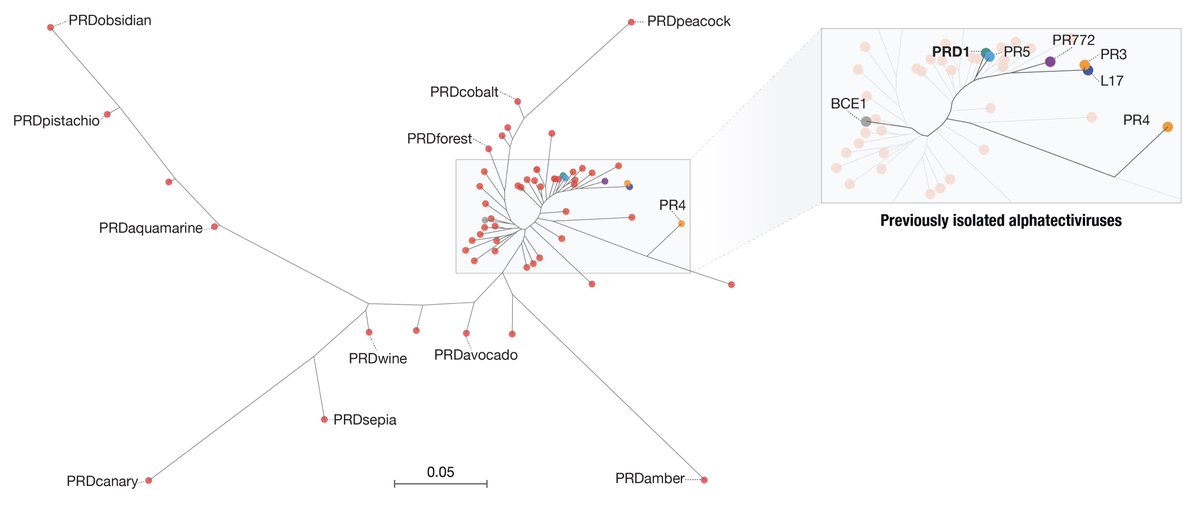
All the phages we were finding belong to the Tectiviridae family, and are closely related to PRD1. Not only were we finding them in large amounts but also, in more diversity than all the previously isolated phages of this group. 9/
Natalia Quinones-Olvera tweet media
English
1
5
6
2K
Lucy M. McCully Espinosa, PhD retweetledi
Natalia Quinones-Olvera
Natalia Quinones-Olvera@nquinoneso·
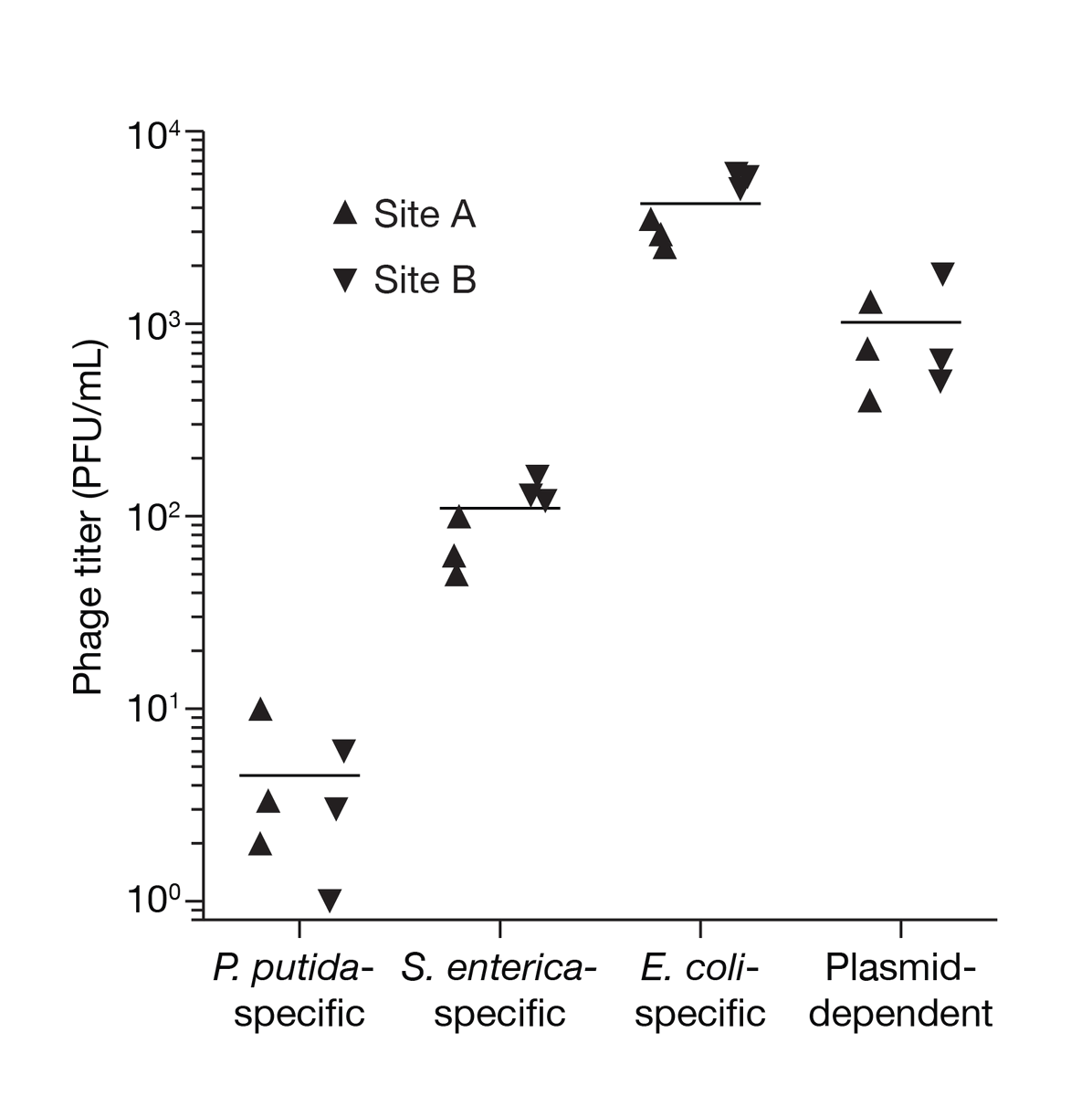
Why? Well, because they had A LOT of plasmid-dependent phages. Like, in wastewater(!) there are almost as many plasmid-dependent phages as E. coli phages, and way more than S. enterica or P. putida phages (the hosts we were using in our assay.) 8/
Natalia Quinones-Olvera tweet media
English
1
7
12
2.4K
Lucy M. McCully Espinosa, PhD retweetledi
Natalia Quinones-Olvera
Natalia Quinones-Olvera@nquinoneso·
So we started screening as many samples as we could, looking for phages that depend on IncP conjugative plasmids (like RP4). This is @implosian and me, showing off our samples. Our favorite samples: compost and wastewater. 7/
Natalia Quinones-Olvera tweet media
English
1
2
16
6.5K
Lucy M. McCully Espinosa, PhD retweetledi
Natalia Quinones-Olvera
Natalia Quinones-Olvera@nquinoneso·
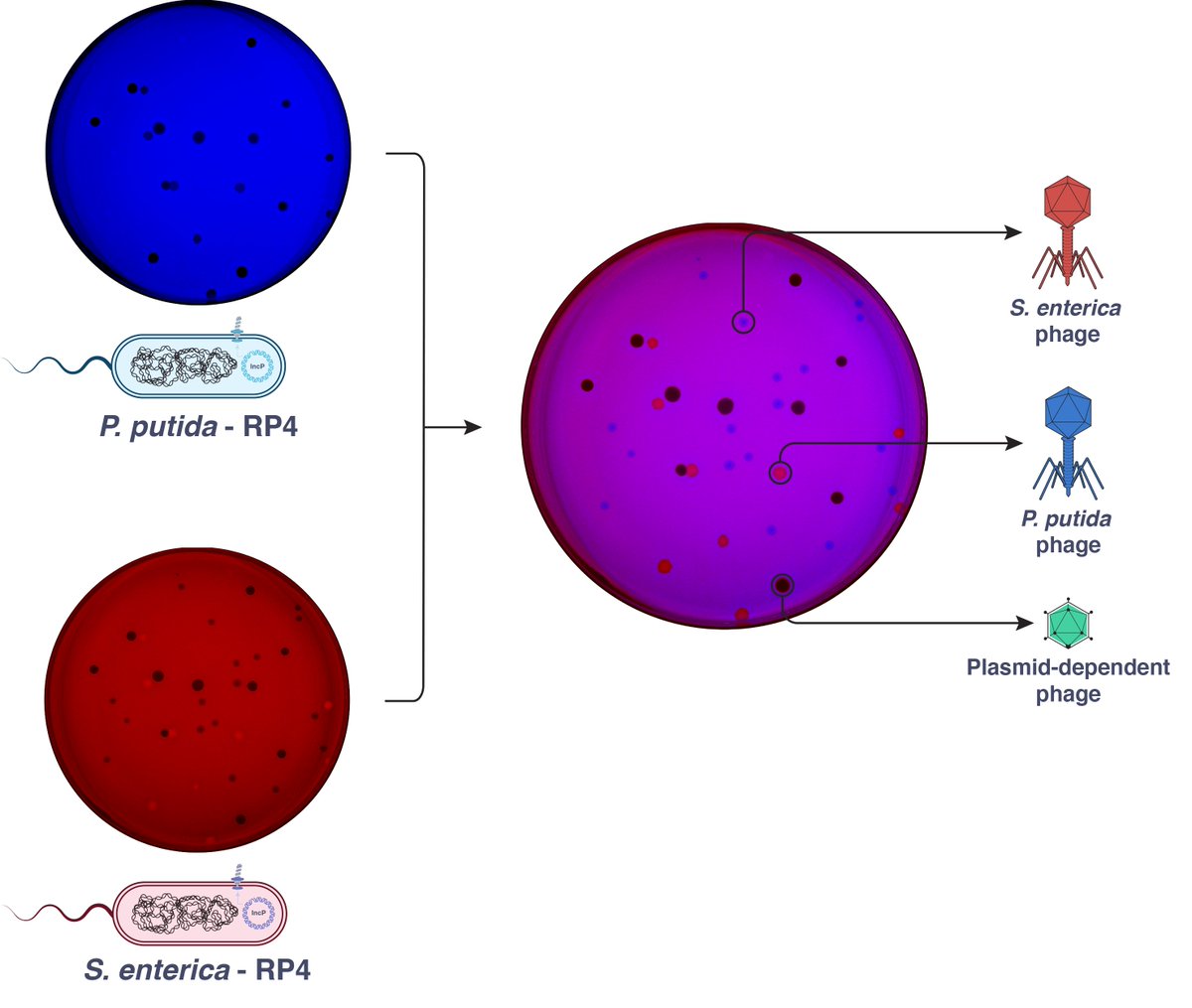
This sounds almost too easy to be true, but it works! Since the determinant of phage susceptibility can be horizontally transferred 🤯, many of these phages have a broad host range. If we add fluorescence to it, it’s even easier to see, and we get Phage DisCo! 🪩 6/
Natalia Quinones-Olvera tweet media
English
1
8
41
6.8K