RR invester
92 posts

Trend says up, but....
Phase says dying.
Do you take it or pass?
That decision is the edge 🤔
Comment “Firewall” and I’ll show you how I filter these.
#trading #daytrading #options #stocks
$SPY $QQQ $NDX $SPX

English
RR invester retweetledi


Tweet 4: Join the Discussion 💬
Is this a fake-out or the start of a crash? 📉 I’m watching these levels closely.
Watch the full analysis: youtu.be/rnpIu_5YQYQ?si…
Not trade advice—educational analysis only. (4/4)

YouTube
English
Tesla ($TSLA) just flashed a major red flag. 🚩 We officially closed below the critical $400 psychological level today, If we don’t reclaim $400 immediately tomorrow, things could get ugly. 🧵 (1/4)
: youtu.be/rnpIu_5YQYQ?si…
YouTube
English
Tweet 3: Volume is Key 📊
Watch the selling pressure at the open on February 24th. If volume stays high and we’re pinned under $400, the momentum is firmly with the bears. (3/4)
English
The Downside Targets 📉
My technical analysis shows a high probability of a "tank" toward $382 if $400 acts as new resistance. If that level snaps, the next major structural support isn't until $368. That’s a serious gap to the downside. (2/4)
English




If you’re buying $GOOG / $GOOGL up here, you’re paying a premium.
Not calling for a selloff.
Just a reminder that your edge comes from buying discounts, not chasing price.

English
@elonmusk @tslaming @Tesla @gigafactories @TeslaZoa 🚨 Tesla’s Battery Breakthrough = New Investment Wave
English

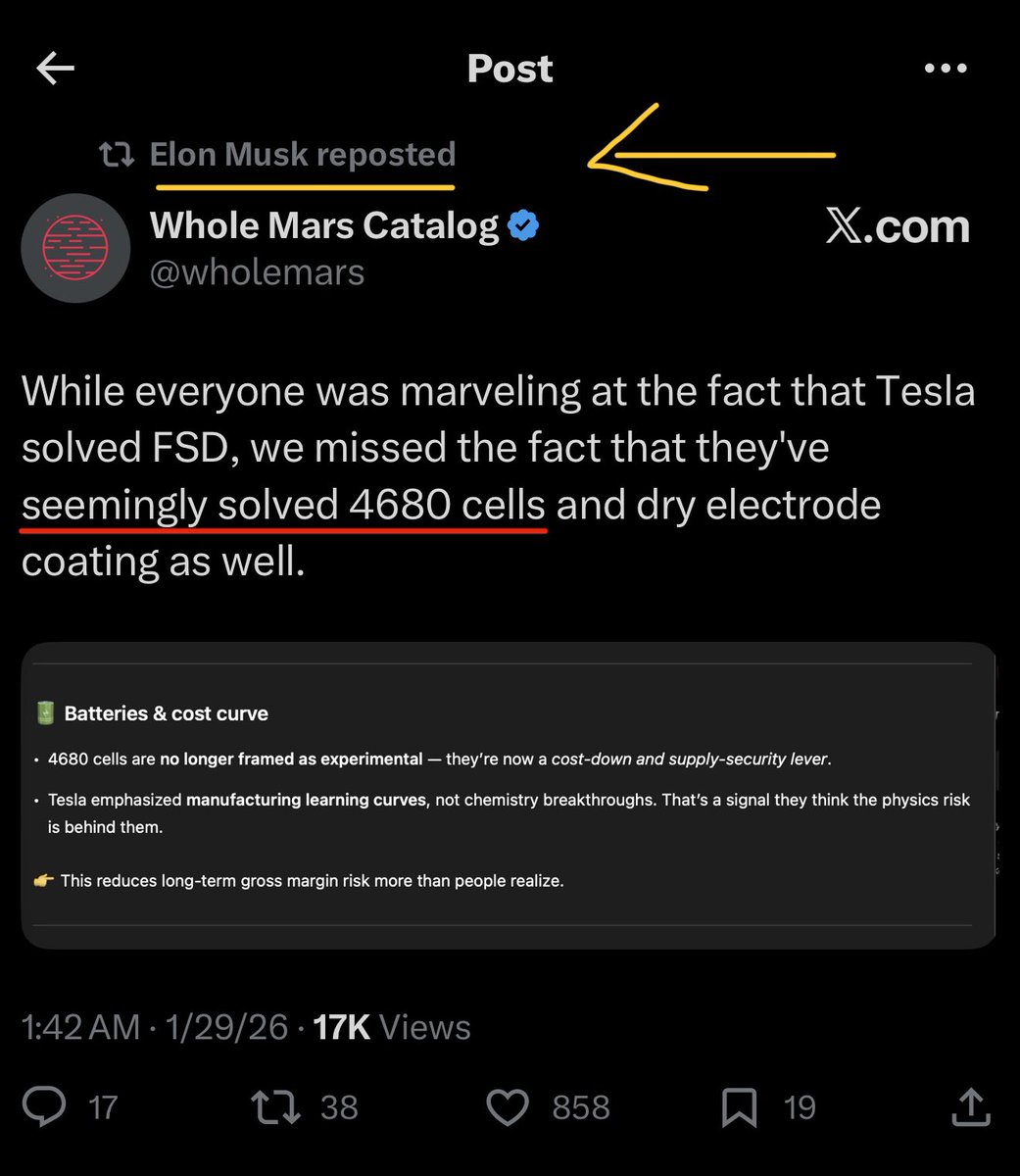
Making the dry electrode process work at scale, which is a major breakthrough in lithium battery production technology, was incredibly difficult.
Congratulations to the @Tesla engineering, production and supply chain teams and our strategic partner suppliers for this excellent achievement!
English

BREAKING 🚨 TESLA LOCKS DOWN THE "SECRET RECIPE" FOR ITS DRY ELECTRODE MANUFACTURING 🔒
For years, the battery industry believed that mass-producing dry electrodes was impossible, a lab trick that simply couldn't scale.
Published on January 29, 2026, patent application US20260031317A1 proves them wrong and reveals the next, ruthless phase in Tesla's intellectual property strategy.
If the previous patent was about owning the car, this one is about owning the factory. This filing serves as the definitive "cookbook" for the holy grail of battery manufacturing.
While Tesla has already secured the rights to the superior performance of the battery, this continuation protects the method. By patenting the exact order of operations and physical constraints required to ditch toxic solvents, Tesla is effectively copyrighting the "kitchen" so that no one else can bake the same cake.
This ensures that even if competitors figure out what makes the dry electrode work, they will be legally barred from using the most efficient way to make it.
To understand why this legal firewall is so necessary, we have to look at the specific engineering trap that Tesla is trying to prevent competitors from exploiting.
🧩 The problem: Copying the result, evading the method
The transition from "wet" to "dry" manufacturing is notoriously difficult because of a cruel physical trade-off: to make dry powder stick together into a solid sheet, you typically need to apply high-shear force or add large amounts of polymer "glue".
Both are bad. High shear crushes the delicate battery crystals (killing lifespan), while excess glue wastes space (killing range).
Tesla has solved this by developing a "Goldilocks" zone, a gentle mixing process that activates the binder without destroying the particles. However, this creates a legal vulnerability.
In the world of patents, securing the "end product" (a high-efficiency battery) is a massive win, but it leaves a loophole. Competitors could theoretically try to achieve similar battery performance using a slightly different, less efficient, or messier process to skirt the patent rules.
If Tesla only protects the final battery, rival manufacturers could reverse-engineer the specifications while claiming their production line is "different enough" to avoid infringement.
To truly secure its competitive advantage, Tesla needs to protect the unique, low-cost "kitchen" where the battery is made, not just the "cake" that comes out of the oven. To close this specific loophole, the new filing moves to secure the manufacturing process itself.
💡 Tesla’s solution: The "method" is the moat
Tesla’s solution, detailed in this continuation, shifts the legal focus from the device to the method of fabrication. This effectively means Tesla is moving from protecting the final battery product to patenting the specific recipe and cooking steps used to make it.
The key innovation here is not just that the electrode works well, but that it is manufactured using a specific, counter-intuitive sequence. The patent application seeks to protect a method that involves nondestructively mixing active materials with porous carbon first.
These active materials are the primary lithium compounds that actually store the energy, while the porous carbon acts as a conductive additive that functions like a microscopic electrical grid.
The process uses nondestructive mixing, which is a gentle blending technique that mixes the ingredients without crushing them, much like folding ingredients into a cake batter to keep it airy.
Only after this initial blend is complete does the method involve adding the dry binder to create the final film. This dry binder is a polymer adhesive that serves as the structural glue to hold the powder mixture together in a solid sheet.
By legally defining this specific order of operations, specifically mixing the dry energy-storing ingredients before introducing the glue, Tesla is fencing off the most logical and efficient way to produce dry electrodes. This prevents competitors from adopting Tesla’s streamlined manufacturing flow, forcing them into less efficient, more complex, or more expensive production methods.
But the "method" is only half the story; the other half relies on the specific physical characteristics of the ingredients themselves.
🔬 The innovation: Large particles and "gentle" manufacturing
This filing doubles down on a specific physical constraint regarding the size of the particles used in the battery. The patent explicitly claims protection for using active material particles that are at least 10 microns in size. For context, ten microns is roughly one-tenth the width of a human hair.
This is significant because traditional battery manufacturing often relies on pulverizing materials into fine dust to make them fit into a wet slurry, which is essentially a muddy paste created by mixing powders with liquid solvents.
Tesla has discovered that by keeping the particles larger and pristine, they can use significantly less binder. Specifically, they use less than 2% by weight of this binding glue.
The patent describes a process where these larger particles serve as the structural bricks of the electrode wall, while the PTFE binder acts as the minimal mortar. PTFE (polytetrafluoroethylene) is the same polymer found in non-stick cookware.
To achieve this structure without cracking the large particles, the method specifies using acoustic or low-speed blade mixers running at a crawl of 10 to 40 meters per minute.
Acoustic mixers use sound energy to vibrate and blend materials without direct contact, while blade mixers gently fold the powder like a slow-moving dough hook. This nondestructive approach is now a core part of the claim, ensuring that the method itself is recognized as a unique invention because it preserves the original quality of the materials.
With the physical method established, Tesla tightens the noose further by adding strict chemical rules that make the patent nearly impossible to sidestep.
📝 The fine print: Three critical constraints
To truly lock out competitors, this continuation filing adds three hyper-specific "fences" around the manufacturing process that move beyond general concepts to define the exact chemical and physical limits of Tesla's technology.
First, the patent imposes a strict "Single Binder" rule. While many battery manufacturers use a cocktail or complex mixture of glues to balance adhesion and flexibility, often mixing PTFE with other polymers like PVDF (polyvinylidene fluoride) or CMC (carboxymethyl cellulose), Tesla’s filing explicitly prohibits this.
The text specifies that the binder "consists essentially of a single dry fibrillizable binder". A fibrillizable binder is a material capable of forming a microscopic web of fibers when mechanically stressed.
This forces the recipe to rely 100% on the mechanical fibrillation of PTFE, a process that physically stretches the binder particles into thread-like networks rather than relying on chemical stickiness. It asserts that their process is so refined they don't need the chemical crutch of secondary glues.
Second, Tesla places a hard legal ceiling on conductive carbon. This carbon serves as an electrical pathway but acts as a "dead weight" filler because it does not store any power itself.
The patent caps this material at "at most 8 wt%", meaning it can comprise no more than eight percent of the total weight of the electrode. While carbon is essential for electricity to flow, it stores no energy.
Competitors might try to make a dry electrode work by dumping in 15-20% carbon to compensate for poor connectivity, but that results in a mediocre battery with less room for active ingredients. By setting this limit, Tesla protects the high-performance version where filler is kept to a bare minimum to maximize energy density, which is the amount of energy stored relative to the battery's size.
Finally, the filing reveals a "Hero" configuration that proves this process isn't just for lower-end standard batteries. It details a specific formula using 98% NMC 811.
NMC 811 refers to a lithium nickel manganese cobalt oxide chemistry rich in nickel, which is difficult to handle but offers superior range. This formula combines that high-performance material with just 1.25% PTFE binder and 0.75% total carbon.
Achieving a stable film with such a high load of active material proves this dry process is ready for Tesla's most demanding vehicles, effectively turning the electrode into a nearly solid block of energy.
Once this highly specific mixture is prepared, the final step of the process seals the advantage by defining the speed of production.
⚡ The "3-pass" efficiency
A critical detail in this continuation is the speed of formation. The filing highlights that this specific recipe allows the dry powder to be turned into a self-supporting sheet, meaning the film is structurally sound enough to be handled like a roll of fabric without crumbling or needing a supporting metal foil.
This result is achieved after passing through a process called calendering, which involves feeding the material through a series of heavy steel rollers that press it flat, much like a pasta machine flattening dough. The patent specifies this happens at most three times.
In manufacturing, fewer passes equals higher speed. By claiming a process that creates a sturdy film in just three steps, Tesla is effectively patenting the velocity of its production line. This velocity determines the overall factory throughput, or the volume of finished product made per hour.
A competitor trying to replicate this might need 10 or 20 passes to get a stable film. This requirement would force them to run the material back and forth repeatedly, making their factories slower and more expensive to run than Tesla's.
This combination of legal, chemical, and manufacturing speed constraints lays the foundation for Tesla’s dominance in the next decade.
🚀 How this continuation contributes to Tesla’s now and future
First, it blocks competitors from "fast-following" the 4680 production method. While other automakers can buy good batteries, this patent prevents them from building factories that operate like Tesla’s. By protecting the specific "mix-then-bind" sequence and the "low-binder" recipe, Tesla ensures that its Gigafactories remain unique. Competitors cannot simply buy the same mixing equipment and run the same recipe without risking patent infringement.
Second, it secures the economics of "cheap" raw materials. By specifically patenting the use of larger (greater than 10 microns) particles, Tesla is validating a cheaper supply chain. Smaller, highly processed particles cost more. This patent confirms that Tesla’s process is optimized for standard, "bulk" grade materials. Protecting this capability ensures Tesla retains a cost margin advantage, as they can turn cheaper, commoditized inputs into premium performance outputs.
Third, it creates a legal "thicket" around dry electrode tech. This filing is a classic "picket fence" strategy. The parent patent protects the battery efficiency (90-94%). This child patent protects the binder loading (less than 2%) and the particle size. Future filings will likely protect the machinery. This layering makes it nearly impossible for a competitor to design a dry electrode without tripping over at least one of Tesla’s patents.
Finally, it validates the "micro-factory" concept. The emphasis on creating a "free-standing" film without a metal foil backing is crucial. It means the electrode film can be made in one machine and rolled up, then applied to foil later. This decouples the manufacturing steps, allowing Tesla to fit production lines into smaller, non-linear spaces, which is essential for the tight footprints of future factory expansions or retrofitting existing lines.
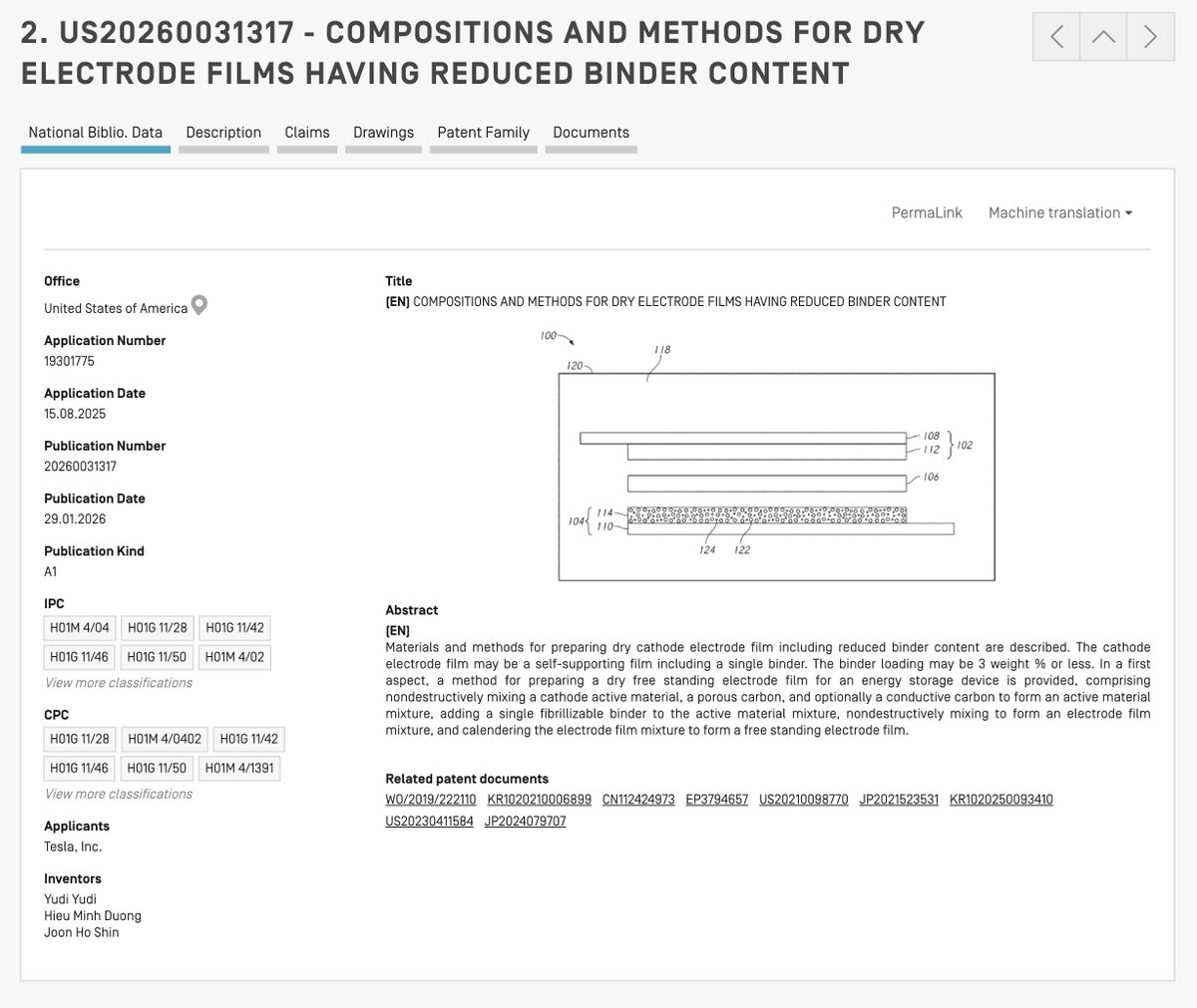
Ming@tslaming
GOOD NEWS 🚨 Tesla has engineered a pure dry cathode that delivers maximum energy with minimal binder 🔋 Published on August 19, 2025, patent US20230411584 reveals the engineering breakthroughs behind a new manufacturing process Tesla has been developing to remove toxic solvents and massive drying ovens from battery production. This patent reveals a specific dry electrode recipe that enables Tesla to build high-performance cathodes with significantly less binder. ⚖️ The problem: The "wet" process limit and particle damage For decades, making lithium-ion batteries has required a "wet" process. Manufacturers mix active battery powders with toxic solvents and liquid binders to create a sludge, which is then spread onto foil and dried in enormous, energy-hungry ovens. This traditional method is incredibly expensive and takes up massive amounts of factory floor space. Even worse, the intense, high-speed mixing required to make this sludge often damages the delicate microscopic structures of the battery materials. When cathode materials, like Lithium Nickel Manganese Cobalt Oxide (NMC), are subjected to this harsh mixing, the microscopic clusters of particles can crack or break apart. This damage degrades the material before it is even put into a battery, leading to poorer performance and a shorter lifespan. The industry has struggled to switch to a "dry" powder process because, without the liquid solvent, you typically need to add more non-active binder (glue) to hold the powder together. Unfortunately, adding more non-active glue means there is less room for energy-storing material, which lowers the battery's range. 🔗 Tesla's solution: nondestructive mixing and fibrillization Tesla's solution, detailed in this patent, is a method for creating a standalone dry electrode sheet using a gentle mixing process and a single, special type of binder. The key innovation is the ability to make a strong, self-supporting sheet using less than 3 percent binder—and in some cases, as little as 1.25 percent. By minimizing the amount of wasted space taken up by glue, Tesla can pack the electrode with 90 to 99 percent active material, directly increasing how much energy the battery can hold. The process relies on Polytetrafluoroethylene (PTFE) as the primary binder. PTFE has a unique ability called "fibrillization," which means that under stress, the polymer particles stretch out into microscopic, spiderweb-like fibers. These fibers act like a net that traps and holds the active battery particles together. Tesla has refined a "nondestructive" method—likely using lower speeds or gentler blending—to mix the materials without crushing them. This preserves the pristine original structure of the cathode particles, ensuring they work as efficiently as possible. A crucial discovery in the patent is the relationship between particle size and the amount of binder needed. Tesla found that using slightly larger active particles—specifically those around 10 to 20 microns in size—makes it easier to form a solid sheet with very little binder. By ensuring these particles are roughly one-tenth the thickness of the final electrode sheet, the structure remains stable without needing excess polymer glue. This effectively turns the bulk of the electrode into a solid block of energy-storing material. To achieve this mix without crushing these specific particles, the patent moves away from standard high-speed milling. Instead, it suggests using acoustic mixers or blade mixers running at very slow speeds. The document specifies blade speeds of just 10 to 40 meters per minute—a gentle pace that blends the ingredients thoroughly while leaving the delicate surface coatings and internal structures of the cathode materials completely unharmed. The recipe for the film is a "hybrid" mixture designed to help the dry formation process. Along with the main battery ingredients (like NMC) and the PTFE binder, the mix includes small amounts of porous carbon and conductive carbon. These carbon materials act like an electrical skeleton inside the PTFE web. This ensures that even with very little binder, electricity can flow easily through the electrode, and the material stays strong when it is pressed into a sheet. The patent also outlines a strict order of operations to ensure quality. The process uses a two-stage mixing approach: the active battery materials and carbon are blended first to create a "dry active base." Only after this base is fully mixed is the dry binder added. This separation prevents the PTFE from turning into fibers too early in the process. It ensures the fiber network forms exactly when it is meant to—during the final pressing stage—rather than getting worn out during the initial mixing. Once the mixture is ready, it is passed through a "calender"—a machine with high-pressure rollers—to press it into a continuous sheet. The patent notes that this new mixture is very easy to work with, requiring as few as three passes through the rollers to form a sturdy, self-supporting film. This film is strong enough to be handled and rolled up without needing a metal foil backing immediately, which simplifies the manufacturing line. Eventually, this dry sheet is laminated onto a metal foil to create the final finished electrode. In terms of performance, the patent data shows that these dry-processed electrodes actually work better than those made with the traditional wet process. The dry cathode films showed excellent efficiency right from the first charge cycle (about 90 to 94 percent). Furthermore, test cells proved they could hold onto their capacity even when discharging power very quickly. For example, the dry electrodes performed better than wet ones during high-speed power drains, likely because electricity flows more easily through the undamaged, dry-pressed material. 🚀 How this patent contributes to Tesla's now and future First, this patent specifically solves the "range vs. cost" trade-off for the 4680 cell. By proving they can manufacture stable electrodes with 99 percent active material, Tesla can essentially "delete" nearly all non-energy components from the cathode. This means future Model Y and Cybertruck battery packs can achieve higher energy density purely through manufacturing efficiency, without needing expensive exotic chemicals. Second, the patent validates a massive reduction in factory footprint for upcoming Gigafactory expansions. The text confirms that the dry film is "self-supporting" after just three passes through a roller, eliminating the need for the massive, 100-meter-long drying ovens that currently bottle-neck production. This allows Tesla to deploy "micro-factories" or much denser production lines, drastically lowering the capital cost (CapEx) required to double or triple global battery output. Third, the data on "nondestructive mixing" directly supports Tesla's million-mile battery ambition. The patent explicitly demonstrates that cells made with this gentle process retained nearly 90 percent of their capacity after 2,000 charge cycles. By not cracking the particles during manufacturing, Tesla is ensuring that the batteries in their robotaxis and grid storage products will last significantly longer than current industry standards, increasing the resale value of every vehicle they sell. Finally, this technology grants Tesla independence from specialized supply chains. The patent shows the process works effectively with standard, large-particle commercial materials (like NMC 811) rather than requiring highly processed, expensive custom powders. This flexibility means Tesla can buy standard raw materials at bulk commodity prices and still produce a superior electrode, securing a long-term margin advantage over competitors who rely on more complex, wet-slurry chemistry.
English
@elonmusk @tslaming @Tesla @gigafactories @TeslaZoa Tesla just cracked dry‑electrode battery scaling — huge for cost, range, and margins.
Ideas: TSLA (core winner), AMAT/ENTG/DD (suppliers), ALB/LIN (materials), LIT/BATT (ETFs).
Big tech shift, long-term upside; watch execution + valuation risks.
English
HOOD pulled back from 150 to ~106. Selling 85–90 puts for 3–4 weeks looks good if you’re ready to own shares at that level. Deep discount, good premium, and safer entry after the big drop
English
I’m posting a bunch of fresh weekly chart breakdowns this weekend.
What tickers do you want me to cover?
Drop the stocks you care about most below and I’ll prioritize those.
English
@prospero_ai How to filter which one went down like above .to see top 10 went down today like above
English

$SNDK is down over 7% today 🤯
Just yesterday it’s NOS level in Prospero dropped from 96 down to 77. 📉
Take a look at the chart below to see how we highlight risks for our users before they occur 👇


English
SLV Strategy Insight 🔍
Long 70C (Jun ’26) @ $7.99 + Short 60C (Jan ’26) @ $7.65.
A timing‑based bullish structure aiming to capture upside while managing premium.
English
SLV Strategy Play ⚡️
Stacked long 70C (Jun ’26) vs short 60C (Jan ’26).
Bullish lean with smart premium timing.
English
This is big...
$META Meta has lost $200 billion in market cap today
That's the 4th largest loss EVER 😲


English
I’m going to @StocksOnSpaces’s upcoming Space. Will you join too? twitter.com/i/spaces/1dRKZ…
English
@TrendSpider Well $SPY's Net Options sentiment is now up to 1 out of 100. It's progress 😅
English