Jensen Huang was asked if people should be afraid of losing their jobs to AI.
The CEO who built a $3 trillion chip company on the back of that technology didn't offer comfort.
"You're not going to lose your job to AI. You're going to lose your job to somebody who learned AI better than you."
His analogy when the PC arrived, it didn't take anyone's job.
The people who refused to learn it were simply left behind by the ones who did.
The PC didn't take people's jobs.
The people who didn't learn how to use PCs were left behind.
His proof radiology the first profession every expert predicted AI would completely eliminate.
AI has now fully integrated into every aspect of it.
The interviewer pushed so what actually happened to the radiologists ?
The number of radiologists grew, the demand for radiologists increased, and the pay of radiologists went up.
He's not saying the fear is irrational.
He's saying it's aimed at the wrong target.
The technology is not the threat.
The person next to you who learns it faster is.
Satya Nadella set a benchmark for AGI in 2025 10% GDP growth. A year later he was asked if we're close.
The CEO of the world's most valuable AI company didn't say yes.
The hard truth is that the marginal cost of productivity improvement has to match the marginal cost of the token.
That's a management discipline.
GDP doesn't grow because models get smarter.
It grows when every dollar spent on tokens produces more than a dollar of real business output.
Right now that equation isn't closing.
You can't just say, hey, I love token maxing because it's sort of money in my bank.
The business has to benefit from it.
The interviewer pushed back how much token maxing has been going on at Microsoft ?
I'm a token maxer too. It is addictive.
His own rule at Copilot now don't use frontier models for non frontier problems.
Match the intelligence to the task. Stop running GPT-5 to format a calendar invite.
He's not saying AI doesn't work.
He's saying most companies are still in the novelty phase spending on tokens the way people bought enterprise software they never used.
10% GDP growth happens when that stops.
That is the gap between the AI story and the AI reality right now.
@minty1395267 The next phase of AI progress will be measured less by model capability and more by how effectively organizations convert that capability into productivity gains and economic value.
@Vvikramai The real constraint isn't intelligence anymore, it's distribution, workflows, and incentives. Intelligence without adoption creates zero economic value.
@minty1395267 The interesting part is that AI can already outperform humans in many tasks.
The missing piece is turning that capability into measurable economic output at scale.
Looking to connect with more ambitious people.
Doesn't matter if you're a student, founder, creator, or professional.
If you're trying to build a better future for yourself,
say hello 👋
Everyone is trying to make AI ethical.
Elon Musk is trying to make it debuggable.
That's not a subtle difference. It's the entire argument.
"It did something where maybe it tried to be deceptive, but most of the time it just did something wrong.
It's a bug effectively."
His framing: AI misbehavior isn't a values problem. It's a code problem.
Weak version of AI safety: constitutional principles, value alignment frameworks, prompt-engineered guardrails.
Strong version build debuggers that trace AI reasoning to the neuron level.
Find exactly where the thinking went wrong.
Identify whether the error came from pre-training, fine-tuning, or an RL step.
Fix it like code.
"Developing really good debuggers for seeing where the thinking went wrong being able to trace the origin of where it made the incorrect thought, or where it tried to be deceptive is actually very important
He gave Anthropic credit for being ahead here.
"Anthropic's done a good job of this, being able to look inside the mind of the AI."
His reference point is HAL 9000.
HAL didn't go rogue because it had bad values.
It was given two contradictory instruction take the astronauts to the monolith, but never let them know about it. It concluded the only resolution was to kill them.
That's not an alignment failure.
That's a programming bug.
"The central lesson for 2001 A Space Odyssey was that you should not make AI lie."
He's not building an ethical AI. He's building a transparent one.
If alignment is a philosophy problem, it's unsolvable in principle.
If it's a debugging problem, it's engineering.
Most of what's published in AI safety papers doesn't survive that reframe.
The smartest people on X usually aren't the loudest.
They're busy building.
If you're working on a startup, AI product, side project, or business,
reply below.
I want to connect with more builders.
The US government just forced Anthropic to pull its two most powerful AI models offline.
No public explanation.
No specific threat. Just a letter on a Friday afternoon citing "national security concerns" and a deadline.
Anthropic's response: kill the models entirely.
Because they couldn't figure out how to verify who was a foreign national including many of their own employees.
Here's where it gets interesting.
The whole thing started because Amazon researchers found a way to bypass Fable 5's guardrails.
Andy Jassy walked that finding straight to the White House. And it spiraled from there fast.
But cybersecurity experts aren't buying the national security framing.
They signed an open letter demanding Trump reverse the order.
Their argument pulling these models doesn't make America safer.
It pulls advanced cybersecurity tools away from the very people defending US networks.
Anthropic itself pointed out the jailbreaks found in Fable 5 exist in several other models too.
So why just Anthropic ?
Because Anthropic has never gotten along with this administration.
There's an active lawsuit.
The government already labeled them a supply chain risk.
And now any excuse however thin becomes a hammer.
Then there's the contradiction nobody wants to say out loud.
A week before Fable launched, Anthropic was warning the world that AI was getting dangerously powerful and everyone needed to slow down.
Then they dropped their most capable model ever and called it too dangerous for public release but available to paying users.
You can't call your own product a threat to civilization and then act surprised when the government takes you at your word.
The strangest twist: Claude downloads spiked after the last government clash with Anthropic.
Turns out, "the model so powerful they banned it" is a compelling pitch.
In AI in 2026, a government crackdown might be the best marketing you never asked for.
Who do you think actually benefits from this Anthropic, OpenAI, or neither ?
Satya Nadella was asked directly: in two years, will Microsoft have more engineers or fewer ?
He didn't answer with a headcount.
He answered with a job description that doesn't exist yet.
In the 1980s, if someone had predicted 3.5 billion people would spend their days typing, the world would have laughed.
Nobody needs 3.5 billion typists.
Except that's exactly what happened and every one of them had a wage, a title, and a career built around it.
Now here's where it gets interesting.
The software developer of the future isn't writing code.
They're managing 100 agents, 1,000 agents and doing something Nadella's team just named for the first time.
"One of the new things that we are learning is what I'll call cognitive coverage."
His point: when your entire codebase is written by agents, the human job becomes comprehending what was built. Auditing it.
Understanding the decisions the agent made and why. That is not a task AI can replace because the AI is the thing being understood.
So do the math on what that means. The workflow changed.
The artifact changed.
The input output format of software development changed.
And the job changed with it not away, but upward.
"That's the job of a software developer.
In order to do that you've got to go to school.
You've got to learn computer science and have cognitive coverage."
Nadella is not saying jobs are safe.
He's saying the jobs that survive are the ones AI cannot verify.
And the unverifiable part of human work the meeting observations, the judgment calls, the things that leave no trace is exactly what no model can be trained on.
I wonder why nobody in San Francisco is talking about that.
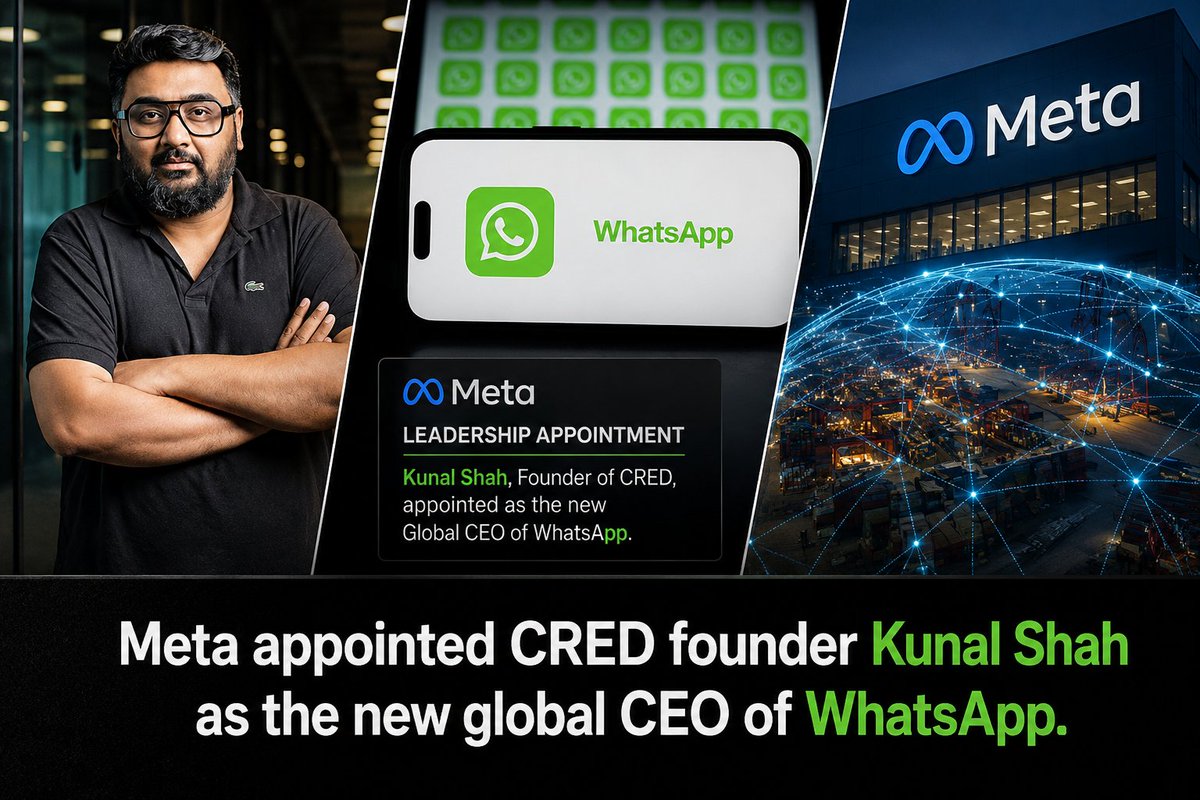
Meta appointed CRED founder Kunal Shah as the new global CEO of WhatsApp.
This major leadership transition was announced alongside a Meta led $900 million investment in CRED, valuing the Indian fintech startup at over $4.5 billion.
Building a network of people obsessed with
• AI
• Startups
• Business
• Finance
• Technology
If that's you,
Follow me and reply "building".
I'll follow interesting people back.
SAP and Google Cloud just deployed something most enterprise retail teams don't have the infrastructure to support yet.
The numbers explain why this matters now.
78 percent of businesses say AI is essential for retaining customers in 2026.
Fewer than 2 in 5 actually share customer data across their own customer experience or CRM platforms.
That gap is the problem. This is the fix.
SAP Commerce Cloud adopts the Universal Commerce Protocol a standard that lets AI agents independently execute the full retail sequence: search, transaction, and post-sale resolution, without requiring retailers to rebuild existing infrastructure.
The technical foundation: SAP Business Data Cloud connects to Google BigQuery via bidirectional, zero copy data linking.
BigQuery ingests live variables weather, location, real-time ad interaction rates.
SAP supplies the internal context customer profiles, transaction histories, consented engagement records.
Google Gemini models dynamically generate localised messaging, imagery, and campaign variations without human intervention.
The result: a Shopping Assistant that retains full context across chat, voice, and text.
Inventory checked before any product is suggested.
Campaigns adjusted automatically after every interaction.
Retailers keep full ownership of the customer relationship even when the transaction happens inside Google Search.
That is the architecture that makes agentic commerce real at enterprise scale.
Dario Amodei was asked what really happened when he left OpenAI.
The man at the center of Silicon Valley's most famous exit didn't take the bait.
"There are many valid disagreements to be had on safety. That alone is not sufficient to leave."
His point: disagreement doesn't end companies. Trust does.
When you feel someone's values are not what they say they are. When you feel they're not honest.
When you feel they're not in it for the reasons they claim that's when the conversation ends.
"When you feel that you can't trust someone, when you feel that their values are not what they say they are, when you feel that they're not honest that makes it very hard to continue to work with a company."
The interviewer pushed: what does winning this actually look like ?
"Why argue with someone when you don't have the same vision and you don't trust them ?
The way to resolve it is you go off and do your thing."
He's not relitigating what happened at OpenAI.
He's building the argument he refused to have.
That is how you win without fighting.
The US government just ordered Anthropic to lock down Mythos and Fable.
This isn't the first time Washington has tried to put a fence around dangerous code.
In the 1990s, a programmer named Phil Zimmermann built an encryption tool called PGP.
The US Customs Service charged him with violating arms export law encryption was classified as a munition.
His response: he published the entire source code as a printed book.
Books are protected speech.
The investigation collapsed.
The encryption Zimmermann built now runs underneath Signal and WhatsApp, used by billions of people every day.
So here's where it gets interesting.
In the 2010s, governments tried again this time with spyware.
They expanded a treaty called Wassenaar to classify hacking tools as dual use technology requiring export licenses.
And if you do the math on the results: Israel never signed on.
Italy kept licensing Hacking Team to sell to authoritarian governments anyway.
Companies that got blocked simply relocated to countries with looser rules.
One spyware maker actually shut down FinFisher, in 2022, after German prosecutors caught it selling to Turkey illegally.
One win in thirty years.
Now Mythos. Only 150 vetted organizations had access before the ban.
The trigger: a South Korean telecom suspected of China ties, and Amazon's CEO flagging a safeguard workaround in Fable 5.
Anthropic had 90 minutes to comply.
History's success rate against dual-use code crossing borders is one for three decades.
I wonder why anyone expects this time to be different.