Misbah Uraizee
600 posts


Misbah Uraizee
@misbahuz
CEO @nectarsocialai, agentic social for brands. ex Meta.


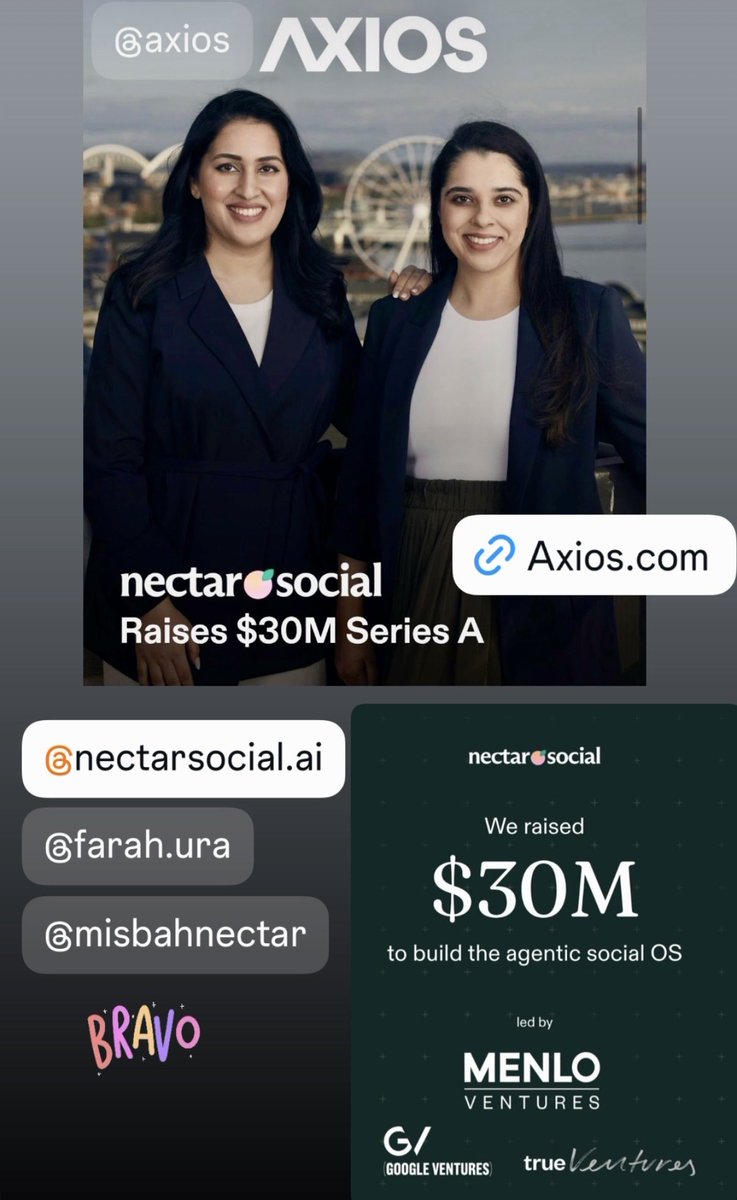
Excited to lead the $30M Series A of @nectarsocialai, alongside @trueventures @GVteam @tonysphere @fffabulous and partner with @misbahuz @farahura 💪 The thesis is simple: 80% of gen Z social media engagement is in private chats and DMs. Brands currently can’t reach this surface area at scale. Until @nectarsocialai Their agents manage 10M+ customer conversations per week across customers like @elfcosmetics and @LiquidDeath and driving $100M+ in new channels. Deployed headless or via webapp. Stoked to work with the team.





I backed NectarSocial.com at the pre-seed, and today they've emerged from stealth with $10.6M in funding co-led by @frederiquedame at @GVteam and @tonyconrad at @trueventures. As an "emerging manager" with @trustfundvc, I'm so proud to have made those introductions — and even prouder to be in the earliest cohort of believers behind Farah Uraizee, Misbah Uraizee, their team, and their vision. 📢 This is a big one. Nectar is the agentic social commerce platform that modern brands have been waiting for. Built by two brilliant sisters and former Meta leaders, Misbah and Farah Uraizee, Nectar is the infrastructure for a new kind of marketing stack — one that doesn’t duct-tape together a dozen outdated tools to guess what’s working. Nectar listens across social platforms in real time. It connects the dots from a TikTok comment or DM to a purchase. It proactively engages customers (and influencers) with nuance and speed. It gives brands full-funnel revenue attribution from social — a sentence that should make any CMO sit up straight. 🧠 Real-time insights 💬 AI-powered social engagement 📈 DM campaigns converting at >12% 💸 6-figure revenue generated for early customers 📊 150% lift in engagement 📣 Influencer monitoring down to the SKU level If you’re building a brand in 2025, you’re not just selling a product — you’re building culture, trust, and community at scale. Nectar makes that scalable. It’s the teammate every disruptor brand needs. This is the operating system for commerce in the attention economy — and I couldn’t be more excited to see them fly. Congrats to Misbah, Farah, and the full team. And a warm welcome to the investors joining this rocket ship: @frediquedame @GVteam @tonyconrad @trueventures BAM, @mercuryfund @ChargeVentures Flying Fish Partners, @xrcventures, FAB — and of course, @trustfundvc 💅 Allie Garfinkle broke the news today here: fortune.com/2025/06/05/nec… And check them out at NectarSocial.com





Initial Claude Design thoughts: 1. First thing it asks for is a design system. I uploaded ours from GitHub. Woukd be curious to see how it builds them from scratch/ websites 2. Love that you can make decks 3. You can first wireframe and the turn it into high fidelity assets 4. Animated videos are pretty good 5. Biggest weakness is you can’t use your Claude code or cowork skills. Really hope we can in the future. For now I’ll try to plan/ brief in Claude code using skills and then copy over to design.
Linear’s CEO just described the biggest shift in product team structure since Agile. For decades, product work meant: PM defines requirements → designers create specs → engineers translate to code. The middle step, translation, absorbed 70% of the time and created most of the friction. Karri is saying that step is collapsing. AI agents don’t need handoff documents or sprint planning rituals. They need structured context about what matters, what constraints apply, and what success looks like. This inverts the leverage points. The person who captures customer intent clearly now has more impact than the person who translates it into implementation. And the person reviewing agent output becomes the quality bottleneck. Linear built their entire product around this bet: structured entities with clear ownership, context attached to work items, feedback connected directly to issues. It turns out the same system that helps humans coordinate also helps agents know what to do. The teams figuring this out first will have a structural advantage. Everyone else will still be writing Jira tickets that read like riddles.
BUILD THE WHOLE PRODUCT If you're a startup CEO, you should think deeply about what Frank Slootman says : "Build the Whole Product, or solve the Whole Problem as fast as you can". In 2026, the biggest winners will be companies who realize that fragmented experiences don't serve the customer well, and will solve the entire end to end problem for their customer. Customers are tired of stitching together five tools that each do 80% of what they need. They want one solution that does 100% of what they need. Fearless, visionary entrepreneurs will build a whole solution for their customer segment, even if it means that solution has to compete across multiple categories, including with entrenched incumbents. Now this doesn't mean they will solve the whole problem for EVERYONE from day one. They will choose very specific customer segments (size, geography, vertical, behavior, etc) and solve the entire problem for that segment, and do it 10x better than the customer could do by cobbling together several systems. And then they will expand concentrically from that initial segment. One of the best examples is Square, which took on decades-old incumbents in payment processing, hardware terminals and POS, and built a hardware + software system that solved the entire problem for micromerchants. Not just software, but also custom hardware that the team built from scratch, despite having zero hardware experience. Why? Because hardware was critical to deliver the whole solution. By doing so, they "compressed" the value chain across 3 industries, and instead of the customer needing to feed 3 profit pools for payments, hardware and POS, they only needed to pay one company, leading to a much lower Total Cost of Ownership. If you're an entrepreneur tackling a WHOLE problem and building a WHOLE product, please ping me. I'd love to connect and chat.
The real moats in 2025: specific workflows, proprietary data with real switching costs, distribution, and UX that makes AI disappear into the job-to-be-done. Simultaneously: we are early (only a % are using AI properly) so this is an amazing time to start a startup.