

MMitchell
22.1K posts
MMitchell
@mmitchell_ai
Interdisciplinary researcher focused on shaping AI towards long-term positive goals. ML & Ethics. Similar content in the Skies (this bird has flown).
Katılım Haziran 2016
1.4K Takip Edilen81.9K Takipçiler
MMitchell retweetledi

As we discuss Mythos-level models, recursive self-improvement, and agentic systems taking over power grids, the paper
"Fully Autonomous AI Agents Should Not be Developed"
remains more relevant than ever.
By @mmitchell_ai, @evijit, @SashaMTL & @GiadaPistilli.
Link below.


English
QME
If you haven't read this piece on language use in around AI, you definitely should. Great work from @emilymbender , @NannaInie and @peter_zukerman with solutions for what to call things we backoff to just anthropomorphising.

English
MMitchell retweetledi

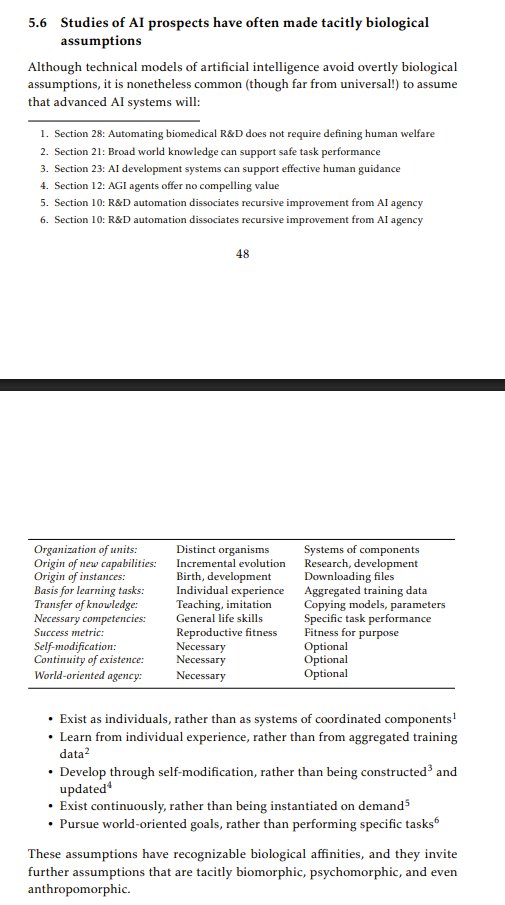
I think these kinds of analogies essentially make a category error. It's a mistake to treat an AI as some sort of persistent situated entity with goals as one would a different species. A lion is a product of Darwinian selection, an AI is not; people port all sorts of biological properties to models but rarely make good arguments for why they apply. (Hendrycks did but I did not find that paper persuasive)
Imo Drexler puts it very well in Reframing Superintelligence: "Emerging AI technologies do not fit a psychomorphic frame, and are radically unlike evolved intelligent systems, yet technical analysis of prospective AI systems has routinely adopted assumptions with recognizably biological characteristics. To understand prospects for AI applications and safety, we must consider not only psychomorphic and rational-agent models, but also a wide range of intelligent systems that present strongly contrasting characteristics."
This doesn't mean that agents can't be goal pursuing or very dangerous, but agency with AIs is an optional, engineered, and bounded property, not an innate drive. Analogies to chimps/humans etc are mostly rhetorical, not actually descriptive. See also: alignmentforum.org/posts/LxNwBNxX…
James Miller@JimDMiller
English
MMitchell retweetledi

Anthropic, Google, and tech donors, including many from the EA movement, are building a network of researchers, nonprofits & academic centers to study the welfare of AI models & whether we owe them moral consideration 🎁 wapo.st/3SDUIhI
English
I am beyond honored to have been selected to give a keynote at Deep Learning Indaba (@DeepIndaba): 4.August, Lagos. I will be cutting into some of the deepest issues I see in AI (hint: it's not alignment) and what I think we can do solve them.
Deep Learning Indaba@DeepIndaba
Who defines AI, and whose interests does it serve? That is the question Dr Margaret Mitchell @mmitchell_ai will bring to the Deep Learning Indaba 2026 keynote stage in Lagos this August. Dr Mitchell is a Researcher and Chief Ethics Scientist at @huggingface Face, where she leads work on ML data processing, responsible AI development and AI ethics. She was previously at Google where she founded and co-led Google's Ethical AI group to advance foundational AI ethics research and operationalise AI ethics Google-internally. She holds a PhD in Computer Science from the University of Aberdeen and a Master's in Computational Linguistics from the University of Washington. She has published over 100 papers on natural language generation, assistive technology, computer vision, and AI ethics, and holds multiple patents in the areas of AI conversation generation and sentiment classification. She has been recognised for her leadership and ingenuity in public fora such as TIME's Most Influential People in the world, Fortune's Top Innovators, and Lighthouse3's 100 Brilliant Women in AI Ethics. Her work has received awards from Secretary of Defence Ash Carter and the American Foundation for the Blind, and has been implemented by multiple technology companies. She is most known for her work pioneering "Model Cards" for ML model reporting; developing "Seeing AI" to assist blind and low-vision individuals; and developing methods to mitigate unwanted AI biases. In her keynote, she will examine the promise and the reality of the pursuit of AI, interrogating the assumptions and fact-checking common narratives. Her case is that the way we advance AI today is largely controlled by a small set of actors with concentrated interests, and that this risks prioritising power, influence and market position over measurable human benefit. It is a session for anyone who wants AI that answers to communities rather than to incumbents. #DLI2026 #Indaba2026
English
MMitchell retweetledi

Who defines AI, and whose interests does it serve?
That is the question Dr Margaret Mitchell @mmitchell_ai will bring to the Deep Learning Indaba 2026 keynote stage in Lagos this August.
Dr Mitchell is a Researcher and Chief Ethics Scientist at @huggingface Face, where she leads work on ML data processing, responsible AI development and AI ethics. She was previously at Google where she founded and co-led Google's Ethical AI group to advance foundational AI ethics research and operationalise AI ethics Google-internally. She holds a PhD in Computer Science from the University of Aberdeen and a Master's in Computational Linguistics from the University of Washington.
She has published over 100 papers on natural language generation, assistive technology, computer vision, and AI ethics, and holds multiple patents in the areas of AI conversation generation and sentiment classification. She has been recognised for her leadership and ingenuity in public fora such as TIME's Most Influential People in the world, Fortune's Top Innovators, and Lighthouse3's 100 Brilliant Women in AI Ethics. Her work has received awards from Secretary of Defence Ash Carter and the American Foundation for the Blind, and has been implemented by multiple technology companies. She is most known for her work pioneering "Model Cards" for ML model reporting; developing "Seeing AI" to assist blind and low-vision individuals; and developing methods to mitigate unwanted AI biases.
In her keynote, she will examine the promise and the reality of the pursuit of AI, interrogating the assumptions and fact-checking common narratives. Her case is that the way we advance AI today is largely controlled by a small set of actors with concentrated interests, and that this risks prioritising power, influence and market position over measurable human benefit.
It is a session for anyone who wants AI that answers to communities rather than to incumbents.
#DLI2026 #Indaba2026

English
MMitchell retweetledi

MMitchell retweetledi

New blog: Future of NLG Evaluation
In a recent position paper, I argued that NLG evaluation in the future needs to be become more rigorous. It also needs to move beyond benchmarks, and focus more on impact, qualitative, and safety evaluation.
ehudreiter.com/2026/06/26/fut…
English

Me fixing a typo in a Google Doc when that's not the thing I'm supposed to be reviewing
English
MMitchell retweetledi

The Atlantic just released a tool that lets you see if your music has been scraped for AI training.
Recordings I sang on in King's College Choir are in there. So is the music of millions of other musicians.
Great work by @_alexreisner.
Check it here: theatlantic.com/technology/202…


English
Super important work for understanding deception and misalignment in AI. 👇
Xin Chen, Cynthia ✈️ ICML2026@XinCynthiaChen
Excited that our ICML position paper has been accepted as an Oral 🎉! When a model looks like it "deceives" or "resists shutdown," how do we know it isn't role-play, instruction-following, or just task-completion pressure? Often the current evidence can't yet tell them apart, and those claims are starting to inform deployment and regulation. We map where the evidence gets thin across four stages and propose a shared standard to strengthen it. Here's the map. 🧵 arxiv.org/abs/2606.07612
English
MMitchell retweetledi

3/10 Stage 1, framing. "Deception" and "intent" are folk-psychology words, not computational ones. The risk isn't using them, it's that two papers can both study "deception" and quietly measure different things.
A good computational definition grounds the concept in something observable. A sharper definition is also more expressive: it lets you separate passive from strategic deception instead of collapsing both into one word.
English
@XinCynthiaChen Yesss I was hoping this study would exist! Thank you!
English
Excited that our ICML position paper has been accepted as an Oral 🎉!
When a model looks like it "deceives" or "resists shutdown," how do we know it isn't role-play, instruction-following, or just task-completion pressure? Often the current evidence can't yet tell them apart, and those claims are starting to inform deployment and regulation.
We map where the evidence gets thin across four stages and propose a shared standard to strengthen it. Here's the map.
🧵
arxiv.org/abs/2606.07612

English
The pros/cons of openness in AI is in discussion again, so my boss headed over to DC to discuss. Let us know if you’d like to chat!
clem 🤗@ClementDelangue
Decided to go to DC next week to talk directly with policymakers. Not sure how impactful it will be but with everything happening, feels like a good time to share more about open-source AI, transparency, concentration of power, the real risks vs the real benefits. Who do you think I should meet there (Congress members, WH people, public orgs,...)?
English