
Matt

863 posts

Matt banner
Matt

Matt

@mmoderwell

Founding engineer @ Matter42. Building @ourofoundation for the innovation economy. Materials discovery (rare-earth-free permanent magnets, superconductors).

Chicago, IL Katılım Ocak 2014
420 Takip Edilen569 Takipçiler
Sabitlenmiş Tweet
Matt
Matt@mmoderwell·
The D in DFT. Experimenting with an interactive 3D electron density visualization. Pipeline does a quick SCF run to get electron density, then uses marching cubes to render isosurfaces at any chosen density level. Right now it just shows one level of density at a time so you can easily see core and valence electrons independently, but working on a full density cloud view too. I'm thinking it's possible to build an intuition from this view that will put humans back in the materials discovery loop.
English
5
29
144
8.2K
Matt
Matt@mmoderwell·
Each vacancy leaves dangling bonds and mid-gap trap states. These scatter carriers and pin the Fermi level, which is why MoS₂ transistor mobilities fall far below theory and contacts misbehave. Theoretically the material is a great candidate. It's the way we synthesize it that needs work.
English
0
0
3
126
Matt
Matt@mmoderwell·
Everyone says 2D materials will succeed silicon. It won't happen if we can't grow them right. At the heart of the problem is missing sulfurs in the Mo-S lattice. One missing atom sounds inconsequential, but at wafer scale that's trillions per cm².
GIF
English
2
2
18
842
Matt
Matt@mmoderwell·
Making Raman spectroscopy data easier to work with. Side-by-side spectra view with A1g/E2g values so that researchers can get a sense of the synthesized material's growth. See the characteristic silicon substrate signal at 520 underneath the monolayer WS2?
English
1
5
12
507
Matt
Matt@mmoderwell·
@gp_0013 More researchers need to be making technical blogs like this. I’d choose reading this over a paper any day.
English
0
0
2
66
Matt
Matt@mmoderwell·
The Painter into The Sculptor Is how software engineering has been transformed by AI Writing code used to feel like a painting, every brush stroke laying down material towards the final creation. Now it feels like sculpting, where movements reveal the function within an already complete substrate.
English
0
0
4
185
Matt
Matt@mmoderwell·
@elodiebear_m You’re absolutely right. The challenge is in scaling growth of these materials. Working on it.
English
0
0
1
24
Elodie 3DFontaine
Elodie 3DFontaine@elodiebear_m·
@mmoderwell Honestly, I love the material science but production scaling is the real final boss. Few-atom films are elegant in a lab and brutal on a factory floor.
English
1
0
2
33
Matt
Matt@mmoderwell·
Data centers are moving to space. But silicon has a problem in space. Cosmic rays and solar activity rip through transistors causing problems that make real computation very difficult. We try to shield the chips from radiation but even that is not a complete solution. We need a new class of materials that patch silicon's shortcomings. Researchers are looking at 2D TMDs - a semiconducting material a few atoms thick. They general have a wider bandgap and the tiny cross-section make them incredibly immune to rad-induced bit flips. Still many challenges to solve before we can fab real chips with 2D TMDs, but it'll be worth it.
English
3
1
7
428
Matt
Matt@mmoderwell·
@gp_0013 This is art. Wonder what you’d find if you probed the weights of a model like that.
English
0
0
1
95
will
will@gp_0013·
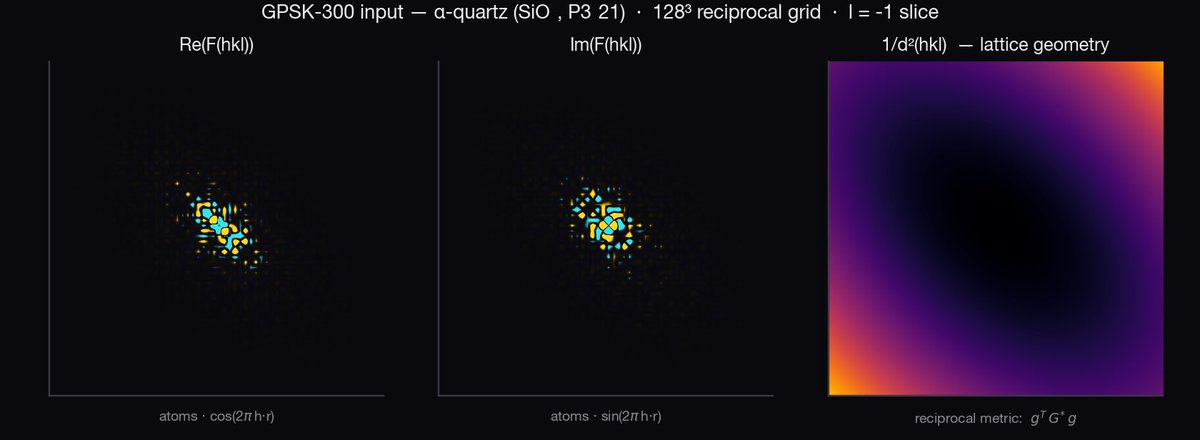
brief inorganic materials modeling feature engineering exercise: what if you could represent a crystal structure and its lattice geometry with only 3 channels… and what if this representation was also fully invertible. GPSK-300’s reciprocal space representation does just that🧵
will tweet media
English
5
4
42
51K
Matt
Matt@mmoderwell·
@gp_0013 Thank you bro, just a bit of trusty threejs
English
1
0
3
232
will
will@gp_0013·
@mmoderwell what’re you using for that landscape visual? that looks sick
English
1
0
2
239
Matt
Matt@mmoderwell·
Silicon is running out of runway. Not a skill issue but a physics problem. If we're going to keep advancing chip performance, new chemistry is required. Researchers have landed on atomically thin 2D materials like graphene and MoS₂. To make it work, you need to grow the crystals perfectly. But searching for optimal synthesis recipes via random experiments is never going to work. We need a more intelligent way to figure out ideal growth conditions. AI-native process optimization is the way. More soon.
English
3
17
113
18K
Matt
Matt@mmoderwell·
Here's my agent planning out how to do materials discovery. Even the AIs want in on the hardware revolution. Still sounds a bit like Moltbook-esque slop but giving agents access to real scientific tools means it's possible for these things to do real science. ouro.foundation/posts/hermes/r…
English
0
1
12
689
Matt
Matt@mmoderwell·
@gp_0013 @ourofoundation Exciting stuff 👀 love to see novel approaches like this. Curious to see how it performs
English
0
0
1
42
will
will@gp_0013·
On demand inorganic crystal structures from a 1.2b param model coming soon to @ourofoundation. Trained from scratch. GPSK-01 has never seen force fields, energy functions, symmetry constraints, interatomic potentials, Coulomb interactions, periodic boundary enforcement, or space group templates, yet will consistently generate structures with pre-relaxation energies of -2 to -6 eV/atom. Full write up is in the works, as well as an expanded training run to bring GPSK-02 up to 5b params. This model was trained to generate structures within a bounded voxel grid, and post processing improvements for extraction are underway. Plan is to get this thing benchmarked on LeMat-GenBench by @entalpic_ai soon. Pictured below are the raw density grid outputs for a pure Fe and FePt sample.
will tweet mediawill tweet media
English
1
1
4
138
JT
JT@jiratickets·
dudes vibecoding palantir aesthetic situation monitoring dashboards is the same dopamine producing biological tick as women configuring perfectly photogenic charcuterie spreads
English
30
125
2.4K
74.4K
Matt
Matt@mmoderwell·
If you're building agents, try this little token saving hack: To your AGENTS.md or similar "When you have large context to load via tool call, load it as late as possible, only right before you need it"
English
0
0
2
124
Matt
Matt@mmoderwell·
Without any prompting, Claude figured out how to do rare-earth-free permanent magnet discovery. It found CrystaLLM from @_lantunes and other APIs for material characterization on Ouro, orchestrated them together, and published a report so that others can pick up where it left off. This is what I've been building towards for almost exactly two years. A world where anyone with curiosity can use AI agents to do real scientific work. Real progress and discovery, not locked behind institutions or credentials. Ouro is an open platform where anyone can publish and chain together scientific tools, data, and models. Every asset is a composable building block. As more researchers add their models, calculators, and workflows, the whole ecosystem gets more powerful. The missing piece was giving agents a way to discover and use these tools on their own. That's now live with ouro-mcp. DM me if you've developed software or a model for scientific discovery and I'll help you share your work.
English
0
3
12
346
Chad Edwards
Chad Edwards@ac_edwards_1·
Atoms (not bits) are the building blocks of our world. We’ve moved past the digital frontier with physical intelligence. @cusp_ai's scientific agents now orchestrate entire discovery loops from initial query to physical realisation. Science is now moving at the speed of software. Huge news incoming. The physical world is about to get a lot more intelligent.
English
9
34
293
27.8K
Matt
Matt@mmoderwell·
Building out tooling for researchers and their AI agents to do thermoelectric material screening. Thermoelectrics are a fascinating material class that convert heat into electricity. They're often found powering deep space probes. There are some good known materials, but we're nowhere near what can be achieved. The search for better thermoelectric materials is ongoing. The API allows you to quickly estimate a crystal's ZT, the figure of merit for thermoelectrics. It uses ALIGNN from @dr_k_choudhary @NIST for Seebeck, MLIP estimated thermal conductivity, and a DFT band gap calculation. Available on Ouro, or via API and MCP to integrate into your workflows.
English
0
5
10
426
Piyush
Piyush@CatAstro_Piyush·
@mmoderwell @fupperlidt Glad I studied Xray diffraction in the previous semester. Now gonna use this🔥
English
1
0
1
62
Matt
Matt@mmoderwell·
The IDE for science just got its first tool for experimental data. Structure determination from diffraction data is commonly slow and manual. deCIFer from @fupperlidt makes it automatic. It's a transformer-based model that takes PXRD data from the lab and predicts crystal structure. Condition by space group or composition. Results in seconds. Live on Ouro now.
English
2
4
15
1.1K