Apprentice
1.3K posts

Apprentice
@monadivalence
Type theory daisuki! Profile picture by @sealily___
Katılım Şubat 2023
274 Takip Edilen210 Takipçiler




A piece of code (a quotient inductive type) in
arxiv.org/abs/2502.20496
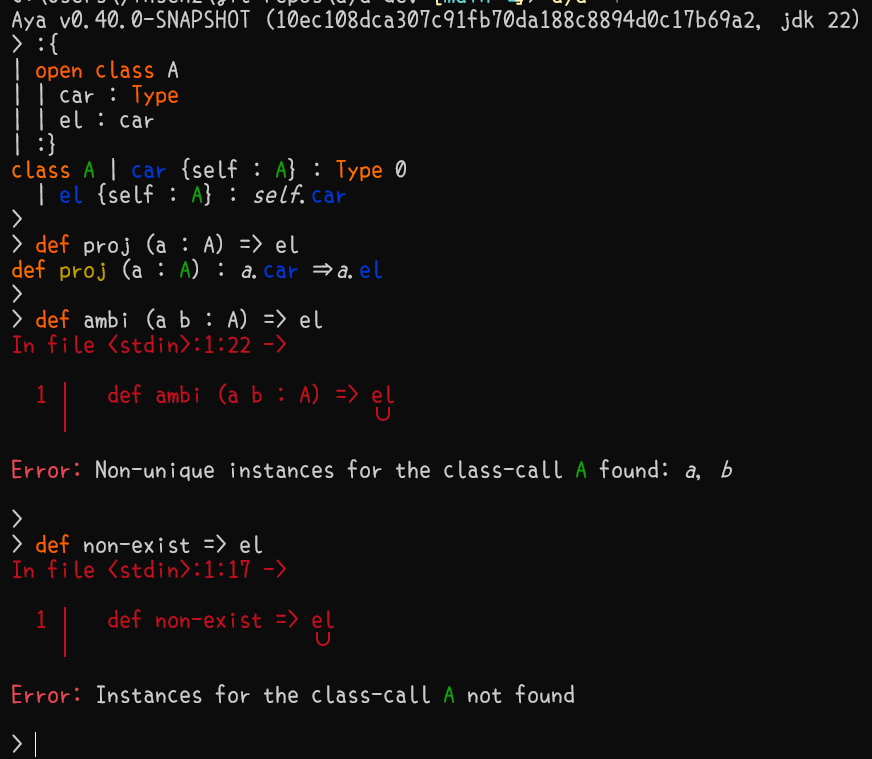
can be written in Aya. Note that the one-linear function `paint` and `strip` are mutually-recursive with `RBTree`.
English


@michael_kove @tekbog Thank you for saying this so I don't have to make a reply myself.
I'm glad that monkeys have finally found the right tool, though.
English

You're not their target user.
The IDE isn't built for "vibecoders".
That being said, their Junie Agent is on par and even more robust when tasks are properly defined.
I use both, but for a enterprise grade application, you can't beat JetBrains.
Most indie hackers don't need it.
English

jetbrains truly fumbled so hard to get anything done in the AI world
got beaten by a vscode fork, several forks even

English
@TheEduardoRFS @krismicinski @onehappyfellow That's why I implemented them in my set-level language, to become a better syntax for quotients
English
@TheEduardoRFS @krismicinski @onehappyfellow Cubical Agda is indeed a lot of fun. I love higher inductive types
English

type fuckheads, assemble! I request your help:
what's a good approach to proving properties of code you intend to execute? let me explain:
English
@TheEduardoRFS @onehappyfellow @krismicinski Quotients are not higher. They're still set-level, but in a syntactically more interesting way
English

@monadivalence @onehappyfellow @krismicinski Same, I think the dependent type theory and "respecting" the equality is the useful bits.
But as long as you're dealing with traditional data types you're in usually set-level type theory anyway.
And even for the higher bits, you're often dealing with quotients only.
English
@scheminglunatic @krismicinski @TheEduardoRFS @onehappyfellow There isn't a path between them imo. Code is usually about set-level structures. I barely notice any interesting homotopy amongst program equivalence
English
@onehappyfellow @krismicinski @TheEduardoRFS My current conclusion is that they will help you understand dependent type theory, which is helpful. But when you reason about programs, you still want to use a Set-level type theory, as opposed to these which I refer to as higher (-dimensional) type theory
English
@krismicinski @monadivalence @TheEduardoRFS i don't mind the thread flowing away from the topic as long as it's interesting
it'd be cool to understand what univalence/hott/ctt bring into verifying program correctness, even if I don't end up using it
English
@onehappyfellow @TheEduardoRFS Tbh if you *just* want to learn about univalence, cubical Agda probably won't help
English
@TheEduardoRFS i really need to learn cubical Agda don't I?
English
@theodorvaryag Though I mostly disagree with this guy
Haskell is indeed C++ in FP
English