Sabitlenmiş Tweet
Hannah Moots 🏺🧬
1.2K posts

Hannah Moots 🏺🧬
@mootspoints
Find me on 🦋 - https://t.co/HGmEkA4lri | Archaeology & Ancient DNA | Mobility in the Iron Age & Roman Mediterranean
Katılım Kasım 2010
1.3K Takip Edilen1.5K Takipçiler
Hannah Moots 🏺🧬 retweetledi

Excited to co-organize a session with @mootspoints at @TRAC_conference 2025!
🧬 Integrating Ancient DNA with Archaeological Theory and Practice
We welcome papers on mobility, migration, & identity in the Roman world and beyond.
📢 Call for abstracts now open!
#TRAC2025 #aDNA

English
Hannah Moots 🏺🧬 retweetledi

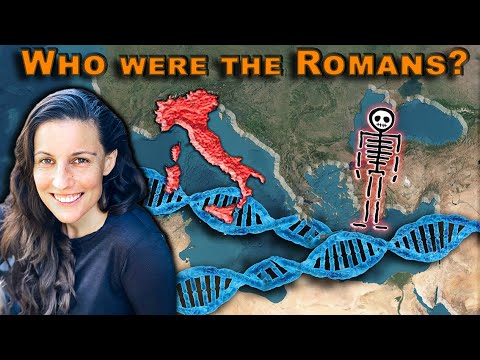
Fantastic conversation with Dr Hannah Moots @mootspoints about her research into the genetics of ancient Rome, and the misinterpretations that exist on social media
Re-posted from the #RealArchaeology lvestreami, in case you missed it!
youtube.com/watch?v=FhaMC4…

YouTube
English

@HaraldRingbauer @iosif_lazaridis And I worry a bit about restricting certain ancestries to certain continents/regions. For instance, I don’t think anyone would say Western hunter-gatherer (WHG) is the only indicator of “European” ancestry
English

@HaraldRingbauer @iosif_lazaridis Definitely, but I'm not sure this ancestry profile disappearing and then re-appearing is more parsimonious than continuity.
English


@HaraldRingbauer @iosif_lazaridis Thanks for your reply, Harald! We also observed this trend of clines with the center of the PCA in plots w/ more data. This one is primarily Iron Age & Roman period individuals from Antonio et al 2024 (again, made a long time ago, and would look better if I had used shrinkmode)

English

@mootspoints @iosif_lazaridis @HannahWells_13 3) The second PCA cline you claim to find is based on very scarce data - did you formally fit it? Because I think starting a cline from the center of Iberia points more towards Algeria IA ⬇️🤔
But it all feels like a Rorschach test to me, based on so few outliers.

English

@iosif_lazaridis @HaraldRingbauer Thanks so much for the reply, Iosif! I think more than trying different competitive qpAdm models, it would be important to study how the diversity of North African ancestries are represented at a given site. And I totally agree you that with more data, it becomes more feasible!
English

@mootspoints @HaraldRingbauer Ideally we would want to simultaneously estimate ancestry from both sources in a single model (if standard errors don't blow up when including similar sources); alternatively when either source alone is considered, the model's resilience can be tested by placing the other->Right.
English

@iosif_lazaridis @HaraldRingbauer ...and only 1 from North Africa. My concern being that this might lead to an underestimation of local, North African ancestries identified at these sites, especially when this is a conservative modelling approach, as you mention in the supplement.
English

@iosif_lazaridis @HaraldRingbauer Of course, the scarcity of data is a challenge, but I think it’s important to investigate and discuss multiple North African ancestries (plural), in a way that’s in-line with how other regions are treated. For instance, your qpAdm modelling has 5 sources from Southern Europe

English

Had a great time speaking w/ Anthony Kaldellis about studying the people of ancient Rome using archaeogenetics and allied disciplines. At Isola Sacra, the necropolis for Rome’s primary port, genetic ancestry and mobility isotopes tell *very* different, but complementary, stories

Medievalists.net@Medievalists
The Genetic History of Rome, with Hannah Moots medievalists.net/2025/01/the-ge… #Podcast
English