

Mario Román
604 posts
Mario Román
@mroman42
This account is mostly inactive. Please do reach me via email :) https://t.co/NPHLcBtWu2
Katılım Şubat 2015
283 Takip Edilen330 Takipçiler
@sarah_zrf Yay! Is this homotopy.io? I have the composition of lenses written there but can you do animations?
English
Mario Román retweetledi

Mario Román retweetledi


Mario Román retweetledi

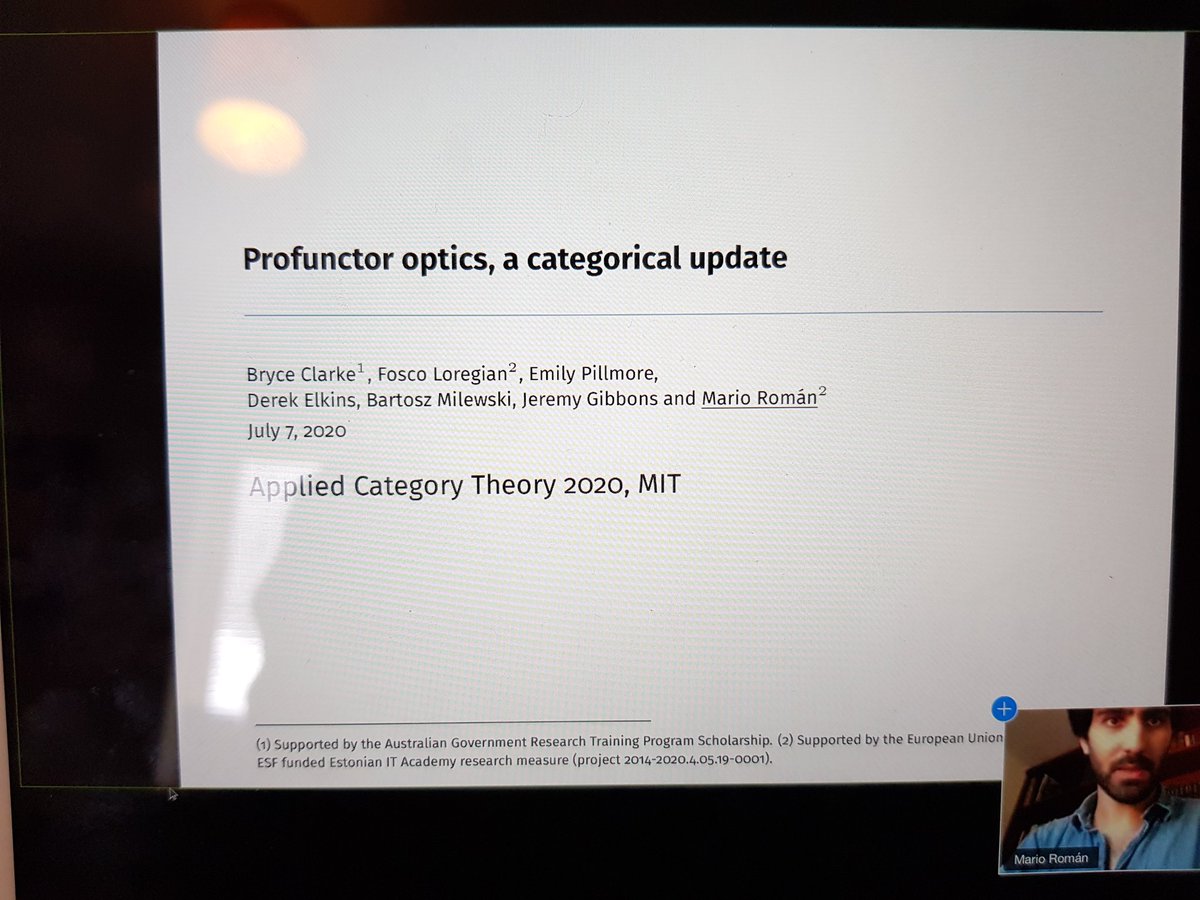
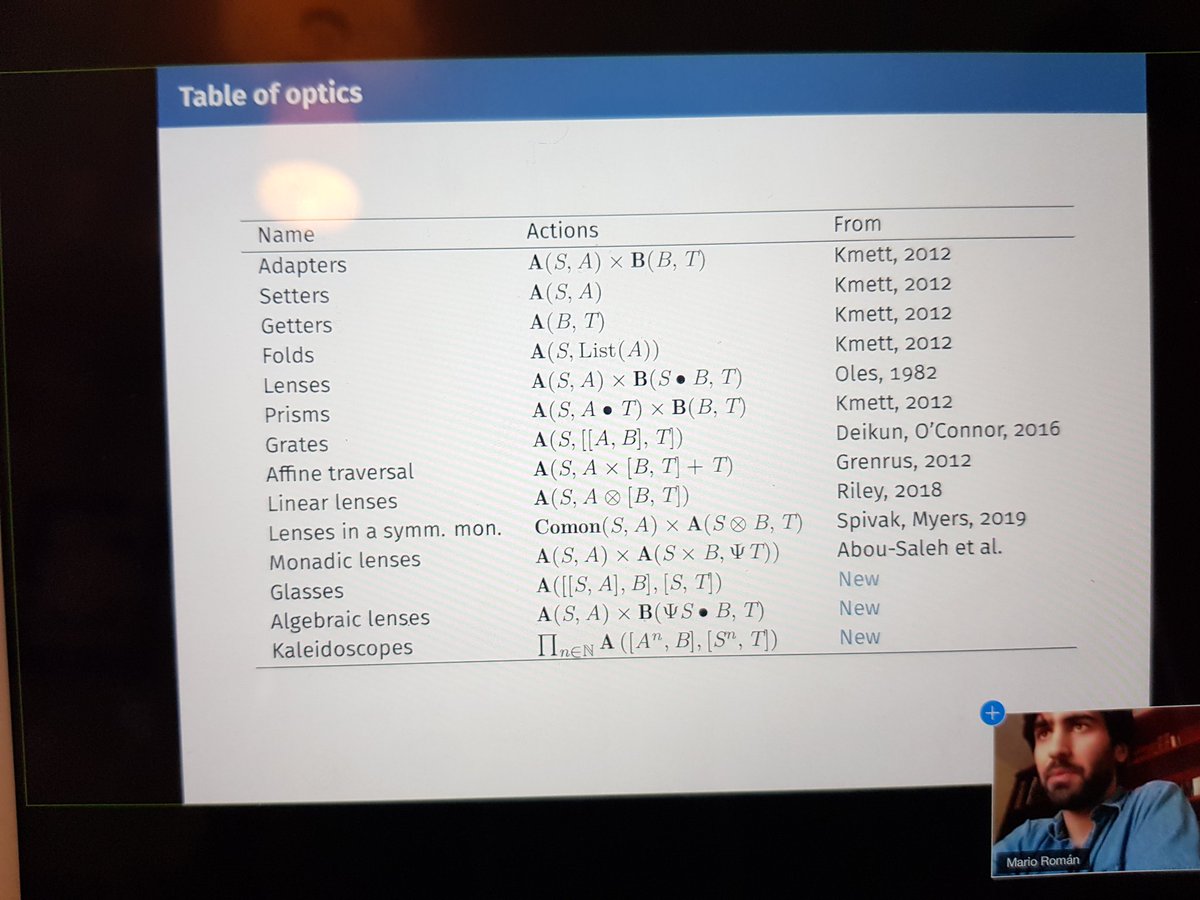
What a nice surprise! Our paper "Profunctor Optics, a Categorical Update" has been accepted for a keynote at Applied Category Theory 2020. When I was first approached to mentor at the ACT 2019, I though I had nothing, and almost declined the offer. But the great team did it!
English
Mario Román retweetledi

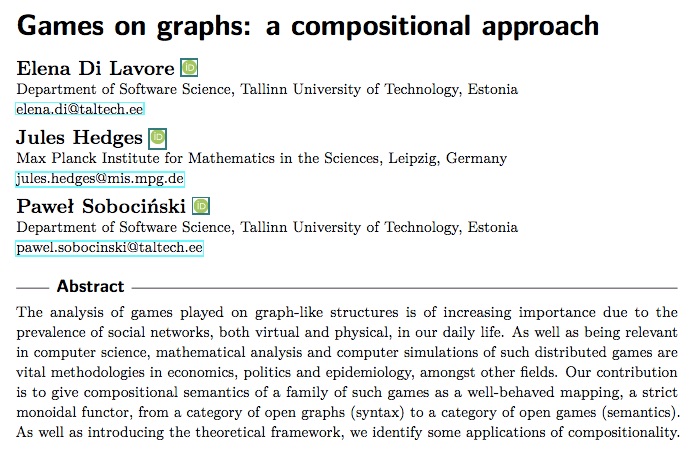
New preprint time! Games on graphs: A compositional approach, with Elena Di Lavore and @PawSob
The punchline: "Open games on open graphs" are strong monoidal functors from the category of open graphs ("syntax") to the category of open games ("semantics")
arxiv.org/abs/2006.03493
English
@star_autonomy Both online editors (TikZiT, Mathcha) and then manually tweaking the tikz code later with the text editor. It takes a bit of patience and has some problems, but sometimes it is easier than pure tikz.
English
@star_autonomy Hi, Nicolas! something that works is to let distributors compose to form sets of possible meanings; a point tracks one of them. The intuition in arxiv.org/abs/2004.04526 can be useful. There are variations on this. It is in progress; hopefully, we will have something written soon.
English
@Nadrieril @_julesh_ This! I think I was assuming the monoidal to be a cartesian product so that forgetful preserves it and then EM -> C -> [Kl,Kl] is composition of strong monoidal functors.
English
I have a technical question about optics, since basically all of the experts on optics are on twitter
For Reasons, for a commutative monad T (say on Set) I'd like to talk about mixed optics where the forwards part lives in Kleisli(T) and the backwards part in Alg(T). (1/n)
English
@_julesh_ I think we talked about this in Tallinn and the proposal was
∫{C ∈ EM} . EM(MS, C × MA) × Kl(UC ⋊ B, T)
≅
∫{C ∈ EM} . EM(MS, C) × EM(MS, MA) × Kl(UC ⋊ B, T)
≅
EM(MS, MA) × Kl(UMS ⋊ B, T)
≅
C(S,MA) × C(MS × B, MT)
Not sure if that is what you want; it is still subcat
English
@8ryceClarke Thank you, Bryce! These things owe a lot to the work together with the ACT group :)
English
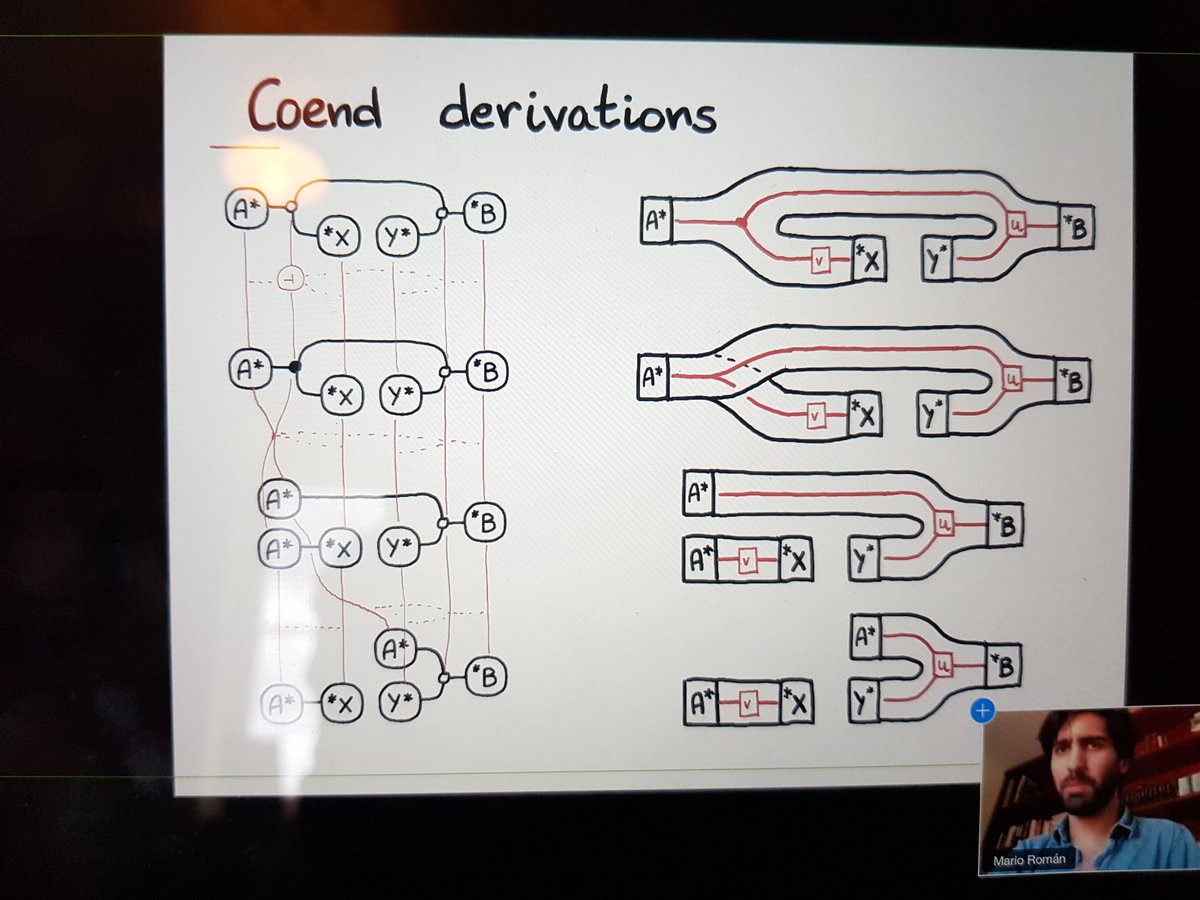
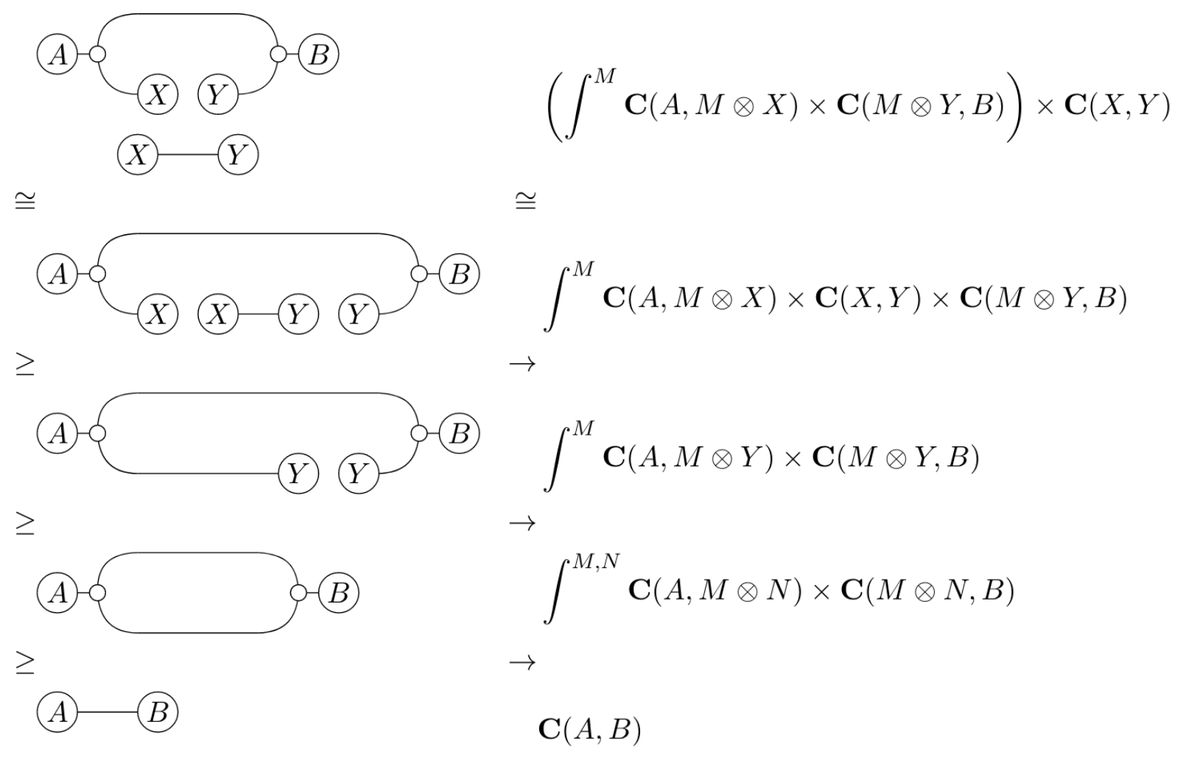
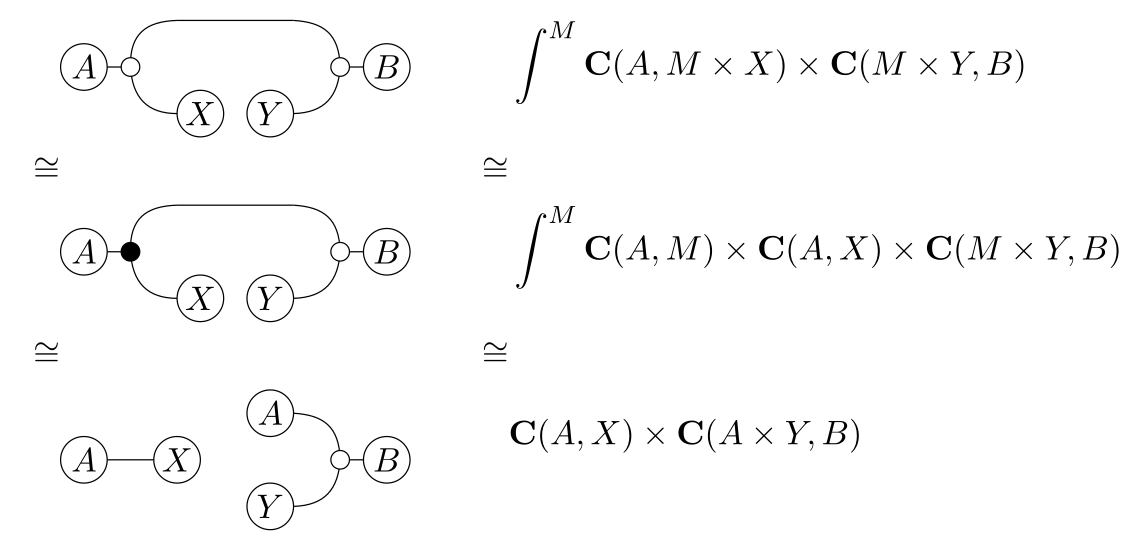
Coends, graphically :)
For instance, this is how to compose a lens with a continuation.
English
@sir_deenicus This is a coend, a particular kind of colimit. So, yes, in some sense, it is analogous; but it is not an integral (at least not in any obvious way). This is a nice intro to coend calculus here: arxiv.org/abs/1501.02503
English
@mroman42 This notation is opaque to me but I'm curious about what the integral notation signifies. Is there some interesting analogy here? Or is something actually being summed?
English
@coecke That is, one is a monoid, creating a bimonoid with the cartesian structure. But then we also have their adjoints.
English
@coecke Black comonoid copies and discards white monoid (or any representable functor); black monoid copies and discards white comonoid (or any correpresentable). White-black monoids coincide iff C is cocartesian; white-black comonoids coincide iff C cartesian.
English
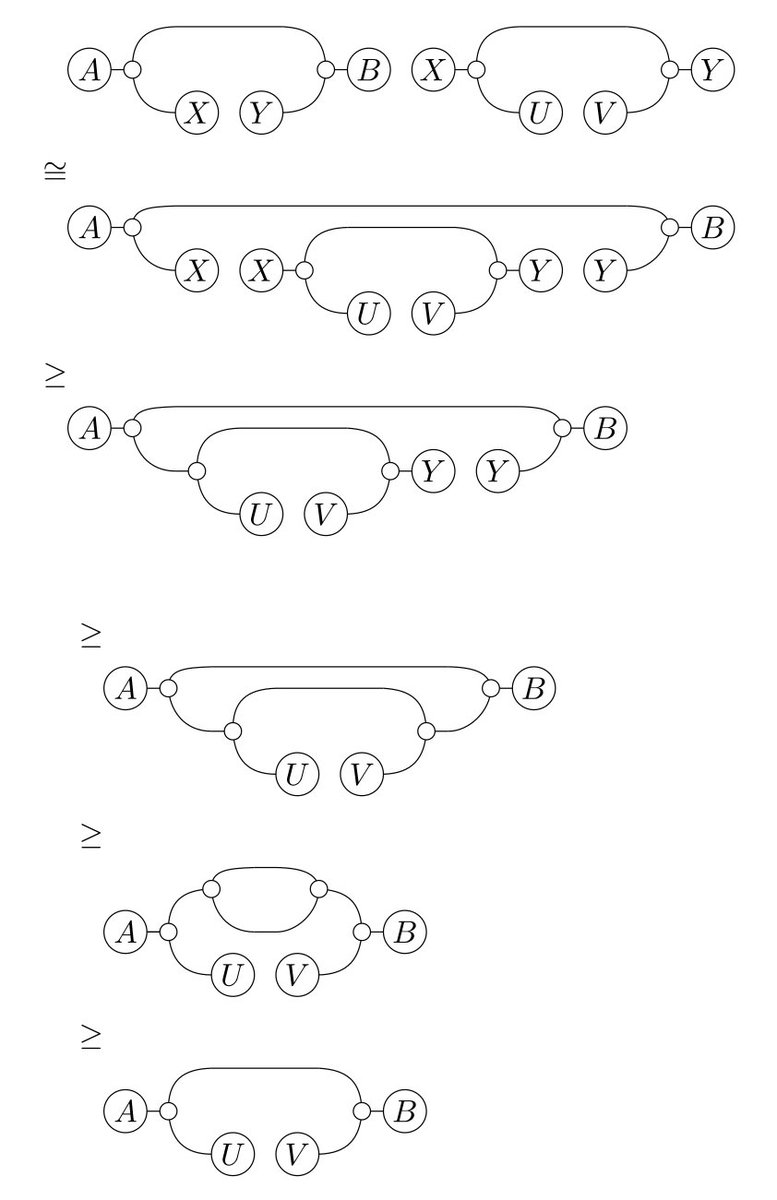
@rwolffoot @PawSob I may be using notation that suggests squashing but it is not intended to mean squashing, 2-cells are still natural transformations.
English

@PawSob @mroman42 It's explicitly a generalisation (without squinting), isn't it? It's Carboni-Walters II, except @mroman42 has replaced proper 2-cells by an order relation. I guess the question is: is this squashing down of 2-cells legitimate when talking about these higher-order structures?
English
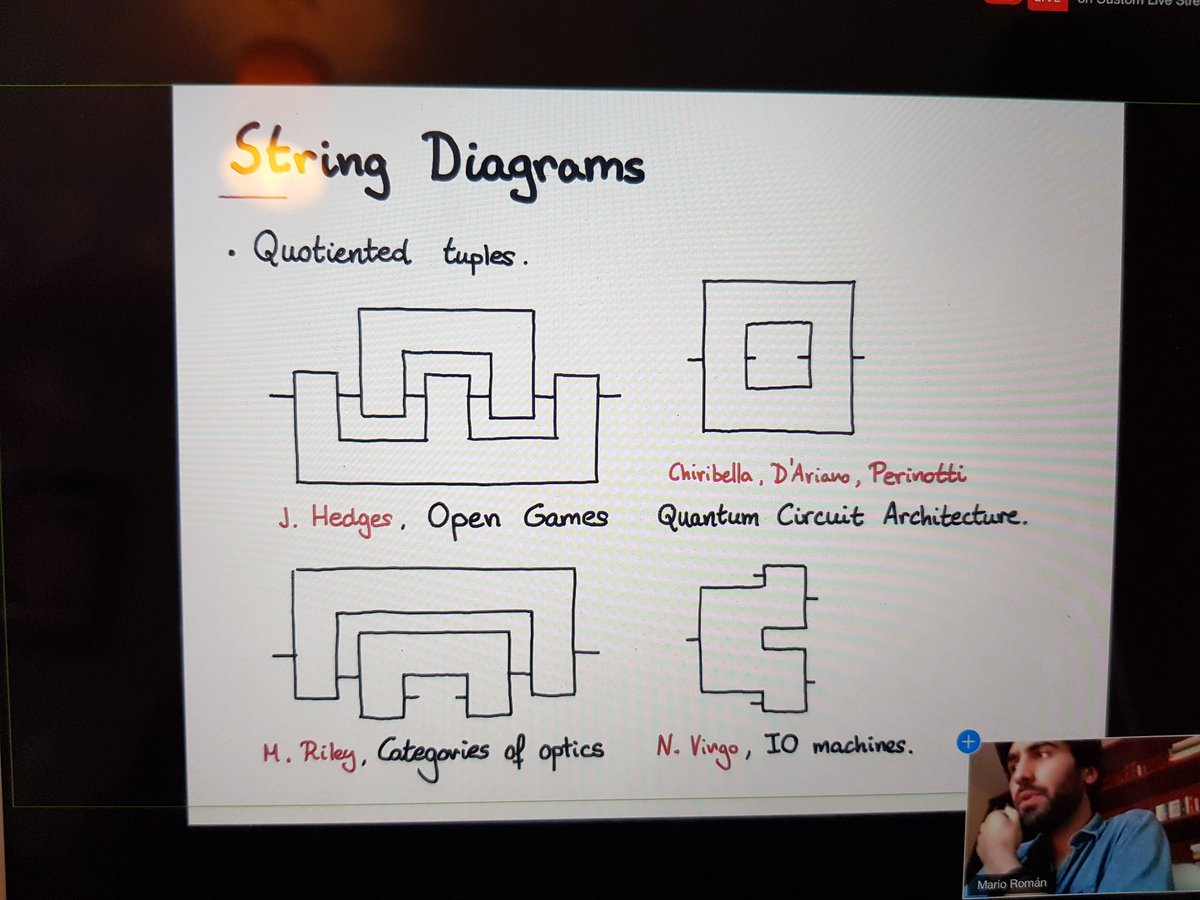
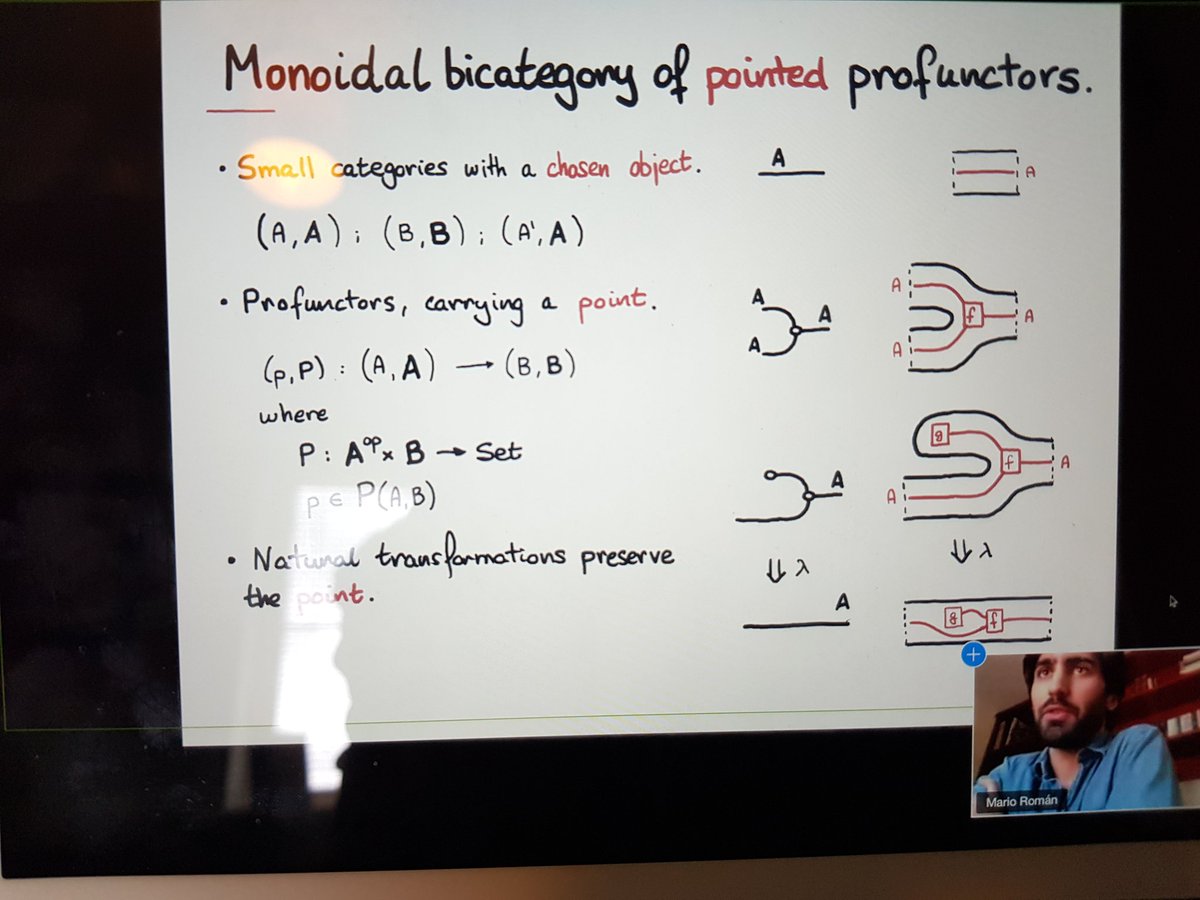
@_julesh_ The open boundaries are nodes in the monoidal bicategory of profunctors. Unlabelled structures are the monoidal product (white) and the comonoid structure lifted from Cat via Yoneda (black).
English
Mario Román retweetledi

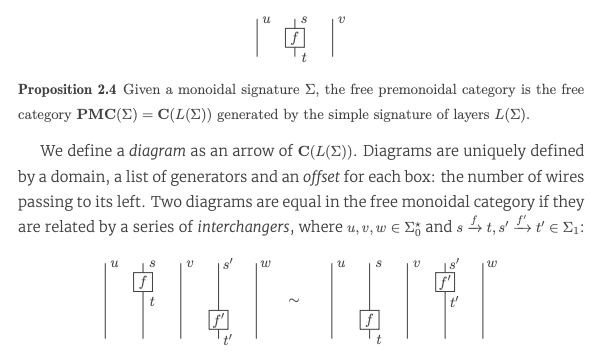
Just released a new version of DisCoPy! github.com/oxford-quantum…
A cool new feature is a drawing function which turns a diagram into TikZ code, ready to copy and paste in a LaTeX article. That's how I wanna draw all my diagrams from now on.
English
@xgrommx Ends appear naturally here as natural transformations, but in principle, this is more suited for coends.
English

@mroman42 how about ends? as I can see here u use existential, but how about forall?
English
@tangled_zans In this case, I am calling continuation just to a function embedded into Optic (!), and then using coends to describe optics.
English

@mroman42 woah! i really need to learn the coend calculus. what's the link between coends and continuations?
English