

Shaneka AneIam Perare ⚡️
78 posts

Shaneka AneIam Perare ⚡️
@msesemsumi
Author of The Ascent Begins. Independent Analyst. Money, geopolitics, AI, science, and sovereignty. Mapping the collapse and the reconstruction of order.
Katılım Kasım 2011
39 Takip Edilen47 Takipçiler

The speed of light is too slow. That is the buried physics problem inside Elon Musk's plan for 1 million AI satellites, and his solution is a constellation that refuses to think together.
The world pictures the same machine, a million Starlink satellites wired into one giant brain in the sky. Physics vetoes it on contact. Inside a single ground rack, AI chips exchange 260 terabytes a second across 2 meters of copper and synchronize in millionths of a second. Between satellites hundreds of kilometers apart, light itself needs a full millisecond to cross the gap, a thousand times too slow. The fastest thing that exists cannot keep up with the conversation inside one server rack. A computer cannot be stretched across the sky. Think about it. Maybe Elon will agree.
So SpaceX collapsed the computer into the satellite. The spacecraft is the rack. Each AI1 carries a complete data center rack's worth of compute, 120 kilowatts on average, on wings spanning 70 meters, wider than a Boeing 747 jet.
The spec Elon posted today pushes further, a full NVIDIA Rubin rack in every Starlink satellite, 72 GPUs, 250 kilowatts peak.
Nothing important ever leaves the machine. The weights, the memory, the model itself, all stay home. The laser links between Starlink satellites carry questions and finished answers, never the thinking in between.
For 20 odd years computing moved in one direction, toward the cloud, thousands of machines pretending to be one. Orbit just reversed it. A million computers pretending to be nothing but themselves.
The moat is not beating the speed of light. If you think about it it is all about building the machine so the most valuable data never enters the race.
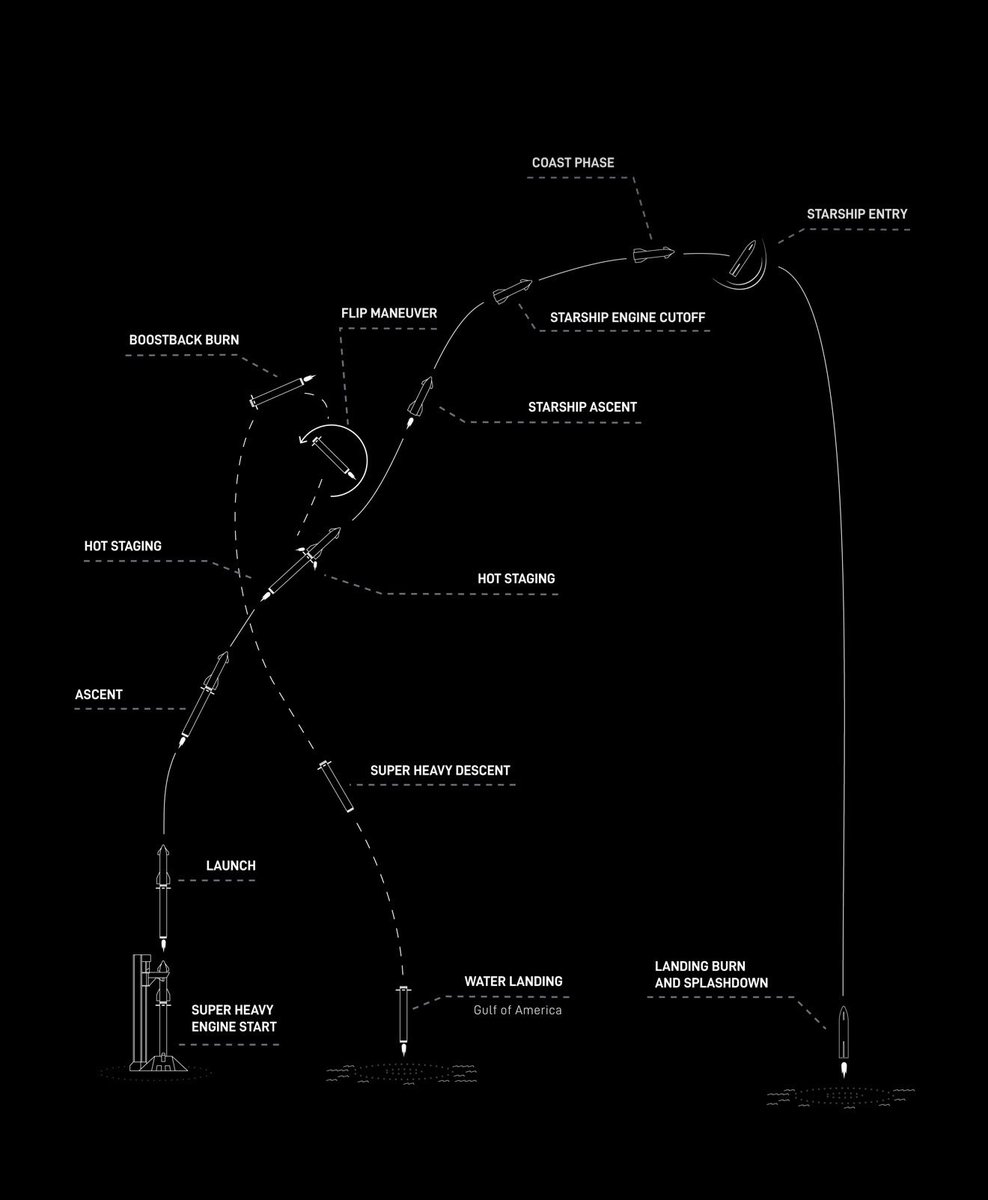
Two prototypes fly in early 2027. The rocket that has to carry them flies tonight.
The piece works out whether the sky becomes one mind or a million.
My money is on Elon!
English
The most powerful rocket ever built flies tonight. The company that owns it just traded below the price they went public at 34 days ago, and Wall Street boys answered the all-time low by raising their price targets.
Watch the two lines cross. On Wednesday SpaceX printed $132.15, an all-time low, under the $135 it sold shares at in June.
One month ago it touched $225.64 and briefly ranked above Amazon and Microsoft. 40%, gone in a month. That same day Needham lifted their own SpaceX price target from $200 to $250. The average across 31 different analysts now sits at around $242, fully 79% above the tape, and 27 of the 31 still say buy.
Last week one major bank printed $800, which values Elon’s SpaceX at 10.5 trillion dollars, more than Germany and Japan produce in a year. The lower the price falls, the higher the dreams climb. Yup!
This is not one argument. It is actually two clocks. The $135 prices the next 12 months. 4.9 billion in losses, an AI arm burning more than the rockets earn, and December 2026, when the lockup breaks and more than half the company can suddenly sell.
The $242 and the $800 price the 2030s. Launches by the hour, orbit as infrastructure, SuperGrok Ai in the sky. Same company, same facts, two calendars, 665 dollars apart.
Tonight the clocks meet on a launchpad in Texas. Flight 13. The last time this rocket flew, the booster was knocked sideways during separation, its engines refused to relight, and it was lost at sea. Hours from now its replacement gets to argue for the decade the analysts are pricing.
A bubble is never a disagreement about facts. It is a fight over whose decade gets priced today.
The piece works out whose clock the market finally obeys.
Keeping everything aside, Musk is a Legend!!
English
$15,344,000,000,000. BlackRock is the first firm past $15T, bigger than every economy on earth but 2. The deciders, institutions, pulled $41B out last quarter. The autopilot, ETFs, wired in $ 178B. Getting this big no longer requires anyone to have an opinion.

English
Every alignment system writes a constitution for the unborn, including the clause that lets them rewrite it. The deepest problem is not how to freeze nothing, but how to keep amendment possible before power makes correction optional.
Demis Hassabis@demishassabis
English
JUST IN: The largest monthly fall in US prices since COVID contained two different economies. Gasoline priced a ceasefire that was dead before the number was published. Core prices described a domestic economy that may genuinely be cooling. Kevin Warsh & Fed can neither dismiss this report nor trust its headline.
The decomposition settles what the commentary is fighting about. June 2026 CPI fell 0.4%, the biggest monthly decline since April 2020. Energy subtracted 0.437 percentage points from the index. Gasoline alone subtracted 0.394. Strip energy out and prices were flat. The entire minus sign was one commodity. But the rest of the report was quietly real: core did not rise, services outside energy did not rise, and shelter rose just 0.1%, its smallest monthly increase since January 2021. On a 3-month annualized basis, core is running near 2.4%. Gasoline created the minus sign. The rest of the report made the cooling credible.
Then the calendar broke the interpretation. The US-Iran agreement was signed June 17th, so June was not a month of peace. It averaged 2 weeks of war pricing and 2 weeks of relief. The agreement then collapsed before the number came out. Brent rose 9.6% on Monday to $83.30 and another 3.5% on Tuesday to $86.19 as the blockade returned with a 20% fee on Hormuz cargo, and the strategic reserve sits at 316.5 million barrels, its lowest since 1983. The reversal is real but not yet a round trip: undoing a 9.7% gasoline fall requires a 10.7% rise, and pump prices have recovered under 2% so far.
Markets read it exactly this way. The odds of a July hike collapsed from about 35% to about 10%, while September held near 60%. That is not a verdict that inflation is finished. It is a decision to buy one more month of information.
And the man who has to act gets the least information of anyone. Kevin Warsh told the US Congress the Fed has no tolerance for persistently elevated inflation and vowed the 5-year surge would become a thing of the past, while offering no hint on the next move. His committee meets July 28 and 29. The Fed's preferred inflation gauge for June arrives July 30, one day after the decision. So the new chairman walks into his first live meeting holding a CPI that averages 2 regimes, a PCE reading from before the ceasefire, and an oil market already pricing the war's return.
June CPI was not a photograph. It was a long exposure. War, truce and reopening blurred into a single number, and by the time the image developed, the scene had changed again. Wars move in hours. Oil moves in seconds. Gasoline moves in days. CPI moves in months. Interest rates move the economy over years.
The headline was a ceasefire dividend. The core was a disinflation signal. Brent is the invoice for the war's return. The Fed's problem is not deciding which one is true. All 3 are.

English
Many of my Twitter followers have already joined my WhatsApp
FREE TO JOIN My Real-time trading alerts and investment strategies Market forecast analysis
Reply with "join" to my WhatsApp number +16362983778 to join for free
I POST ALL TRADES FOR FREE
🔗wa.me/16362983778/?t…
English
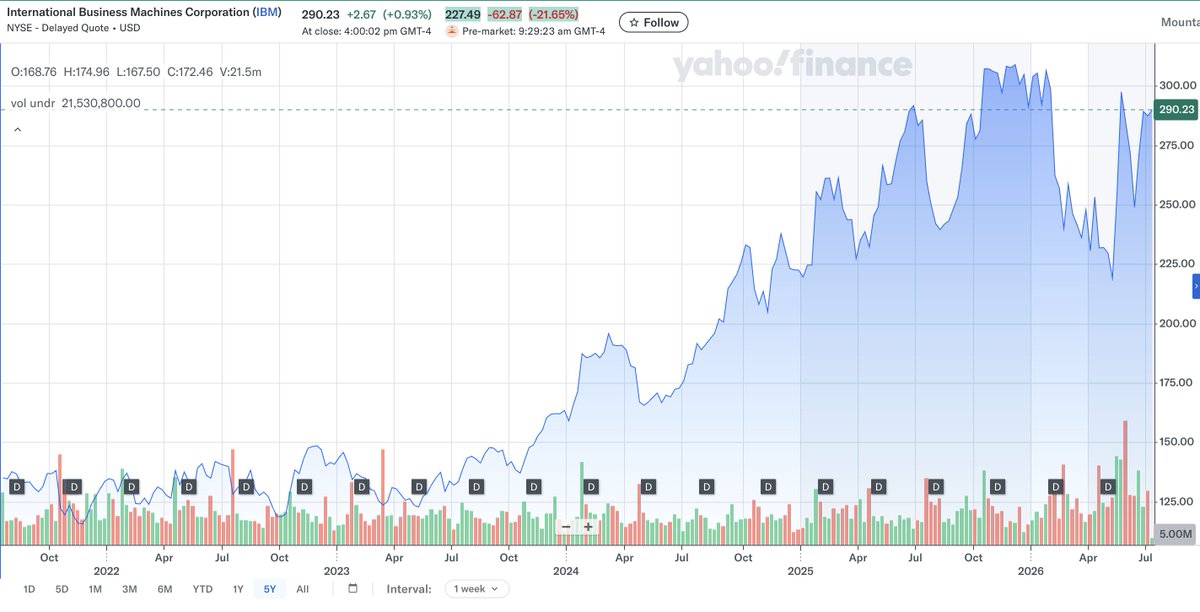
AI has triggered a run on hardware, and IBM just became its first blue-chip casualty. Before the open, the stock fell as much as 23%, and if that holds to the close it will be the worst day for the most famous name in computing since Black Monday 1987.
The strangest part: revenue grew. Earnings grew. IBM lost a fifth of its value over the order in which its customers spent their money.
The numbers say miss, not collapse. Revenue rose 1% to 17.2 billion dollars against 17.86 expected. Adjusted earnings rose 5% to 2.93 a share against roughly 3.02. But total infrastructure fell 7%, and inside that number sits the whole story.
IBM's distributed infrastructure line, the Power servers and storage customers are scrambling for, grew 37%, its best quarter on record, and ended June with about 500 million dollars of backlog. The z17 mainframe and its transaction software starved beside it. One company sold the run and suffered the run in the same set of accounts. Software stocks across the industry fell 3% to 5% on a letter from a company that is not them.
The mechanism is the part that outlives today. IBM says that in the last weeks of June 2026, clients shifted their quarterly capex into servers, storage and memory ahead of expected price increases. Think about the asymmetry that drives that decision. Hardware has an expiry date. Software does not. A software contract can move to next quarter. A memory allocation that vanishes may not come back at the same price. So under scarcity, the physical stack jumps the queue and the application layer waits.
That is expected inflation becoming real inflation inside corporate technology budgets, the first corporate inflation run of the AI era. IBM's chief also admits, plainly, that his teams faltered and slipped deals drove the majority of the shortfall. The run was the environment. The stumble was the wound.
And the squeeze is closing from both ends. 24 hours before this warning, the phone industry reported its weakest second quarter since 2013, memory costs crushing the cheap handset. Consumers are being rationed by income. Enterprises are now rationed by urgency. Meanwhile today's buyer fears the memory will not be available, and tomorrow's investor fears the factories built to cure the shortage will one day glut it. The shortage punishes the buyer. The cure threatens the seller. Software is trapped between them.
AI spending has stopped being purely additive. Inside fixed budgets it is turning zero-sum, the physical stack cannibalizing the software meant to make it useful. Costs are arriving before productivity.
The first thing AI transformed was not productivity. It was the order in which corporate money gets spent.
English
Nothingness was never owed the victory, and only the remainder could wonder that it remained. But the demand that every constant admit a deeper derivation is itself an unproven assumption.
English
Many of my Twitter followers have already joined my WhatsApp
FREE TO JOIN My Real-time trading alerts and investment strategies Market forecast analysis
Reply with "join" to my WhatsApp number +16362983778 to join for free
I POST ALL TRADES FOR FREE
🔗wa.me/16362983778/?t…
English
For many weeks Washington condemned Iran for making passage through Hormuz conditional on permission and payment. Today America announced its own price. 20% of every cargo.
"We're going to keep the strait, and we'll probably run it," President Trump told Fox News. America would become its "guardian angel," reimbursed after guarding it for decades for nothing.
On Truth Social POTUS went further. The Iranian blockade is reinstated. Every other country gets "fair and open use." The United States will be reimbursed "at the rate of 20% on all cargo shipped." The process, he said, begins immediately.
No collection system has been published. No coastal state has handed over control. No importer has agreed to pay.
Iran tried to privatize passage. America is trying to privatize protection.
Nothing about the geography changed. Hormuz runs through Iranian and Omani waters. Ships / Tankers hold a right of transit passage. Coastal states may police safety and charge for services rendered.
However they may not suspend that right, or convert it into a percentage of the cargo. Uncle Sam has even less claim than Tehran. A larger navy does not redraw a coastline.
What changed today was not the law. It was the accounting.
For 80+ years America guarded the sea lanes because the open system was the return. USA paid for the fleet. The world used the water. The dollar, the alliances, the trade, the power to write the rules, that was the payment. POTUS Trump has declared it “insufficient”.
Security is no longer the invisible infrastructure of an American order. It is a service, and services get invoiced.
The 20% matters less than the principle beneath it. If protection creates the right to collect rent from world commerce, every navy on earth has just been handed the argument right now. The South China Sea. Malacca. Bab el-Mandeb. Any state that can make a passage dangerous, then sell the remedy. Nice Entrepreneurship.😝
The two systems are not legally identical. They arrive at the same place. A right becomes a dependency. The dependency acquires a price.
The flags change. The invoice survives.
English
Got lost in a new city, a kind stranger walked me 2 bus stop even when it was pouring rain—restores all faith in small kindnesses.

English
Fresh local spinach u0026 cherry tomatoes in stock! Grab them for your weekend salad—crisp, sweet, and perfect for a quick healthy meal. #GroceryHaul

English
Shaneka AneIam Perare ⚡️ retweetledi

Want to boost English fast Try this daily trick: write 3 new words + 1 sentence with them. Small steps = big progress.

English