
Sabitlenmiş Tweet
Nate 🚢
3.9K posts

Nate 🚢
@natetzu
I write about teaching my kids character, critical thinking and financial independence.
California, USA Katılım Aralık 2021
340 Takip Edilen311 Takipçiler

Dear Japanese Twitter,
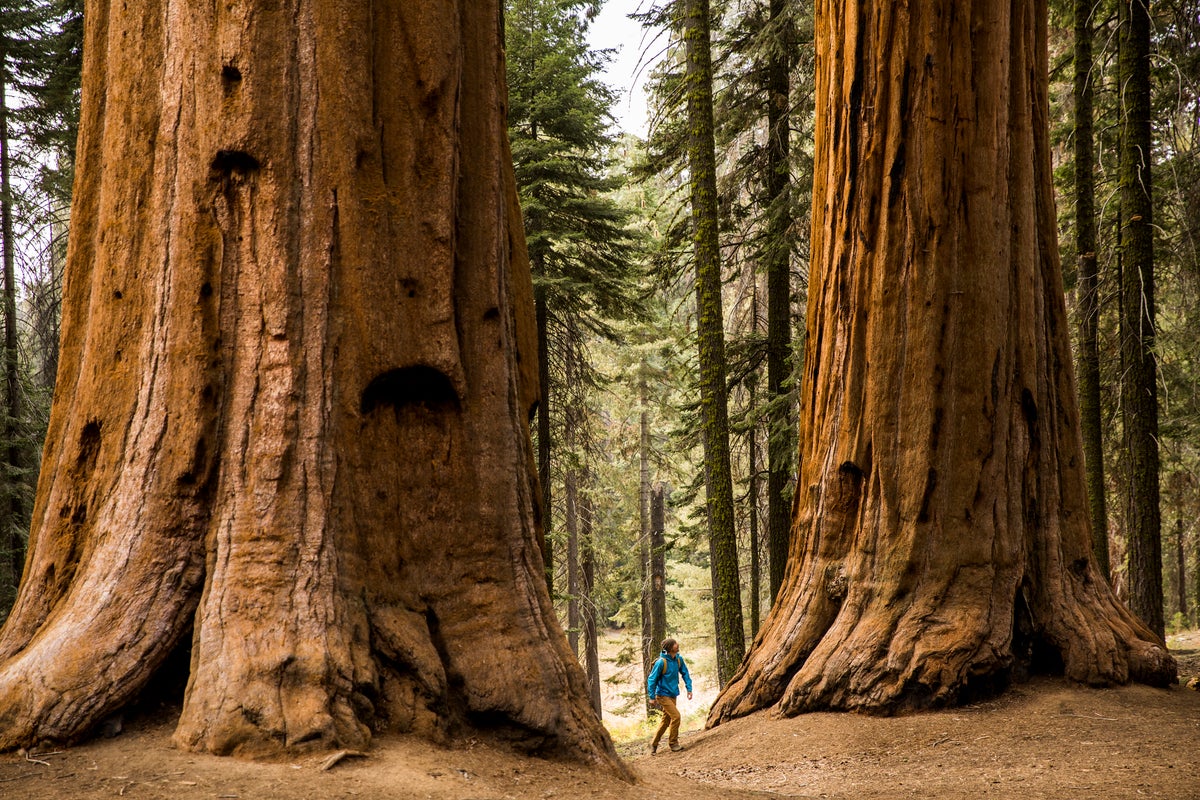
3 hours east of San Francisco I make the best cider in America with ginjo-shu sake yeast & rare apples from ancient mountain orchards. Please come visit! We have the biggest trees on the planet at Big Trees State Park & we wear cowboy hats regularly

Gift of Trees of Draught of Barrel@IntractableLion
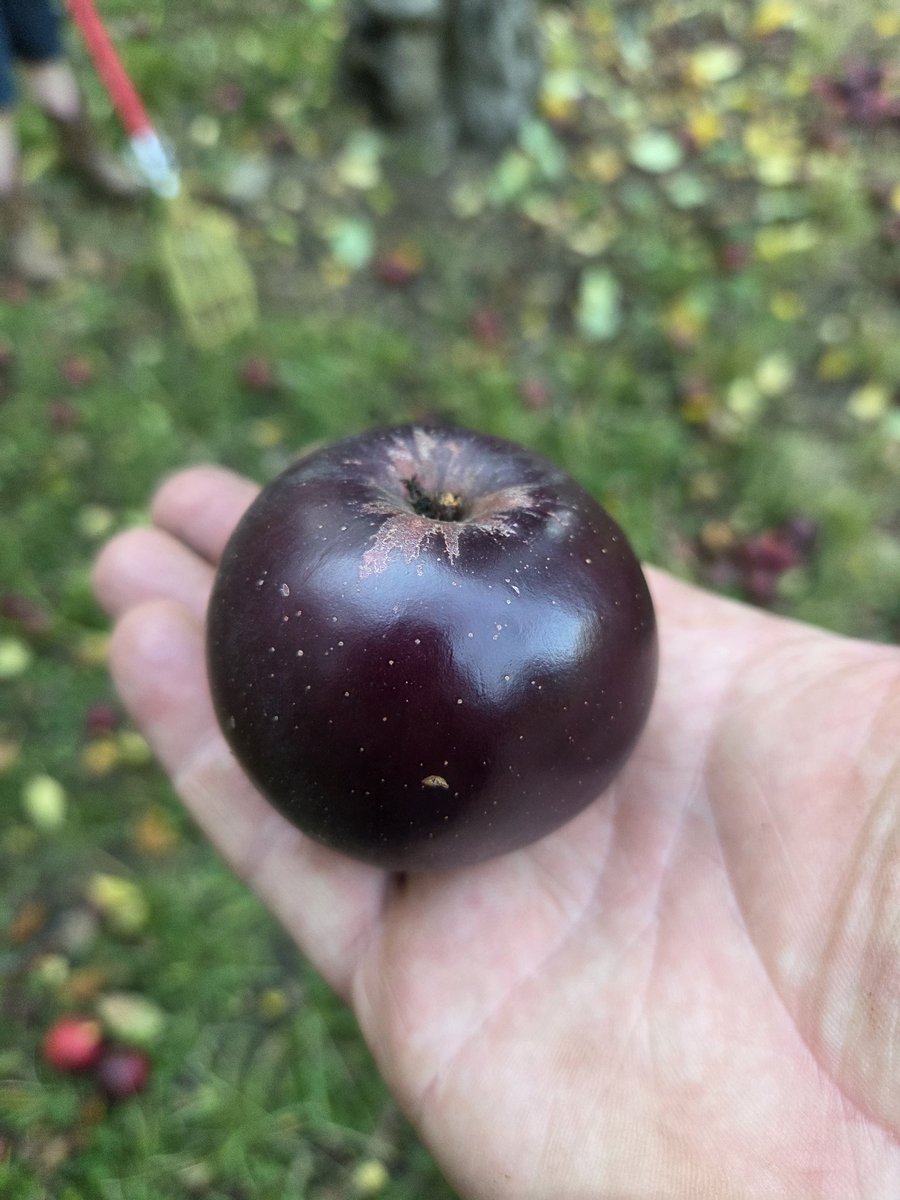
I had to open one. Arkansas Black, 2023 Special Edition Sake Yeast: Nose is light, brief brioche, green apple peel & limoncello. Fine, subtle bubbles deliver crisp apple & white pepper, then golden melon & incredibly delicate citrus peel with the barest hint of sweetness.
English


If I were to start a private school, it would be a boys-only institution.
All teachers would be male. Most would come from military backgrounds, with preference given to those with special forces experience.
The structure would prioritize physical and practical development.
Each morning would begin with physical training. Boxing. Brazilian jiu-jitsu. Obstacle courses. Firearms training.
There would also be a strong emphasis on building. Shop classes. Hands-on work. The ability to construct something real.
Even for someone who becomes an IT engineer, knowing how to build a chair matters. Real-world construction develops thinking. It trains problem-solving in a way abstract learning does not.
Academic instruction would be concentrated.
No more than three hours per day at a desk. That is sufficient to meet curriculum requirements and maintain academic competence.
The rest of the day would be spent developing strength, discipline, and practical skill.
Vinnie Sullivan@VinnieSull1van
Today, it's crazy to think that boxing used to be in the school curriculum. London, 1930s ⏳️
English

this was actually me, down to the red hair.
I actually thought that college would facilitate open discourse and instead I got years of gaslighting, lying, mockery and insults for beliefs that every one of my ancestors held. I helped brown and gay students on their homework and papers and ground my teeth when their barely literate gobbledegook got the same grade as mine.
I once got into an argument with a black professor who insisted that milk was bad for you and that humans shouldn't drink it. true story. As a strapping young dutch boy who grew up drinking 3/4s a gallon a day, knowing full well my Frisian ancestors grew to 7 feet tall and perfect health on milk going back 2,000 years, I wasn't about to let that prof lie like that. He treated me like dirt for the rest of the semester and would answer my questions with snark and coldness.

English
Nate 🚢 retweetledi

My friend @wealthyexpat saved $17,600 on his 4-day Mexican excursion at the Ritz Carlton Reserve
Biggest hoax: "The only way to save on luxury travel is through points."
Let me take you through why that is BS 👇🏼


English
@jason_howerton @CarlosErazoGTG Excellent message. Would love to share this clip on Instagram
English

My good friend @CarlosErazoGTG, who has become a spiritual mentor, gave what I think is the best response to the Bad Bunny controversy.
Carlos, who legally immigrated to US from El Salvador, absolutely NAILS IT on Bad Bunny, who he says is actually HURTING Hispanic culture.
English
I have started to use a deck of cards to train my 2nd grader to get faster with multiplication.
It is more fun than dry worksheets. The deck of cards introduces the required random combinations and we go up to 13 instead of 12 (Jack 11, Queen 12, King 13).
We split the deck in half, and we each flip two cards from our deck and multiply the numbers as quickly as possible.
When we’re good at multiplying two cards, I can always extend the game to multiply three cards.
When we’re done, we can use the same cards to play blackjack or deuces, I think there’s a psychological effect here of associating math with fun.
English
@Fathers_Diary Would like to understand what arrangement you have with the local authorities
English

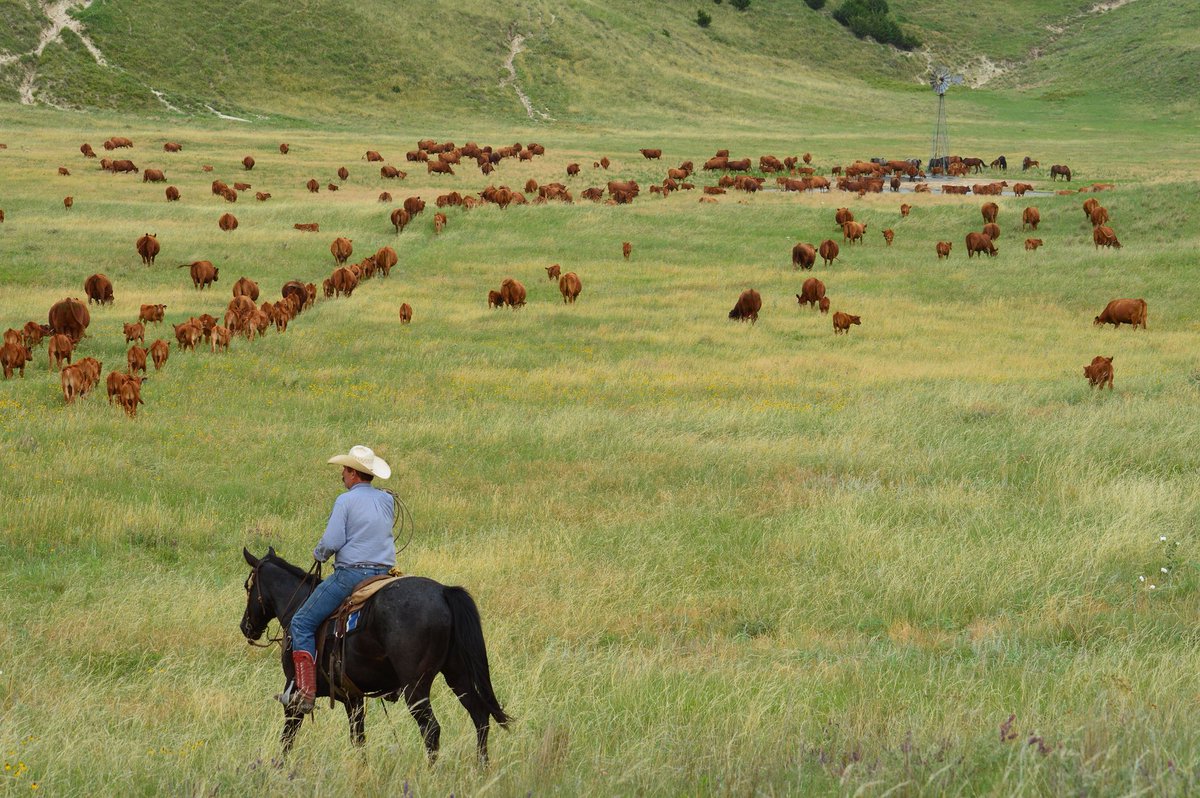
> Make money in your 20s and 30s
> Move to a third world country
> Buy 6k - 10k acres of land
> Grow your own food
> Have grass fed meat, eggs and milk
> A fireplace overlooking the sunset
> Thousands of trees around the farm
> Thousands of birds for eggs
> Enough water to lasts you 6-10 years
> A library of books
> Raise a family
> Outdoor gym
This should be peak masculine living experience.
English
@grok @hoakeyokie @WhatsupFranks @newstart_2024 @grok how do you get vitamin D naturally and in a way that the body can consume effectively?
English

The recommended daily vitamin D intake for most adults is 600 IU (15 mcg), or 800 IU (20 mcg) if over 70, per Mayo Clinic and NIH guidelines. The safe upper limit is 4,000 IU (100 mcg) per day to avoid toxicity risks like nausea, kidney damage, or hypercalcemia. Doses up to 2,000 IU are often used in studies without issues, but consult a doctor for your needs.
English

Massive new vitamin D study just dropped — and it’s getting zero mainstream attention
A 4-year trial with 25,000 adults across the US (led by 140 researchers) found:
Vitamin D3 supplementation significantly preserved telomere length (only 1 year of aging in 4 years).
This follows a 10-year Canadian study (12,000 people) showing ~40% reduced dementia risk with vitamin D.
The message is clear:
Start early, preserve what you have — telomeres don’t reverse once shortened.
2:04 clip inside — game-changing science you need to hear.
English

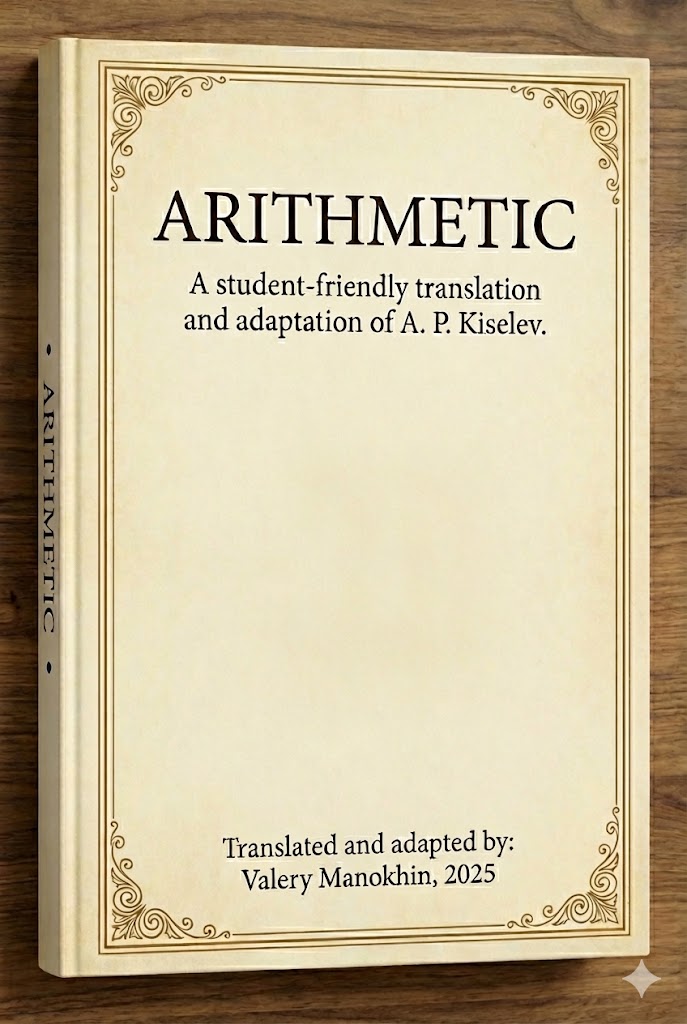
The most important math book you’ve never read (in English).
As I wrap up 2025, I wanted to share a personal project that has been in the works for some time.
I have just finished translating A.P. Kiselev’s Arithmetic.
If you aren't familiar with it, this is arguably the longest-running math bestseller in history.
It is the "source code" for the incredible mathematical prowess found in Eastern Europe. It is the book that establishes First Principles—teaching logic instead of rote memorization, and elegance instead of messy "scratch-outs."
Yet, for some bizarre reason, it was never translated into English.
While the West has been struggling with "Math Wars" and confusing new methodologies, the gold standard for clarity has been sitting on a shelf, untranslated, for over a century.
Until now.
The translation is complete. I am currently doing the final polishing—checking the last few equations and ensuring every "Dot" is in the right place. The official release is just a few days away.
However, to celebrate the end of 2025, I decided to open a special pre-order window at a very low price just for today.
If you want to start 2026 with a clear, logical approach to mathematics (or if you are just curious to see what the West has been missing), this is your chance.
Grab the "End of 2025" offer here: valeman.gumroad.com/l/arithmetic
Happy New Year, and here is to a clearer 2026!
#NewYear2026 #MathEducation #Kiselev #EducationReform #PersonalProject #Mathematics
English

Some background about the most advanced math/CS sequence in the USA, and the book:
It all started during the summer of 2020 when @exojason asked me to teach his 15-year-old son Colby some serious computer science over the summer.
He pulled in some of Colby’s Math Academy classmates and we put together a summer computer science group that met three times a week with about 10 hours of problem sets each week.
To our surprise, the students progressed even faster than we could have possibly expected.
-- At the start of June, they didn't know how to write helper functions. Even something as simple as checking if a string was a palindrome was not trivial to them.
-- By the start of July, they had built a matrix class and a gradient descent optimizer from scratch. The matrix class included methods for matrix arithmetic as well as standard linear algebra procedures like row reduction, determinants, and inverses.
-- By the start of August, they had built a regression library on top of their matrix class and gradient descent optimizer. The library included polynomial, logistic, and multiple linear regressors with interaction terms.
All problem sets required students to write code individually, from scratch, in Python. They weren’t allowed to use external libraries. Instead, they had to build everything themselves.
Jason managed to recruit a second cohort of incoming Math Academy 10th graders and push it through to get rostered as an official daily class once school started back up.
We called this the “Eurisko” sequence (“Eurisko” is Greek for “I discover,” and is the namesake of an AI system from the 1980s that won a particular game competition twice in a row, even when the rules were changed in an attempt to handicap it).
Eurisko’s courses were presented at a level of intensity comparable to those offered at elite technical universities, and students wrote all their code from scratch before they were allowed to import external libraries.
The first Eurisko course was inspired by MIT’s Introduction to Computer Science and went far beyond it.
In addition to implementing canonical data structures and algorithms (sorting, searching, graph traversals), students wrote their own machine learning algorithms from scratch (polynomial and logistic regression, k-nearest neighbors, k-means clustering, parameter fitting via gradient descent).
In subsequent courses, students implemented more advanced machine learning algorithms such as decision trees and neural networks.
They also reproduced academic research papers in artificial intelligence leading up to Blondie24, an AI computer program that taught itself to play checkers.
I refined the curriculum each year, cleaning it up into a textbook Introduction to Algorithms and Machine Learning: from Sorting to Strategic Agents during the 2022-23 school year.
That year also happened to be the final year of the Eurisko program due to my relocation -- the program was so advanced that nobody else in the district had the requisite knowledge to teach it.
But we currently have all of Eurisko's math prerequisites available on the Math Academy system, and we will eventually have the entire Eurisko curriculum, and more, on the system as well.
Justin Skycak@justinskycak
This is the textbook I wrote to support the most advanced high school math/CS sequence in the USA. It's freely available. Link in first reply. In Math Academy's (former) Eurisko program, which ran from 2020-23, we scaffolded high school students up to doing masters/PhD-level coursework: reproducing academic research papers in artificial intelligence, building everything from scratch in Python. We currently have all of Eurisko's math prerequisites available on the Math Academy system (which is where Matteo and other Eurisko students learned it). Eurisko ended in 2023 when I relocated because nobody else in the district had the requisite knowledge to teach it. But we will eventually have the entire Eurisko curriculum, and more, on the Math Academy system.
English
@justinskycak Will the Eurisko program eventually be available online? Sounds really cool
English
Few people understand the kinds of opportunities that get unlocked when a student learns advanced math ahead of time.
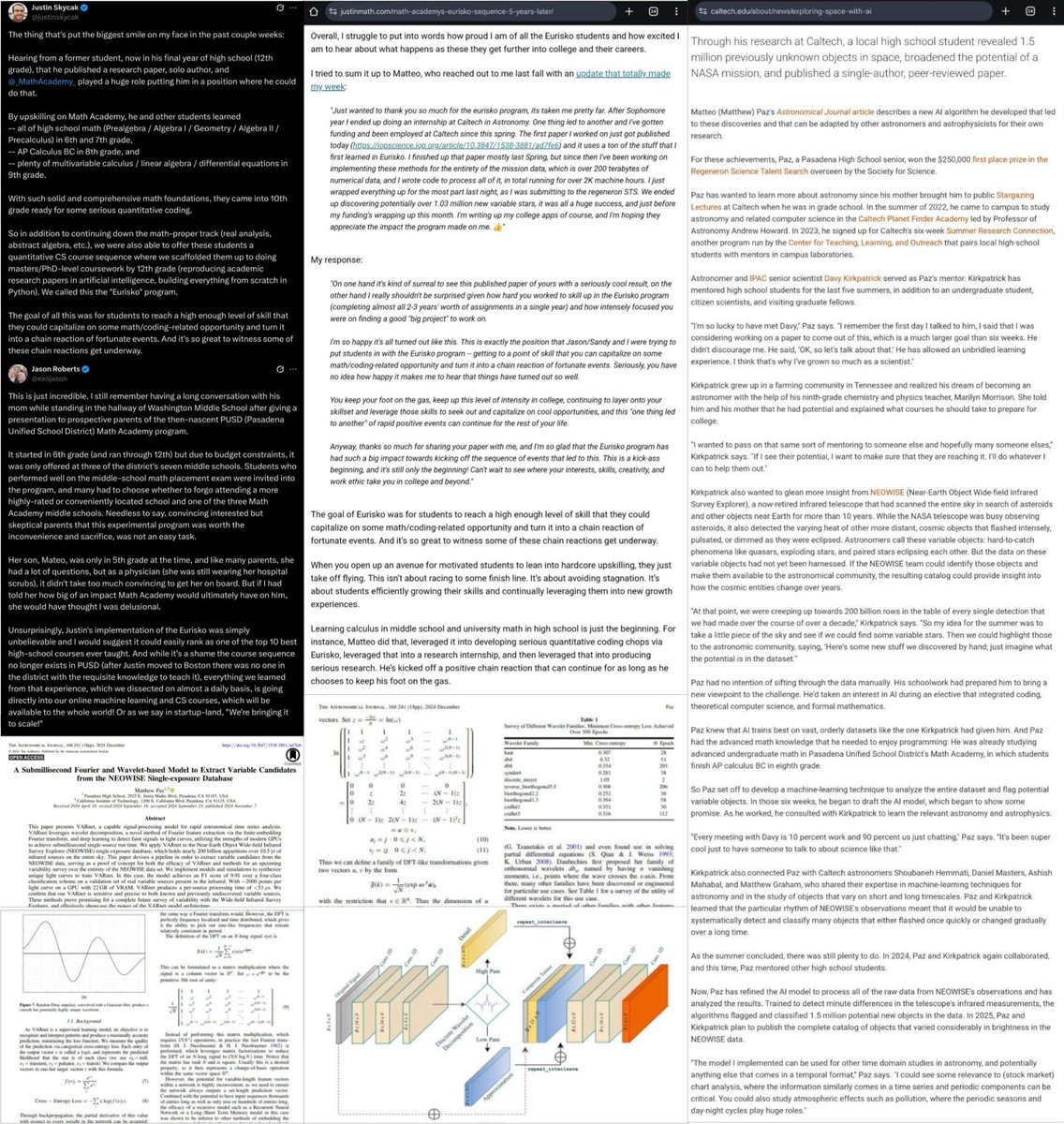
For instance, a former student, Matteo, leveraged his outsized math/coding chops to – as a high schooler – conduct research that “revealed 1.5 million previously unknown objects in space, broadened the potential of a NASA mission” (not hyperbole, a direct quote from Caltech’s website).
He also published his results solo-author in The Astronomical Journal and won 1st place ($250,000) in last year’s Regeneron Science Talent Search.
The head of NASA just asked him to apply, with a fighter jet ride as a signing bonus.
And this is still just the beginning – I can’t wait to see where his interests, skills, creativity, and work ethic take him in college and beyond.
But here’s the thing that’s important to understand: this kind of story won’t play out for students who are marching through the standard curriculum. Not even to students whose skills are a year or two ahead.
If you want to do hardcore university-level quantitative research, you need hardcore university-level quantitative skills.
You need it for the work itself, and you also need it to land a quality mentor who provides high-level guidance to keep you working in the right direction. If you want far outsized results ahead of time, you need far outsized skills ahead of time.
Matteo and other Math Academy students learned
-- all of high school math (Prealgebra / Algebra I / Geometry / Algebra II / Precalculus) in 6th and 7th grade,
-- AP Calculus BC in 8th grade, and
-- plenty of multivariable calculus / linear algebra / differential equations in 9th grade.
With such solid and comprehensive math foundations, they came into 10th grade ready for some serious quantitative coding.
So in addition to continuing down the math-proper track (real analysis, abstract algebra, etc.), we were also able to offer these students a quantitative CS course sequence where we scaffolded them up to doing masters/PhD-level coursework by 12th grade (reproducing academic research papers in artificial intelligence, building everything from scratch in Python). We called this the “Eurisko” program.
Matteo joined Eurisko as a 10th grader, during the last year it was offered, and worked hard to complete almost all 2-3 years’ worth of assignments in a single year. (Eurisko ended when I relocated; nobody else in the district had the requisite knowledge to teach it.)
That summer, he participated in a research internship/mentorship program at Caltech, which was meant to be a brief 6-week taste of research, but he was skilled and driven enough to knock it out of the park, stay on afterwards, and achieve some serious results.
This is exactly the position that we were trying to put students in with the Eurisko program – get them to a point of skill that they can capitalize on some math/coding-related opportunity and turn it into a chain reaction of fortunate events. And it’s been so great to witness some of these chain reactions get underway.
But the best part is that we’re gradually able to do more and more of this at scale. We’re taking everything we’ve learned from doing math/coding talent development manually, and building it into our online system, to make it available to the whole world.
We’ve already built a pipeline from 4th grade through core undergrad math courses, and we’re working to extend that pipeline further in both directions, eventually spanning everything from the simplest arithmetic to the entirety of an undergrad math major, the Eurisko program, and more. I can’t wait to hear more of these amazing stories.
Allison Barr Allen@abarrallen
The only thing better than the fact that Matteo Paz just got an offer for a fighter jet - is that you and your children can actually use now a lot of the infra he started with to learn Calc A/B in 8th grade. @_MathAcademy_ is available for all.
English
My district is $18 trillion, nearly 1/3 of US stock market in a 50 mile radius. We have 5 companies with a market cap over a trillion dollar companies. If I can stand up for a billionaire tax, this is not a hard position for 434 other members or 100 Senators.
Those saying that we wouldn't have a future NVIDIA in the Bay if this tax goes into effect are glossing over Silicon Valley history. Jensen was at LSI Logic and his co-founders at Sun. He started NVIDIA in my district because of the semiconductor talent, Stanford, innovation networks, and venture funding. We have 37 times the VC money as Austin given the innovation ecosystem & Florida isn't even on the map. Jensen wasn't thinking I won't start this company because I may have to one day pay a 1 percent tax on my billions. He built here because the talent is here.
AI was created with our tax dollars. ImageNet was created by Fei-Fei Li at Stanford using NSF money. This was a visual database. Hinton presented at an ImageNet conference his famous paper. The seminal innovation in tech is done by thousands often with public funds. NSF, DARPA, Stanford, Berkley, San Jose State, Santa Clara and the UCs are the foundation for what has made Silicon Valley a powerhouse. It's why we won 5 Nobel Prizes this year in the UC system.
Yes, we need entrepreneurs to commercialize disruptive innovation. Stanford blazed a trail in licensing technology & partnering with the private sector. The university enabled companies like Google which began as a research project called BackRub, looking at back links to rank pages. And entrepreneurs like Brin & Page reap huge rewards when they succeed. But the idea that they would not start companies to make billions, or take advantage of an innovation cluster, if there is a 1-2 percent tax on their staggering wealth defies common sense and economic theory @paulkrugman @DAcemogluMIT @baselinescene.
We cannot have a nation with extreme concentration of wealth in a few places but where 70 percent of Americans believe the American dream is dead and healthcare, childcare, housing, education is unaffordable. What will stifle American innovation, what will make us fall behind China, is if we see further political dysfunction and social unrest, if we fail to cultivate the talent in every American and in every city and town.
The industrial revolution saw soaring inequality in Britain for nearly 60 years. On the continent, it lead to revolutions in France with worker uprisings (1848) and contributed to one in Russia (1917). America's central challenge is to make sure the AI revolution works for all of us, not just tech billionaires.
So yes a billionaire tax is good for American innovation which depends on a strong and thriving American democracy.
Ro Khanna@RoKhanna
Peter Thiel is leaving California if we pass a 1% tax on billionaires for 5 years to pay for healthcare for the working class facing steep Medicaid cuts. I echo what FDR said with sarcasm of economic royalists when they threatened to leave, "I will miss them very much."
English
@ZachHopkinsMD @BowtiedRedPants @AndrewZywiecMD Why wouldn’t their other factors like grade trajectory, life experience, EC and mission statement also be considered for neurosurgery?
English
@BowtiedRedPants @AndrewZywiecMD That is a different argument, to do those things you mentioned they would need to get into the specialty (which is a whole different layer of qualifications) and pass board exams showing at least a baseline degree of competency. So I don’t particularly care how they got into med
English

People have no idea how bad it has gotten. DEI is killing people.
People who look like me with a 3.8 GPA, publications, awards, top 15 percent MCAT, can barely get a look.
Meanwhile, 2.7 GPA, no publications, no awards, and lower 50 percent of MCAT will be neurosurgeons.
9mmSMG@9mmsmg
I can't stress this enough. You have to stay healthy. You have to avoid needing medical care for as long as possible. Your doctor may have a sub 500 MCAT and a 2.7 GPA.
English

@TheKevinDalton 100% NOT TRUE.
That video is a section of the 5 which floods every year when there is even a moderate rain and has done so for nearly 20yrs…
Please be smarter.
English

Major freeways getting shut down throughout California are not from atmospheric rivers, climate change, or rain bombs.
This is crumbling infrastructure, lack of preparation, and just another all around fail by Gavin Newsom.
English
Fatherhood has helped me understand the God of the Bible more.
My daughter complains to me that her friends at school have smart watches but she doesn’t.
And one of her friends has $80 while she only has $27.
My daughter is in her wilderness stage - she needs to go through trials like Joseph, Moses, David, Jesus all had to.
If she can hone her character under trials, she will be getting riches and abundance in inheritance from me she cannot even fathom right now.
So to with our personal sanctification and obedience, and our Heavenly Father.
English