Ray🇨🇳🇷🇺🇵🇸🇵🇰🇮🇷🌏🚀🌌
81.6K posts

@neotechcn
争取世界和平,驶向星辰大海


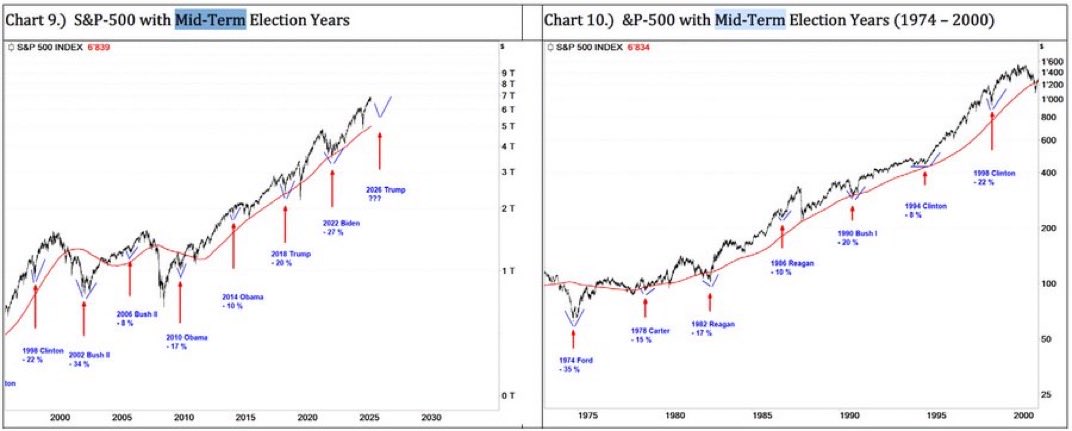
Today is the DAY. April 17, 2026. The intermediate top before the most difficult time of the presidential cycle. THE BAD NEWS We're entering the mid-term correction phase. Historically, markets correct an average of 16% during this period. It's the weakest part of the 4-year presidential cycle. And it starts NOW. THE CHART SPX Seasonal Composite 4-Year Presidential Cycle (99 years of data): Election Year → Post-Election Year → Mid-Election Year → Pre-Election Year Red line (current cycle): Peaked April 17, 2026 Black line (historical average): Shows consistent mid-term weakness The pattern is clear. Mid-election years are brutal. THE HISTORICAL PATTERN Out of the last 20 presidential cycles, we've witnessed 19 sharp mid-term corrections. Average decline: 16% Timing: Mid-election year (Year 2 of the cycle) This is where markets reset. THE GOOD NEWS After 19 out of 19 sharp mid-term corrections, we've seen a new bull market. Duration: 2 years Phase: Pre-election year + election year (Year 3 and Year 4) This is the most bullish part of the cycle. THE SETUP We're at the top of Year 2. The correction is coming. But the 2-year bull market follows. THE MESSAGE Buy any dip in the coming months. Not now. Not at the top. But when the market corrects 10%, 15%, 20% — that's your entry. Because history says: Mid-term corrections are buying opportunities for the pre-election rally. THE PLAYBOOK 1. We're at the intermediate top (April 17, 2026) 2. Expect a 16% correction over the next 6-9 months 3. Layer in during weakness (-10%, -15%, -20%) 4. Hold through the pre-election year rally (Year 3) 5. Ride the election year momentum (Year 4) THE PATTERN NEVER FAILS 19 out of 19 times, the mid-term correction was followed by a 2-year bull market. That's 100%. THE LESSON Don't panic during the correction. Don't fight the cycle. Buy the dip. Hold for 2 years. That's the presidential cycle playbook. Today is the DAY. The top is in. The correction starts now. The opportunity is coming.


This assault on Iran is going to change the United States forever. There will be no more free money from the Middle East, Americans will have to earn their money like other countries and they'll have to seriously tighten their belts...


内外盘六条铁律,帮助你判断主力是在出货还是吸筹,避开80%的陷阱。 很多散户都会关注软件上的主力资金净流入数据,认为这是判断主力是否进场的重要依据。这其实是一个巨大的误区 炒股不是简单地看数据下单,而是要看资金意图下单。主力可以操纵资金净流入,但却无法操纵内外盘里的真实买卖意愿。👉


如果你的资金不到五万,一定要死磕这个做T技巧。在一只票反复做T,比你一直拿着赚得多得多。 本期分享五个核心的日内做T方法和技巧。 日内做T有一个大前提,那就是必须有底仓,而且还必须选择一家股性强的公司。如果股价仅凭一条直线,再好的公司、再高明的手法也难以创造空间。


Breaking: The Next "Panama Port" Scenario? Is the U.S. Planning to Help Peru Reclaim Chancay Port from China? This move is part of a U.S. strategy to target ports globally that are operated or majority-owned by Chinese entities; it also represents the latest development in Donald Trump’s efforts—driven by the "Donroe Doctrine"—to project American power across the entire Western Hemisphere. During a congressional hearing, Maria Elvira Salazar, Chair of the U.S. House Subcommittee on the Western Hemisphere, openly incited Peru’s incoming administration to seize back Chancay Port—a facility majority-owned and operated by Chinese enterprises. She baselessly smeared this commercial deep-water port as a "military threat to the Western Hemisphere" (alleging that Chinese submarines and aircraft carriers would be deployed and resupplied there), warned that Peru risked being "unable to regulate Chancay Port," accused China of being a "predator," and vowed that the United States would step in to assist. In reality, the port is a major project resulting from open and fair cooperation between the Chinese and Peruvian governments, jointly developed and operated by enterprises from both nations. The port's operations have created favorable conditions for Peru's economic development; since its opening in November 2024, it has rapidly emerged as a vital hub for the "New Land-Sea Corridor" connecting Asia and Latin America. Since becoming operational, the port has reduced shipping times between South America and China to approximately 23 days and lowered logistics costs by over 20%. In its first year of operation, the port handled a container throughput exceeding 336,000 TEUs. U.S. lawmakers have engaged in rampant fear-mongering regarding the false narrative that the port serves a "dual military-civilian use." By interfering in Peru's internal affairs and baselessly alleging that China is "plundering resources and undermining sovereignty," they have issued slanderous accusations devoid of factual basis. These claims have been sternly refuted by China and have also damaged Peru's sovereignty and the credibility of its government. The ultimate objective of this campaign is to wait until Chinese investment has fully constructed the port, then expel the Chinese enterprises involved, allowing Western companies—controlled by the United States—to take over. As early as March of this year, General Laura Richardson, Commander of U.S. Southern Command, declared before Congress that 23 ports and 12 space facilities operated by China across Latin America were all under U.S. military surveillance, collectively designated as "potential dual-use military-civilian assets." It is, in fact, the U.S. empire that stands as the true, naked "predator."


We are told that security in the Middle East requires defeating Iran, security in East Asia requires defeating China, and security in Europe requires defeating Russia. We never discuss security in terms of how to learn to live together by harmonising interests and managing competition. This is by design. This is hegemonic peace, in which security depends on defeating rivals rather than managing a balance of power. Subsequently, security relies solely on deterrence rather than reassurance; diplomacy is dismissed as appeasement; peace agreements are temporary and deceptive; and war is peace. Our rivals do not have legitimate security concerns, as their policies are allegedly always motivated by aggressive, irrational, or expansionist behaviour. We have convinced ourselves that our liberal hegemony is a force for good, and that our opponents oppose our dominance because they reject our benign values of freedom. Discussing the security concerns of adversaries is believed to “legitimise” their policies, which is treasonous. The world is divided into good guys (liberal democracies) and bad guys (autocracies). We should not ask how defeating Russia, as the world's largest nuclear power, is a rational security strategy, or why our governments refuse to even speak with Moscow to discuss the European security architecture and end the war. Our governments have relabelled nuclear deterrence as nuclear blackmail to signal that there can be no more constraints. All empires can become irrational during decline. Leaders take greater risks to avoid decline, legitimacy crises at home must be distracted with enemies abroad, outdated strategies from a bygone era of strength are still embraced, and there is a tendency to double down on narratives of being indispensable, representing universal values, and dismissing all opposition as illegitimate and dangerous. Are we the fanatics?


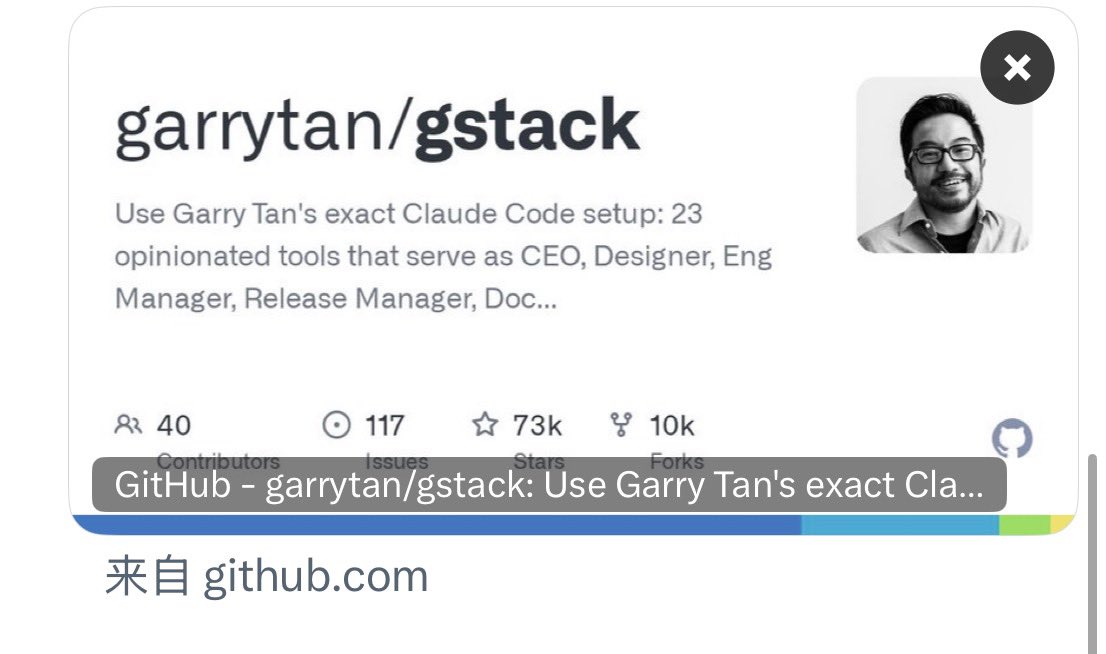
Karpathy's Confusion Protocol is now in GStack Karpathy called it: the #1 AI coding failure mode is the agent confidently picking the wrong path at an ambiguous decision point. You lose 10 minutes of work and have to start over. gstack now has an ambiguity gate built into every workflow. Hit a fork in architecture, data modeling, or a destructive operation with unclear scope? The agent stops and asks. No more “I assumed you wanted…” Not a blunt “confirm everything” prompt. Scoped to decisions where guessing wrong actually costs you time.