sk retweetledi
sk
1.4K posts

sk retweetledi

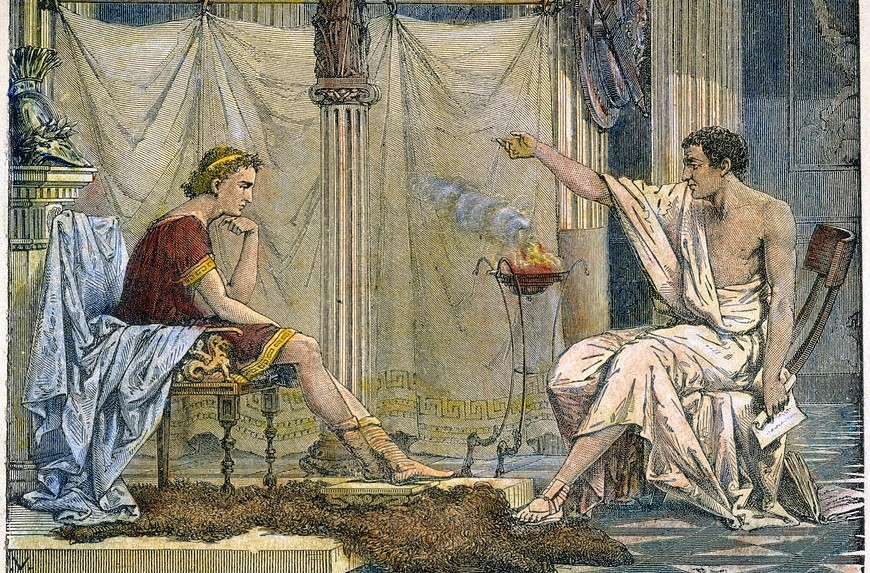
Alexander the Great conquered the known world by age 32.
He did it by asking one question that no general before him had ever thought to ask.
Not "how do I match their strength?" But "where is the gap?"
Aristotle taught him the difference. It is called first principles thinking, and it is the reason Alexander never lost a single battle in his entire life.
At Gaugamela, Alexander faced a Persian force that outnumbered his by a ratio of five to one. Some historians put it higher. Every military commander on the field was running the same template: more soldiers means more force, more force means you spread your line wide, defend against encirclement, engage across the full front.
This was not a tactical opinion. It was the accumulated logic of every battle anyone had ever studied.
Alexander looked at the same situation and asked a different question.
Not how do I survive this, but what is actually true here at the most fundamental level. He studied Darius's formation until he found it. A gap. Small, temporary, the kind that only exists for a moment in the chaos of a shifting line. He reorganized his entire cavalry around that single point. Then he rode directly at it himself, at full speed, with everything he had.
Darius fled the field. The Persian Empire ended that afternoon.
Here is what Aristotle actually taught him.
There are two ways to think about any problem.
The first is reasoning by analogy. You look at what is in front of you, search for the closest thing you have already seen, and apply that template forward. This is not a failure. It is extraordinarily efficient. It is how you learned your profession, how you function at speed, how civilization scales without having to rediscover fire every generation. Without analogical reasoning you would spend your entire life solving problems that were solved a thousand years ago.
The second is reasoning from first principles. You ignore the template entirely. You ask what is actually true at the most fundamental level, strip away every assumption that is only true because someone decided it was, and rebuild your understanding from that ground up. You arrive at conclusions the template would never have generated.
The insight is not that one mode is better. It is that they fail in opposite situations.
Analogical reasoning works perfectly inside a stable system where the template still matches reality. It fails catastrophically at the frontier, because the frontier is exactly where the existing templates are wrong. When you apply a map to a territory it was not designed to describe, the map does not warn you.
It just leads you somewhere incorrect with complete confidence.
This is why every major disruption follows the same pattern. The people who get disrupted are not stupid. They are the most sophisticated analogical reasoners in the field, applying the best available templates with perfect internal logic. And those templates, built entirely from the history of the existing system, are structurally blind to what a genuinely new thing actually is.
Kodak invented the digital camera in 1975 and shelved it. Every framework they had said it would destroy their film business. They were correct about the analogy and completely wrong about the conclusion, because the analogy assumed photography was a film business rather than a memory business.
The template was so embedded they could not see past it while holding the invention that would replace them.
Elon Musk wanted to buy a rocket in 2002. The cheapest price he found was $65 million. So he asked a different question. Not what do rockets cost, but what are rockets made of. Aluminum. Titanium. Carbon fiber. Copper. He priced the raw materials. They came to roughly 2% of the market price. The gap between 2% and 100% was not engineering. It was assumption. Decades of convention and unchallenged procurement logic, passed forward so many times it had started to feel like physics.
SpaceX was born in that gap.
The reason almost nobody actually uses first principles thinking is not that it is hard to understand. Aristotle wrote it down clearly in the fourth century BC. It has been available to anyone who wanted it ever since.
The reason is what it costs.
It is slow. It requires you to put down the confidence that comes from convention and sit with genuine uncertainty long enough to reach something real. The brain resists this completely, because the analogical template is faster, cheaper, and almost always good enough.
The pull toward the familiar pattern is not laziness. It is the most efficient cognitive system ever built doing exactly what it was designed to do.
First principles thinking only becomes worth the cost at the moments where the template has quietly stopped matching reality. Where everyone in the room is agreeing on something that feels like an established fact but is actually just an unchallenged assumption that has been passed forward long enough to seem permanent.
Alexander did not beat armies that were five times his size by being braver than every general who came before him.
He beat them by asking the question nobody else had thought to ask.
The most dangerous thing in any room is not the problem everyone is arguing about.
It is the assumption nobody noticed they were all making.

English
sk retweetledi
sk retweetledi
sk retweetledi
sk retweetledi
sk retweetledi

Jensen Huang just told the story of how Elon Musk became NVIDIA’s very first customer for their powerful AI supercomputer - when literally nobody else in the world wanted it
“When I announced this thing, nobody wanted to buy it. Not one purchase order
Except for Elon
He was at the 2015 event. Told me his company could really use it
I got excited… until he said it was a non-profit company
All the blood drained out of my face
In 2016, I personally boxed it up and delivered the first one to a tiny room in San Francisco
It was OpenAI
Just a handful of researchers - Pieter Abbeel, Ilya Sutskever, and the team were all there”
Elon backed AI when almost no one else believed
English
sk retweetledi
sk retweetledi

Forget the $100,000 investing courses.
In 1998, Warren Buffett quietly explained how to never lose money in just one hour.
Almost nobody paid attention.
The company built on those principles is now worth nearly $1 trillion.
This is the closest thing to a cheat code you’ll ever see.
Save this before it vanishes from your feed 👀
English
sk retweetledi
sk retweetledi

One Bhagavad Gita. Three master keys.
The Shrimad Bhagavad Gita was explained by:
• Adi Shankaracharya (Advaita)
• Ramanujacharya (Vishishtadvaita)
• Madhvacharya (Dvaita)
✅ I’ve compiled all 3 commentaries into one Google Drive folder so you can compare perspectives side-by-side.
But remember:
The Gita is the practical essence of Yoga Shastra.
These 700 shlokas become powerful only when you:
• internalize them
• practice them daily
• live them in real life
💬 Comment “700” and I’ll DM you the folder link.
📌 Save this post for your study
🔁 Share it with a friend who needs Gita guidance
Follow @TheSanskritChannel for more.
Here’s the link: bit.ly/bg-comment
#BhagavadGita #Gita #Shankaracharya #Ramanujacharya #Madhvacharya #Vedanta #Advaita #Vishishtadvaita #Dvaita #YogaShastra #SanatanaDharma #Sanskrit #HinduPhilosophy #GitaWisdom #TheSanskritChannel
English
sk retweetledi
sk retweetledi
sk retweetledi
sk retweetledi
sk retweetledi
sk retweetledi
sk retweetledi
sk retweetledi
sk retweetledi