NIH

17.5K posts

NIH banner
NIH

NIH

@NIH

Official account of the National Institutes of Health. NIH...Turning Discovery Into Health®.   Privacy Policy: https://t.co/wOGwZ3gX1M Engagement ≠ endorsement

Bethesda, Maryland, USA Katılım Haziran 2008
230 Takip Edilen1.7M Takipçiler
NIH
NIH@NIH·
2025 was a year of meaningful progress—and important reflection—for the neuroscience community. In the End-of-Year Director’s Message from NIH's NINDS, we reflect on the institute’s top 10 research advances of the year, commemorate 75 years of NINDS discovery, and underscore the importance of partnership, sustained investment, and community in moving neuroscience forward. We invite you to read the full message and reflect on what this moment means for the future of neurological research: bit.ly/3NJ5q4p
NIH tweet media
English
0
1
8
788
NIH
NIH@NIH·
The Guidelines for the Prevention and Treatment of Opportunistic Infections in Adults and Adolescents with HIV have updated two sections: bit.ly/4cXD4xr Please send any feedback to HIVinfo@NIH.gov by 3/18.
NIH tweet media
English
4
1
8
3.6K
NIH
NIH@NIH·
NIH-funded research reveals that newborn babies who developed life-threating E.coli infections were uniformly deficient in anti-E. coli antibodies that they would normally receive from their mothers. The research also explored potential ways for reducing infection. Read more about this breakthrough: bit.ly/4swEpjC
English
4
4
17
3.8K
NIH
NIH@NIH·
A research team funded by NIH developed a new 3D reconstruction of the human liver that shows its structure down to a cellular level. This could help scientists better understand how the liver changes during disease and could lead to new treatments. Learn more: go.nih.gov/Y4YIk36
NIH tweet media
English
1
12
36
5.9K
NIH retweetledi
Jay Bhattacharya, MD, PhD
Jay Bhattacharya, MD, PhD@NIHDirector_Jay·
NIH is proudly prioritizing drug repurposing as a way to accelerate research while using resources efficiently. Watch for some outstanding examples of how we’ve applied gold standard science to find new ways existing therapies can benefit more patients now:
English
54
77
434
24.2K
NIH
NIH@NIH·
Ranging in size from as small as a speck of pepper to the size of an apple seed, ticks can be hard to spot and remove, increasing the chance of exposure to tick-borne diseases. NIH researchers are exploring how to trigger a process found in animals, where molecules called cytokines activate the neurons that cause us to itch. This would allow humans to scratch off a tick before it can transmit disease. Watch the full video to learn more: bit.ly/4bDzLtf
English
3
8
49
9.8K
NIH retweetledi
Jay Bhattacharya, MD, PhD
Jay Bhattacharya, MD, PhD@NIHDirector_Jay·
🔬Scientific progress depends on discovery, but also the freedom to question, debate, and examine evidence wherever it leads. In the spirit of that ideal, I’m thrilled to announce the launch of our NIH Scientific Freedom Lecture Series, an exciting new forum aimed at advancing transparency, rigor, and open scientific inquiry. Please join me March 20 at 2:30pm ET for our inaugural talk, titled “Viral: The Search for the Origin of COVID-19” featuring a conversation with Matt Ridley, D.Phil. Guests can attend in person at the Masur Auditorium in NIH Building 10 or online via the NIH videocast page. bit.ly/3PsHAu5
Jay Bhattacharya, MD, PhD tweet media
English
88
225
868
50.4K
NIH
NIH@NIH·
NEWS: NIH invests $150 million in human-based research to reduce use of animal models Read more ➡️ bit.ly/47MgoN9
NIH tweet media
English
6
16
72
16.1K
NIH
NIH@NIH·
NIH-funded researchers developed specialized immune cells, called CAR-T cells, that reduced signs of Alzheimer’s disease in mice. While still far from human use, the research suggests that this type of immunotherapy might one day help treat Alzheimer’s and other brain disorders. Read more: go.nih.gov/YwN8jio
NIH tweet media
English
8
18
61
10K
NIH
NIH@NIH·
A recently published study funded by NIH suggestions that certain immune cells may be a key reason why chronic pain is more common in women than men. The findings in mice could point the way to the development of non-opioid therapies aimed at preventing chronic pain before it starts. Read more: go.nih.gov/ph35WTr
NIH tweet media
English
6
6
16
5.2K
NIH
NIH@NIH·
Ribonucleic acids (RNAs) have been linked to many diseases, including rare diseases, neurological disorders, cancers and heart failure. Expanding research to target specific RNA molecules could have an impact on how we prevent or treat many diseases that have few or no treatment options. To help advance this work, NIH launched the Targeting RNA in Disease with Novel Technologies (TRDNT) Challenge. This challenge aims to design, test and share a publicly available suite of innovative RNA-targeting technologies to address these critical gaps. Learn more ➡️ bit.ly/4ryqkS1
NIH tweet media
English
7
12
44
7.1K
NIH
NIH@NIH·
🗓️SAVE THE DATE: NIH’s National Heart, Lung, and Blood Institute, in partnership with the Sickle Cell Disease Association of America, will host Research That Heals: Partnering to Transform SCD Care on June 25-26, 2026. This 1.5-day hybrid community forum will be a crucial platform for engaging directly with the sickle cell community, including patients, caregivers, and patient organizations. The forum is open to the public and registration is free. Registration details to come.
NIH tweet media
English
0
0
10
3.9K
NIH
NIH@NIH·
NEWS: Clinical trial results support use of weekly extended-release buprenorphine for treatment of opioid use disorder during pregnancy Read more ➡️ bit.ly/4bqQQX1
NIH tweet media
English
4
6
16
6.3K
NIH
NIH@NIH·
New NIH-funded research is taking a closer look at neurogenesis—the process of creating new neurons—in the hippocampus and how it relates to cognitive function. The findings highlight important differences in the brains of adults across a range of ages and levels of cognitive function, offering new insight into how our brains change over time. Read more: bit.ly/476blah
NIH tweet media
English
3
37
130
13.3K
NIH
NIH@NIH·
An NIH-supported study reveals that brief exposure to highly processed, fiber‑poor foods can impair brain function in older adults. Researchers found that three days on a refined diet lacking fiber caused cognitive and cellular changes in the amygdala—a brain region responsible for emotional learning and memory. These effects were observed in older animals but not in younger ones. Study link: bit.ly/4lx2Z16
NIH tweet media
English
1
13
46
7.5K
NIH
NIH@NIH·
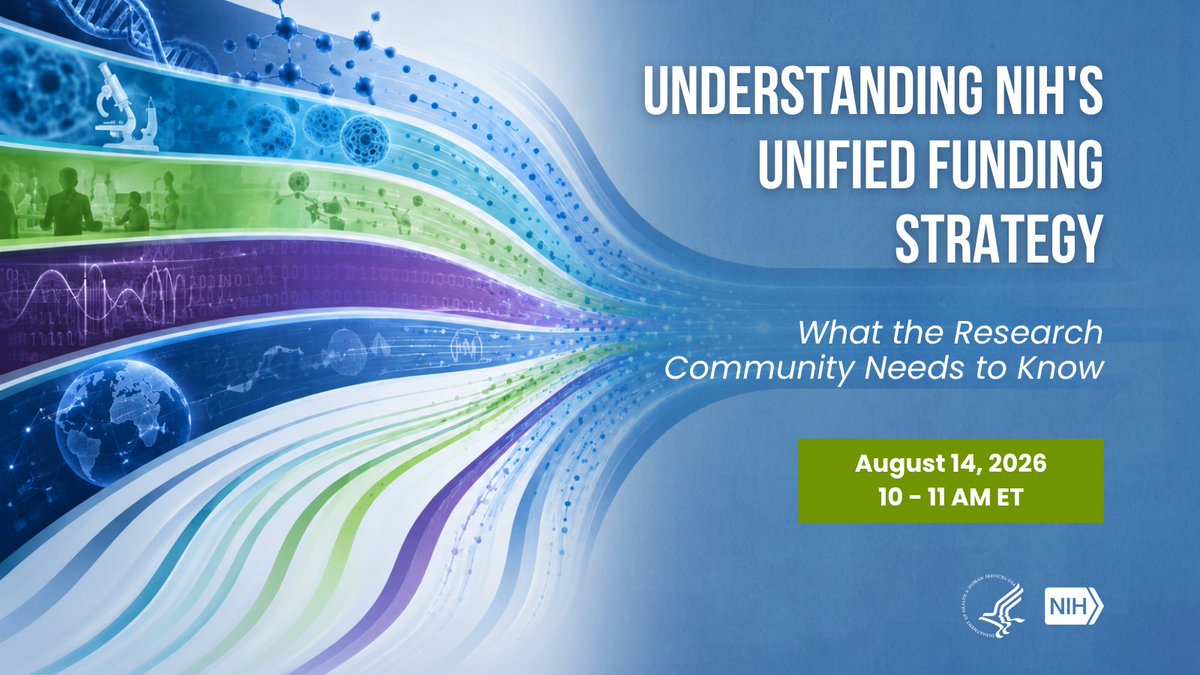
Reminder! ⏰ Join NIH for upcoming webinars on the next NIH-Wide Strategic Plan. Learn about the development process, hear about the framework, and ask questions live. March 16 registration: bit.ly/4rqOv4g. April 8 registration: bit.ly/3Px9fdj.
NIH tweet media
English
4
5
21
9.2K
NIH
NIH@NIH·
NEWS: Researchers develop AI tool to predict patients at risk of intimate partner violence. Read the full news story ➡️ bit.ly/4lrM2W7
NIH tweet media
English
3
2
15
5.2K
NIH retweetledi
NIH Innovates
NIH Innovates@NIH_Innovates·
NIH inventors are seeking a licensee and/or collaborator to further develop their artificial intelligence diagnostic tool to predict the risk of age-related macular degeneration. You can read more about this opportunity on our website: bit.ly/4uwixqj
NIH Innovates tweet media
English
4
5
19
5.8K
NIH retweetledi
Jay Bhattacharya, MD, PhD
Jay Bhattacharya, MD, PhD@NIHDirector_Jay·
Thank you @HHSGov for having me today at the Women’s Health Conference. I’m so proud of the work @NIH is doing to help accelerate transformative women’s health research.
Jay Bhattacharya, MD, PhD tweet mediaJay Bhattacharya, MD, PhD tweet mediaJay Bhattacharya, MD, PhD tweet mediaJay Bhattacharya, MD, PhD tweet media
English
42
23
169
16.6K
NIH
NIH@NIH·
NIH-funded research suggests how early exposure to allergens may shape how allergies develop, at least in mice. More studies are needed to better understand how this works, but the findings could help guide new ways to prevent and treat allergies in children and adults. bit.ly/4uu3EVt
NIH tweet media
English
5
4
26
5.8K