Sabitlenmiş Tweet
Niyas M. A.
232 posts

Niyas M. A.
@niyasma0
The Royal Society Newton International Fellow | University of Oxford
Katılım Eylül 2011
422 Takip Edilen195 Takipçiler
Niyas M. A. retweetledi

We invite postdocs interested in faculty positions to join us for an interactive Young Researchers Meeting on 2 August 2025.
Hear from the Director, Deans & faculty members, and find out what IISc has to offer!
Register by 12 noon (IST) on 1 August at: docs.google.com/forms/d/e/1FAI…

English

@Yuanxiong_Cao @KavliOxford @OxfordDPAG @UniofOxford @xierx1 @SchoeniPhlippsn Nice work! Congratulations @Yuanxiong_Cao
English
Niyas M. A. retweetledi

Can you image how droplets, magnets, and hydrogels can combine together at the microscale? Check out our latest work published in Sci Adv, Permanent Magnetic Droplet-derived Microrobots. @KavliOxford @OxfordDPAG @UniofOxford @xierx1
@SchoeniPhlippsn
science.org/doi/10.1126/sc…
English

What if complexity was already built in — just waiting to be released?
In our latest @ScienceMagazine, we show how COFs can selectively excise organic macrocycles with precision.
A chemistry that reveals what’s already there. Clip-off Chemistry.
Link: science.org/doi/10.1126/sc…
English

@Yagai_G @NatureNano Wow! Congratulations. Beautiful work👏🏽. Nicely shows subtleties involved in sample preparation as well.
English

Another intriguing story on secondary nucleation from our group is now out in @NatureNano!
This time, we show it's not just about creating exotic structures—supramolecular chirality can flip, too. A gentle reminder: never underestimate the influence of impurities!
nature.com/articles/s4156…
English
Niyas M. A. retweetledi

Just dropped: our Review Article on mesoscale hierarchical supramolecular polymers via secondary nucleation is out in @NatureChemistry!
From tiny seeds grow tangled worlds 🌱🔁🌀
nature.com/articles/s4155…
English
Niyas M. A. retweetledi

Delighted to share our recent work published in @NatureComms.
This work demonstrates a donor-acceptor chromophoric design to achieve both Thermally Activated Delayed Fluorescence (TADF) and Triplet-triplet Annihilation (TTA) in thin films.
nature.com/articles/s4146…
English
Niyas M. A. retweetledi

Really happy to be part of this work!
Huge congrats to Phillip for his work on these incredible nanoribbons from @KokeLab!
Aurelio Mateo-Alonso@KokeLab
Out in @J_A_C_S! Intramolecular singlet fission in individual graphene nanoribbons: One graphene nanoribbon, two independent triplets! More here: pubs.acs.org/doi/epdf/10.10… @Polymat_BERC @Ikerbasque @ehu_kimika @GroupGuldi @ManuelMelleLab
English
Niyas M. A. retweetledi

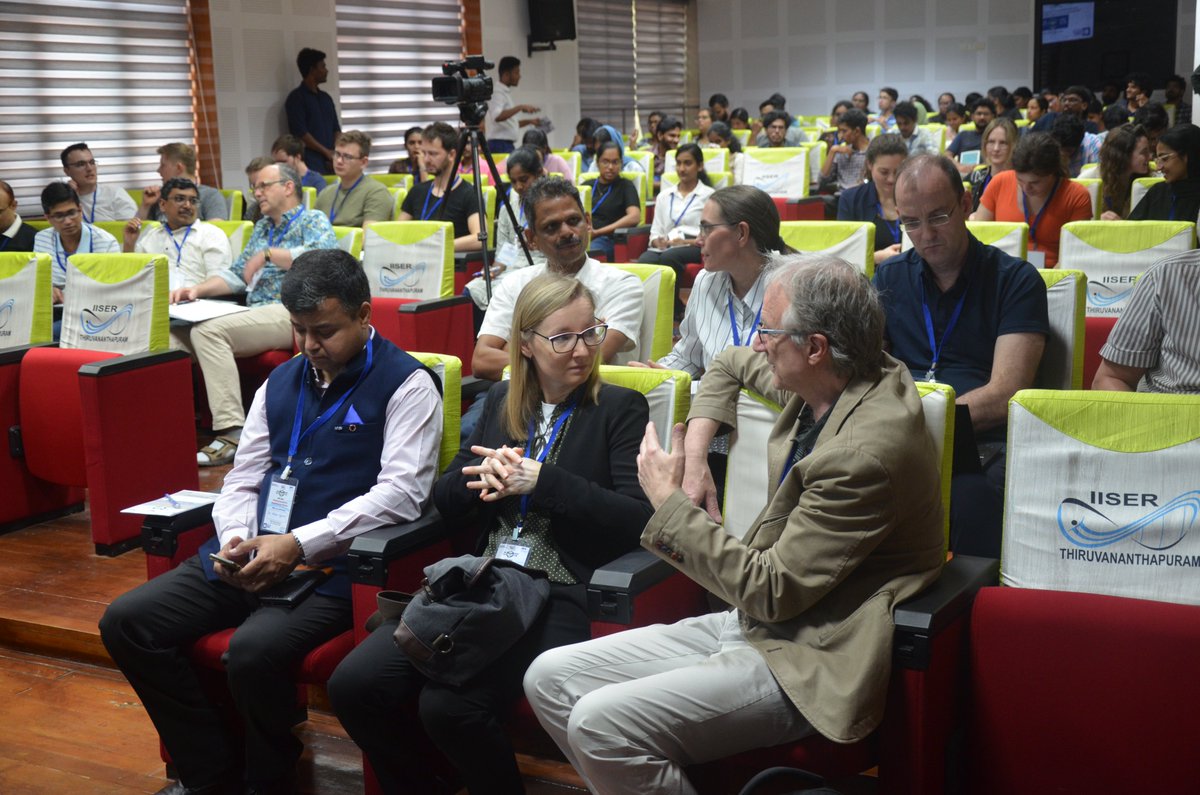
Kicking off the International Research Training Group (IRTG) Startup Meeting @iisertvm! IRTG aimed at developing a collaborative research program between IISER TVM and the University of Wuerzburg @Uni_WUE.
Starting of the 1st DST-DFG indo-German #IRTG.
@IndiaDST @dfg_public


English
Niyas M. A. retweetledi

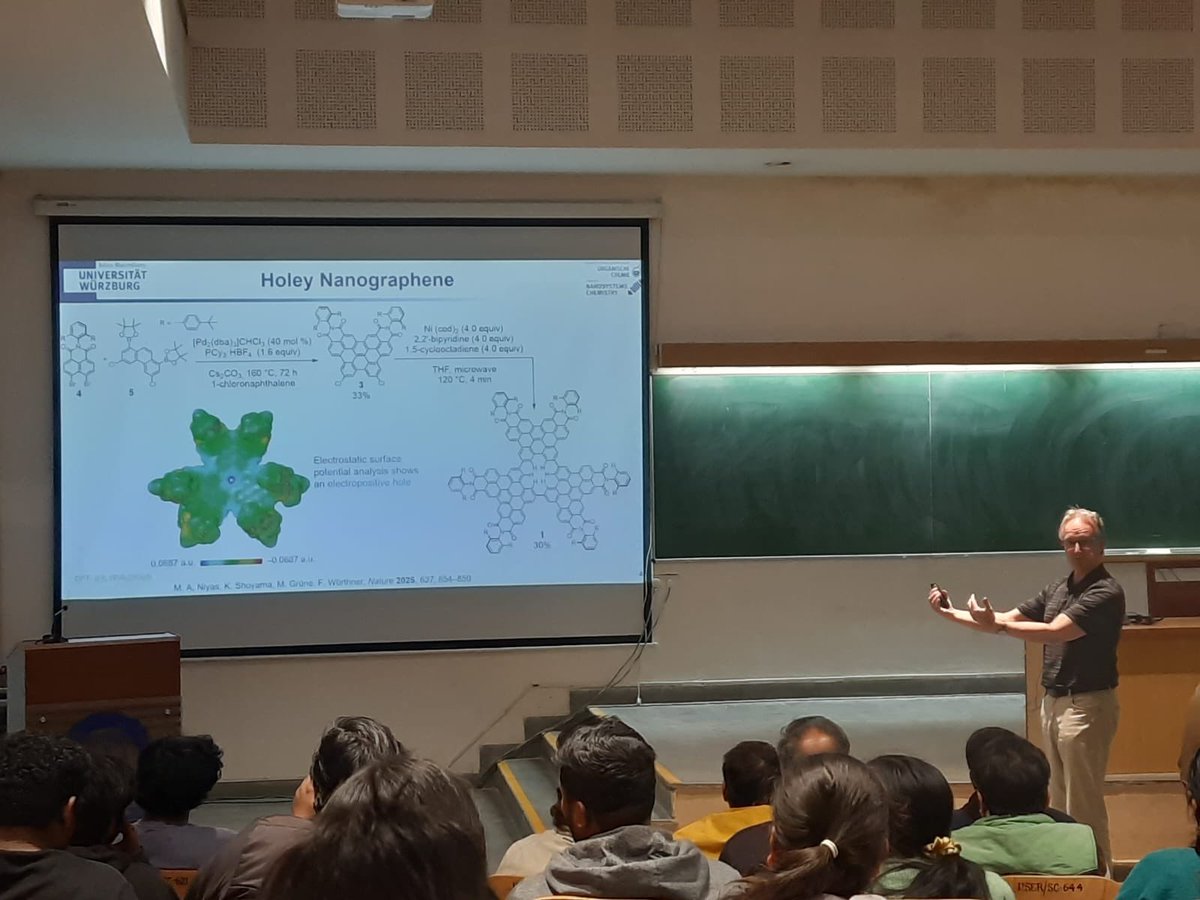
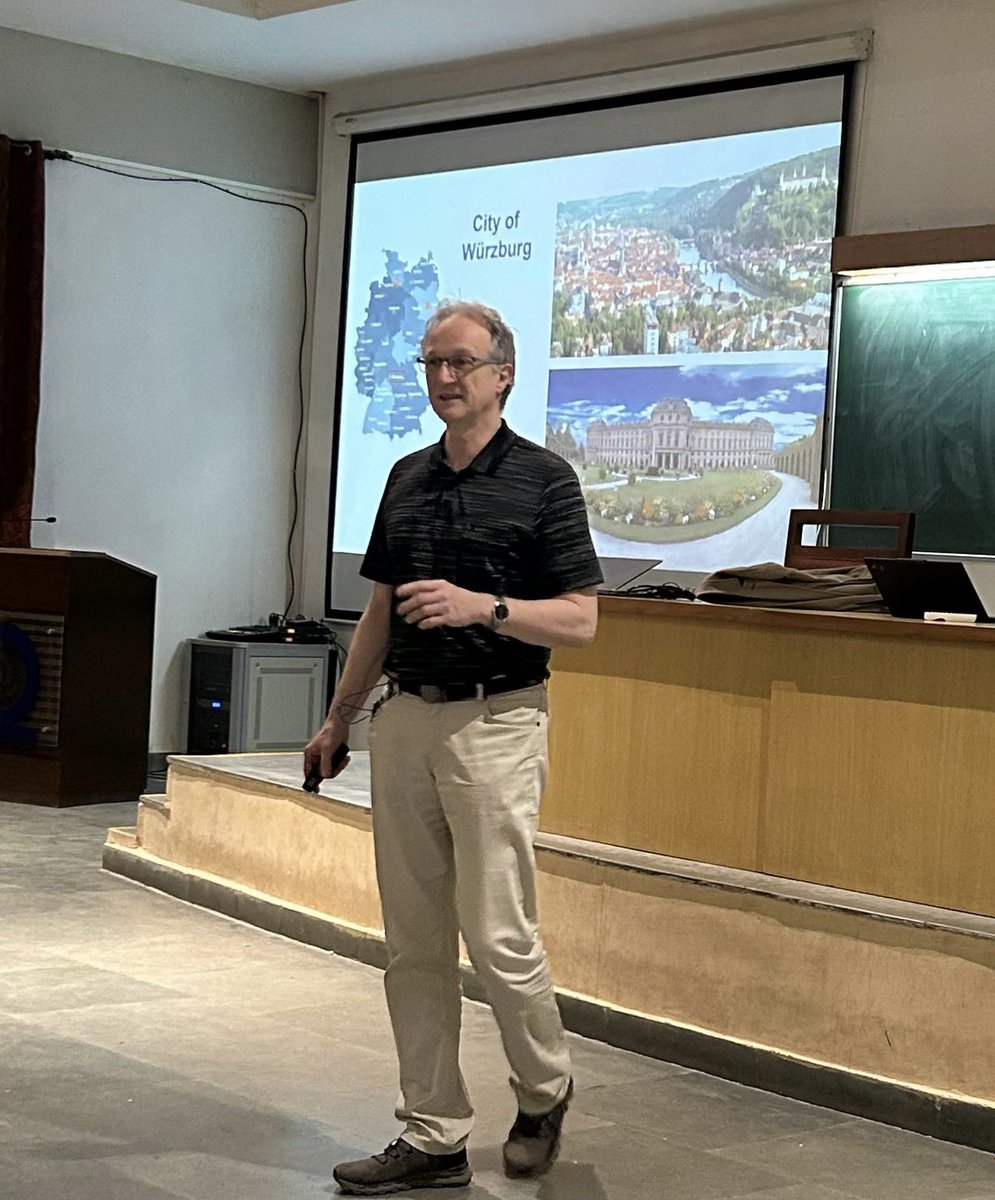
Prof. Frank Würthner @wuerthnergroup from @Uni_WUE, a Jubilee Chair Professor from the Indian Academy of Sciences, delivered a fascinating talk on Supramolecular Engineering of Functional Nanosystems hosted by @DCS_IISERMOHALI @IiserMohali


English

The fact that I baked a Maria Skłodowska-Curie themed cake (polonium and radium) on the day the results of @MSCActions were announced can mean only one thing 👀🎉

English
Niyas M. A. retweetledi

I don't know why so many Americans have this idea that Germans all feel guilty about WWII. I don't know anyone my generation or even my parents' generation who feels this way. I think this is a story that Americans are telling themselves.
What is true is that at least the Germans I know feel a responsibility to make sure what happened in Nazi Germany doesn't happen again, not here, and not anywhere else. I certainly do.
This is why we are scared by what we see happening in the United States. The concentration of power, the streamlining of opinions, the normalization of evil, and the populism to excuse it. These are all warning signs we were taught to recognize.
Americans have this idea that the Holocaust happened in Germany because something is especially wrong with Germans. We're just somehow especially evil. This is why the bad guys in Hollywood movies are always Germans. This is why they make jokes about our supposedly military sounding language.
I strongly disagree. What happened in Germany could have happened anywhere. It's just that Hitler was the first to exploit this weakness. He was a master of mass manipulation (probably strongly influenced by Le Bon's "The Crowd" -- worth a read if you don't know it).
Now we have new masters of mass manipulation. And of course Germans worry about it.
Don't confuse what we feel is our responsibility with guilt.
Yes, ugh, "responsibility". That sounds terribly German, doesn't it. I'm sure you read this wiz a Schermen eksent.
No, I'm not proud to be German. Why would I? I didn't do anything for it, I just happen to have been born to two Germans. But I am glad I am German because all things considered it's a good country.
But if it was possible to just identify as Earthling and not belong to any country, that's what I'd want to be.
English

Excited to share the Feature article which presents how cyclophane-based host–guest complexes can modulate excited-state properties in an advanced way involving both singlet and triplet excited states.
pubs.rsc.org/en/content/art…

English
Niyas M. A. retweetledi

Wonderful to have our BS-MS alumnus, Dr. @niyasma0 from @wuerthnergroup, visit the lab! It was a great scientific exchange and a joyful reunion. Wishing you all the best for your postdoc journey at @UniofOxford as a Newton International fellow!🥳 #AlumniReunion


English

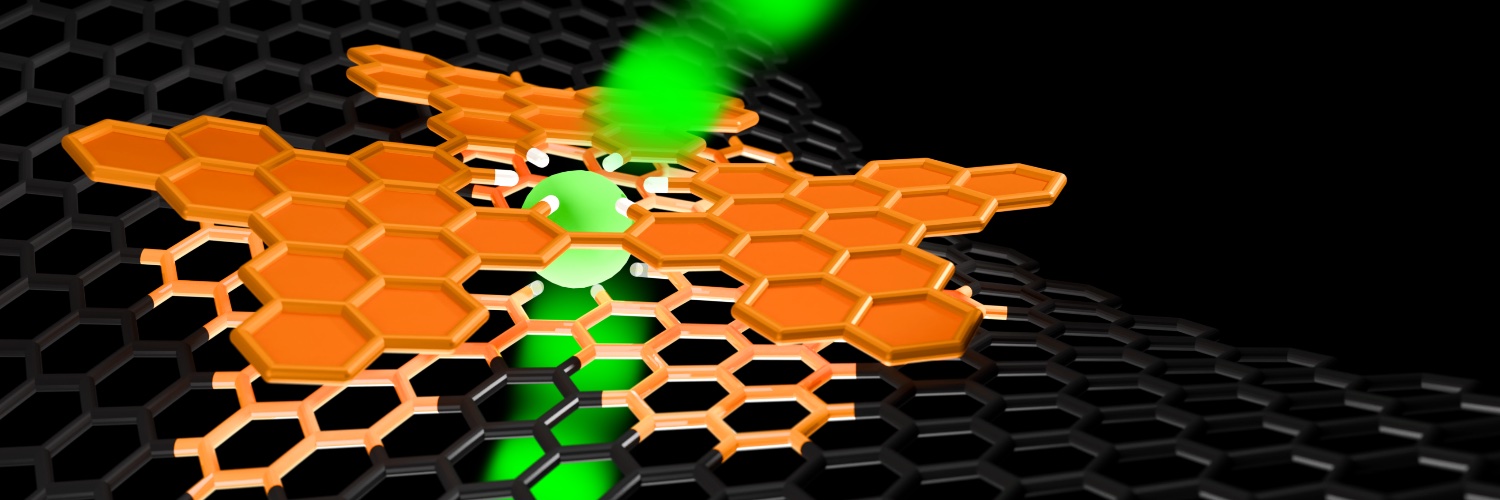
💫Proud to present: Bilayer nanographene reveals halide permeation through a benzene hole... Published in @Nature. Great job by the authors @niyasma0!
nature.com/articles/s4158…
Read with open access: rdcu.be/d6mo9

English

@StawskiWojtek @wuerthnergroup @Nature 2/ Instead of a steric clash, it is actually an attractive hydrogen bonding between electropositive C-H and anions. C-H bonds are polarized due to the six e-withdrawing imide substituents making it H-bond donors.
English

@wuerthnergroup @Nature @niyasma0 It's a very small cavity.I can see it happening in octulene (not cited btw.) but here it's esentially [18]annulene core. How does it avoid steric clash between the anion and the inner Hs? (opposite H-H distance of ca. 4A, typical Br-H hydrogen bond is >2A) onlinelibrary.wiley.com/doi/abs/10.100…
English

@StawskiWojtek @wuerthnergroup @Nature 1/ Binding on the hole doesn’t prove permeation through the hole. It is not binding, but permeation that we investigate in this work. We showed that using a kinetically stable bilayer, we can prove and test permeation through tiny holes.
English