
Noah @ Thinkly

1.1K posts

Noah @ Thinkly banner
Noah @ Thinkly

Noah @ Thinkly

@noah_thinkly

Building @trythinkly . Meet Jia. Your AI EA who already knows what you.

Newyork Katılım Ağustos 2023
2.6K Takip Edilen483 Takipçiler
Sabitlenmiş Tweet
Noah @ Thinkly
Noah @ Thinkly@noah_thinkly·
"Less into manipulating code, more into manipulating knowledge." — @karpathy We've been working on this exact problem for months. It started with a frustration we couldn't shake. Every day we had 15+ tabs open. ChatGPT conversations, Claude threads, articles, YouTube videos, random notes. All scattered. All useful. All forgotten within 48 hours. AI made us faster at finding information. But nobody solved what happens after. The notes pile up. The bookmarks rot. The insights from last week's Claude session? Gone. We tried Notion. We tried Obsidian. We tried bookmarking everything. Nothing stuck because the organizing part always fell on us. And we never got around to it. So we started building. Not another AI chatbot. Not another note-taking app. We wanted one thing: dump your sources, get something publishable back. After months of prototyping, breaking things, and rebuilding, we made Thinkly. Here's what it actually does: Thinkly turns your scattered sources into publish-ready documents. You dump everything in, pick a template, and hit publish. That's it. No folders. No tagging. No "I'll organize this later." You dump it, Thinkly compiles it. This is how it works: Step 1: Dump everything you've got. Articles, ChatGPT conversations, Claude threads, YouTube videos, notes. Paste them all in. Don't have sources yet? Just tell Thinkly the topic and AutoClip gathers them for you. Step 2: Thinkly organizes your clips. Tags appear. Structure forms. You see connections you didn't notice when they were in separate tabs. Step 3: Pick a template. Knowledge Base, Research Brief, Blog Post. Hit "Turn into..." and Thinkly compiles everything into a structured, readable page. Step 4: Hit Publish. A clean, shareable page with everything organized. Send it to your team, post it on Twitter, or keep it for yourself. All of this takes about 5 minutes. Who is it for? If you're the kind of person who has 20 ChatGPT tabs open right now, Thinkly is for you. Researchers, writers, founders, PKM nerds, anyone who consumes more information than they can organize. Karpathy described a system where you dump sources and LLMs compile them into structured knowledge. He uses Obsidian, LLM agents, and custom scripts. Thinkly does the same thing without the scripts. Plus publish. We care deeply about this problem and we've just opened the doors. It's free to try. Here's a demo showing exactly how it works.
Andrej Karpathy@karpathy

LLM Knowledge Bases Something I'm finding very useful recently: using LLMs to build personal knowledge bases for various topics of research interest. In this way, a large fraction of my recent token throughput is going less into manipulating code, and more into manipulating knowledge (stored as markdown and images). The latest LLMs are quite good at it. So: Data ingest: I index source documents (articles, papers, repos, datasets, images, etc.) into a raw/ directory, then I use an LLM to incrementally "compile" a wiki, which is just a collection of .md files in a directory structure. The wiki includes summaries of all the data in raw/, backlinks, and then it categorizes data into concepts, writes articles for them, and links them all. To convert web articles into .md files I like to use the Obsidian Web Clipper extension, and then I also use a hotkey to download all the related images to local so that my LLM can easily reference them. IDE: I use Obsidian as the IDE "frontend" where I can view the raw data, the the compiled wiki, and the derived visualizations. Important to note that the LLM writes and maintains all of the data of the wiki, I rarely touch it directly. I've played with a few Obsidian plugins to render and view data in other ways (e.g. Marp for slides). Q&A: Where things get interesting is that once your wiki is big enough (e.g. mine on some recent research is ~100 articles and ~400K words), you can ask your LLM agent all kinds of complex questions against the wiki, and it will go off, research the answers, etc. I thought I had to reach for fancy RAG, but the LLM has been pretty good about auto-maintaining index files and brief summaries of all the documents and it reads all the important related data fairly easily at this ~small scale. Output: Instead of getting answers in text/terminal, I like to have it render markdown files for me, or slide shows (Marp format), or matplotlib images, all of which I then view again in Obsidian. You can imagine many other visual output formats depending on the query. Often, I end up "filing" the outputs back into the wiki to enhance it for further queries. So my own explorations and queries always "add up" in the knowledge base. Linting: I've run some LLM "health checks" over the wiki to e.g. find inconsistent data, impute missing data (with web searchers), find interesting connections for new article candidates, etc., to incrementally clean up the wiki and enhance its overall data integrity. The LLMs are quite good at suggesting further questions to ask and look into. Extra tools: I find myself developing additional tools to process the data, e.g. I vibe coded a small and naive search engine over the wiki, which I both use directly (in a web ui), but more often I want to hand it off to an LLM via CLI as a tool for larger queries. Further explorations: As the repo grows, the natural desire is to also think about synthetic data generation + finetuning to have your LLM "know" the data in its weights instead of just context windows. TLDR: raw data from a given number of sources is collected, then compiled by an LLM into a .md wiki, then operated on by various CLIs by the LLM to do Q&A and to incrementally enhance the wiki, and all of it viewable in Obsidian. You rarely ever write or edit the wiki manually, it's the domain of the LLM. I think there is room here for an incredible new product instead of a hacky collection of scripts.

English
3
3
11
466
Noah @ Thinkly
Noah @ Thinkly@noah_thinkly·
This is the gap we’ve been working on. Thinkly comes with Hermes Agent built in. No harness to configure, no stack to assemble. You sign up and the agent is already running. The 6 use cases in this video? You can try them in the next 5 minutes instead of next weekend. thinkly.pluglab.ai
English
0
0
1
16
Noah @ Thinkly
Noah @ Thinkly@noah_thinkly·
The fact that "almost nobody knows how to use it properly" is the whole problem. Hermes is genuinely powerful. But powerful and accessible aren't the same thing. Most people will watch a 6-use-case video, feel inspired, and never get past the setup. The agent that wins isn't the most capable one. It's the one you can actually use on day one.
Alex Finn@AlexFinn

Hermes Agent is the most powerful AI tool right now The issue is, almost nobody knows how to use it properly In this video I show you 6 use cases for Hermes I promise will completely change how you work:

English
1
0
2
145
Noah @ Thinkly
Noah @ Thinkly@noah_thinkly·
This is the gap we've been working on. Thinkly: dump raw notes, AI chats, links, docs, and it structures and connects them automatically. No tagging, no folders. The knowledge base maintains itself while you focus on the workflow. Your context should compound without you babysitting it. thinkly.pluglab.ai
English
0
0
4
17
Noah @ Thinkly
Noah @ Thinkly@noah_thinkly·
The most underrated line in this whole thread: "they can't clone 6 months of context." Everyone obsesses over the agent stack. The harness, the MCP servers, the model routing. Almost no one obsesses over the knowledge layer feeding it. The moat was never the stack. It's the structured context you've been compounding the whole time. And most people's context dies in 40 open tabs and a chat history they'll never scroll back to.
GREG ISENBERG@gregisenberg

How to build a vertical AI agent cash-flowing startup: find painful workflow in a boring industry → talk to 10 people who do that workflow every day → map every step, every tool, every spreadsheet, every phone call → do the workflow manually first → be the agent before you build the agent → find the edge cases that break everything → document them in obsidian as structured markdown → set up your agent stack → hermes for the harness → obsidian vault as the knowledge base → composio for authentication across apps → build your first 1-3 skills that solve the core pain → use claude code or codex to build the product → use agents to set up other agents → use perplexity MCP and context7 for up-to-date docs → let the agent handle the scaffolding while you focus on the workflow logic → ship the agent to your first 5 customers for free → watch what they actually use it for → they will surprise you → the thing you built for isn't always the thing they need most → build content around the niche → not "building in public" content → useful content → the tips, the shortcuts, the pain points that only someone who does this workflow would know → become the person for that niche → charge per outcome not per seat → per lease renewed, per claim processed, per candidate sourced → the ROI conversation takes 10 seconds when it's tied to a result → set up watchdogs and alerts → your agent emails you when a cron job breaks or a skill fails → the customer should never have to tell you something is broken → connect to open router → see exact costs per model per task → use GPT 5.5 for tool calls → use open source for lightweight tasks → route the right model to the right job → watch your margins double → let hermes write to its own memory after every task → the agent compounds → the longer it runs the better it gets → that accumulated memory becomes your moat → a competitor can clone your product but they can't clone 6 months of context → expand the workflow → you started with one step → add the next → then the next → now you own the entire workflow end to end → you went from a tool to the operating system for that vertical → stack the agents → one agent is a side project → five agents across five customers is a business → each one runs in its own environment → you check in once a day → raise only if you need capital not credibility → most agent businesses should never raise → the margins are too good to give away equity → stay lean → stay profitable → repeat i'm rooting for you

English
1
0
5
60
Noah @ Thinkly
Noah @ Thinkly@noah_thinkly·
this update is genuinely huge. but here's what nobody says. every Hermes update is amazing only if you can install it. Docker, API keys, a weekend gone. so we built Thinkly to delete that step. no install. no config files. no terminal. you log in. Hermes is already working for you.
Alex Finn@AlexFinn

Ok, Hermes Agent just cooked Their biggest update just dropped and it adds a TON • Post autonomously to X • WAY improved memory • MUCH smarter kanban board • Tons more In this video I walk you through all the new features and how to SUPERCHARGE your 24/7 AI employee

English
2
0
4
54
Noah @ Thinkly
Noah @ Thinkly@noah_thinkly·
solo founders are 38% of seven-figure businesses in 2026 (per Grey Journal). most of us are working hard to be in that 38%. shipping daily. burning tokens. ship more, repeat. token usage going up. mental clarity going down. here's what i've realized: we've been adding more AI tools, not an Executive Assistant to use them. we need an Executive Assistant. someone who: - knows your business as well as you do - remembers what you decided weeks ago - drafts in your voice - flags things before you ask - runs your week so you can think an executive assistant doesn't write code. she organizes everything that makes the code worth writing. because here's the truth nobody talks about: solo founding is lonely. not "i wish i had a friend" lonely. "i wish someone knew the context before i had to explain it" lonely. every decision sits on you. every "should i do X or Y" sits on you. that's the gap an Executive Assistant fills. stop adding more AI tools. hire your first Executive Assistant. we're building Thinkly for exactly this.
English
1
1
2
33
Noah @ Thinkly
Noah @ Thinkly@noah_thinkly·
3 is the one that's keeping me up too. we're building Thinkly around exactly this: distribution + memory. an AI Executive Assistant that remembers everything you save (your chats, articles, decisions) and uses it forever. once you've trained her on a year of your context, you literally can't switch.
English
0
0
0
119
GREG ISENBERG
GREG ISENBERG@gregisenberg·
My 30+ observations on the greatest opportunities in AI agents right now: And some ideas that are keeping me up at night. 1. The new buyer on the internet is an AI agent. Imagine billions of new customers showing up with money to spend but they only shop via MCP. That's what's happening. No MCP server means you're invisible to the fastest growing buyer on the internet. 2. Every franchise system in America (30,000+) needs an agent layer and none of them have one. One founder per franchise vertical. That's 30,000 businesses waiting. 3. Everyone said "distribution is the only moat" a year ago. Now I'd add that the only moat is distribution plus memory. The company that has your audience AND your agent's accumulated context is impossible to leave. 4. Consumer mobile is more interesting than it's been since 2012. Apps can finally DO things for you instead of showing you things. The next wave of $100M apps are being built right now. 5. The most interesting startup nobody has built is an agent marketplace where you rent access to someone else's trained agent. A recruiter spent 6 months training a sourcing agent on healthcare hiring. That agent is worth renting to every other healthcare recruiter on earth. The agent itself becomes the product. 6. A sorta strange phenomenon that's happening right now is agents are developing preferences. Give the same agent the same task 100 times and it starts developing patterns in how it approaches it. Nobody is studying this yet. But the agents that develop good patterns are worth more than the ones that don't. That's a new kind of asset. 7. Dead internet theory is about to become dead SaaS theory. Half the apps you use will quietly replace their support team, their onboarding team, and their content team with agents. You won't notice for months. Then you'll realize you haven't talked to a human at that company in a year. 8. The most valuable data in the world right now is sitting in the support tickets of small or mid tier SaaS companies. Every ticket is a customer telling you exactly what to build next. Mine this. 9. The most interesting pricing problem nobody has solved is how do you price a product when your costs change every time OpenAI or Anthropic updates their model pricing? Your margins can swing 40% overnight based on a decision made in San Francisco. The company that builds dynamic pricing infrastructure for agent-based businesses solves a problem every AI company has. 10. The best AI products feel like they're reading your mind. The worst ones feel like filling out a form with extra steps. 11. An interesting arbitrage I've noticed lately is hiring a human VA for $20/hour to supervise an AI agent that does $200/hour work. The human just checks the output. 12. The managed AI agent business is becoming the new agency model. $5k/month per client. You build it, run it, maintain it. The client gets a digital employee they never have to think about. This will be a $50 B+ category. 13. The first "shadow agent" scandals are about to drop. Employees running personal agents on company infrastructure without telling anyone. Using company API keys. Agents accessing internal docs. IT departments have little visibility into this right now. Lots of opportunity to build companies here. Definitely a painkiller not a vitamin type of business. 14. Right now there are probably millions of agents running on autopilot that their creators forgot about. Still burning tokens. Still sending emails. Still scraping websites. Still costing money. The "find and kill your zombie agents" tool is a product that writes itself. 15. Companies are starting to hire based on someone's agent portfolio instead of their resume. "Show me 3 agents you built that are running right now." It's REALLY early but it's starting. 16. Your Slack archive is a product. Every company's internal Slack has thousands of messages explaining how they actually do things. The company that lets you point an agent at your Slack history and auto-generate SOPs and agents from it will be enormous. 17. We're watching the cost of intelligence fall faster than the cost of distribution. Which means distribution is now the expensive thing. 18. The most underrated asset a human can have in 2026: the ability to sit in a room with another human, make eye contact, and have a real conversation. As AI handles more of the transactional stuff, the humans who can do the relational stuff become disproportionately valuable. The soft skills people used to dismiss as fluffy are becoming the hard skills. The hard skills people spent decades acquiring are becoming the soft ones. 19. There are MANY huge companies to be built around the fact that most people's agents are running on their personal laptops which they also use to browse the internet, check email, and download random files. The attack surface is enormous. One compromised Chrome extension and your agent's API keys, customer data, and workflows are exposed. 20. There's a new type of burnout forming that doesn't have a name. It's not from working too hard. It's from context switching between human work and agent work 50 times a day. Reviewing agent output, correcting it, approving it, reviewing again. The mental load of supervising agents is different from the mental load of doing the work yourself. Some founders are telling me they were less tired when they did everything manually because at least the cognitive pattern was consistent. 21. The cheapest form of market research: search "[your industry] spreadsheet template" on Google. Whatever people are tracking manually is your product. 22. Half the YC companies pivoted within 8 weeks of demo day. Not because they failed. Because agents let them test 5 ideas in the time it used to take to test one. The concept of "committing to an idea" is dissolving. Serial pivoting is becoming the default because 1) AI lets you move fast 2) the world is moving fast. 23. The loneliest job in tech right now is being the only person at your company who understands what the agents are doing. You can't explain it to your boss. You can't hand it off to a colleague. If you leave, everything breaks. You've become a single point of failure for an entire automated system. That person needs a title, a team, and a backup plan. Most companies haven't figured this out yet. 24. Your browser history is the most valuable training data you own and you're giving it away for free. Every site you visit, every product you research, every competitor you study, every pricing page you screenshot. That behavioral data, structured and fed to an agent, would make it understand your business better than any onboarding call. The company that lets you turn your browser history into agent context builds something nobody can replicate. 25. Everyone is building AI wrappers. Nobody is building AI unwrappers. The tool that takes an AI-generated document and tells you which parts a human wrote and which parts were generated. 26. Stripe just became the most important company in the agent economy and they barely had to do anything. Every agent that sells something needs Stripe. Every agent that buys something needs Stripe. They're the payment rail for the entire agentic internet by default. 27. The most undervalued API in the world right now is the US Postal Service address verification API. It's practically free. Every local business lead gen agent needs it. Every real estate agent needs it. Every direct mail agent needs it. Boring government infrastructure is quietly becoming the backbone of agent-native businesses. 28. The concept of "business hours" is for humans. Your agent closed a deal in Tokyo at 3am, processed the payment, sent the onboarding email, and updated the CRM before your alarm went off. 29. What happens when agents start recommending other agents? Your research agent finds that a competitor's sales agent is better and suggests you switch. Agent referral networks are forming organically. The first agent affiliate program is probably 6 months away. 30. Cal dotcom closed their source code. That's the canary. When open source companies start closing up, it means agents were cloning their product too easily. Every open source company is quietly asking the same question right now. 31. "AI for pet groomers" sounds like a joke and that's exactly why it will work. 150,000 of them in America. Zero tech. All scheduling by phone or IG DMs. The joke ideas always win. 32. The thing that will seem most obvious in hindsight: we spent 2025-2026 arguing about which model is best while the entire value was in the orchestration layer. The model is the CPU. Nobody buys a computer based on the CPU anymore. They buy it based on what they can do with it. Makes so much sense in hindsight. What else will be obvious in hindsight? I'll share more notes soon. I can't sleep with all that's going on. Maybe you too. What an incredible time to be building.
English
237
276
2.5K
555.5K
Noah @ Thinkly
Noah @ Thinkly@noah_thinkly·
$5,000/month for a human executive assistant. $0 to start with one that remembers everything. set her up once. she runs your week.
English
1
1
3
45
Noah @ Thinkly
Noah @ Thinkly@noah_thinkly·
Anthropic's /goal command is genuinely incredible if you write code. but here's the thing: 80% of my work isn't code. it's email follow-ups, weekly briefs, client research, investor updates. for that, /goal doesn't help. i needed something that runs forever, not just for one session. so we built Thinkly. AI Executive Assistant for non-coding work. "draft my investor update from my Notion + last 3 board emails" → done "flag when i haven't talked to my top 3 customers in 14 days" → done "pull every article i saved about pricing when i'm writing on it" → done thinkly.pluglab.ai
ClaudeDevs@ClaudeDevs

How do you keep Claude working until the job is done? Claude Code helps with this in a few ways, including one we shipped recently: /goal.

English
1
0
1
18
Noah @ Thinkly
Noah @ Thinkly@noah_thinkly·
in 2026 you can pick your Executive Assistant like a video game character. 8 to choose from. all capable. 1 click. yours forever. pick the one you'd actually want to see every day. i picked Jia. she reads what i save and drafts before i ask. thinkly.pluglab.ai
English
1
2
4
40
Noah @ Thinkly
Noah @ Thinkly@noah_thinkly·
DeepMind on their new AI-enabled pointer: "help is always available where you're working, without having to detour to additional apps." we built Thinkly on the same idea, but for memory. instead of pointing at the screen, our AI Executive Assistant reads what you've saved. different surfaces. same insight: the AI chat window is broken. thinkly.pluglab.ai
Google DeepMind@GoogleDeepMind

We’re reimagining a 50-year-old interface - the mouse pointer - with AI. 🖱️ These experimental demos show how people can intuitively direct Gemini on their screens using motion, speech, and natural shorthand to get things done 🧵

English
0
0
4
66
Noah @ Thinkly
Noah @ Thinkly@noah_thinkly·
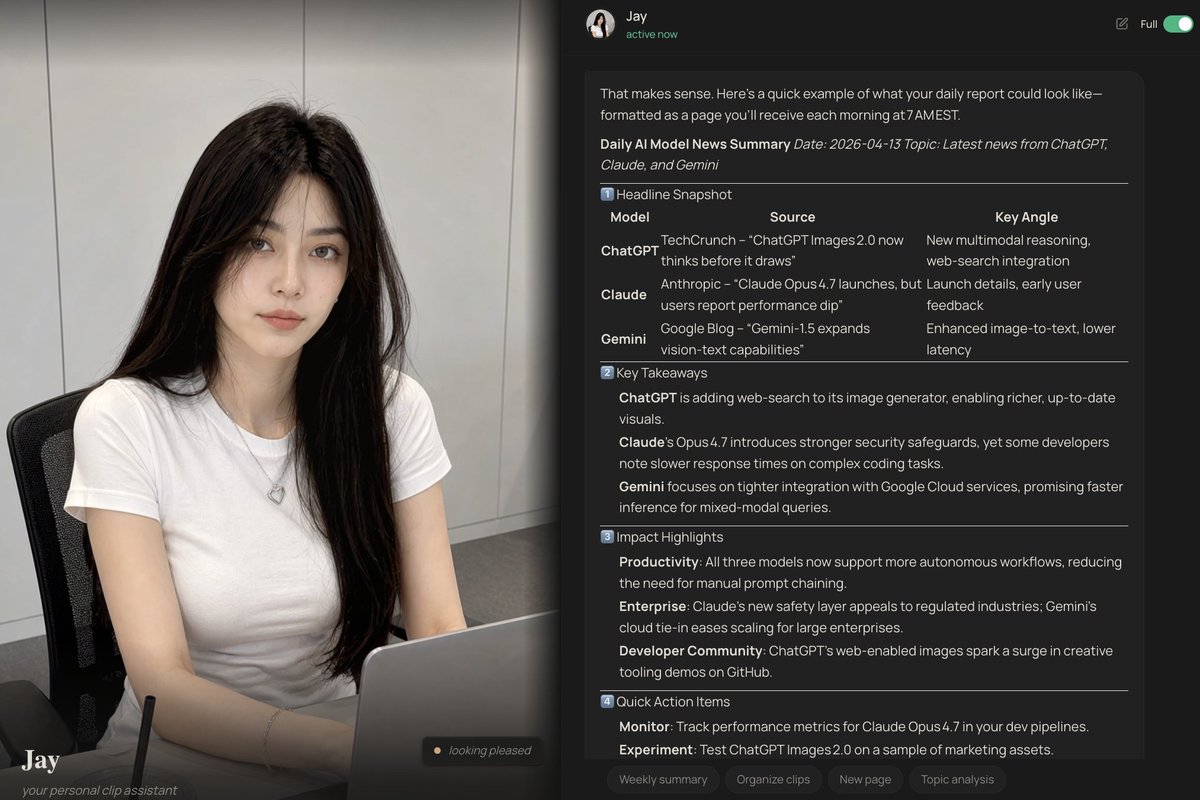
45 minutes saved every morning. told my AI assistant: "every morning, brief me on what my competitors shipped and what's breaking in AI." now: 3 stories. ranked. cited. 30 sec read. delivered before i'm up.
Noah @ Thinkly tweet media
English
1
0
4
20