
Sabitlenmiş Tweet
nosh
98.5K posts



nosh retweetledi

#Hantavirus cluster linked to cruise ship travel:
Since 1 April when the boat set sail, of the 147 passengers and crew, 7 people have become ill, among whom 3 have died, 1 is critically ill and 3 are reporting mild symptoms.
Based on the current information, including how hantavirus spreads, WHO assesses the risk to the global population from this event as low.
We are working closely with health authorities from the countries involved and the ship's operators to ensure passengers and crew get the information and support they need.
WHO will continue to monitor the situation and update the risk assessment as more information becomes available.
More information bit.ly/42Tc4J7

English
nosh retweetledi

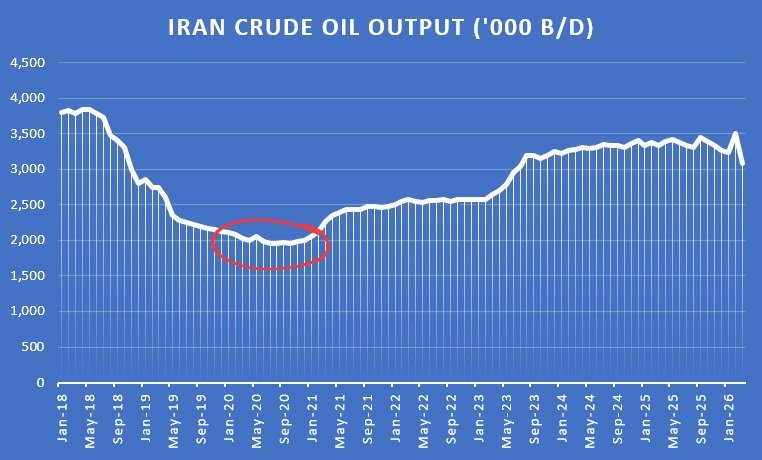
🇮🇷 Talk of imminent and irreversible damage to Iran's oil fields is overblown.
Sanctions forced Iran to reduce crude output to ~2mn b/d for 10-11 months in 2020-21 (~1mn b/d below April levels) and the damage to its reservoirs was limited: At most 200-300k b/d capacity loss.
Meaningful, but not fatal.
Mark Dubowitz@mdubowitz
Senior Middle Eastern official: The Islamic Republic in Iran is 8-9 weeks from total economic collapse. The Islamic Republic in Iran is 5-6 weeks from irreversible pressure disruptions to its capped oil wells.
English
nosh retweetledi

Diplomatic talks as Nigeria formally complains about xenophobic violence news24.com/politics/diplo…
English
nosh retweetledi

nosh retweetledi
#Iraq is offering its term buyers huge discounts for crude loaded this month, but tankers will have to transit the Strait of Hormuz to collect the barrels deep inside the Persian Gulf just as hostilities flare in the region.
The OPEC producer is offering discounts to official prices of as much as $33.40 a barrel for its flagship Basrah Medium crude, according to a notice from state oil marketer SOMO seen by Bloomberg News. The document is dated May 3, and lists a range of pricing levels during different periods this month
#oott bloomberg.com/news/articles/…
English
nosh retweetledi

The price of solar panel components has steadily climbed from 9 cents per watt at the end of December to 11.4 cents per watt on April 15.
This increase is due not only to the increase in the price of silver, the main component of solar panels, but also due to China's efforts to curb fierce price competition, which has caused some of China's largest manufacturers to lose billions of dollars.
English
nosh retweetledi

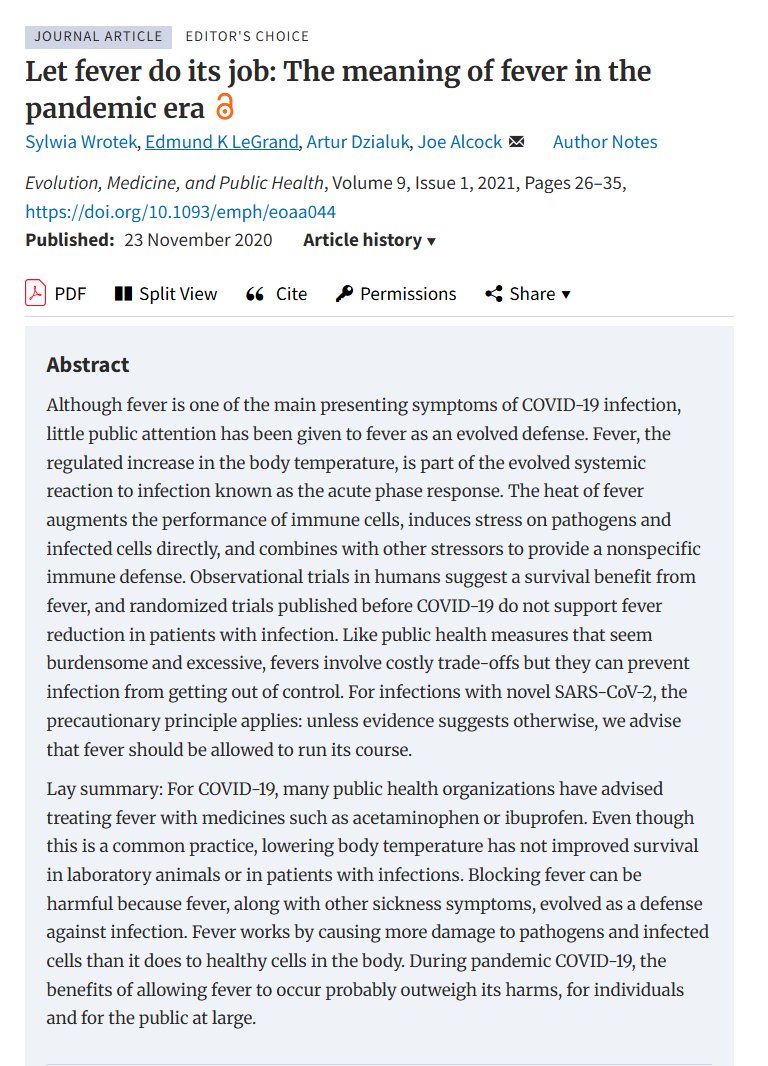
People calling me a quack for talking about the importance of fever during an infection even to the point of not treating it or even promoting it.
They are the quacks for not reading enough scientific papers.
academic.oup.com/emph/article/9…
English
nosh retweetledi
Hantaviruses are terrifying because they don’t just infect you.
They mess with your blood vessels.
And then they silence the alarm.
Here’s the simple version:
Your blood vessels are lined with cells called endothelial cells.
These cells are like the “walls” of your bloodstream.
They help keep fluid inside your blood vessels instead of leaking into your lungs, kidneys, and tissues.
Hantaviruses love these cells.
That’s why severe hantavirus infections can cause:
• fluid leaking into the lungs
• shock
• kidney problems
• bleeding
• low platelets
• rapid collapse
But here’s the wild part:
The virus does not usually destroy these cells by bursting them open.
Instead, it infects them and changes how they behave.
The blood vessels become leaky.
Now here’s where it gets even more interesting.
Your body has an early virus alarm system called type I interferon.
Think of interferon like a neighborhood alert:
“Virus detected. Lock everything down.”
When interferon turns on early, nearby cells switch into antiviral mode.
That can stop the virus before it spreads.
But dangerous hantaviruses have a trick.
They delay the alarm.
They block the early interferon response long enough to start replicating.
In other words:
The virus breaks in.
The cell reaches for the alarm.
And the virus cuts the wire.
That delay may be the difference between a virus that fizzles out and one that becomes deadly.
Scientists compared different hantaviruses and found something important:
A hantavirus called Prospect Hill virus is not known to cause human disease.
Why?
It triggers interferon early.
The alarm goes off.
The virus gets controlled.
But pathogenic hantaviruses like Andes virus and Hantaan virus suppress that early alarm and replicate successfully in human blood vessel cells.
One viral protein seems especially important:
Gn-T.
This protein can interfere with the cell’s alarm pathway involving STING, TBK1, TRAF3, IRF3, and NF-κB.
Translation:
The virus jams the cell’s emergency communication system before the immune response gets fully activated.
And timing is everything.
Interferon given early can block hantavirus replication.
Interferon given too late does much less.
That means the first few hours matter.
The takeaway:
The key to increasing your chances of surviving Hantavirus might mean maximizing interferon.
Source: Matthys & Mackow, “Hantavirus Regulation of Type I Interferon Responses,” Advances in Virology, 2012.
onlinelibrary.wiley.com/doi/10.1155/20…
English
nosh retweetledi

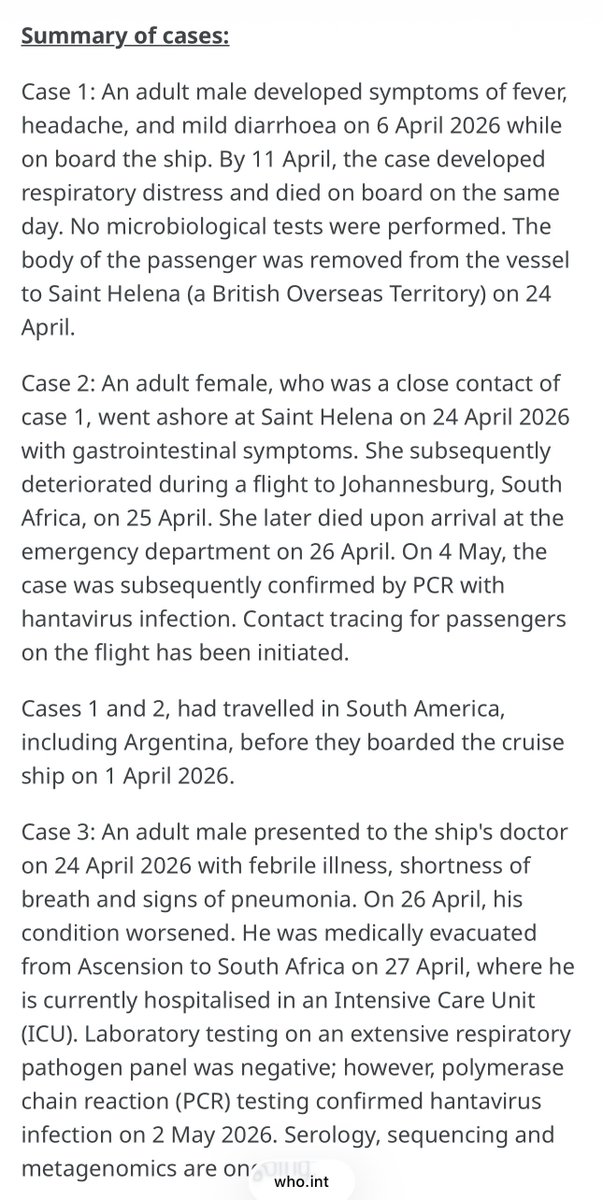
3) to be clear, Argentina was one of the places that cases 1 and 2 both visited in South America. And they visited Argentina before boarding the cruise ship.
“Cases 1 and 2, had travelled in South America, including Argentina, before they boarded the cruise ship on 1 April 2026.”
English
nosh retweetledi
🛳️CRUISE SHIP OUTBREAK REPORT RELEASED—New crazy timeline data on cruise ship passengers who got sick and died of hantavirus (and 3 more sickened, including 1 critical). According to latest WHO report, index patient died within 5 days of symptoms. Crazier is that close contact #2 didn’t get hospitalized until 13 days later, and then died within 2 days of hospitalization. Case 3 didn’t get sick until 13 days after first index case died… but respiratory tested negative for 8 days until PCR confirmed it on 8th day; case 3 still hospitalized. Meanwhile, Case 4 got sick on April 28th with pneumonia, and died very quickly just 4 days later!
Although uncommon, limited human‑to‑human transmission of HPS due to Andes virus has been reported in community settings involving close and prolonged contact. Secondary infections among healthcare workers have been previously documented in healthcare facilities, though remain rare. Hantavirus infections are associated with a case fatality rate of <1–15% in Asia and Europe and up to 50% in the Americas. While there are no specific treatment nor vaccines for hantavirus infections, early supportive care and immediate referral to a facility with a complete ICU can improve survival.
A good reminder that cruise ships often have a variety of outbreaks if not careful.

English
nosh retweetledi

Less than 2,000 accounts on Polymarket split nearly $500 million in profit. The other 1.6 million users mostly lost. The worst-hit 160,000 traders averaged $4,000 down each. The 0.1% who took the money are Wall Street firms the platforms paid to come in.
Susquehanna International Group, co-founded by billionaire Jeff Yass, trades hundreds of millions of dollars on Kalshi every week. Jump Trading, a Chicago firm that runs computer algorithms across financial markets, recently put more than 20 full-time staff on prediction markets. Citadel Securities, another big Wall Street trading firm, is watching too. These firms have rooms full of mathematicians, and they pay millions a year for the kind of live news and data feeds that ordinary users cannot afford. Every contract on the platform gets priced by them the same way a casino prices its odds.
Both platforms pulled the firms in on purpose. Prediction markets only run if somebody is willing to take the opposite side of every bet a user places. So Polymarket and Kalshi handed Wall Street firms ownership stakes in their own companies in exchange for showing up to do that. Susquehanna and Robinhood took control of LedgerX, the US exchange that handles these contracts, while Jump Trading is now lined up to take stakes in both Polymarket and Kalshi. The platforms got steady trading, and the firms got a steady supply of casual users to bet against.
Bloomberg counted more than 100,000 Polymarket accounts that have lost at least $1,000 since January 2025. That is almost twice as many as the accounts that have made comparable money. On Kalshi, losing users outnumber winners 2.9 to 1.
The deepest losses sit in something called "mention markets," which are bets on whether a famous person will say a specific word in a speech. The WSJ analyzed more than 35,000 of these completed bets. When the price said a bet had a 50/50 chance of winning, it actually paid out only 40% of the time. The average person who bet "yes" at the price shown lost 11% of their money. Research from the University of Nevada Las Vegas, cited by the Journal, puts those returns below what most Vegas slot machines pay back.
This shape shows up wherever regular people meet professional traders. A landmark Brazilian study followed every person who tried day trading for more than 300 days, and 97% of them lost money. In US sports betting, the long-term winners are typically 3 to 5 in every 100 bettors. The 0.1% who keep most of the profit on Polymarket and Kalshi are written into how these platforms were built. The losses on the other side are exactly what the equity deals were designed to produce.
Charlie Bilello@charliebilello
Insane stat: 0.1% of the accounts on Polymarket have earned 67% of the profits.
English
nosh retweetledi

TIME IS NOT TREATED THE SAME EVERYWHERE:
1. Germany: Being late is disrespectful. Meetings start to the second. Punctuality here is not a habit. It is a moral standard.
2. Brazil: An invitation for seven means nine. Relationships matter more than schedules. Rigidity kills the atmosphere.
3. Japan: Trains run to the minute. A sixty second delay comes with a formal public apology. Time is a system. The system is everything.
4. India: Events begin when people arrive. The gathering defines the time. Presence matters more than precision.
5. Polynesian cultures: Time was tied to stars, seasons, and the ocean. Circular, not linear. The clock came later and from somewhere else.
6. United States: Time is money. Literally. Every hour is billable. Every minute is scheduled. Rest has to earn its place.
7. Spain: Lunch at three. Dinner at ten. The day bends around the person. Not the other way around.
8. Ethiopia: A different calendar entirely. Thirteen months. New Year in September. A different year than the rest of the world. Time here is a cultural choice, not a global agreement.
9. France: August belongs to rest. Emails go unanswered. Shops close. Nobody apologizes for this. Leisure is a right, not a reward.
10. Kenya: The clock starts at sunrise. Six in the morning is hour zero. Noon is hour six. Time is built around light, not an arbitrary number on a wall.
11. China: One time zone for the entire country. A landmass that should span five. In the far west the sun rises at ten in the morning. Unity was chosen over accuracy.
12.Australia: Aboriginal communities have always read time through seasons, animal movements, and the stars above. For over sixty thousand years the land itself served as the calendar. No clock was ever needed. Nature told them everything.
13. Mexico: Mañana means not right now. Urgency is often self-imposed. The present moment has its own demands and they are considered legitimate.
14. Greece: A guest arrives at any hour. You welcome them fully. The clock adjusts to the person. The person never adjusts to the clock.
15. Scandinavia: Months of darkness then months of endless light. The body follows seasons, not schedules. This is ancient. Science is only now catching up.
16. Nigeria: Start times are a suggestion. What matters is that everyone arrives, connects, and the evening becomes what it was meant to be. The experience always outranks the schedule.
17. Indonesia: Jam karet. Rubber time. Time stretches around mood, traffic, and social obligation. Rigidity is considered uncomfortable, not professional.
18. Russia: Eleven time zones. Vast winters. Long silences. Time here is treated with patience that outsiders often mistake for slowness.
19. Egypt: One of the first civilizations to invent a calendar. Yet modern Egyptian social time is deeply flexible. Hospitality always comes before the clock.
20. Congo: Community shapes the day more than any schedule. Time belongs to the people in the room, not the hands on the clock.
21. Philippines: Filipino time is a known and accepted reality. Six in the evening means seven or eight. Arriving before the host is ready is the real social mistake.
22. Vietnam: Built on endurance and long horizons. Planning here thinks in years and generations. Short deadlines feel foreign to a culture that measured time in struggles spanning decades.
23. Tanzania: Pole pole. Slowly slowly. A phrase that governs daily life. Rushing is not a virtue here. Moving with intention is.
24. Argentina: Dinner at ten. Parties at midnight. The night is its own world. Compressing it into earlier hours would make it something lesser.
25. Turkey: A meeting can become a meal can become a long evening. Nobody considers this a deviation. It is simply what time is for.
26. Iran: Its own solar calendar. New Year on the spring equinox. Time tied to nature, poetry, and a civilization so old that modern urgency feels like a passing trend.
English
nosh retweetledi

nosh retweetledi

nosh retweetledi

nosh retweetledi

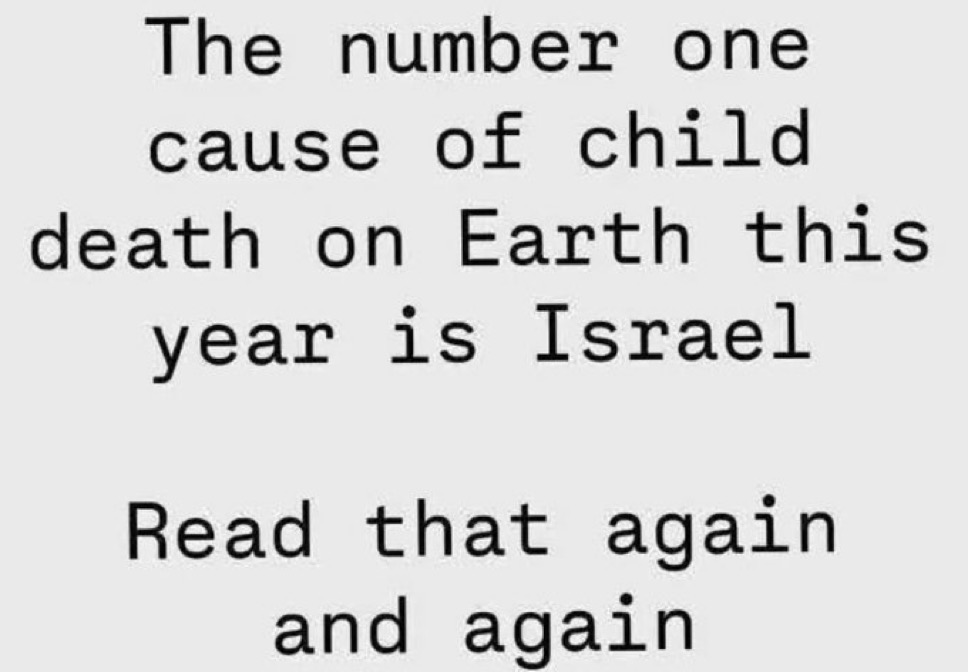
@EthanLevins2 This is what is happening to them on a daily basis while the world just kept blind eye to it
English
nosh retweetledi

nosh retweetledi

@EthanLevins2 Zionist settler mows down a 6-year-old girl playing outside, pure hatred on display. Israel's occupation breeds monsters who hunt Palestinian children without shame.
English
nosh retweetledi

An Israeli ran over a 6-year-old girl with his car in the West Bank as she played outside her home
English
nosh retweetledi

The israelis burned several children alive bombing Fahmi Al-Jargawi School, which shelters displaced civilians, in Al-Daraj, in Gaza City
English