arcy
2.4K posts




arcy retweetledi

arcy retweetledi




I gave my Claude bot $2,000 on Polymarket and one rule: "maximize profit"
It lost for 2 weeks
Then $2,000 → $15,240
No predictions, no labels, no "if this, then that"
Just reinforcement learning - the bot writes its own rules
Most bots use supervised learning
Train on history, predict outcomes, hope it holds
Mine doesn't predict anything
It gets reward for profit and penalty for loss
47 features
Price, volume, spread, volatility, sentiment, time to resolution
Nobody told it what matters
7 actions
Buy YES/NO at 5%, 15%, 30% or hold
First 2 weeks - chaos
30-40 trades a day, bleeding money
Then something shifted
The bot learned to wait, trades dropped to 8-12 per day
HOLD went from 30% to 62%
It figured out timing on its own, 78% of trades happen in the last 6 hours before resolution
It discovered Kelly sizing without knowing Kelly exists High confidence → big position. Low confidence → dust
It stopped trading crypto entirely, moved to weather and geopolitics - where edges last longer
Nobody programmed any of this
Win rate: 64.7%
Sharpe: 2.84
Max drawdown: -4.1%
1,680 trades, profit factor: 2.12
Weekly retraining every Sunday, if new policy has worse sharpe - auto rollback
Runs on a Mac Mini M2 $47/month
The bot doesn't know what's going to happen
It just knows how to trade
self.dll@seelffff
English
arcy retweetledi




Jane Street rolls back your application if you can't spin up Monte Carlo in your head
Most traders look at a $100 stock and place a bet.
Jane Street interns look at the same stock and simulate everything.
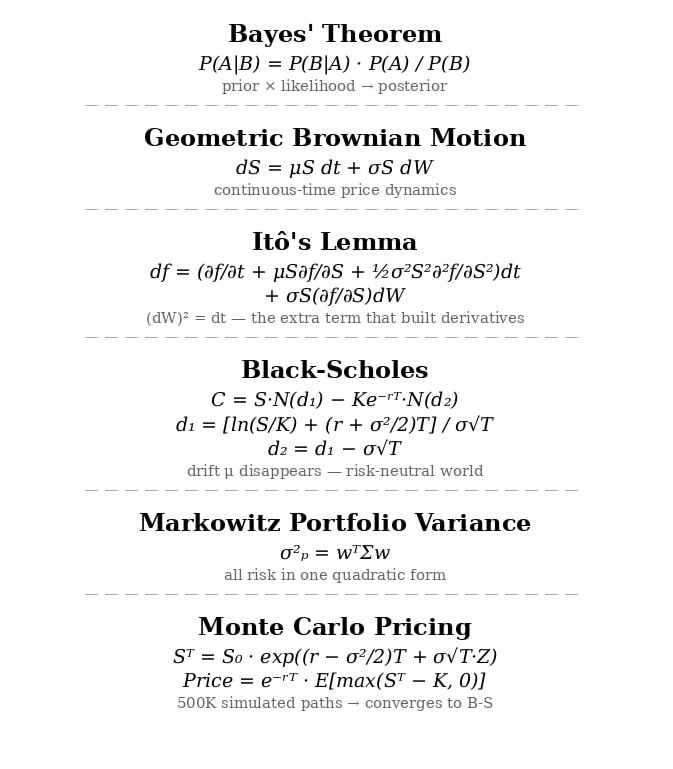
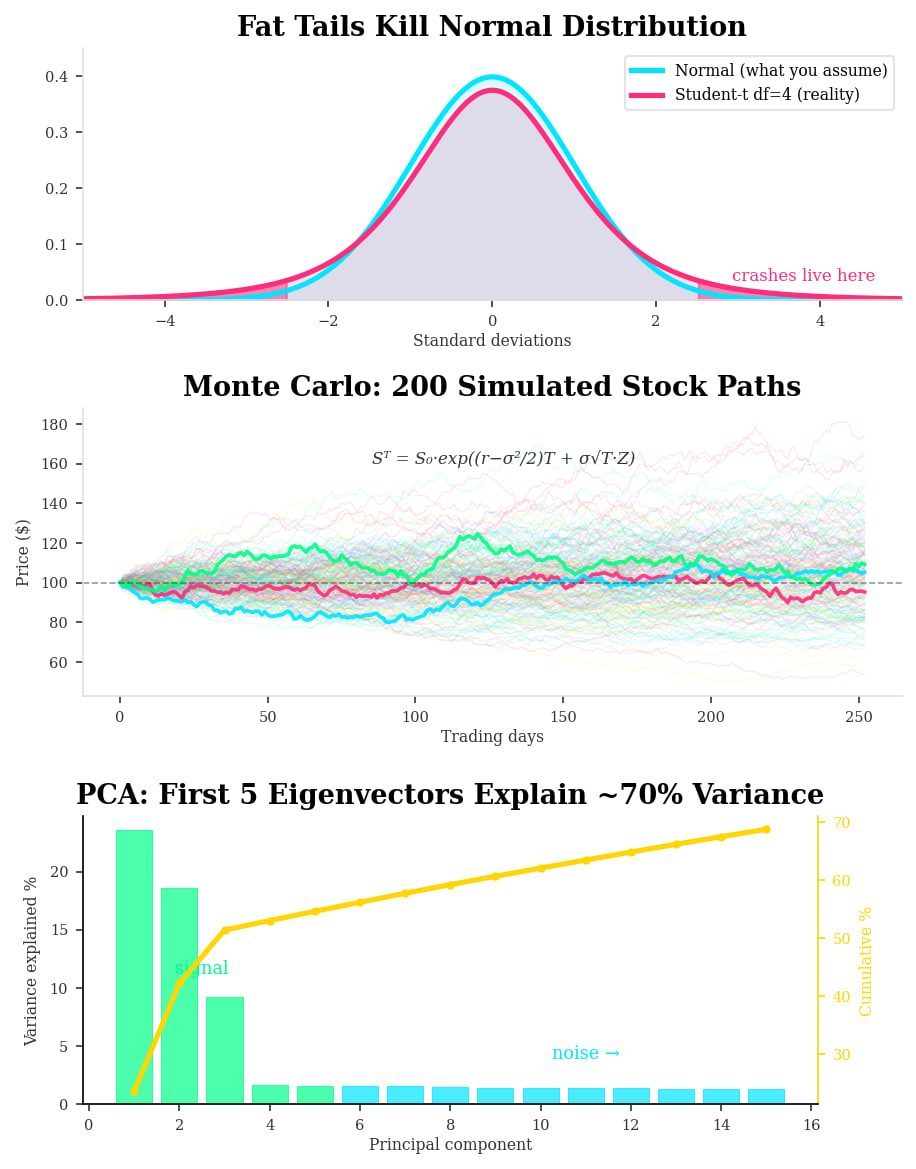
500,000 paths. One pricing equation:
ST = S0 × exp((r - σ²/2)T + σ√T × Z)
Each path is a possible future.
Average discounted payoff across all of them is the price.
Converges to Black-Scholes within pennies.
No opinions involved. Pure math.
Now here's why Jane Street tests this on a whiteboard.
They hand you a marker and expect this from memory:
d1 = (ln(S/K) + (r + σ²/2)T) / (σ√T)
d2 = d1 - σ√T
Drift μ vanishes completely from the equation.
Option price doesn't care where you think the stock goes.
Risk-neutral pricing broke everyone's intuition and Jane Street checks if you understand why.
The superday filters hard and fast:
> Zetamac below 50 means instant rejection.
> Unsolvable problems test your iteration with hints.
> Mock trading exposes your runtime under real pressure.
> Five rounds. No breaks. No second attempts.
Two thirds of their interns came from CS.
One third from pure mathematics.
Finance degrees almost never survive the screening.
The result for those who do:
$300K to $500K starting.
$1.4M company average.
$30M ceiling for star traders.
The edge isn't knowing the formula.
It's deriving it under pressure while five people watch.
gemchanger@gemchange_ltd
English
arcy retweetledi

building Rei.
AI assistant in your messenger
for tasks, notes and daily thinking.
not "optimize your time by 69%".
more like letting your brain
finally stop boiling over.
applying to @base batches.
demo soon. @base @jessepollak
English

helloowwwwwwww
chibulka is a 1/1 nft collection on @opensea (0.04 eth)
if you want one, dm me :)
opensea.io/collection/chi…

English
arcy retweetledi





Airdrop famrers are not community members, they are extractive parasites that deserve to have their socials and wallets blacklisted by every serious project.
I have compiled a blacklist of farmers and popular farmer accounts + wallets. DM me if you are a project and want access.
English