Notes on Iowa

14.8K posts

Notes on Iowa banner
Notes on Iowa

Notes on Iowa

@notesoniowa

Exploring Iowa’s past every day. Started with a 371 mile walk up the Des Moines River to chase the 1835 Iowa Dragoons. Run by @KevMakesHistory

Katılım Şubat 2021
329 Takip Edilen2.9K Takipçiler
Notes on Iowa
Notes on Iowa@notesoniowa·
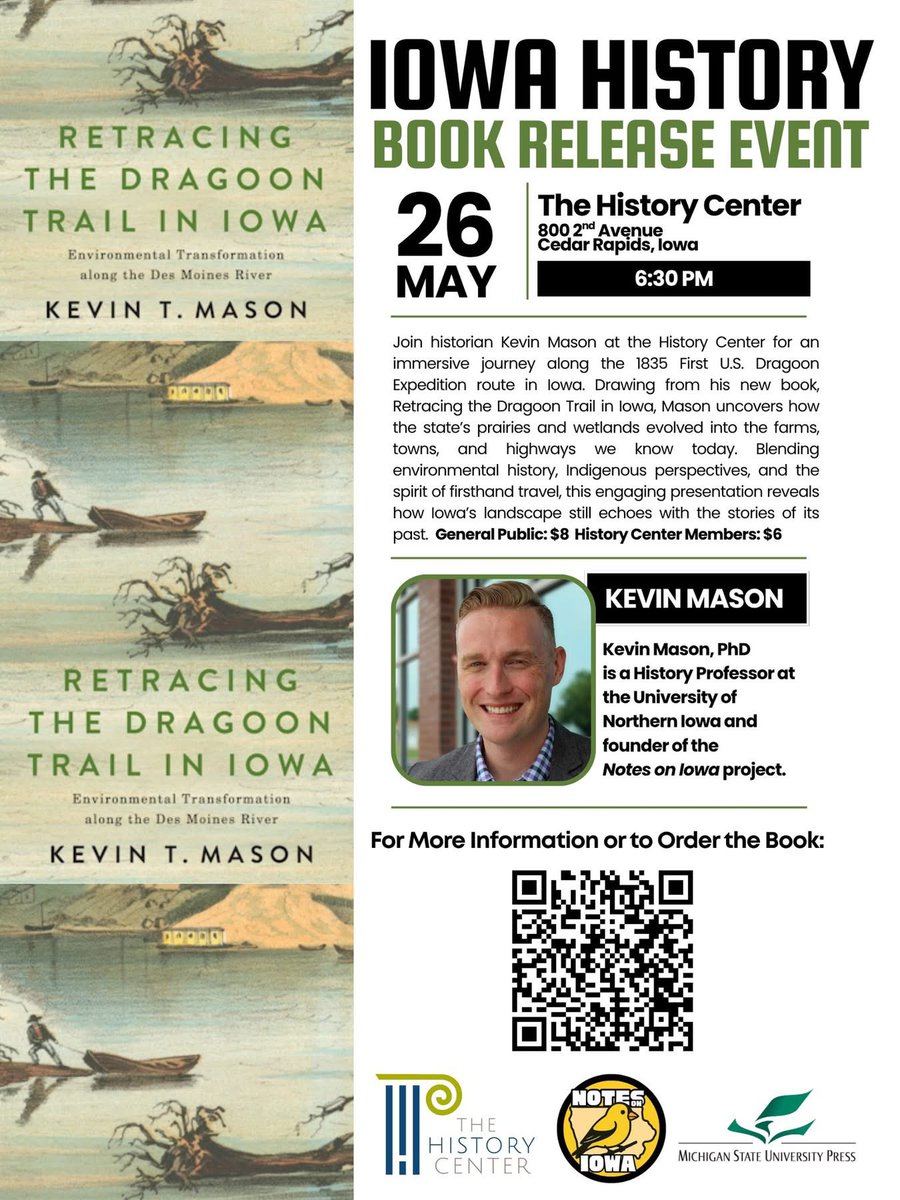
Today’s the day for an Iowa history event at The History Center in Cedar Rapids: Kevin Mason will be discussing his new book Retracing the Dragoon Trail in an event hosted by the the History Center. 📍802 2nd Ave - Cedar Rapids 🗓️ Today, May 26 🕓 6:30 PM 🎟️ $8 General Public; $6 History Center Members Don’t miss this chance to celebrate a new book on Iowa’s past!
Notes on Iowa tweet media
English
0
0
2
278
Notes on Iowa
Notes on Iowa@notesoniowa·
Merle Hay Gives All
English
0
1
10
489
Notes on Iowa
Notes on Iowa@notesoniowa·
📍Cedar Rapids, Iowa
Indonesia
2
2
21
1.1K
Notes on Iowa
Notes on Iowa@notesoniowa·
Iowa Time Machine ⏰: On May 24, 1979, Iowa Governor Robert D. Ray testified before the United States House of Representatives’ subcommittee on Immigration, Refugees, and International Law. Governor Ray detailed his sense of moral obligation to resettle Tai-Dam refugees displaced by the aftermath of the Vietnam War in Iowa. Ray, born in Des Moines in 1928, grew up in Iowa’s capital city. A Rough Rider, Roosevelt graduated from Roosevelt in 1946 before entering the United States Army. Following military service in post-war Japan, Ray returned to Des Moines and attended Drake University, where he gained a business degree before enrolling in law school. Ray started a successful career as a trial lawyer in 1954. Always interested in politics, Ray became chair of the Iowa Republican Party in 1963. 6 years later, in 1969, Ray rose to the highest office in the state when the people of Iowa elected him governor. Serving as Iowa's governor from 1969 to 1983, Ray accomplished a great deal during his time in office, including extending the governor's term from 2 years to 4, advancing civil rights, advocating for renewable energy, and moving his family to Terrace Hill. Best known for his humanitarian work, Ray engineered his refugee resettlement program to help the Tai-Dam people. Controversially, Ray went above and beyond federal limits to resettle an additional 1,500 refugees in Iowa. To detail the thinking behind his decision, Ray said, “I think what it shows is that everyone can do something and make a difference in this world. We might not be able to do it all, but we can do something, and isn’t there great satisfaction in that? The happiest people I know are those who are doing things for others. Think about Christmas time; what makes you happiest? Is it what someone gives you or what you give to make somebody pleased, right?” #Iowa #OTD #History #Refugees #GoodWorks
English
1
2
9
726
Notes on Iowa
Notes on Iowa@notesoniowa·
Iowa Time Machine ⏰: On May 23, 2013, legendary Iowa radio broadcaster Jim Zabel passed away. An iconic presence on the airwaves across Iowa, Zabel called over 6,000 sporting events during a career highlighted by serving as the voice of Iowa Hawkeye football and men’s basketball. Born on September 5, 1921, in Davenport, Iowa, Zabel grew up in Scott County and graduated from Davenport (Central) High School in 1939. A track standout for the Blue Devils, Zabel once ran in an exhibition against the world-famous sprinter Jesse Owens. The experiences gained on the track helped inform decades of detailed analysis while Zabel served as the voice of the Drake Relays. A Hawkeye through and through, Zabel spent the next four years in Iowa City. He served as editor of ‘The Daily Iowan’ while working toward a degree in journalism. Following his graduation in 1944, the WHO hired him as sports director, and a legendary career started to take shape. Zabel eventually worked for radio stations WHO-AM and WHO-TV, where he hosted both sports and general-interest content. Long-running television programs, including “Beat the Bear” and “Let’s Go Bowling,” paired with Zabel’s notable play-by-play acumen over a decades-long career. Although catchphrase calls like “I love it, I love it, I love,” “Hug and kiss those radios, folks,” and “Man-oh-man-oh-man,” still resound with Hawkeye fans who remember the 49-year run of consecutive games called, Zabel’s legacy extended well beyond sports. Zabel’s voice continues to reverberate in the minds of many Iowans, and the lives he touched with his carefree demeanor are remembered fondly. "If you want to know what to put on my tombstone," Zabel said in 1994, "just three words: I HAD FUN." #Iowa #OTD #History #Broadcasting #Radio
English
3
6
27
2.1K
Notes on Iowa
Notes on Iowa@notesoniowa·
📍Dolliver State Park
English
0
0
3
236
Notes on Iowa
Notes on Iowa@notesoniowa·
Iowa Time Machine ⏰: On May 22, 1956, Elvis Presley took the stage at Veterans Memorial Auditorium in Des Moines as “Heartbreak Hotel” sat atop the Billboard Chart. The concert was Elvis's first visit to Iowa. Also, it marked the first major event at the iconic downtown Des Moines arena, commonly called “Vets” or “The Barn,” by adoring Iowans across generations. After arriving from a concert in Topeka, Kansas, the evening prior, the King sent the audience into a frenzy by opening with the current No. 1 song in the land. Throughout a set featuring classics like “Blue Suede Shoes,” the crowd went wild before Elvis closed to a resounding ovation following a rendition of “Hound Dog.” Des Moines Register reporter, Nick Lambarto, who covered the concert, wrote: “A lot of the 'fallout' from Elvis Aaron Presley’s 'atomic' singing hit empty seats during his concert May 22, 1956, but the estimated 4,000 who were present – most of them teenagers – absorbed enough to keep them staring into space for the rest of the school term.” As the opening act of the new auditorium built to honor Iowa’s World War II Veterans, Elvis served in the 1st Medium Tank Battalion in Germany during his military service. The concert marked a successful first event for a venue that would welcome thousands of Iowans yearly for concerts and sporting events. #Iowa #OTD #History #Music #Concerts
English
0
1
5
560
Notes on Iowa
Notes on Iowa@notesoniowa·
Looking for a chance to get out and explore Iowa's history? Notes on Iowa founder and author Kevin Mason will be bringing his new book "Retracing the Dragoon Trail in Iowa" (out now on @msupress ) to communities across the state. Don't miss this opportunity to dive deeper into Iowa's past!
Notes on Iowa tweet media
English
0
1
3
562
Notes on Iowa
Notes on Iowa@notesoniowa·
Iowa Time Machine ⏰: On May 20, 1957, Iowa State running back Dexter “Money” Green was born. A 1978 All-American and two-time All-Big 8 performer, Green raced for 3,347 yards over a storied career for the Cyclones. Originally from Woodbridge, Virginia, Green arrived in Ames and helped the Cyclones to a trio of eight-win seasons from 1976 to 1978. Due to his small stature (He stood only 5’9” and 170 pounds when he enrolled at Iowa State), many doubted his ability to contribute to the Cyclone backfield. However, by his sophomore season, Green put any questions to rest with his first 1,000-yard season. In 1976, despite a significant injury to his right knee, Green racked up 214 rushing yards and two touchdowns in a 21-17 road win over seventh-ranked Missouri. The following season, Mizzou arrived in Ames bent on revenge, only to watch as Green bounced off tacklers for a 28-yard fourth-quarter run to lead the Cyclones to a 7-0 victory. Green helped the Cyclones go from 4-7 in 1975 to 8-3 in 1976 before leading the team to back-to-back bowl appearances in 1977 and 1978. Iowa State’s leader in yards (3,437) and touchdowns (34) at the time of his graduation, Green left a storied legacy in Ames. Green passed away from cancer at the age of 46 in 2003, but left Cyclone fans with memories that ensure he’ll always be remembered in Ames. #Iowa #OTD #History #Football #CollegeFootball
English
0
0
7
1K
Notes on Iowa
Notes on Iowa@notesoniowa·
Iowa Time Machine ⏰: On May 19, 1931, the Iowa Hawkeyes announced they would not compete in the Big Ten golf meet in protest of the team’s no. 1 golfer, George Roddy, being held out of a match the previous week due to the color of his skin. A native of Keokuk, Iowa, Roddy allegedly walked to Iowa City for college carrying a suitcase and golf clubs when his parents couldn’t afford the bus fare. A barrier-breaking athlete at Iowa, Roddy dominated on the links, creating a legacy of excellence while striving for equality. The first African-American to golf for Iowa, Roddy made an impression on the course when he shot a course-record 72 at Finkbine Field in a duel against Minnesota in May of 1930. Lettering and serving as team captain, the standout golfer from Keokuk knocked in low scores and captured the All-University Championship in 1929 and 1930. Iowa, barred from conference competition due to a football eligibility scandal during the 1930s, returned to Big 10 action in 1931. Roddy, however, often found himself sidelined as he did not compete in meets held at white-only courses like Chicago’s Westmoreland Country Club. Despite the challenges, Roddy still stood out as one of the greatest golfers in Hawkeye history. #Iowa #OTD #History #Golf #Big10
English
2
8
58
5.4K
Notes on Iowa
Notes on Iowa@notesoniowa·
📍Stratford, Iowa
Polski
0
0
9
402
Notes on Iowa
Notes on Iowa@notesoniowa·
Iowa Time Machine ⏰: On May 18, 1965, regionalist painter Marvin Cone passed away. A beloved professor at Coe College and a contemporary of Grant Wood, Cone helped create enduring depictions of Iowa. Born in Cedar Rapids, Cone attended CR Washington High School. After high school, Cone headed to Paris with his high school friend Grant Wood. Returning stateside, Cone attended Coe College and graduated in 1914 before studying for several years at the Art Institute of Chicago. While serving with the Iowa National Guard during World War I, Cone designed the ‘Red Bull’ insignia, which is still worn by Iowa’s troops today. After the war, Cone studied in France briefly before returning to Cedar Rapids. Hired at Coe to teach French, Cone also resumed his friendship with Wood. Cone and Wood went abroad in the summer of 1920, hoping to improve their technical skills. The visit proved influential, resulting in a stunning series of impressionistic views of picturesque cityscapes and landscapes, Paris streets and gardens, and the French countryside. Architecture and landscape fascinated Cone for the rest of his life. In 1932, Cone and Wood started the Stone City Art Colony. "What would be the purpose of that? Let the camera with its clever mechanism imitate,” Cone once said. “Art, such as poetry, music, and painting, is simply a portion of the experience of the artist. When we actually see ideals, they become real to us. Art traces an abstraction and makes it audible or visual. It symbolizes the whole of life. We believe in something we can see.” #Iowa #OTD #History #Art #Painting
English
0
1
3
362
Notes on Iowa
Notes on Iowa@notesoniowa·
📍Harcourt, Iowa
Polski
0
1
13
654