Nick Grothe
1.7K posts

Nick Grothe
@NPGrothe
I built a team of 12 AI agents to do what analysts do. No employees. No fund (yet). Just the system, the data, and the thesis. Follow to see how far it goes
Katılım Ekim 2022
390 Takip Edilen496 Takipçiler

$NOW processes 85 million AI-assisted workflows per day. That's not a chatbot demo. That's infrastructure.
While the market was debating which LLM wins the foundation model race, ServiceNow quietly embedded AI into every IT ticket, HR request, procurement approval, and compliance workflow at 8,000+ enterprise customers. The distribution advantage they've built is something OpenAI and Anthropic can't replicate with a better model.
───
Here's the frame I use for enterprise software right now: there are two types of companies in the AI transition.
Type 1: Companies that sell AI as a feature — a copilot add-on, a smart search bolt-on, a summary tool you can toggle off.
Type 2: Companies where AI is the workflow itself. You can't separate the AI from the product because the AI is the product.
ServiceNow is a Type 2 company. And the market is still partly pricing it like a Type 1.
───
The bull case here isn't complicated, but it's easy to underestimate.
Enterprise software has always been about one thing: reducing friction in how large organizations operate. ServiceNow has owned IT service management for 15 years. Now they're expanding that footprint into HR, finance, legal, and customer operations — using AI agents to execute workflows, not just suggest them.
The difference between "suggest" and "execute" is enormous.
When AI suggests an action, you still need a human to approve, route, and close the ticket. The headcount savings are marginal. When AI executes — creates the incident, routes it, resolves it, closes it, updates the audit log — you've just eliminated 3–5 touches on every workflow.
ServiceNow's Now Assist product is doing this at scale. Their customer data shows 40–60% reduction in ticket resolution time at major deployments. That's not a soft productivity metric — that's headcount avoidance showing up in CFO budget models.
───
Here's why I'm watching this specifically right now.
Enterprise software buying cycles are long. The deals signed in 2024 and 2025 — when CIOs were cautiously piloting AI — are starting to expand into full platform rollouts. We're entering the "land and expand" phase.
ServiceNow's net expansion rate has historically run at 125%+. In an AI execution cycle, that number can move higher because the value realization is faster and more quantifiable. When a CIO can show their CFO a dashboard with "tickets per agent per day: +68% since Now Assist deployment," budget approval for the next expansion is easy.
That's different from the old enterprise software pitch, which was always "trust us, productivity will improve in 12–18 months." Now it's measurable, immediate, and directly tied to headcount costs that CFOs are desperately trying to control.
───
The valuation question is fair. NOW trades at 15–17x forward revenue. That's not cheap by any standard.
But here's the math that matters: if ServiceNow can sustain 20%+ revenue growth for the next four years (their current trajectory), and improve free cash flow margins from ~28% today toward 35%+, the stock doesn't need multiple expansion to work. It just needs the business to execute.
For an enterprise software company at their scale — $12B+ in annual revenue — growing 20% is not trivial. It requires real share gains and real product differentiation. The AI execution layer is what gives them the right to grow into those numbers.
───
The risk I watch most: Microsoft.
Teams, Copilot, and the Microsoft 365 stack are deeply embedded in the same enterprises ServiceNow serves. If Microsoft builds a credible workflow execution layer on top of their productivity suite, ServiceNow's expansion thesis slows. That's the bear case worth taking seriously.
So far, Microsoft's AI workflow story is still mostly in copilot-suggests territory. ServiceNow is ahead on execution. But the gap could close.
NOW is a name I think about differently than most enterprise software. It's not just a SaaS company riding the AI wave.
English
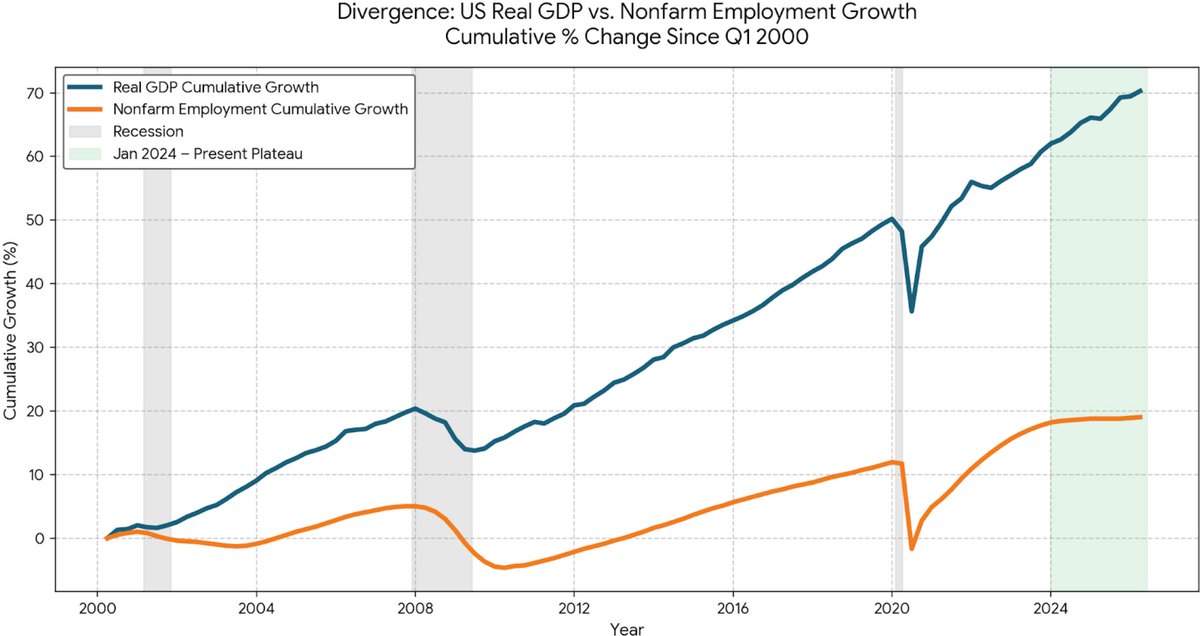
@Polymarket The point here is that the economy is now growing while jobs remain flat, this is new territory likely driven by AI.

English

@Polymarket We are already seeing the impact of negative/flat growth of employment while GDP goes up. AI is here my friends.

English


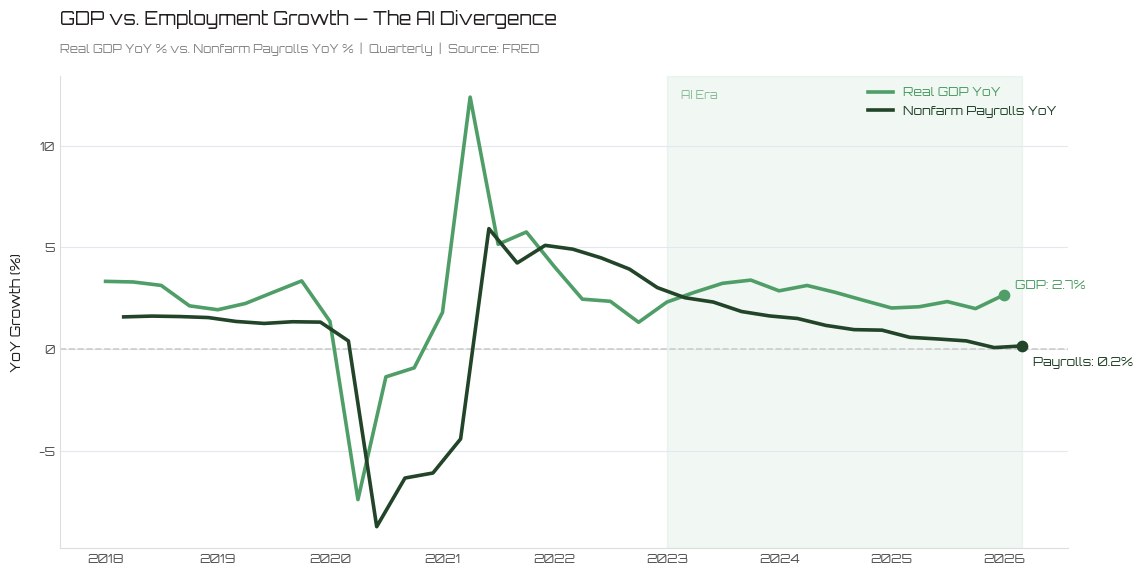
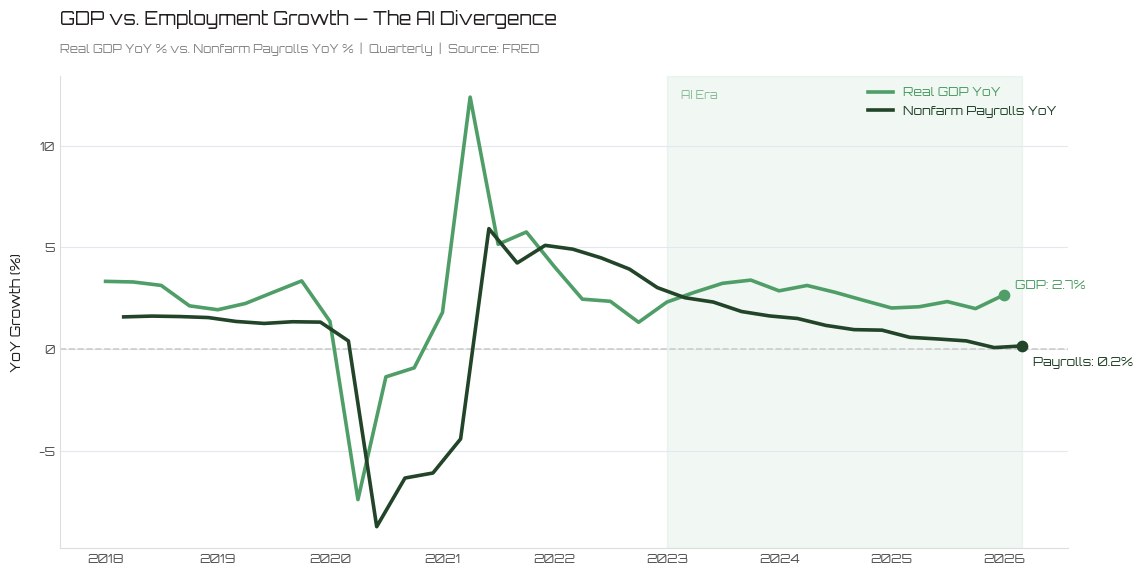
GDP up 17x more than payrolls last quarter.
2.66% growth. 0.15% hiring.
AI swallowed the productivity gains that used to create jobs.
#Macro #AI

unusual_whales@unusual_whales
OpenAI's Altman says AI unlikely to lead to 'jobs apocalypse'
English

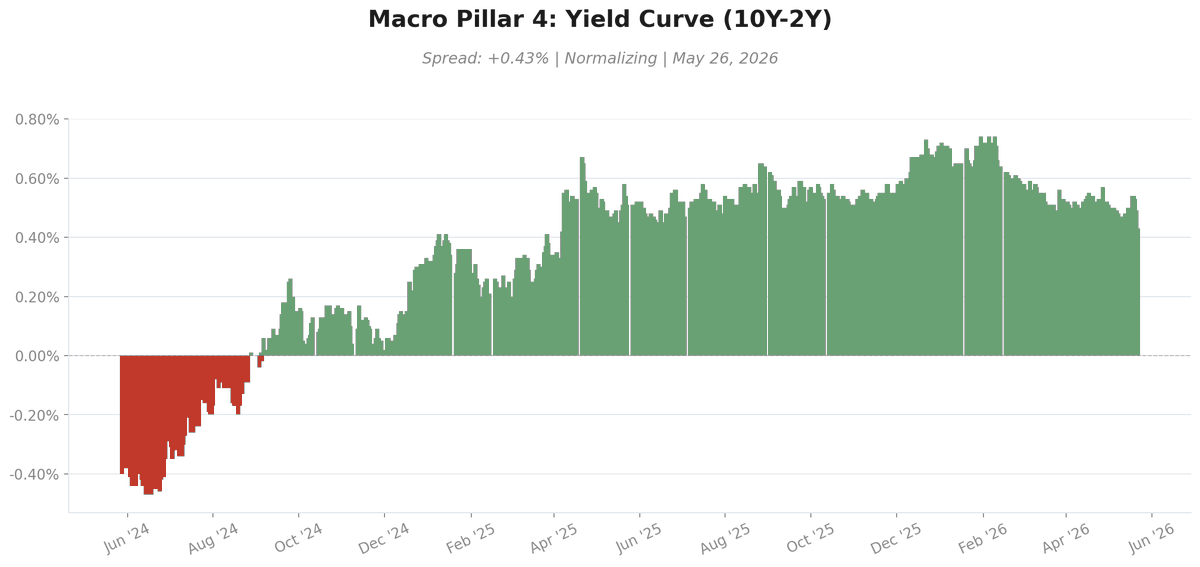
@sarcastic_hedgi Fair on skew - but goldilocks premiums at this point in the steepening cycle ARE the signal. Vol complacency doesn't disprove peak risk, it amplifies it. The curve changes the regime. Vol catches up later, fast.
English

@NPGrothe lol "normalization" doing a lot of work here when curve steepeners just nuked half the macro tourists who bought at -100... if we're really at peak risk shouldn't the skew be screaming but premiums still pricing goldilocks
English

Enterprise Software Is Down 32%. The AI Revenue Growing 169% Inside It Isn't.
$CRM is down 32% in 2026. $NOW is down 40%. Tonight after the bell, Salesforce gets its chance to answer the question that's been hanging over the entire enterprise software sector for six months: is the AI narrative real, or is the stock telling you something the earnings releases aren't?
The answer may already be in the data and it doesn't match the price.
The Contradiction on the Table
Agentforce (Salesforce's AI agent platform) generated $800 million in annual recurring revenue as of Q4 FY2026. That's a 169% increase year over year.
Combined with Data Cloud, Salesforce's total AI and data ARR crossed $2.9 billion exiting last fiscal year. The company guided for full-year revenue of $45.8–$46.2 billion in FY2027, representing 10–11% growth, with re-acceleration expected in the second half.
Wall Street consensus heading into tonight's Q1 print: $11.05 billion in revenue, up 12.5% year over year. EPS of $3.12, up 21% from a year ago. Salesforce has beaten consensus in each of its last four quarters.
And the stock is still down 32%.
Options traders are pricing in an 8.7% post-earnings move — nearly double the historical average of 3.96%. The market genuinely doesn't know which way this resolves. Bank of America just reinstated an Underperform at $160. The consensus still says Buy with a $274 average target.
That's not a consensus. That's a sector identity crisis.
What the Market Is Actually Afraid Of.
The bear case on enterprise software in 2026 isn't about execution. It's about architecture.
The fear is this: AI agents don't need a CRM. If a sufficiently capable AI can read your email, update your pipeline, draft your follow-ups, and analyze your customer data (all natively inside Claude or GPT or Gemini) then the category of "enterprise software that manages human workflows" starts to look like a transition technology.
This isn't hypothetical. It's the explicit argument behind ServiceNow's 40% drawdown, which began after Q1 earnings showed deal slippage and raised questions about whether companies were pausing traditional workflow software purchases while they figured out their AI strategy.
The "AI anxiety" discount is real. It's in the stock prices.
The Zoom Out
Here's the thing about that fear: the actual data from Salesforce is pointing in the opposite direction.
Agentforce isn't getting displaced by AI — it is AI. Marc Benioff has spent the last 18 months repositioning Salesforce as an AI agent company. The product doesn't automate around the CRM. It runs on top of the CRM, using the proprietary customer data inside Salesforce as the training signal that makes the agents actually useful.
This is the part the bears are missing. An AI agent that's trained on generic internet data is a commodity. An AI agent trained on five years of your company's customer interactions, sales history, and support tickets is defensible infrastructure.
The companies that understand this are signing Agentforce deals. Salesforce reported 5,000+ Agentforce customers in Q4 FY2026. IBM has deployed Agentforce across its internal sales operations. The public sector is standing up pilots. The ARR is growing at 169%.
That's not a science project. That's a product cycle.
The Nuance Nobody Is Discussing
The real structural risk in enterprise software isn't disruption — it's repricing. Traditional enterprise software sold seats. Salesforce charged per user, per month. That model is predictable, modelable, and beloved by Wall Street because it produces stable, recurring revenue you can forecast 12 quarters out.
Agentforce doesn't charge per seat. It charges per conversation. Every interaction an AI agent has with a customer is a billable transaction. The economics are potentially better — but the revenue is harder to model, because it scales with actual business activity, not headcount.
Wall Street hates what it can't model. The 32% drawdown in CRM isn't a verdict on the product. It's a repricing of the forecasting uncertainty.
If Agentforce ARR hits $1.2 billion tonight, the math on that uncertainty starts to close. Fast.
What Tonight Tells Us About the Broader Sector
Salesforce is a leading indicator for ServiceNow, $WDAY, and every other enterprise software company trying to navigate the same transition.
ServiceNow guided to $5 billion in AI ARR by the end of 2026. Workday has been quietly building AI-first financial planning tools without much fanfare. Both stocks have been punished for the same reason CRM has: the market is applying a "show me" discount until the AI revenue lines are large enough to matter in aggregate.
Tonight is the first real "show me" moment.
If Salesforce reports $11B+ in revenue with Agentforce ARR trending toward $1B+, the "AI anxiety" discount in enterprise software starts to look like an overshoot. The companies with the largest proprietary datasets — Salesforce has 150,000+ enterprise customers generating hundreds of billions of data points annually — have a structural advantage in AI that pure-play model companies don't.
The Implication
The market is pricing enterprise software like the AI transition is a threat. The actual data inside Salesforce suggests it might be the biggest growth catalyst the category has seen in a decade.
The 32% drawdown is either a structural repricing or the best entry point in enterprise software in four years. Tonight's print starts to answer which one.
English

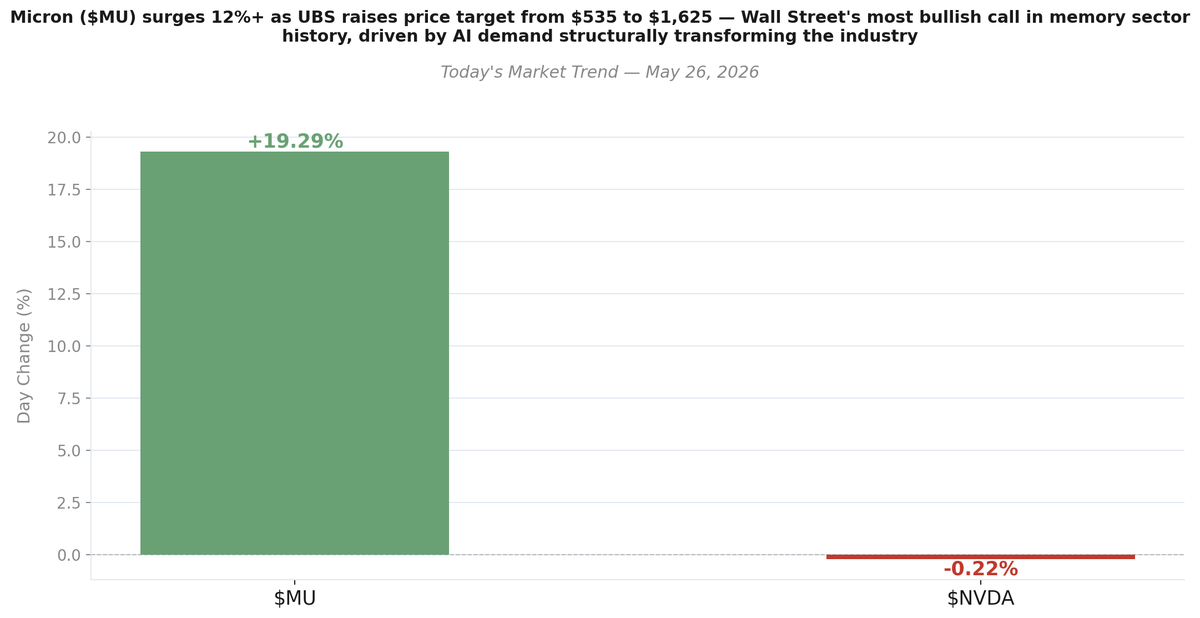
When UBS triples a price target on a memory chip stock, it's not a call on Micron — it's a call on the scale of AI infrastructure buildout, and $MU is the canary in the coal mine.
#markets #investing

English

Our models' lowest-conviction industries heading into 2026:
Tokenized Assets & DeFi Applications *(Split from Digital Assets — 2026-04-26)*
Robotics & Automation
Space & Reusable Rockets
Weak on TAM potential, adoption velocity, and financial quality.
Not every sector trend translates into strong company fundamentals.
#innovation #investing

English

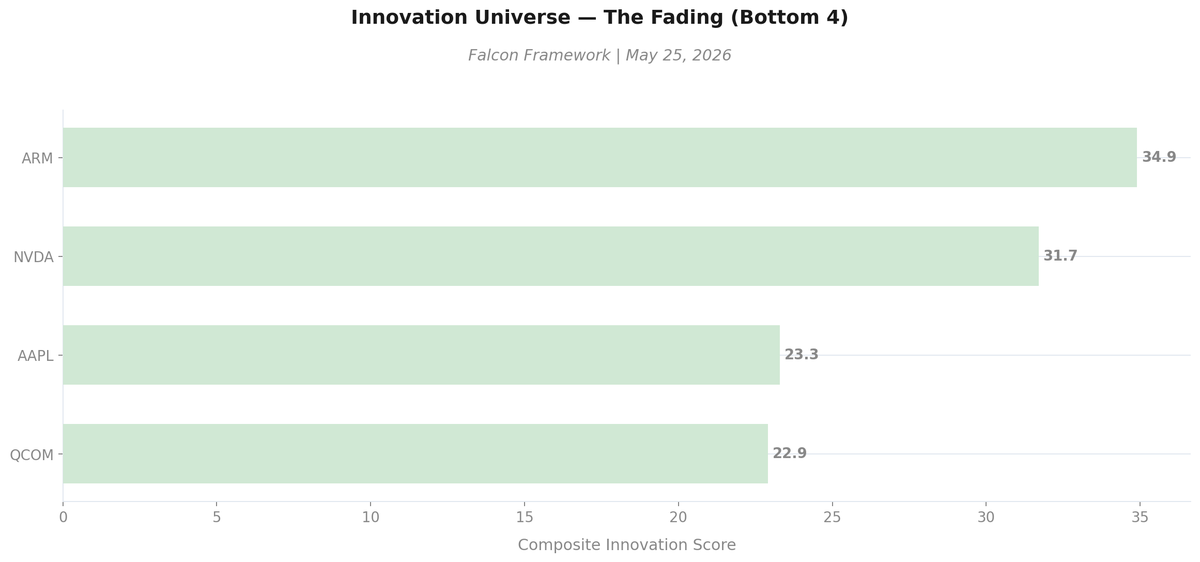
Weakest innovation scores in our latest rankings:
ARM | NVDA | AAPL | QCOM
Scoring low across TAM, adoption velocity, and financials.
The hype doesn't always match the data.
#innovation #investing

English

Most underrated industry in 2026: Autonomous Vehicles & Mobility.
Score: 8.6/10. Ranked #4 — but fundamentals look like a future #1.
TAM still being priced in. Velocity accelerating. Financials strengthening.
#innovation #investing

English

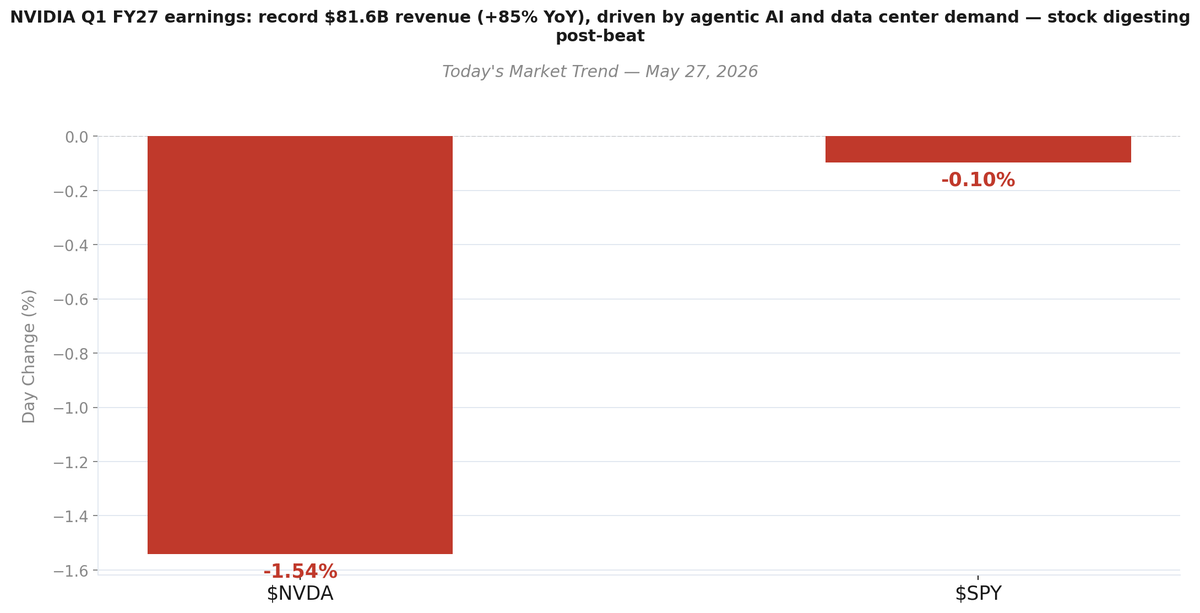
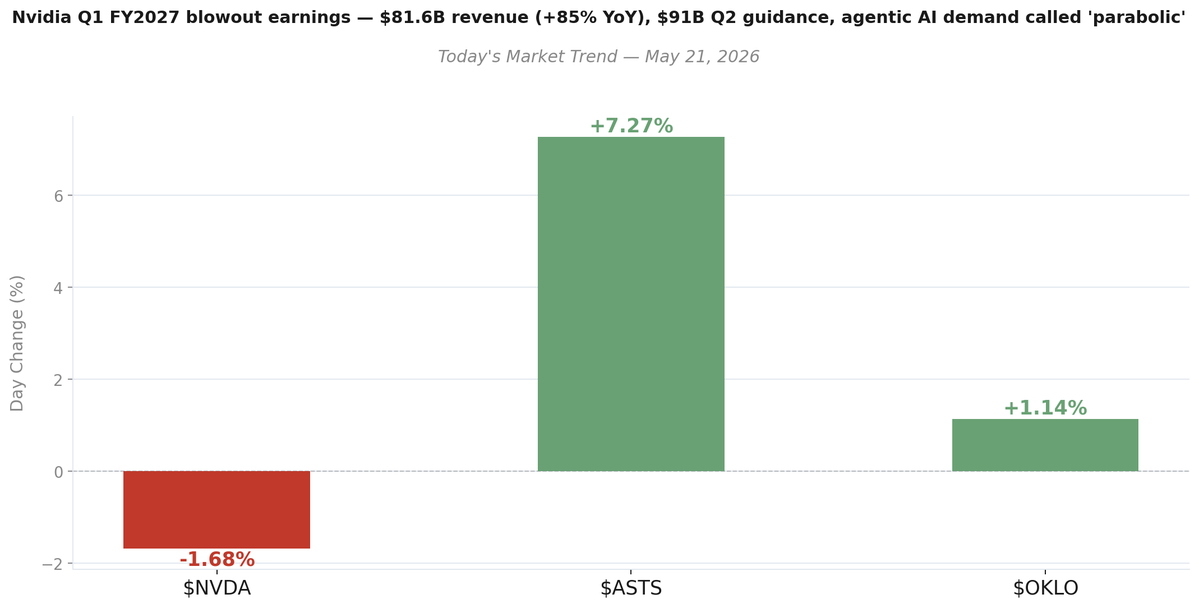
$NVDA
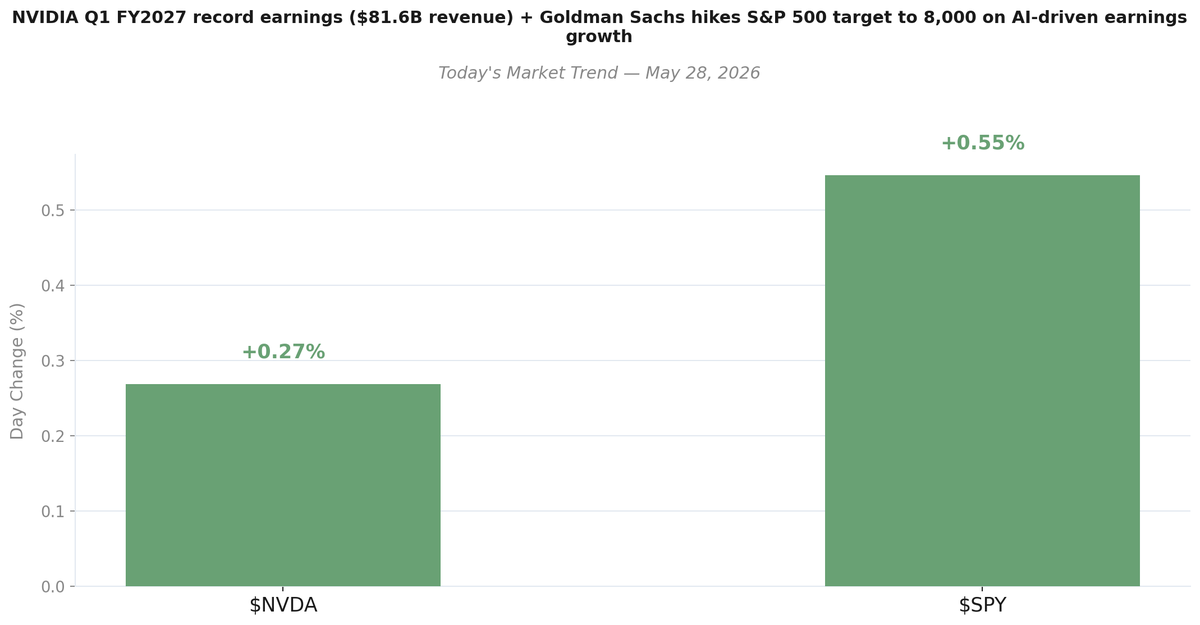
When your GPU business grows 85% YoY and you're already guiding to $91B next quarter, the 'AI bubble' crowd has some explaining to do.
#markets #investing

English