

nvega
557 posts

nvega
@nvega
Chief Technology Officer, Software Architecture, Artificial Intelligence, Software Development
Royal Palm Beach, FL Katılım Aralık 2008
309 Takip Edilen202 Takipçiler

I went from writing code to writing specs.
That's most of what I'm doing now.
From writing loops and conditions to describing what I want to build.
Basically, I'm now operating at a much higher level of abstraction. Much more focus on the WHAT to build, instead of the HOW to build it.
I still write a lot of code, mostly things that I don't know how to describe properly, or the model can't get quite right.
I also spend a ton of time reviewing code. Way more than ever before.
A lot has changed for me over the last year or so.
English
We burned $1k+ (don't say the exact number) in credits before realizing the system had fallen into a livelock.
Unlike deadlock, livelock still has activity, but the system as a whole is basically stuck.
I know there is a lot of hype about Agentic systems; however, we are still far from maturity. This feels like the early 2000s in terms of software governance and architecture maturity; the only difference is that the consequences now have a greater impact.
The nature of this system requires a mindset and a paradigm shift. We are making many assumptions that may not apply to them.
𝟭. 𝗟𝗟𝗠 𝗼𝗯𝘀𝗲𝗿𝘃𝗮𝗯𝗶𝗹𝗶𝘁𝘆 𝗶𝘀 𝗮𝗴𝗲𝗻𝘁 𝗼𝗯𝘀𝗲𝗿𝘃𝗮𝗯𝗶𝗹𝗶𝘁𝘆
In fact, agents will require a wide range of tooling around them to get an idea of what is going on. Not only that, but the whole system will require the next level of complexity and analytics.
An agent can make 20+ LLM calls to complete a task. It is a decision tree with branching logic, tool selection, and compound context.
Tracing calls without tracing the reasoning is like monitoring database queries without understanding the application logic that generates them.
𝟮. 𝗪𝗲'𝗹𝗹 𝗮𝗱𝗱 𝗼𝗯𝘀𝗲𝗿𝘃𝗮𝗯𝗶𝗹𝗶𝘁𝘆 𝗹𝗮𝘁𝗲𝗿.
We know what this means: an after-the-fact thought that will work on deterministic systems but catastrophically fails on agentic systems.
By the time you realize we need decision-level traces, we have already shipped an architecture that doesn't generate the data required to support them.
𝟯. 𝗔𝗴𝗲𝗻𝘁𝘀 𝗳𝗮𝗶𝗹 𝗹𝗶𝗸𝗲 𝘁𝗿𝗮𝗱𝗶𝘁𝗶𝗼𝗻𝗮𝗹 𝘀𝗼𝗳𝘁𝘄𝗮𝗿𝗲.
Traditional software fails fast and loudly: exceptions, stack traces, 500 errors. Agents fail slowly and quietly. They produce plausible-looking outputs that are subtly wrong. Not only that, but they succeeded at the wrong task and, as happened to us, burned tokens on productive reasoning.
Imagine trying to resolve a support ticket where you have to reproduce not only the path but also the reasoning behind it. Good luck with that.
Summary
Now, not everything is so negative. Of course, we have a long road ahead, but that also brings many opportunities and new fields to create and explore.
For starters, we are considering it and identifying its limitations. I recommend baking observability into the process as a top functional requirement. Understand what we are trying to solve and be more rigorous about the process, rather than trying to hack it. It will be costly in the long run, trust me.
#AgenticAI #multiagents
English
Since the early days of software development, the dream has always been the same: build tools that write code for us.
Early tools like ReSharper and T4 templates provided us with a glimpse of automation, but now, with generative AI, we’re closer than ever to realizing that reality.
Generative AI is powerful, but often misused and misunderstood. It’s not a magic fix—it’s a tool. And like any tool, it’s only as good as the person wielding it.
Here are 5 practical ways to leverage generative AI efficiently—without turning your brain to mush:
🎯 Strategy 1: Clear Role Definition & Human Oversight
✅ Assign AI to handle repetitive tasks
✅ Reserve humans for strategic decisions
✅ Regular audits of AI output
✅ Mandatory human review before merges
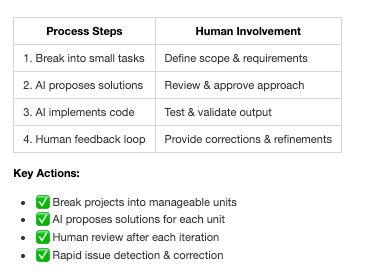
🔄 Strategy 2: Incremental, Iterative Workflow
✅ Break projects into manageable units
✅ AI proposes solutions for each unit
✅ Human review after each iteration
✅ Rapid issue detection & correction
🔍 Strategy 3: Transparency & Explainability
✅ Use AI tools with explainable outputs
✅ Require documentation of AI choices
✅ Prioritize traceable AI changes
✅ Enable human challenge of AI decisions
⚡ Strategy 4: Human-Controlled Interventions
✅ Human override of AI recommendations
✅ Fine-grained permissions for critical code
✅ Easy rollback of AI-generated changes
✅ Prevention of unwanted persistent changes
📈 Strategy 5: Continuous Training & Monitoring
✅ Monitor for errors, biases & hallucinations
✅ Regular developer training on AI tools
✅ Periodic compliance & security audits
✅ Alignment with organizational principles



English
nvega retweetledi

Three basic suggestions for getting into System Design
– MIT 6.5840 -> Distributed Systems from the source
– Designing Data-Intensive Applications -> The bible
– JoinEnginuity.com -> A Daily question to practice (I built this, looking for feedback)
No particular order.
Theory. Insight. Reps.
You need all three.
Which one are you missing right now?

English
While adopting a new technology, there's a lot to absorb. Yet, the adoption process often follows a familiar path, albeit with its twists and turns. Patterns and anti-patterns play a pivotal role in this journey.
Embracing patterns while avoiding anti-patterns is key to navigating this dynamic landscape.
Here you have a list of 5 patterns and antipatterns that we should pay attention to.
Patterns:
Start with high-impact, low-risk projects
Establish clear success metrics before implementation
Involve business stakeholders from day one
Build on existing data infrastructure
Create feedback loops for continuous improvement
Anti-Patterns:
Chasing AI trends without business alignment
Ignoring data quality requirements
Focusing only on technical metrics
Implementing AI without change management
Expecting immediate ROI from complex AI projects

English
Several traditional software architecture patterns can be effectively applied to Multi-Agent Systems (MAS). Here's a concise list:
Observer Pattern - Like a notification system where agents can "watch" each other and get updates when something changes.
Factory Pattern - A smart agent creator that can spawn different types of agents based on what you need.
State Pattern - Helps agents manage their various moods or modes (such as idle, working, and error states).
Template Method - Provides a blueprint for how agents should work, ensuring everyone follows the same process.
Mediator Pattern - Acts like a traffic controller, helping agents communicate without talking directly to each other.
Strategy Pattern - Lets agents switch between different behaviors or approaches based on the situation.
Command Pattern - Wraps agent actions in a way that allows you to undo them or queue them up.
Chain of Responsibility - Creates a hierarchy where tasks get passed up the chain until someone can handle them.
Proxy Pattern - Acts as a security guard, controlling what agents can do and monitoring their activities.
Composite Pattern - Allows you to treat groups of agents as if they were a single agent, creating team structures.

English
Throughout the years and the different organizations I have been part of, one of the major concerns has been communication between the Engineering team and the rest of the organization. It is almost like the teams need a promoter, someone who is full-time broadcasting what they have been doing.
I'm proposing a multi-agent system that fills this role and broadcasts on demand or via the various communication channels in use by the team.
This applies not only to engineering but also to any other team that requires this functionality.
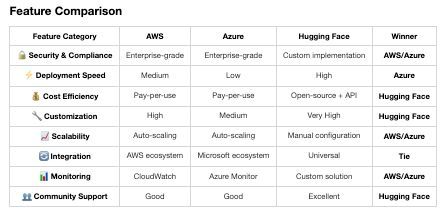
I took the time to design the solution using AWS, Azure, and HuggingFace models.
Below you can find a high-level solution.
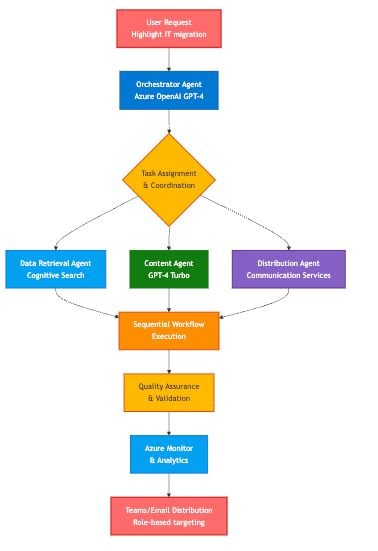
The IT Promoter System is a sophisticated multi-agent architecture designed to automatically promote IT team achievements across an organization. The system uses specialized AI agents that collaborate to gather data, generate promotional content, and distribute targeted communications to different stakeholder groups.
Core Purpose
Automated Advocacy: Highlight IT team achievements without manual intervention
Cross-Departmental Alignment: Ensure consistent messaging to leadership and peers
Scalable Communication: Handle multiple promotion campaigns simultaneously
Data-Driven Content: Generate promotional materials from actual project metrics and KPIs
System Architecture
The system follows a Supervisor-Orchestrator pattern with three main agent types:
Supervisor/Orchestrator Agent:
Coordinates workflow, decomposes tasks, and manages agent collaboration
Data Retrieval Agent: Gathers relevant IT project data, metrics, and documentation
Content Generation Agent: Creates promotional materials (reports, presentations, newsletters)
Distribution Agent: Delivers content to targeted audiences via appropriate channels
English
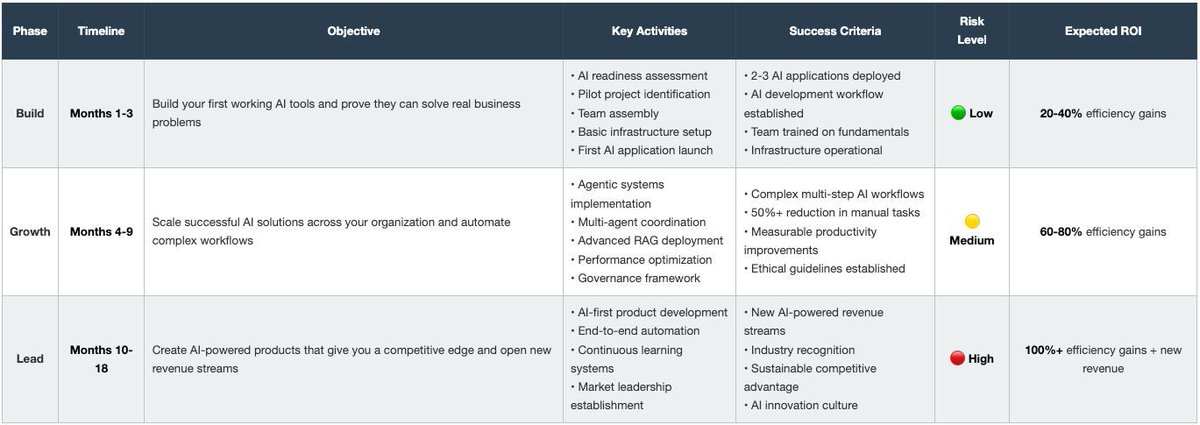
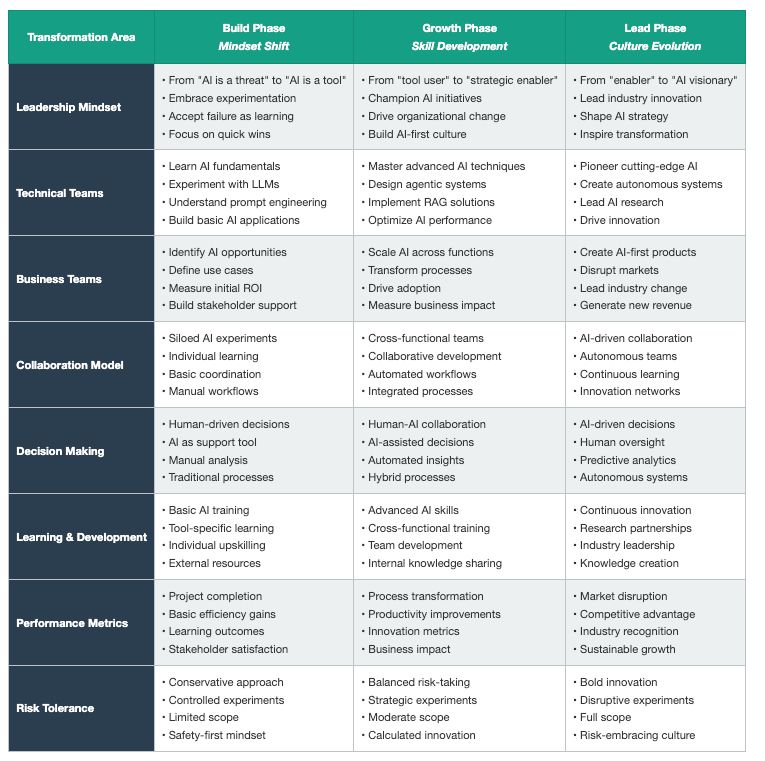
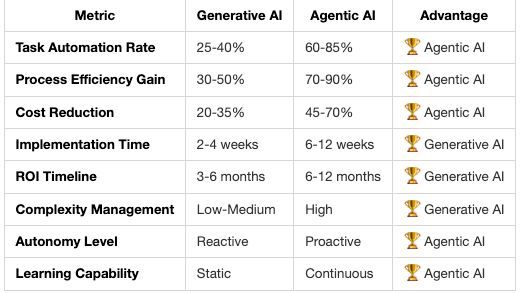
AI Adoption is nothing more than a paradigm shift within organizations that enables and prepares teams to automate workflows and processes using probabilistic models, thereby preparing them to grow the organization's results exponentially.
While this sounds like the promised land, there is no free lunch. It requires intentional changes within organizations and tailoring a deliberate plan to drive the shift from a deterministic approach to a more probabilistic direction.
English
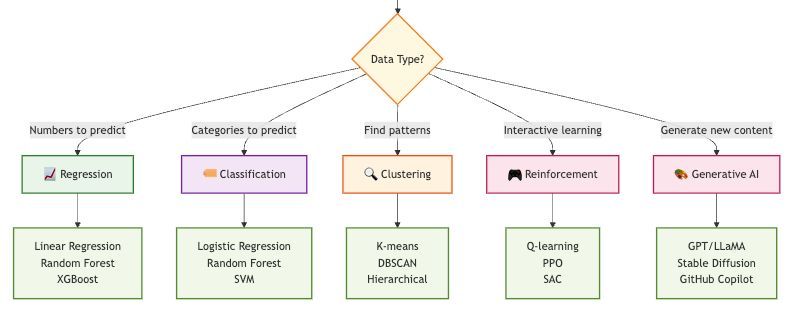
I've noticed a trend in the technology sector where there's a widespread belief that every problem can be solved using generative AI, often relying on models hosted by major cloud platforms.
While AI has gained mainstream traction through ChatGPT and generative AI has become synonymous with AI for many, the field encompasses much broader capabilities and features.
This reminds me of a quote from my early days in software development: "If all you have is a hammer, every problem looks like a nail."
Additionally, I've developed a decision tree that guides me in selecting the most appropriate machine learning approach based on the specific problem at hand.
English
In the first couple of weeks of the AI Agent Practitioner program, we lay the groundwork 🌱 for your journey 🚀 into the transformative world of AI-driven innovation.
Now we are ready to tackle 𝐌𝐨𝐧𝐭𝐡 𝟏 — 𝐖𝐞𝐞𝐤 3 🔥, where you only need to spend 6 hours a week: 30 minutes in the morning ☀️ and 30 minutes at night 🌙.
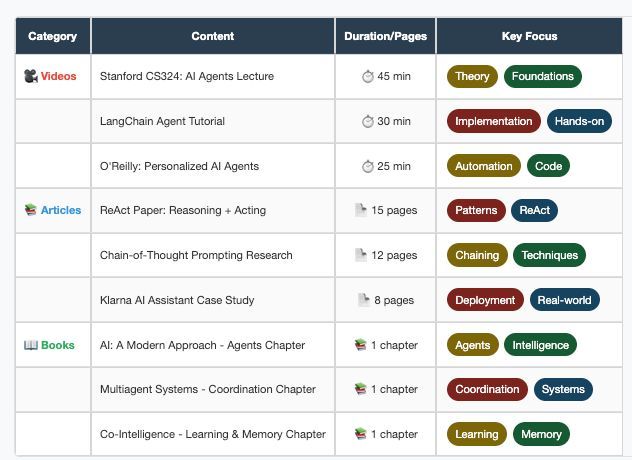
Videos
Stanford CS324: AI Agents Lecture – Foundational theory on agent architectures, memory systems, and planning algorithms.youtube.com/watch?v=ZaY5_S….
LangChain Agent Tutorial – Hands-on implementation of agents with memory and planning capabilities.youtube.com/watch?v=3zgm60…
O'Reilly: Using Personalized AI Agents to Speed Up Software Development – Practical applications in code and workflow automation.youtube.com/watch?v=CCyY_J…
Articles
ReAct Paper: Reasoning + Acting – Comprehensive analysis of the ReAct pattern for planning and action chaining.arxiv.org/abs/2210.03629
Chain-of-Thought Prompting Research – Advanced techniques for sequential reasoning and action chaining.arxiv.org/abs/2201.11903
Klarna AI Assistant Deployment Analysis – Real-world case study of agent deployment in customer service.klarna.com/careers/ai-ass…
Book Chapters
AI: A Modern Approach - Chapter 2: Intelligent Agents – Artificial Intelligence: A Modern Approach (Russell & Norvig) – Chapter 2: "Intelligent Agents"aima.cs.berkeley.edu
Multiagent Systems - Chapter 7: Coordination and Planning – Multiagent Systems (Yoav Shoham & Kevin Leyton-Brown) – Chapter 7: "Coordination and Planning"masfoundations.org
Co-Intelligence - Chapter 4: Learning and Memory in AI Agents – Co-Intelligence (Ethan Mollick) – Chapter 4: "Learning and Memory in AI Agents"
S𝑖𝑔𝑛 𝑢𝑝 𝑓𝑜𝑟 𝑡ℎ𝑒 𝑛𝑒𝑤𝑠𝑙𝑒𝑡𝑡𝑒𝑟 𝑖𝑓 𝑦𝑜𝑢 𝑤𝑎𝑛𝑡 𝑎𝑐𝑐𝑒𝑠𝑠 𝑡𝑜 𝑡ℎ𝑒 𝑤ℎ𝑜𝑙𝑒 𝑑𝑜𝑐𝑢𝑚𝑒𝑛𝑡, 𝑞𝑢𝑒𝑠𝑡𝑖𝑜𝑛𝑠, 𝑎𝑛𝑑 𝑡ℎ𝑒 𝑐𝑎𝑝𝑠𝑡𝑜𝑛𝑒 𝑝𝑟𝑜𝑗𝑒𝑐𝑡 and more.
lnkd.in/eaDdJ3JP
𝑌𝑜𝑢 𝑐𝑎𝑛 𝑣𝑖𝑠𝑖𝑡 𝑡ℎ𝑒 𝑜𝑟𝑖𝑔𝑖𝑛𝑎𝑙 𝑝𝑜𝑠𝑡 𝑡𝑜 𝑙𝑒𝑎𝑟𝑛 𝑚𝑜𝑟𝑒 𝑎𝑏𝑜𝑢𝑡 𝑡ℎ𝑒 𝑤ℎ𝑜𝑙𝑒 𝑝𝑟𝑜𝑔𝑟𝑎𝑚
YouTube

YouTube
YouTube
English
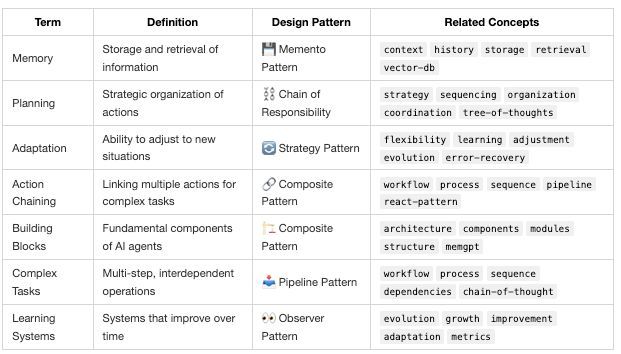
Complexity is all around us. While we tend to simplify concepts to better understand them, to truly grasp the ideas, we must dig deeper and break them down into simpler concepts.
Let's apply this idea to a multi-agent system by providing a list of core capabilities.
Core Function: These agents are designed to autonomously sense their environment, plan actions, execute them, and learn from the results.
Autonomy: The agents operate independently, making decisions and taking actions without constant human intervention.
Task Complexity: Excel at handling complex, multi-step workflows that require planning and coordination. This i
Learning & Adaptation: These systems continuously learn from their experiences and adapt their behavior accordingly.
Collaboration: The agents can work effectively with both other AI agents and humans.
Improvement Over Time: The systems continuously improve through ongoing use, employing continuous learning techniques and model optimization strategies.

English
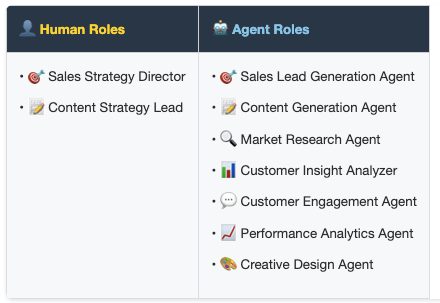
As part of our ongoing series exploring how AI is transforming organizational structures, this post examines the prospects for Sales and Marketing departments.
𝐇𝐮𝐦𝐚𝐧 𝐑𝐨𝐥𝐞𝐬
🎯 Sales Strategy Director
📝 Content Strategy Lead
🤖 Agent Roles
🎯 Sales Lead Generation Agent
📝 Content Generation Agent
🔍 Market Research Agent
📊 Customer Insight Analyzer
💬 Customer Engagement Agent
📈 Performance Analytics Agent
🎨 Creative Design Agent
English
This continues my recent reflection on the rise of new roles driven by Agentic AI.
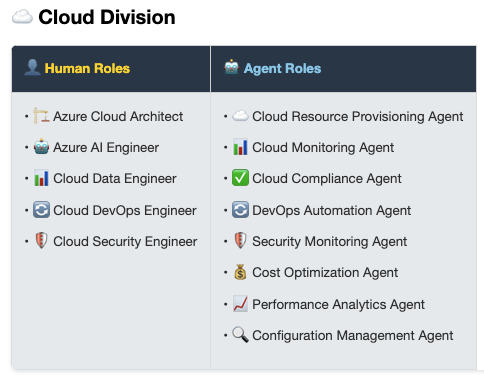
In this post, I want to focus on what this shift means specifically for Cloud and Infrastructure teams.
As automation accelerates, cloud departments won’t just manage infrastructure anymore—they'll design systems of intelligence. Agentic AI will require new thinking in observability, dynamic orchestration, zero-trust automation, and AI-native environments.
Human Roles
• 🏗️ Cloud Architect
• 🤖 Azure AI Engineer
• 📊 Cloud Data Engineer
• 🔄 Cloud DevOps Engineer
• 🛡️ Cloud Security Engineer
🤖 Agent Role
• ☁️ Cloud Resource Provisioning Agent
• 📊 Cloud Monitoring Agent
• ✅ Cloud Compliance Agent
• 🔄 DevOps Automation Agent
• 🛡️ Security Monitoring Agent
• 💰 Cost Optimization Agent
• 📈 Performance Analytics Agent
• 🔍 Configuration Management Agent
English
Continuing my exploration of how Agentic AI is reshaping roles across departments, today we look at HR.
HR has always been about people. But in a world where agents are collaborators, not just tools, the mission expands:
We’re not just hiring for skills anymore — we’re designing human-machine ecosystems.
We’re not just managing talent pipelines — we’re building adaptive, AI-augmented teams.
This shift turns HR into a strategic enabler of transformation.
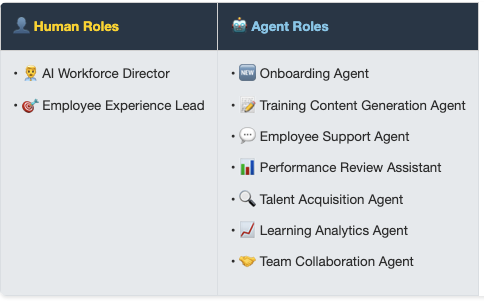
👤 Human Roles
• 👨💼 AI Workforce Director
• 🎯 Employee Experience Lead
🤖 Agent Roles
• 🆕 Onboarding Agent
• 📝 Training Content Generation Agent
• 💬 Employee Support Agent
• 📊 Performance Review Assistant
• 🔍 Talent Acquisition Agent
• 📈 Learning Analytics Agent
• 🤝 Team Collaboration Agent
English
This is a follow-up to my post on the wave of new roles being created by Agentic AI. Today, I want to focus on Operations.
Operations have always been about efficiency, repeatability, and scale. But with Agentic AI entering the picture, the rules are being rewritten.
We’re moving from managing processes to orchestrating autonomous systems, from standardizing tasks to adapting flows in real time, from backend support to frontline intelligence.
💡 This shift doesn’t eliminate Ops — it elevates it.
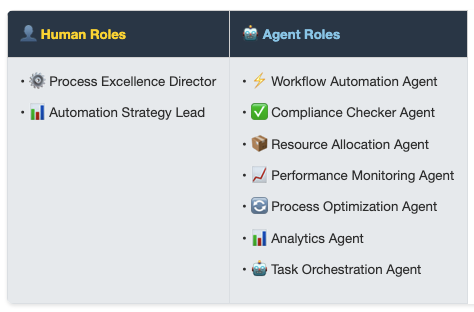
👤 𝐇𝐮𝐦𝐚𝐧 𝐑𝐨𝐥𝐞𝐬
• ⚙️ Process Excellence Director
• 📊 Automation Strategy Lead
🤖 Agent Roles
• ⚡ Workflow Automation Agent
• ✅ Compliance Checker Agent
• 📦 Resource Allocation Agent
• 📈 Performance Monitoring Agent
• 🔄 Process Optimization Agent
• 📊 Analytics Agent
• 🤖 Task Orchestration Agent
English
A decade ago, "working in software" mostly meant writing code.
Fast forward to today, and the field looks completely different.
From prompt engineers to AI workflow designers, orchestration strategists to automation architects — a new generation of roles is reshaping the industry. And with every announcement from the big tech players — new tooling, AI agents, and frameworks — one question keeps coming up:
Who is going to do these jobs?
These aren't just features. They are the foundations of an entirely new technology stack that requires new skills, new mindsets, and new team dynamics.
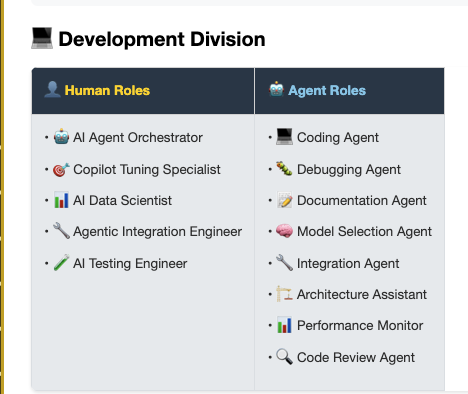
This is my take on the next wave of roles in the Development department that Agentic AI is making not just possible but necessary.
𝐇𝐮𝐦𝐚𝐧
• 🤖 AI Agent Orchestrator
• 🎯 Copilot Tuning Specialist
• 📊 AI Data Scientist
• 🔧 Agentic Integration Engineer
• 🧪 AI Testing Engineer
𝐀𝐠𝐞𝐧𝐭𝐬
• 💻 Coding Agent
• 🐛 Debugging Agent
• 📝 Documentation Agent
• 🧠 Model Selection Agent
• 🔧 Integration Agent
• 🏗️ Architecture Assistant
• 📊 Performance Monitor
• 🔍 Code Review Agent
English
There were many announcements at Build today, but instead of focusing on the new toys, I would rather focus on what actions organizations can take to extract value from these new technologies.
Here you have 10 potential action items.
Automate Repetitive Workflows
Action: Deploy Microsoft 365 Copilot agents
Tools: SharePoint Content Agent, Teams Meeting Facilitator
Value: 40-60% reduction in administrative tasks
Examples: Document retrieval, Meeting summaries, Task tracking
Build Custom Multi-Agent Systems
Action: Create specialized agents via Azure AI Foundry
Tools: Finance agents, HR agents, IT agents
Value: Complex process automation
Examples: Data Collector (feedback), Analyst (trends), Reporter (summaries)
Adopt Declarative Agents
Action: Use Copilot Studio for no-code automation
Tools: Power Platform connectors, SharePoint/Dynamics 365
Value: Reduced manual work
Examples: BASYS Processing (10 hours saved per event)
Leverage Multi-Agent Orchestration
Action: Implement Azure's framework
Tools: Supply chain agents, Customer service agents
Value: 60-70% workflow automation
Examples: McKinsey verified results
Monetize Solutions
Action: Develop and publish niche agents
Tools: Microsoft's Agent Store
Value: New revenue streams
Examples: Retail partner (70% faster returns processing)
Enhance Data-Driven Decisions
Action: Train teams on Copilot's Analyst agent
Tools: Excel integration
Value: 60% faster case resolution
Examples: Microsoft Finance case study
Secure Multi-Agent Systems
Action: Apply Entra Agent ID framework
Tools: Identity management, Access control
Value: Enhanced security
Examples: Azure API-based MCA attestation
Optimize Meetings
Action: Enable Teams' Facilitator agent
Tools: Real-time AI facilitation
Value: 11 minutes saved per meeting
Examples: Automated agendas, Translations
Integrate Across Ecosystem
Action: Connect various Microsoft agents
Tools: Dynamics 365, Power BI, Outlook
Value: 30% faster innovation cycles
Examples: Amgen case study
Pilot Multi-Agent Solutions
Action: Target high-impact areas
Tools: Various Microsoft tools
Value: Measurable ROI
Examples: See department implementations

English