

Odelia Energy
42.7K posts

Odelia Energy
@odeliaenergy
Soli Deo Gloria · Veteran-Founded · Nuclear Fuel Cycle Intelligence, Supply Chain & Procurement
Katılım Ağustos 2021
5.5K Takip Edilen7.7K Takipçiler
SODIUM, SALT, AND NOW LEAD: ONE BUILDER IS COLLECTING THEM ALL
THE AGREEMENT
· Hyundai E&C signed a framework agreement with First American Nuclear (FANCO) in New York on July 13 to cooperate on EAGL-1, a 240 MWe fast reactor SMR and the only US design cooled by lead-bismuth.
· The early-stage scope covers balance of plant design, constructability reviews, modularization strategy, and support for FANCO's Bridge Power model, which runs gas-fired package boilers on the plant's turbines until the reactor is licensed and swapped in.
· The companies will also explore Hyundai E&C as EPC contractor for EAGL-1, which opened NRC pre-application engagement in April and is slated for first deployment in Indiana as part of a planned closed fuel cycle energy park.
· The deal completes what Hyundai E&C calls a full next-generation lineup: light water SMRs with Holtec, sodium-cooled fast reactors with TerraPower, molten salt reactors with Thorizon, and now lead-bismuth with FANCO.
OE READ: The lineup is interesting. Framework agreements are cheap optionality, and Hyundai E&C now holds a seat in every major Gen IV coolant family in the Western pipeline, which looks like a bet on the buildout itself rather than on any single design. The open question on EAGL-1 is how delivery roles sort out, since AtkinsRéalis already holds exclusive EPCM rights for the reactor in North America.
In a race this crowded, is the builder the only sure winner?


English
TWENTY YEARS IN, DOE RE-UPS ARGONNE'S OPERATOR
THE RENEWAL
· DOE renewed its management and operating contract for Argonne National Laboratory with UChicago Argonne, LLC, the University of Chicago entity that has run the lab for the Office of Science since 2006.
· The new five-year contract starts October 1, 2026, continuing a partnership that supports nearly 8,000 researchers a year across six DOE national user facilities.
· Argonne remains at the forefront of nuclear energy innovation, drawing on eight decades of expertise in next-generation reactor technologies and nuclear fuel recycling.
OE READ
M&O renewals read like paperwork, but they are the stability layer under everything built on top of a national lab. Advanced reactor developers and fuel recycling programs lean on Argonne's people and facilities, and locking in the operator for another five years keeps that foundation steady right as the commercial buildout accelerates. How much of the reactor race actually runs through the national labs?
English
CANADA'S PLAN TO DOUBLE CANCER-FIGHTING ISOTOPES JUST GOT 90,000 KG HEAVIER
WHAT HAPPENED
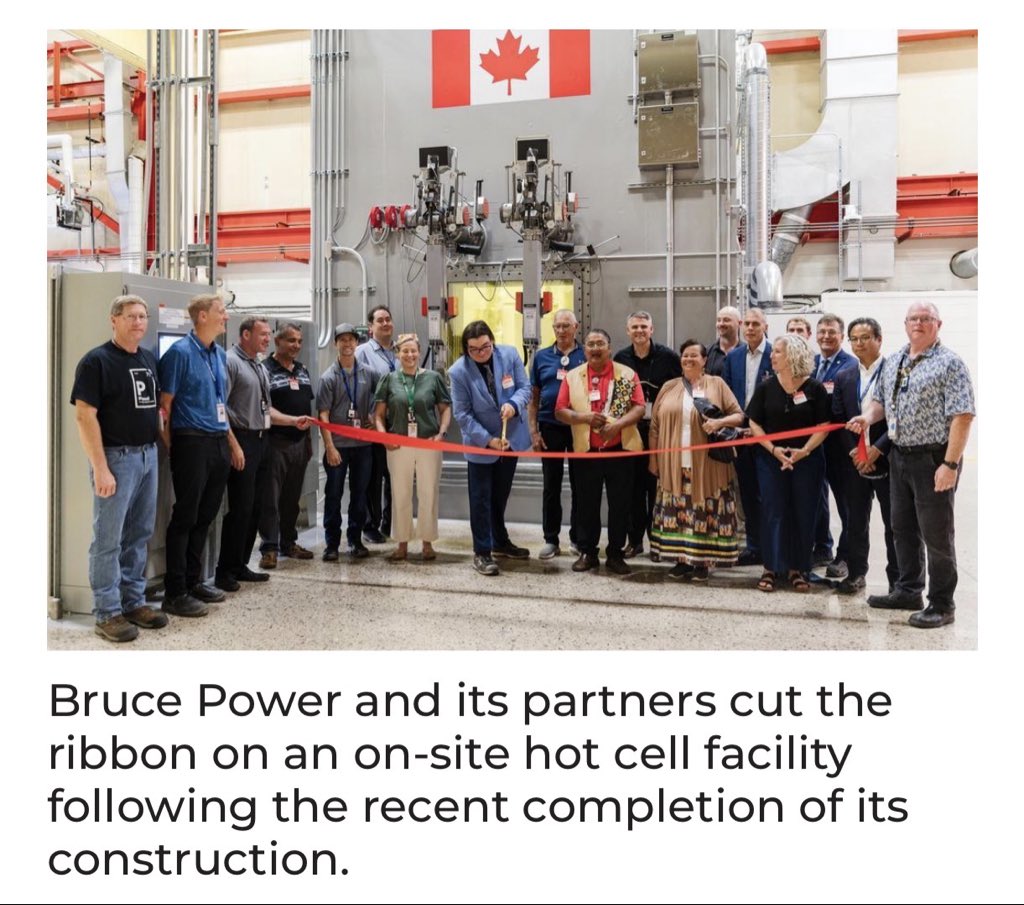
· Bruce Power has completed construction of its on-site hot cell, delivered with Kinectrics and Bird Construction, supporting production of lutetium-177, a medical isotope used to treat prostate cancer and a growing number of targeted therapies.
· An application is before the Canadian Nuclear Safety Commission to add the hot cell to the lutetium-177 production process; once licensed, Bruce can perform Target Carrier Removal on site, prepping the isotope for further processing into therapies at off-site facilities, with expected gains in logistics and worker safety.
· The facility builds on 2022, when Bruce's Isotope Production System made it the first commercial power reactor in the world to produce lutetium-177, and an additional IPS is planned for Unit 6 to expand output.
OE READ
For a short-lived isotope like Lu-177, the supply chain is the product. Every handling step Bruce pulls inside its own fence makes a power plant look a little more like pharma infrastructure. This is what isotope superpower talk looks like when it turns into concrete and lead glass.
How much of the reactor-to-patient chain ends up inside the plant fence by 2030?
$BWXT $TRP

English

WAR ONCE DIVIDED THESE THREE NATIONS. NOW THEY'RE WORKING ON BUILDING NUCLEAR REACTORS TOGETHER IN WASHINGTON
THE WASHINGTON CONVENING
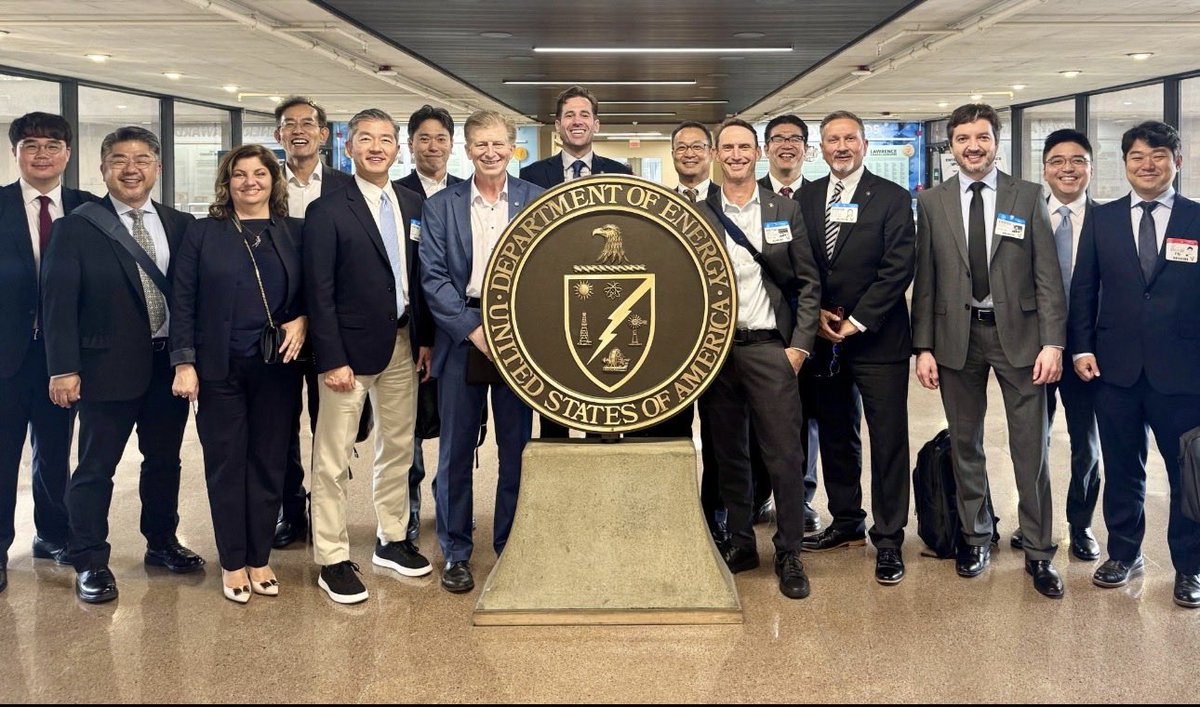
· Oppenheimer Energy hosted a delegation of Japanese and Korean nuclear supply chain and construction partners in Washington, D.C. last week, describing the group as close U.S. allies and company partners.
· The company says the visiting expertise met a genuinely welcoming American policy environment, with the U.S. government encouraging both domestic industry and allied participation in a durable resurgence of abundant nuclear energy.
· The group is seen photographed around the Department of Energy seal, and the moment is framed as nations once divided by war now building the next generation of peaceful nuclear energy side by side.
OE READ: The timing is the story. This convening landed the same week Washington, Tokyo, and Seoul signed a trilateral memorandum in Ankara to deploy SMRs in third countries, and ministerial paper only becomes steel when private players wire the industrial relationships together. Korean construction discipline and Japanese heavy component capacity are exactly what the American buildout is short on.
Who turns these handshakes into purchase orders first?
English
FOUR BILLS TO SPEED UP NRC LICENSING. TWO DEMOCRAT BILLS TO BALANCE THEM. ALL SIX CLEAR BY VOICE VOTE.
THE PACKAGE
· The House Energy and Commerce Subcommittee on Energy advanced all six nuclear bills to the full committee by voice vote on Tuesday, with the Nuclear REFUEL Act and the DOE Nuclear Transparency Act passing as amended and the other four as introduced.
· Four bills trim NRC review: H.R. 5549 makes the mandatory uncontested licensing hearing optional, H.R. 9613 narrows the Advisory Committee on Reactor Safeguards to novel and safety significant issues by codifying Executive Order 14300, and H.R. 3978 and H.R. 9612 move used fuel recycling and uranium enrichment facilities into the same licensing framework used for other fuel cycle facilities.
· Two Democrat-led bills push the other way: H.R. 9614 lets the NRC Chairman raise pay for career senior executives at an agency its sponsor says has lost 400 experts since January 2025, and H.R. 9084 requires DOE to announce and post licensing decisions for the facilities it permits, a pathway that runs parallel to NRC licensing.
OE READ
The deregulation is not the surprising part. Democrats had been threatening to walk away from bipartisan nuclear work over the NRC commissioner firing and White House review of the agency's decisions, and Republican willingness to move two Democrat bills looks like what bought the peace. The tell is H.R. 9613: Democrats advanced a bill codifying an executive order that narrows the NRC's own advisory committee, on the same day one of their bills was pitched as a defense of the agency's independence.
When both parties want throughput, who is left arguing for the review?

English
Odelia Energy retweetledi
NEWCLEO FILED WITH THE NRC FOR A LEAD-COOLED FAST REACTOR. IT IS NOT A LICENSE APPLICATION.
WHAT WAS SUBMITTED
· newcleo submitted a Regulatory Engagement Plan to the NRC for its LFR-AS-200, setting out the company's proposed licensing approach and an indicative schedule for the technical submissions and staff interactions that come before any application is filed.
· The LFR-AS-200 is a 200 MWe lead-cooled fast reactor aimed at industrial buyers, selling both low-carbon electricity and process heat to data centers, hydrogen producers, and cement and steel manufacturers.
· It is designed to run on newcleo's proprietary MOX fuel made from recovered or surplus nuclear materials, which the company says would cut the final volume and radiotoxicity of spent fuel while generating power.
OE READ: A Regulatory Engagement Plan is a scoping and scheduling document, so nothing here is docketed and nothing is approved. The detail worth holding onto is that newcleo told investors in May it was developing engagement plans for two US projects, the reactor and a MOX fuel fabrication facility, and only the reactor plan has landed. The fuel plant is the harder license, and it is the one the LFR-AS-200 cannot operate without.
Which is the real gate here, the reactor or the fuel plant that feeds it?
$NHIC

English
Odelia Energy retweetledi
PENNSYLVANIA'S NUCLEAR FEES WERE WRITTEN FOR GIANT REACTORS. THE SMR FIX IS HEADED TO SHAPIRO'S DESK
WHAT H.B. 2017 DOES
· The Pennsylvania General Assembly gave final passage to H.B. 2017, which amends the state's Radiation Protection Act of 1984 to formally define small modular reactors and micro reactors as distinct from traditional light-water reactors.
· Current law charges nuclear operators fees on a per-site basis, which sponsors say discourages SMR developers because the technology spreads generation across more, smaller sites. The bill creates a separate fee structure and directs the Environmental Quality Board to set reasonable fees for SMR sites.
· The fees fund the Department of Environmental Protection's environmental monitoring, oversight, and decommissioning work. After clearing the House unanimously in February, the bill won final General Assembly passage this week and heads to Gov. Josh Shapiro for signature.
OE READ: Fee codes written in the gigawatt era tax a business model built on many small sites, and Pennsylvania's fix is now one signature away in the same week New Jersey signed its own nuclear procurement law. One precision note: most leading SMR designs are light-water reactors too, so the statute's real dividing line is size and site count, not coolant type. Which state modernizes its nuclear framework next?

English
“produce lutetium-177” is Bruce’s shorthand. What actually happens in-reactor is irradiation of ytterbium-176 targets. The ampule ships out and ITM in Munich finishes it into pharmaceutical-grade, non-carrier-added Lu-177. Bruce starts the reaction, ITM delivers the drug substance.
English
Odelia Energy retweetledi
THE FUTURE OF NUCLEAR DEPENDS ON MORE THAN REACTOR TECHNOLOGY. IT DEPENDS ON UNDERSTANDING HOW PROJECTS ACTUALLY GET BUILT.
A free six-episode series begins July 17 at 9:00 a.m. EDT, starting with Nick Touran (Reactor Designer, WhatIsNuclear.com) and then exploring the full journey from concept to operation: reactor design, licensing, financing, construction, fuel, and plant operations.
The series features Allison Macfarlane (former NRC Chair), Jigar Shah (former DOE Loan Programs Office Director), Kathryn Huff, Heather Hoff (Diablo Canyon), and host Dr. Sweta Chakraborty.
OE Read: What stands out is the mix of operators, former regulators, financiers, and technical experts, combined with a host focused on behavioral science and public engagement. At a time when AI-driven electricity demand is putting new attention on nuclear energy, the series tackles a question the industry rarely explains end-to-end: What does it actually take to get a nuclear plant from idea to operation?
The bigger question is whether better public understanding can help accelerate deployment, or whether the industry’s biggest obstacles remain regulatory, financial, supply chain, and workforce challenges that education alone cannot solve.

English
Odelia Energy retweetledi
NEW JERSEY SPENT 50 YEARS BLOCKING NEW NUCLEAR. IT JUST GAVE ITSELF TWO YEARS TO PICK A PROJECT.
POWER NJ ACT
· Governor Mikie Sherrill signed the Power NJ Act on July 13, directing the Board of Public Utilities and the Economic Development Authority to jointly procure at least 1,100 MW of new nuclear generation, three months after she lifted the state's 50-year moratorium on new nuclear development.
· The statute sets a fixed clock: BPU must open the request for expressions of interest by January 9, 2027, developers then get 60 days to submit, and a final board order on any winning project must land before July 8, 2028.
· A project only clears that final order if the developer has secured federal financing, the project delivers a net benefit to ratepayers, and costs are not unreasonable or excessive in light of customers' overall bills.
· Ratepayers pay nothing during construction and carry no cost overrun exposure; once the plant is delivering power, electricity suppliers buy Reliable Capacity Certificates at a fixed negotiated price instead of volatile market prices.
OE READ: The federal financing condition is the load-bearing provision here, and it is doing more work than the ratepayer language that drew the headlines. New Jersey has effectively conditioned its own procurement on Washington showing up with capital, which caps state exposure but also means a developer without a credible federal financing path cannot clear the final board order no matter how strong the bid looks. Worth noting that PSEG already holds an NRC early site permit, issued May 2016 for the site adjacent to Salem and Hope Creek and sized for roughly 2,200 MWe with no reactor design selected, and has signaled it would rather host a partner-led project than commit its own balance sheet.
Who brings the reactor, and who brings the balance sheet?
$PEG $CCJ $BAM

English

⚡️📰Today the 2 reactors at the 2.2 Gigawatts Temelín #Nuclear plant in #Czechia were cleared to operate for another 20 years😊 for up to 80 years converting #Uranium fuel into 24/7 #CarbonFree #electricity 🌞⚛️🤠🐂#NetZero #CleanEnergy #EnergySecurity 🏄 english.radio.cz/temelin-nuclea…
English