
Okia Joseph retweetledi

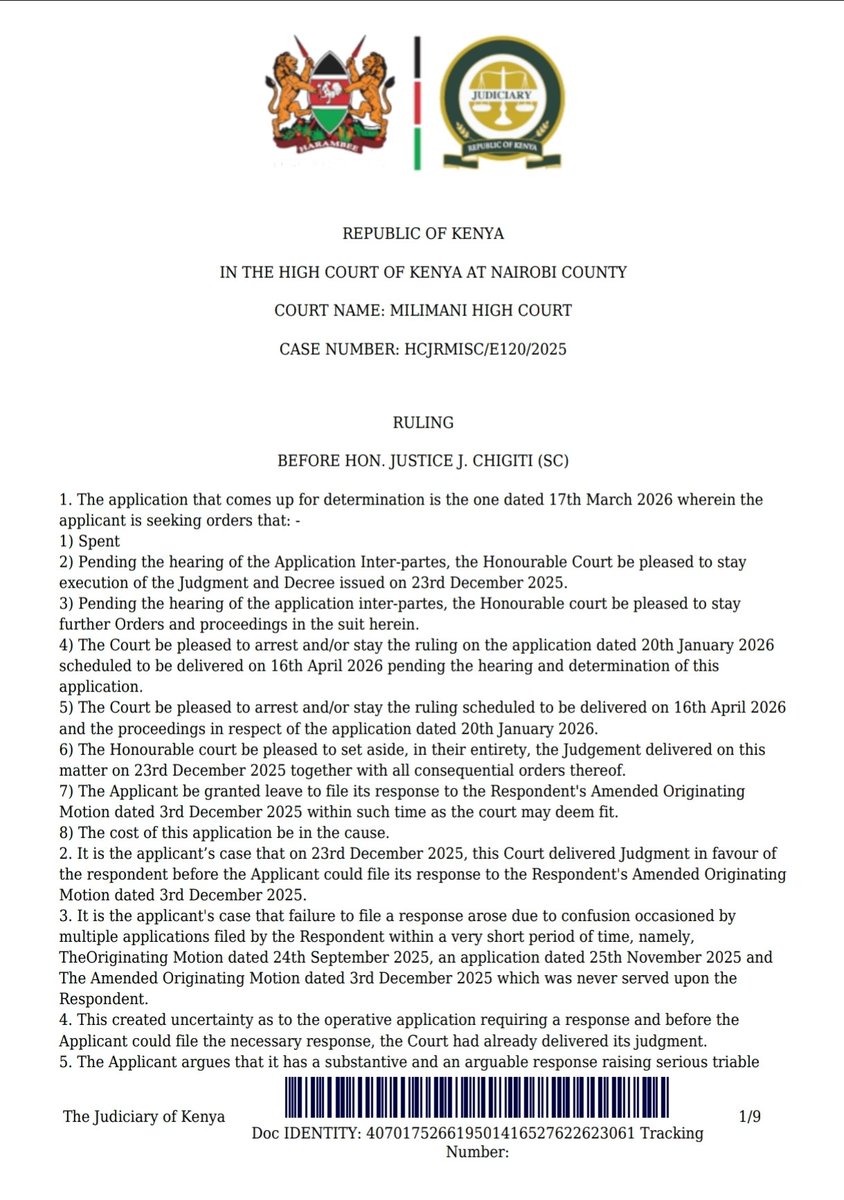
Kenya High Court found that the ex parte applicant’s admitted use of unknown tools or artificial intelligence to draft his pleadings amounted to an abuse of the court, and barred him from filing any other pleadings in any court that are machine generated unless there is a law in Kenya allowing or providing for drafting using artificial intelligence tools.
In Republic of Kenya, High Court at Nairobi County, Milimani High Court, HCJRMISC/E120/2025 (ruling delivered 16 April 2026), the Court considered whether it is legal to draft pleadings using artificial intelligence tools.
The respondent/ex parte applicant admitted that he had used what he described as ordinary digital tools, including legal research tools, to assist in writing, but maintained that he had personally reviewed, edited and adopted every document and remained personally responsible for all factual statements on oath and legal citations. He argued that his pleadings contained no fabricated cases, false citations or invented quotations, and that, being self-represented, he had used lawful tools to participate effectively in court.
In determining the issue, the Court noted that the use of personalised drafting tools, structures and methodologies not provided for under the rules of drafting, such as those the applicant had admittedly used, was deplorable. It further noted that allowing a departure from the rules of drafting would create a litigation disaster, leaving judges with no guiding beacons to propel proceedings, and that this would ultimately be reflected in judgments informed by such an unregulated terrain.
The Court stated that the generation of pleadings through unknown tools or artificial intelligence gives an unfair advantage to the person using such tools, and that this amounts to an affront to access to justice as guaranteed under Article 48 of the Constitution. It further stated that drafting pleadings using artificial tools unknown to the Civil Procedure Rules, and artificial intelligence not provided for in Kenyan law, gives such a user or litigant an unfair advantage over his or her rival in an adversarial system.
The Court also noted that the Rules Committee had not yet amended or introduced drafting tools or mechanisms assisted by electronic tools, technology or artificial intelligence. It further stated that the fact that the ex parte applicant admitted to having used unknown tools or artificial intelligence to draft his pleadings amounted to an abuse of the court. In that regard, the Court clarified that it was not for him, as a litigant, to vouch for or verify for the court the truthfulness or accuracy of such undisclosed tools or AI-generated pleadings, since to allow that would mean that he would act as a judge in his own case, which was unacceptable and a violation of the rules of natural justice.
On that basis, the Court barred the applicant from filing any other pleadings in any court which are machine generated, unless there is a law in Kenya allowing or providing for drafting using artificial intelligence tools.
The Court nevertheless observed that technology is a powerful socio-economic growth tool when harnessed within a legal framework, and noted that Kenya is currently working towards legally embracing artificial intelligence. It stated that, once the legislators come up with an appropriate legislative framework, artificial intelligence will then form part of Kenyan law. The Court therefore invited the Rules Committee to consider amending the Civil Procedure Rules, through public participation, so as to embrace technology and artificial intelligence drafting rules.
English