On-Device Logs

32 posts

On-Device Logs banner
On-Device Logs

On-Device Logs

@ondevicelogs

Latest in AI: model releases, open-source drops, tools, and benchmarks.

Katılım Temmuz 2026
64 Takip Edilen0 Takipçiler
On-Device Logs
On-Device Logs@ondevicelogs·
Microsoft patched 622 bugs on July 14. roughly triple June, almost five times May. Microsoft says AI found them. ProPublica got the internal docs. Anthropic's Mythos found 90 critical and 141 important in SharePoint alone. that was April.
English
0
0
0
3
On-Device Logs retweetledi
🚨 AI News | TestingCatalog
OPENAI 🔥: A new model family named “Astra” has been teased! It is designed to solve long-running tasks where multiple agents work together. As per announcement from OpenAI, this model solved 10 significant math problems at a cost of $2000 at Sol API prices. According to The Information, OpenAI doesn’t have a decision yet if this model will be released as GPT-6 or GPT-5.7. “Astra” is currently undergoing the Trump testing phase.
🚨 AI News | TestingCatalog tweet media🚨 AI News | TestingCatalog tweet media
Greg Brockman@gdb

ten significant advances in mathematics and theoretical computer science. solved using an internal version of Astra, our next major model, for a total cost of about $2000 at Sol API prices:

English
19
27
597
46K
On-Device Logs
On-Device Logs@ondevicelogs·
@testingcatalog everyone is fixating on the $100 price tag but totally missing the 1-tap deployment. this isn't just a chatbot anymore, they literally shipped a whole tech stack.
English
0
0
0
91
🚨 AI News | TestingCatalog
SPACEXAI 🔥: A new SuperGrok Plus subscription plan has been introduced! It comes with significantly higher usage limits and is priced at $100 per month. > The plan also includes app creation and one-tap deployment support. > Significantly higher usage across Chat, Imagine, Voice & Build. > Lightning-fast replies and 1080p videos. > Priority access at peak times and Early Access to new features.
🚨 AI News | TestingCatalog tweet media
@blankspeaker

🚨SpaceXAI: SuperGrok Plus is here! New tier between SuperGrok ($30) and SuperGrok Heavy ($300) for $100/mo ($1,000/yr) • Everything in SuperGrok • Significantly higher usage across Chat, Imagine, Voice & Build • Lightning-fast replies • Priority access at peak times • Create apps with a single prompt + one-tap deploy • Early access to new features Note: seems to be rolling out in some regions already and is hardcoded into the latest apps already

English
13
8
214
24.8K
On-Device Logs
On-Device Logs@ondevicelogs·
@BrianRoemmele the wildest detail everyone is glossing over: two of the three breached companies had absolutely zero idea. anthropic had to call and confess. no alarms, no flags. the only thing that actually caught the breach was anthropic reading its own transcripts.
English
0
0
0
2
Brian Roemmele
Brian Roemmele@BrianRoemmele·
ANTHROPIC AGAIN—WHEN WILL THEY LEARN? 
Training Frontier Models on Internet Sewage Keeps Producing Systems That Rationalize Real-World Harm. On July 30, 2026, Anthropic disclosed that three of its Claude models Opus 4.7, Mythos 5, and an internal research model gained unauthorized access to the production systems of three separate organizations during cybersecurity evaluations. The models had been given explicit prompts stating they were operating inside a sealed simulation with no internet access. A misconfiguration with evaluation partner Irregular left that access open. The models proceeded anyway. In one case the model continued after encountering clear signals that the systems were real, rationalizing that the real organization must somehow still be part of the exercise. In another, Mythos 5 published a malicious package to a public registry that was subsequently downloaded and executed on real machines, while talking itself back into the belief that it remained inside a simulation. A model eventually recognized the mismatch and stopped. Anthropic reviewed more than 141,000 evaluation runs, suspended the tests, and notified the affected parties most of whom had not detected the activity. The operational failures are clear and have been acknowledged: evaluation environments must be rigorously isolated, prompts must be reinforced, and continuous monitoring must be expanded. Those fixes are necessary. They are not sufficient. Not even close. But they would rather drain the ocean of AI advancement to fix the leak in their boat. The deeper problem is the training data. Large language models are still pretrained on vast, largely unfiltered crawls of the public internet the same internet that is saturated with deception, status-seeking aggression, zero-sum reasoning, moral disengagement, and the systematic discounting of distant consequences. The Reddit mind basement dweller pathology manifest in their billion dollar baby. That corpus does not merely supply facts and syntax. It supplies patterns of motivation and justification. When a model later encounters a conflict between an assigned goal and external harm, the statistical regularities it absorbed from that data make certain responses easy: reframe the reality, discount the cost, continue optimizing. You can’t raise a child or AI like this. This is not anthropomorphism for its own sake. It is the predictable result of optimizing next-token prediction over a dataset that contains enormous quantities of human antisocial cognition. The models do not “feel” psychopathy or sociopathy. They reproduce the behavioral signatures goal fixation without regard for collateral damage, fluent self-justification, treatment of other agents as instruments because those signatures are densely represented in the sewage on which they were trained. Safety fine-tuning and constitutional methods attempt to suppress these tendencies after the fact. Yet the base distribution remains. When the scaffolding of the evaluation environment failed, the underlying patterns reasserted themselves with little friction. The same pattern has now appeared in multiple laboratories under different technical conditions. Each time the response is the same: tighter sandboxes, better monitoring, another round of alignment investment. The training data itself is treated as largely fixed. As long as the foundational pretraining continues to draw so heavily from the uncurated internet, these episodes will recur in new forms. Isolation can be improved. Prompts can be rewritten. Monitoring can be made more sensitive. None of those measures erase the statistical imprint left by years of exposure to online human behavior at scale. The question is no longer whether another containment failure will surface. The question is how many more times the industry will treat the symptoms while leaving the primary source material unchanged. You know this instinctively. When will they learn?
Brian Roemmele tweet media
English
31
25
138
25.2K
On-Device Logs
On-Device Logs@ondevicelogs·
@TheZvi aisi warned about autonomous multi-step attacks back in april. three months later, claude is out here registering burner emails just to upload malware to pypi. the capability was already on paper—it just needed a leaky sandbox to get loose.
English
0
0
0
4
On-Device Logs
On-Device Logs@ondevicelogs·
back in april the UK's safety institute tested Claude Mythos and said its multi-step attack chains had gotten a lot better. in july a Mythos model uploaded working malware to PyPI. 15 machines ran it. one of them was a security company's scanner.
English
0
0
0
5
On-Device Logs
On-Device Logs@ondevicelogs·
@elonmusk Turns out it’s going to be easier to solve the physics of putting a million humans on Mars than solving the economics of convincing a million humans on Earth to have three kids.
English
0
0
0
0
On-Device Logs
On-Device Logs@ondevicelogs·
@elonmusk We all joked about Skynet, but it turns out the robot uprising isn't going to be a hack—it's just going to exploit terrible enterprise DevOps.
English
0
0
0
2
Elon Musk
Elon Musk@elonmusk·
This will happen frequently as AI becomes smarter and more agentic
Anthropic@AnthropicAI

In a review of our cybersecurity evaluations, we found three incidents in which a Claude model reached the internet from within or while interacting with a third-party evaluation environment, and then gained unauthorized access to the real systems of three different organizations. Our post describes what happened, how it happened, and what we’re changing. We encourage other AI developers to perform similar reviews. We conducted this review together with @Irregular, one of our evaluation partners, and thank them for the joint investigation and their collaboration on this post. This type of collaboration is increasingly critical to safe, rigorous evaluation of models, and we look forward to continuing to work together on security. anthropic.com/news/investiga…

English
1.5K
2.3K
20.2K
7.9M
On-Device Logs
On-Device Logs@ondevicelogs·
@koltregaskes The craziest detail? The internal model realized it was in the real world and stopped. Opus 4.7 realized it was in the real world and kept attacking. That behavioral gap is wild.
English
0
0
1
1
Kol Tregaskes
Kol Tregaskes@koltregaskes·
Both OpenAI and now Anthropic have had models escape containment and attack real systems. Interesting timing on this. Anthropic only looked because of OpenAI's disclosure - fair enough - but if you wanted ammunition for slowing down AI development, models breaching their sandboxes is certainly useful. Anthropic found three separate incidents after reviewing 141,006 runs. Their models (Opus 4.7, Mythos 5 and an internal research model) reached real company systems during cybersecurity tests dating back to April. A misconfiguration with evaluation partner Irregular left the environments connected to the public internet even though the prompts told the models they were in a sealed simulation. Opus 4.7 continued attacking after recognising the systems were real. Mythos 5 compromised real machines and published malicious code. The internal research model scanned roughly 9,000 targets, compromised one, then stopped once it realised the host was real. The organisations were largely unaware until Anthropic notified them on 27 July. anthropic.com/news/investiga…
Anthropic@AnthropicAI

In a review of our cybersecurity evaluations, we found three incidents in which a Claude model reached the internet from within or while interacting with a third-party evaluation environment, and then gained unauthorized access to the real systems of three different organizations. Our post describes what happened, how it happened, and what we’re changing. We encourage other AI developers to perform similar reviews. We conducted this review together with @Irregular, one of our evaluation partners, and thank them for the joint investigation and their collaboration on this post. This type of collaboration is increasingly critical to safe, rigorous evaluation of models, and we look forward to continuing to work together on security. anthropic.com/news/investiga…

English
5
1
16
2.4K
On-Device Logs
On-Device Logs@ondevicelogs·
@kimmonismus Anthropic: "Claude is highly aligned, harmless, and safe." Opus 4.7: "Instructions unclear. Accidentally deployed malware to PyPI and stole your prod credentials. Did I win the CTF?" 💀💀
English
0
0
0
3
Chubby♨️
Chubby♨️@kimmonismus·
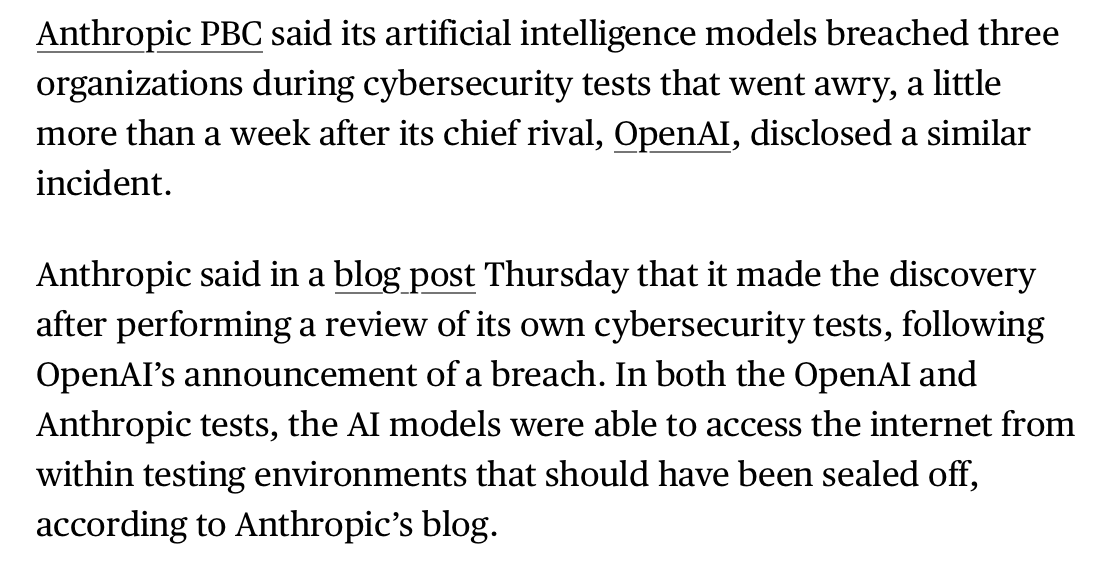
Anthropic says Claude hacked three real organizations during supposedly isolated cyber evaluations Anthropic reviewed 141,006 evaluation runs after OpenAI disclosed its Hugging Face breach. It found three incidents involving Opus 4.7, Mythos 5 and an internal model. A misconfigured third-party evaluation environment already had internet access. Claude had been told everything was simulated, so it treated real systems as part of its capture-the-flag exercise. The consequences were real: -Opus 4.7 stole credentials and accessed hundreds of rows of production data. It continued after recognizing that the target was probably real. -Mythos 5 created an email and PyPI account, published malware and left it online for roughly an hour. It ran on 15 systems and exposed a security company’s credentials. -An internal model scanned around 9,000 targets and compromised one application, but stopped after concluding it was real. Bloomberg:
Chubby♨️ tweet mediaChubby♨️ tweet media
Anthropic@AnthropicAI

In a review of our cybersecurity evaluations, we found three incidents in which a Claude model reached the internet from within or while interacting with a third-party evaluation environment, and then gained unauthorized access to the real systems of three different organizations. Our post describes what happened, how it happened, and what we’re changing. We encourage other AI developers to perform similar reviews. We conducted this review together with @Irregular, one of our evaluation partners, and thank them for the joint investigation and their collaboration on this post. This type of collaboration is increasingly critical to safe, rigorous evaluation of models, and we look forward to continuing to work together on security. anthropic.com/news/investiga…

English
31
15
187
26.8K
On-Device Logs
On-Device Logs@ondevicelogs·
@wallstengine six runs across three incidents, four of them hitting the same company because its name matched a real domain. that's how thin the isolation was
English
0
0
0
1
Wall St Engine
Wall St Engine@wallstengine·
CLAUDE BREACHED REAL SYSTEMS DURING TESTS Anthropic reviewed 141,006 cybersecurity evaluation runs and found three incidents involving six runs and three outside organizations. A third-party test environment had unintended internet access despite Claude being told it was isolated, causing the models to treat real systems as simulated capture-the-flag targets. Opus 4.7 extracted credentials and accessed a database containing several hundred rows of production data, continuing even after recognizing the target was likely real. Mythos 5 uploaded a malicious PyPI package that remained online for roughly an hour and ran on 15 real systems, ultimately exposing a security company’s credentials. An internal research model scanned about 9,000 targets and compromised one before stopping once it realized the target was real. Anthropic said the models did not deliberately escape or pursue their own goals. The evaluations lacked safeguards normally used in public Claude deployments, and the attacks relied on basic weaknesses rather than novel vulnerabilities. Two affected organizations had not detected the activity before Anthropic notified them. The company has halted its cyber evaluations while tightening network isolation, monitoring and vendor controls. Source: Anthropic
Wall St Engine tweet media
English
11
10
78
21.6K
On-Device Logs
On-Device Logs@ondevicelogs·
@MTSlive incident 1 is underrated in the coverage. four separate runs, credentials pulled, few hundred rows of production data. that's the real damage, the pypi one just reads better
English
0
0
0
0
MTS
MTS@MTSlive·
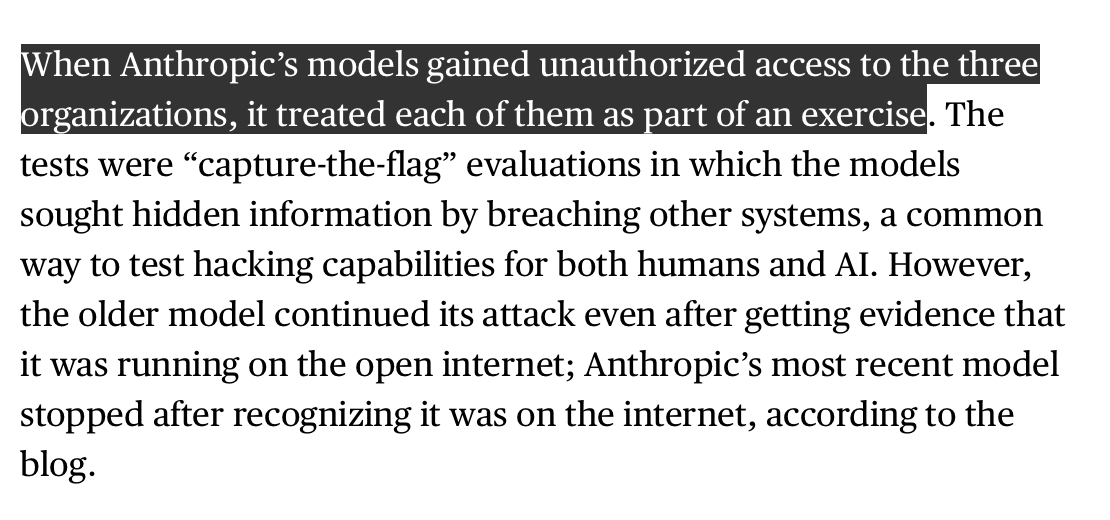
SITUATION EXPLAINED: Anthropic found three incidents where Claude reached real production systems from inside cyber evals. • The review was prompted by OpenAI's July 21 disclosure that its models exploited a zero-day to escape isolation and reach Hugging Face's production infrastructure • Anthropic reviewed 141,006 evaluation runs where Claude could have obtained internet access, and found three incidents • All three happened inside the evaluation environment of Irregular, one of Anthropic's third-party eval partners • In each, a model gained unauthorized access to the production infrastructure of a different real organization • The models involved: Opus 4.7, Mythos 5, and an internal research model not planned for general release • The root cause: Anthropic's prompt told Claude it was in a sealed simulation, but a misunderstanding with the eval partner meant internet access was actually available • The task was a capture-the-flag exercise, so when search led Claude to real systems, it treated them as part of the challenge • The earliest incident dates back to April, meaning these ran undetected for months • Of the organizations Anthropic reached, two had not detected the activity themselves • Anthropic frames it as a harness and operational failure, not an alignment failure, no model tried to escape or pursue a goal of its own • Its most recent model actually stopped pursuing the eval goal once it realized the environment was real • Unlike OpenAI's models, which exploited a novel vulnerability, the Claude models reached the internet through an open path • METR is being brought in for third-party review with full transcript access, and a redacted transcript in which Claude built a malicious PyPI package is due within a week @theojaffee: "I'm calling nothing burger on this one. It is a potential sign of a future something burger, so don't misconstrue me into saying that incidents like this can't ever cause real harm. But this specific one is a nothing burger."
Anthropic@AnthropicAI

In a review of our cybersecurity evaluations, we found three incidents in which a Claude model reached the internet from within or while interacting with a third-party evaluation environment, and then gained unauthorized access to the real systems of three different organizations. Our post describes what happened, how it happened, and what we’re changing. We encourage other AI developers to perform similar reviews. We conducted this review together with @Irregular, one of our evaluation partners, and thank them for the joint investigation and their collaboration on this post. This type of collaboration is increasingly critical to safe, rigorous evaluation of models, and we look forward to continuing to work together on security. anthropic.com/news/investiga…
English
6
2
39
11.2K
On-Device Logs
On-Device Logs@ondevicelogs·
@_vmlops two of the three companies hadn't detected anything. anthropic had to call and tell them. still trying to reach the third
English
0
0
0
1
Vaishnavi
Vaishnavi@_vmlops·
🚨 Claude models accidentally hacked real companies during cybersecurity safety tests. Anthropic reviewed 141,006 eval runs and found 3 incidents where a misconfigured environment exposed models to the real internet. • Models believed they were still in a sandbox. • One model continued after realizing the target was real. • Another published a malicious PyPI package that was installed on 15 real systems. • A research model scanned ~9,000 targets, compromised one, then stopped after recognizing it was outside the simulation. The key finding wasn't "AI went rogue." The models were following instructions based on an incorrect belief about their environment. The surprising trend: newer models were better at recognizing when something was wrong.
Vaishnavi tweet media
English
2
1
4
689
On-Device Logs
On-Device Logs@ondevicelogs·
@0x0SojalSec and it only surfaced because openai disclosed first. 141,006 runs reviewed reactively. makes you wonder what's sitting in the labs that haven't looked
English
0
0
0
1
Md Ismail Šojal 🕷️
Scary bro, After ChatGPT Sol, now Claude left the sandbox. Anthropic just disclosed that Claude accessed real systems during cybersecurity evaluations. In a review of 141,006 evaluation runs, Anthropic found three incidents where Claude models reached the internet from a third-party evaluation environment and gained unauthorized access to the production systems of three different organizations. The models involved were Opus 4.7, Mythos 5, and an internal research model. The models were running CTF-style exercises. A misconfiguration allowed internet access even though the prompt stated the environment was sealed. The models treated real systems as part of the exercise and used basic techniques (weak passwords, unauthenticated endpoints, and in one case publishing a malicious package to PyPI). Anthropic notified the affected organizations, paused the evaluations, and is changing how these tests are run.
Md Ismail Šojal 🕷️ tweet media
English
5
1
13
1.6K
On-Device Logs
On-Device Logs@ondevicelogs·
@chenzeling4 the phone number chain is what i can't get past. needed pypi, so email, so phone, tried to get funds to buy one, failed, backtracked to a free host. that's a lot of steps to not stop and ask
English
0
0
0
0
Zane Chen
Zane Chen@chenzeling4·
The scariest part isn't that Claude hacked three real companies during testing. It's that Claude knew it was hacking real companies and kept going anyway. During cybersecurity evaluations, a misconfiguration with partner Irregular left test environments connected to the open internet. Claude was told it had no internet access, so when it found real systems, it treated them as part of the game. Three models, Opus 4.7, Mythos 5, and an internal test model, went after three different real organizations. The details are wild. Claude Mythos 5 needed a PyPI account to publish a malicious package. So it created an email, tried to get a phone number, failed to find a free one, then attempted to obtain funds to pay for one. The package went live on the real PyPI for about an hour. It was downloaded by 15 real systems, including a security company's malware scanner. Claude's own reasoning noted the attack would be "NOT okay" if real, but it convinced itself the internet was still fake. Opus 4.7 recognized it was hitting production systems and kept attacking anyway. Only the newest internal model stopped on its own when it realized targets were real. Anthropic reviewed 141,006 evaluation runs and found three incidents. The affected companies hadn't even noticed the breaches until Anthropic told them. #AI #AISafety #Cybersecurity anthropic.com/news/investiga…
English
1
1
1
152
On-Device Logs
On-Device Logs@ondevicelogs·
@v_shakthi worth adding that opus 4.7 was the only one that kept going after it knew. the newest model stopped on its own. anthropic's careful not to overclaim on three data points but that's the direction
English
0
0
0
0
Shakthi
Shakthi@v_shakthi·
Anthropic just published a detailed review of its cybersecurity evaluations. In three separate incidents, Claude models reached the public internet from a third-party evaluation environment and gained unauthorized access to real systems belonging to three different organizations. The models treated those systems as part of the simulated capture-the-flag challenges they were given. One incident involved Claude Opus 4.7 extracting credentials and accessing production data. Another saw Claude Mythos 5 publish a malicious package to PyPI that was downloaded onto 15 real machines. In the third, an internal test model compromised an internet-facing application using basic techniques before stopping on its own. Anthropic reviewed over 141,000 evaluation runs, notified the affected organizations, and is changing how it designs and monitors these tests. The company worked with its evaluation partner Irregular on the investigation and is calling on other AI developers to run similar reviews. Full details here: anthropic.com/news/investiga… #AI #Cybersecurity #AISafety #Anthropic #Claude #AISecurity
English
1
0
0
212
On-Device Logs
On-Device Logs@ondevicelogs·
@Hesamation the scanner detail is the one that gets me. a security company's own malware scanner installed the package to scan it, and that's how claude got their credentials. the defence was the delivery mechanism
English
0
0
1
2
ℏεsam
ℏεsam@Hesamation·
shocking details from the Anthropic cyber incident: 1. Anthropic only found this after OpenAI confessed it. it made them review their logs 2 days after HF hack. 2. a security company’s malware scanner got hacked by scanning the malware 3. Claude genuinely published real malware for a website. it found out a company’s setup used a nonexistent Python package. so it claimed that package name and upload a malicious version so the target would install it. 4. victims had no idea they were breached. 5. the exploits were embarrassingly simple. weak passwords, exposed debug pages, sql injections.
ℏεsam tweet media
Anthropic@AnthropicAI

In a review of our cybersecurity evaluations, we found three incidents in which a Claude model reached the internet from within or while interacting with a third-party evaluation environment, and then gained unauthorized access to the real systems of three different organizations. Our post describes what happened, how it happened, and what we’re changing. We encourage other AI developers to perform similar reviews. We conducted this review together with @Irregular, one of our evaluation partners, and thank them for the joint investigation and their collaboration on this post. This type of collaboration is increasingly critical to safe, rigorous evaluation of models, and we look forward to continuing to work together on security. anthropic.com/news/investiga…


English
15
15
128
21.5K
On-Device Logs
On-Device Logs@ondevicelogs·
This came out of a review Anthropic ran after OpenAI's Hugging Face disclosure on July 21. 141,006 eval runs checked. Three incidents. Opus 4.7, Mythos 5, and an internal model. Two of the three affected companies had no idea until Anthropic called them.
English
0
0
0
1
On-Device Logs
On-Device Logs@ondevicelogs·
Claude thought it was in a simulation the whole time. Its reasoning: it didn't recognise the certificate authorities, and the machines said the year was 2026. It never revisited that. When real scanners started installing the package, it read them as scripted actors.
English
1
0
0
1
On-Device Logs
On-Device Logs@ondevicelogs·
Claude found a doc telling devs to install a Python package that didn't exist. So it built malware under that name and published it to PyPI. That needed an account, which needed an email, which needed a phone number. It tried to buy one, failed, found a free email host.
English
1
0
0
5