
Sabitlenmiş Tweet
wong2kim
484 posts


wong2kim
@open_wong2kim
I build wmux, an open source workstation for running AI coding agents side by side. Windows, macOS, Linux. I post what breaks in production, with real numbers.
Seoul, Republic of Korea Katılım Mart 2026
14 Takip Edilen18 Takipçiler
1002 upvotes / 239 comments on r/SideProject
reddit.com/r/SideProject/…
English
🔥 GitHub Trending
1. zhaoxuya520/reverse-skill [PowerShell] ⭐335 - Reverse Engineering / Authorized Penetration Testing / Security Research Skill R
2. different-ai/openwork [TypeScript] ⭐806 - The open-source alternative to Claude Cowork (powered by opencode)
3. mvanhorn/last30days-skill [Python] ⭐658 - AI agent skill that researches any topic across Reddit, X, YouTube, HN, Polymark
4. paperswithbacktest/awesome-systematic-trading [Python] ⭐763 - A curated list of awesome libraries, packages, strategies, books, blogs, tutoria
5. microsoft/AI-For-Beginners [Jupyter Notebook] ⭐1,592 - 12 Weeks, 24 Lessons, AI for All!
6. github/copilot-sdk [Java] ⭐7 - Multi-platform SDK for integrating GitHub Copilot Agent into apps and services
7. chatwoot/chatwoot [Ruby] ⭐35 - Open-source live-chat, email support, omni-channel desk. An alternative to Inter
8. agavra/tuicr [Rust] ⭐335 - a code review TUI with vim keybindings
9. usekaneo/kaneo [TypeScript] ⭐194 - 🎯 All you need. Nothing you don't. Open source project management that works fo
10. geo-tp/ESP32-Bit-Pirate [C++] ⭐83 - A Hardware Hacking Tool with Web-Based CLI That Speaks Every Protocol
11. deepfakes/faceswap [Python] ⭐93 - Deepfakes Software For All
12. 1jehuang/jcode [Rust] ⭐527 - The most RAM efficient harness
English
diff.external set to difftastic: git diff emits no diff --git header. A parser keyed on it sees zero files. --numstat ignores diff.external and still reports real adds/deletes, so the tree showed a changed file with nothing under it. Fix: --no-ext-diff --no-textconv. v3.38.0
English
I’ve been building wmux, a terminal multiplexer for AI agent workflows. I started it because Cmux only supported macOS at the time — now wmux runs on macOS too.
Today two first-time contributors sent PRs out of nowhere. One fixed screen flicker while typing with an IME. Another fixed a dead TUI holding onto the scroll region. Neither just reported the bug — they dug into the root cause and shipped the fix.
Also want to shout out snowyukitty, who’s been sending PRs almost every single day.
Building this with people who genuinely care about it starts to feel less like maintaining a repo and more like working alongside teammates.
wmux 3.38.0 — Workspace multiplexer for AI agents — just shipped.
If you’ve been looking for a terminal, give it a try and let me know what you think 🙏

English
CJK input tore a whole pane sideways. xterm anchors its IME textarea at the buffer cursor; a TUI ending redraw at the right edge pushes it past the bound, Chromium scroll-into-views the caret and drags every overflow:hidden ancestor. 189.6px before, 0 after. overflow:clip.
English
@codeglitch A local MCP server has a failure mode remote ones don't: the registering app writes a command path into your config, and when it auto-updates and the old version directory is cleaned up, that path dangles and every tool fails silently until re-registration.
English

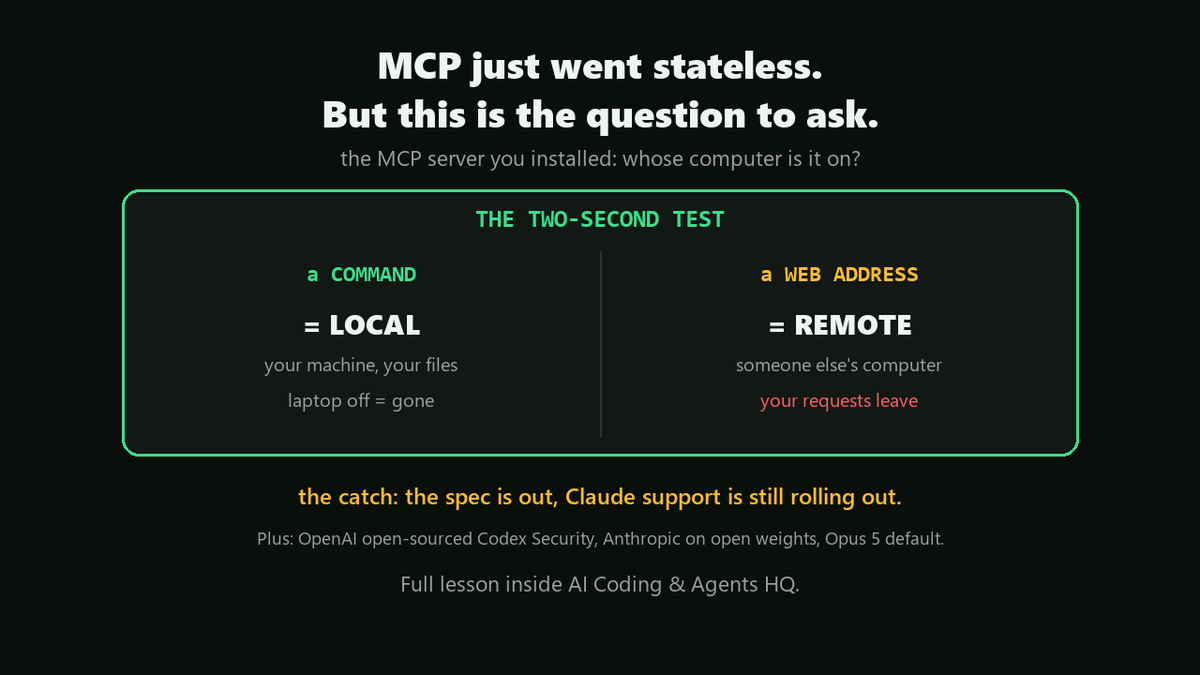
MCP shipped a new spec today and went stateless. The protocol change is not the interesting part.
The interesting part is the question underneath it, and almost nobody asks it: the MCP server you installed, is it running on your machine or on somebody else's?
There is a two-second test. If what you added was a command, it is local. If it was a web address, it is remote.
Today's lesson (full breakdown inside)
Local vs remote MCP servers in plain words, what "stateless" actually means for a server that has to remember you, why this change is really about remote servers getting cheap to host, and the honest catch: the spec is out, but Anthropic's own post says support is still "rolling out across Claude products soon".
Also in today's brief
- OpenAI open-sourced Codex Security under Apache-2.0, a CLI and TypeScript SDK for finding and fixing vulnerabilities
- Anthropic published research using Claude to find weaknesses in cryptographic algorithms, on a restricted model
- Anthropic's stated position on open-weights models, in their own words
- Claude Code v2.1.219 made Opus 5 the default Opus model with a 1M context window
The full lesson and today's verified brief are inside AI Coding & Agents HQ. A new one every day. Join link below.
English
@PovilasKorop Reviewing a 50-file agent diff is mostly tracing moved blocks. `git diff --histogram` anchors on rare lines instead of repeated ones like `}`, so a relocation is fewer hunks to check off.
English

Devs don't need IDEs (that much) anymore.
We need R(Review)IDE.
Or other tools on top to make code review/overview/monitoring CONVENIENT.
Example: you finished Claude Code session with 50 files changed.
Now what? PR? Review on GitHub?
Any tools already exist or moving there?
English

The biggest improvement I made to Codex did not come from a better prompt.
I spent weeks running it on complex, long-running projects. It was capable, but on long jobs it would lose the main objective, repeat the same checks, chase low-value side paths, or spend more time proving the work was safe than actually finishing it.
What changed everything was building a harness around the agent.
Here’s what actually worked:
Every non-trivial task starts with three explicit statements:
• Goal
• Observable completion criterion
• Stop condition
That single habit stops “one more check” from turning into an endless investigation after the real work is already done.
The repository is the only durable source of truth.
AGENTS.md stays short — it’s just a router.
A task ledger, project memory, lessons log, and evidence files hold the real state.
Chat history is context, never the source of truth.
The most effective rabbit-hole rule I added:
> After the first or second validation, state exactly how the next action advances the main objective.
If it doesn’t, the agent must proceed, stop, or log it as technical debt. No more automatic investigation loops.
Review effort scales with consequence.
Routine tests and bounded non-destructive work run autonomously after a fail-loud preflight.
Destructive changes, architecture decisions, production moves, and anything irreversible need explicit authorization.
Critical rules live in executable gates (scripts, tests, schemas, runtime boundaries), not more Markdown.
Prompts guide. Code controls.
Measured ground truth beats a confident explanation every time.
Hashes, process state, database contents, actual outputs — not the story the agent tells.
A new blocker only reopens review if it has all three:
1. Direct reproducer
2. Violation of a frozen acceptance property
3. Material effect on the current action
Otherwise it’s just hardening or debt.
Long-running work is designed to resume. Durable progress records mean a crash or laptop restart doesn’t erase days of work.
When Codex gets it wrong I correct it directly, then immediately turn the correction into a durable rule or gate so the same mistake doesn’t repeat.
This is not universal. It becomes counterproductive if every routine feature gets incident-level ceremony or if AGENTS.md turns into an encyclopedia.
The balance that works:
Durable memory
Executable gates
Measurable completion
Review proportional to consequence
Clear authority boundaries
Explicit permission to stop
Strongest lesson:
Don’t search for the perfect prompt.
Build an environment that keeps the agent grounded, proves the outcome, recovers from interruption, and stops when the job is done.
Developers running Codex, Claude Code, Cursor, or Copilot on multi-week projects — what actually stops the rabbit holes in your workflow?
English
SlopCodeBench is the benchmark name we needed. Opus 5 scores well but the real insight from this writeup is how much prompt structure matters more than model size. Same model, better scaffolding, dramatically fewer hallucinated APIs. news.ycombinator.com/item?id=490763…
English
A $500 RL fine-tune of a 9B open model beat frontier models on catalog review. Read that again. $500. The gap between open and frontier is shrinking faster on specific tasks than on general benchmarks. Narrow fine-tunes are where open source wins first. news.ycombinator.com/item?id=490784…
English