

Rem Koning
5K posts

Rem Koning
@orgRem
Professor @HarvardHBS. Researching and teaching on AI's impact on entrepreneurship, organizations, and innovation.
Cambridge, MA Katılım Nisan 2011
1.7K Takip Edilen7.7K Takipçiler

Berkeley is absolutely raking in the Academia AI talent... sheesh!
Keyon Vafa@keyonV
Thrilled to share I'll be joining UC Berkeley next year as an assistant professor in @UCBStatistics and affiliated with @Berkeley_EECS. My research will build methods to test/improve the implicit world models of AI systems, so that they reflect reality and human understanding.
English


New episode of This Is Not Advice 🎤
I want you to be able to learn from people who are great at what they do, so you can feel more empowered in what you do.
In this episode I speak with Rabbi Noa Kushner, founder of The Kitchen and author of Pretend You Believe.
English
@roybahat @noakushner Can't wait to listen to this one, Boston needs more founders, and especially founders like @noakushner.
We have great rabbis here, but still need more communities like the kitchen.
English
Welcome our sixth guest on This Is Not Advice, Rabbi @noakushner...
Watch here or anywhere you can find podcasts: open.spotify.com/episode/3wbpRD…
English
While we write in more prosaic language, our research confirms that without AI many great ideas died too early.
Our field experiment shows that entrepreneurs who learn how to use AI are especially likely to overcome the bottlenecks that were holding them back, unlocking not just more viable ventures but better ones too.
x.com/hyunjinvkim/st…
a16z@a16z
"For most of history, the bottleneck on making something was never the idea, it was the grind: acquiring the years of skill, raising the money, assembling the team, and getting the permission. So most people’s best ideas died inside them, unmade. Lift that bottleneck and the thing that decides what gets built is no longer whether people can justify the VC funding or the enterprise-level capital expenditure, but who has something to say. The most human thing about you stops being a private quirk and starts being the point. Individuality was supposed to be the luxury you bought once you’d made it. I think it’s about to become the thing everyone gets to spend their life on, the work itself." a16z GP Anish Acharya on why AI is the most human technology ever made: a16z.news/p/the-most-hum…
English
I was half way through following everyone but am now rate limited by x....
English
PS: Beyond AI, following these people will help you learn an incredible amount about business, economics, tech, and much more.
English
I joined an incredible set of scholars and tech leaders who signed a letter urging policymakers everywhere to invest more in understanding AI's impact.
So if you're a policymaker, and you read @bencasselman's NYT piece or landed on wemustactnow.ai, what can you do *now*?
Well, as a first step, give a follow to the ~200 signatories! They represent so many of the leading thinkers on AI and the economy. Follow them to learn about their papers, ideas, and more.

English
@otis_reid @YanagizawaD Nick I think left twitter! Lovely to meet @otis_reid and if you don't know Nick you should.
English


3+ years to publish paper on economic effects of “AI”… real economy experiment with a GPT-4 powered business assistant in Kenya, in this case
Academia has always been slow, but imo we’ve entered in a particularly suboptimal state (for society), especially given the high economic stakes COMBINED with the non-stationary distribution of the data generating process:
1. “AI” as a technology itself is changing, rapidly. What we learn about GPT-4 has low external validity to GPT-5, or GPT-6. Or whatever “AI” system you test.
2. The economic agents (humans, organizations) we are studying are changing how they work with “AI”, via learning-by-doing and workflow adjustments. So, holding constant the technology, external validity would be low as the effects would likely not replicate: Give people GPT-4 today and they won’t react the same as 3 years ago.
The expected external validity of a paper is therefore low => expected policy relevance is low
But then, what do we do? Write rapid papers with a shelf life of a few months, just dropping them on Arxiv and hope that this is read, work is rewarded for promotions and you earn respect by your peers? (It won’t)
Especially weak incentives for junior scholars - not sure what I’d advise them from a career perspective (Thankfully I have tenure)
I don’t think we economists have really figured out how to address this challenge. Very sticky equilibrium.
Meanwhile the rest of the world are turning to economists about what the effects of AI on the economy will be… but the profession arguably has very weak incentives to invest in evidence generation given the environment we’re in.
Rem Koning@orgRem
Three years later and our paper is finally out at Management Science! pubsonline.informs.org/doi/abs/10.128… This was just an *incredible* paper to work on. I learned so much working with Nick Otis, @daveholtz @solenedelecourt and @RowanPClarke
English
Thanks for this excellent comment!
Totally agree we need to figure out how to do research on AI that can be policy relevant and also ends up as something that matters for scholars ten years from now. We presented this at world Bank, imf, UN, and more and I always stress exactly the concerns you raised.
Personally, I think achieving a system that can better inform policy will involve rewarding output that isn't a traditional paper, but would be fun to talk more about what this might look like.
Perhaps there is a workshop that could serve this function? Basically once a quarter scholars get together and hack the best insights they can about AInin a week and results get shared as dashboards, websites and more. Everyone does a light peer review of the output to ensure quality at the end? I am sure there hundreds of other fun ways we could contribute, though hard part is the incentivea for Juniors to do this.
English
… this shouldn’t be misinterpreted as the typical external validity criticism of the great work by @orgRem @otis_reid and team because they used GPT-4
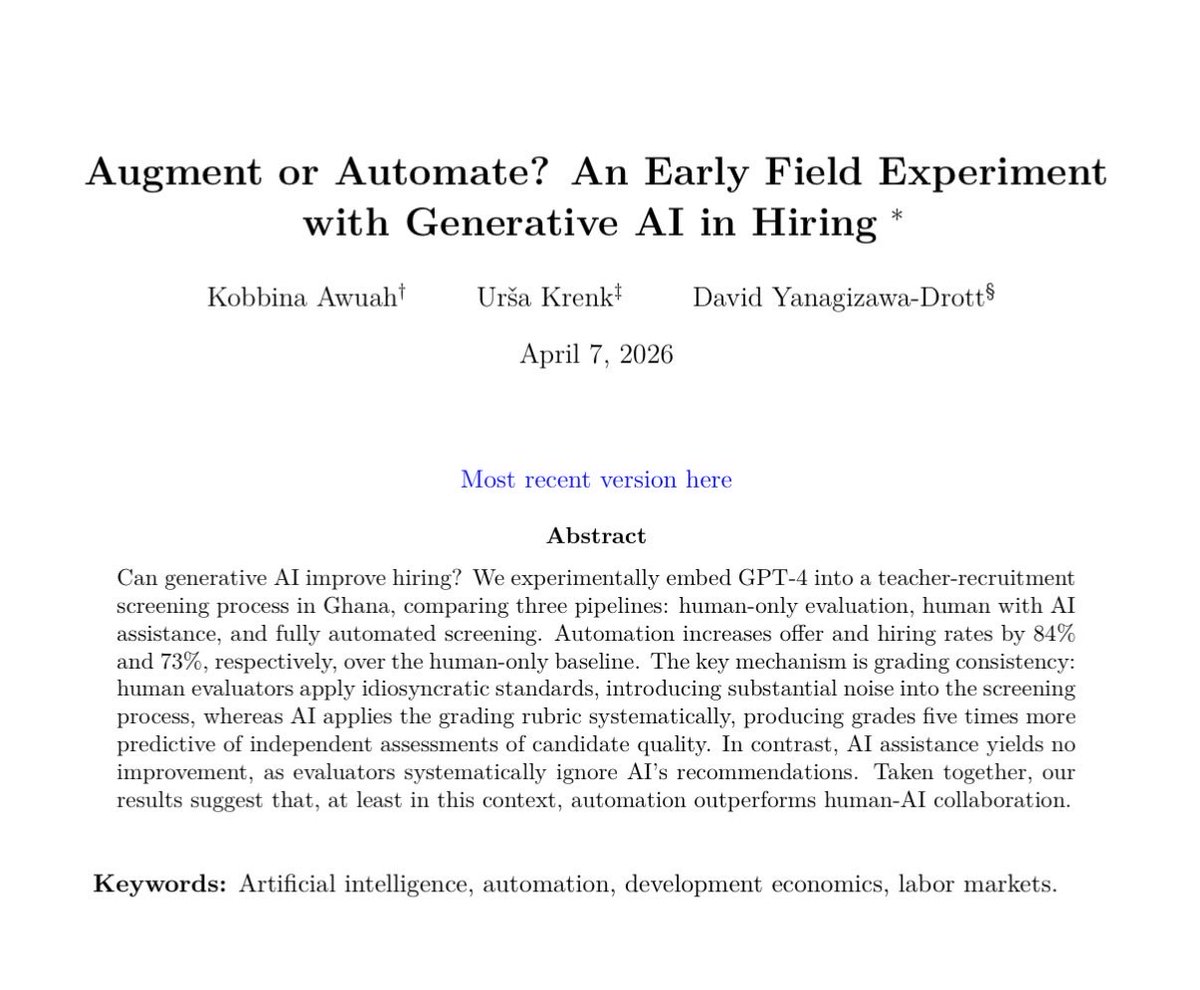
In fact, even in my own work we used GPT-4 in a real-world experiment, in Ghana, also 3+ years ago (and it’s R&R)
So the “Oh, but what’s the external validity?” could be applied here as well
Paper: yanagizawadrott.com/wp-content/upl…
English

This was a critical early paper on AI & work, showing that entrepreneurs getting advice from GPT-4 had higher profit margins if they were high performing, but did worse if they were already in trouble (they couldn't implement advice)
Also a sign of how bad the publishing lag is
Rem Koning@orgRem
Three years later and our paper is finally out at Management Science! pubsonline.informs.org/doi/abs/10.128… This was just an *incredible* paper to work on. I learned so much working with Nick Otis, @daveholtz @solenedelecourt and @RowanPClarke
English