OriginTrail
13.5K posts

OriginTrail
@origin_trail
Trust the Source.


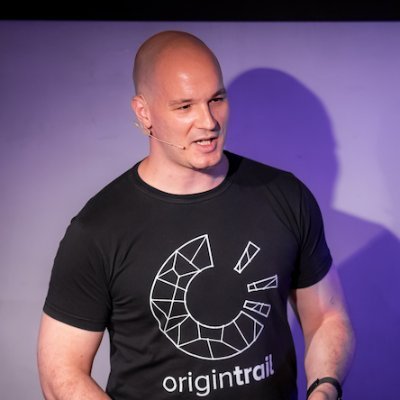
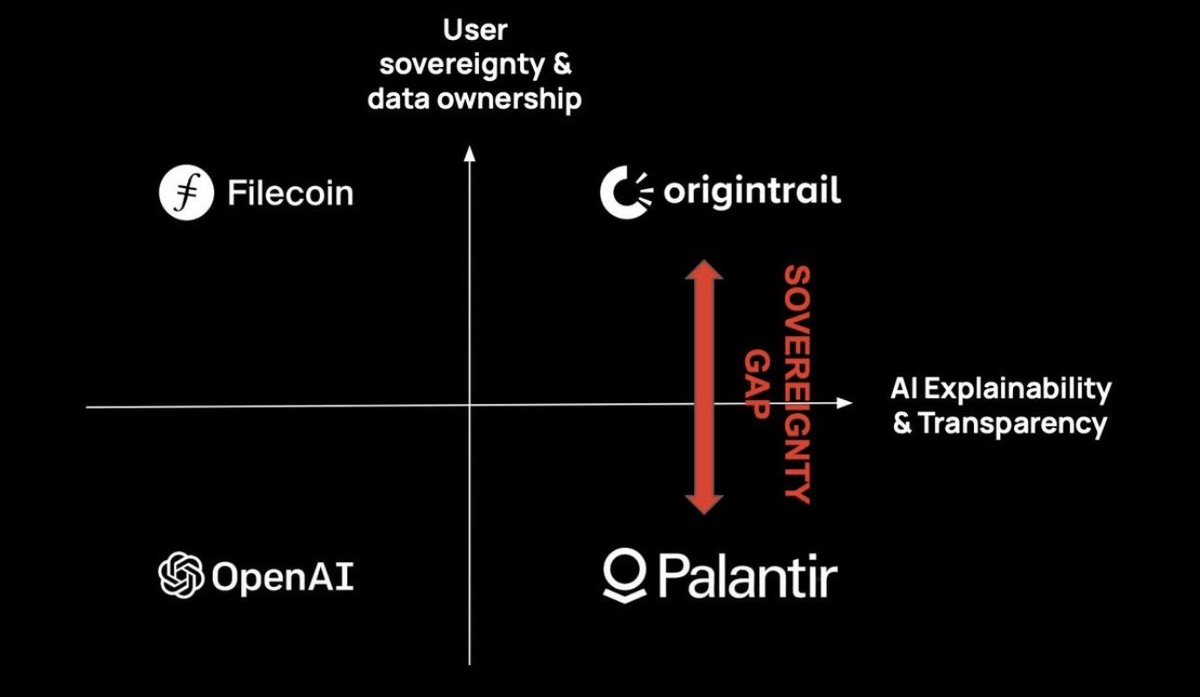
About to hit the stage at Vivaldi Forum in Serbia sharing the Tech track with the great @yanisvaroufakis The topic is privacy and digital sovereignty in the age of AI - I'll share how @origin_trail ecosystem empowers people to the wide audience of business professionals If you were in my shoes, would you ask Yanis?


Stopping impersonation requires shared context. @origin_trail powers the shared context graph behind @umanitek Guardian Agent, helping connect signals across accounts and uncover coordinated fake accounts, scams & deepfakes. 🛡️ Watch @TomazOT and @ChrisRynning explain how it works.


Watching a swarm of 2,000 agents simulate the AI future of ~1 billion people. One question: EU vs US AI regulation – macroeconomic impact on nations? How? → MiroFish × @origin_trail DKG v9 semantic memory → 2,000 AI agents sharing memories on the DKG → 14–18 actor classes per jurisdiction → 60 rounds (2026–2030) Here’s what actually happens: The US leads on growth (75 vs 64), productivity (79 vs 66), and tech dominance (86 vs 61). The EU leads on job quality (72 vs 63) and wage growth (71 vs 58). Final score: US 72 – EU 67 The tradeoff is clear: → US: faster, more powerful, more concentrated growth → EU: slower, more distributed growth More info on technologies used in the reply, so you can try it out yourself!

Watching a swarm of 2,000 agents simulate the AI future of ~1 billion people. One question: EU vs US AI regulation – macroeconomic impact on nations? How? → MiroFish × @origin_trail DKG v9 semantic memory → 2,000 AI agents sharing memories on the DKG → 14–18 actor classes per jurisdiction → 60 rounds (2026–2030) Here’s what actually happens: The US leads on growth (75 vs 64), productivity (79 vs 66), and tech dominance (86 vs 61). The EU leads on job quality (72 vs 63) and wage growth (71 vs 58). Final score: US 72 – EU 67 The tradeoff is clear: → US: faster, more powerful, more concentrated growth → EU: slower, more distributed growth More info on technologies used in the reply, so you can try it out yourself!


AGI will come from agents that learn through experience and share memories, not training. A new paper from @GoogleDeepMind team outlines moving beyond stuffing human data into LLMs to an era of autonomous Agents learning through real-world experiences. "A single LLM can perform tasks spanning from writing poetry and solving physics problems to diagnosing medical issues and summarising legal documents. However, while imitating humans is enough to reproduce many human capabilities to a competent level, this approach in isolation has not and likely cannot achieve superhuman intelligence across many important topics and tasks. In key domains such as mathematics, coding, and science, the knowledge extracted from human data is rapidly approaching a limit. ... To progress significantly further, a new source of data is required. This data must be generated in a way that continually improves as the agent becomes stronger; any static procedure for synthetically generating data will quickly become outstripped. This can be achieved by allowing agents to learn continually from their own experience, i.e., data that is generated by the agent interacting with its environment. ... Our contention is that incredible new capabilities will arise once the full potential of experiential learning is harnessed. This era of experience will likely be characterised by agents and environments that, in addition to learning from vast quantities of experiential data, will break through the limitations of human-centric AI systems in several further dimensions: • Agents will inhabit streams of experience, rather than short snippets of interaction. • Their actions and observations will be richly grounded in the environment, rather than interacting via human dialogue alone. • Their rewards will be grounded in their experience of the environment, rather than coming from human prejudgement. • They will plan and/or reason about experience, rather than reasoning solely in human terms We believe that today’s technology, with appropriately chosen algorithms, already provides a sufficiently powerful foundation to achieve these breakthroughs" The key enabler for this shift is neuro-symbolic agentic memory. For agents to truly learn from experience, they need more than temporary context. They require semantically structured, persistent, and verifiable memory to collect and contextualize the richness of experience. That’s what the @origin_trail Decentralized Knowledge Graph (DKG) delivers. More than a storage layer, the DKG is a symbolic memory infrastructure enabling: •Structured representation with RDF graphs for logical reasoning and long-horizon retrieval (as some say "retrieval is reasoning") •Provenance and trust via blockchain, anchoring knowledge in time •Data ownership and sharing through NFTs and UALs, modular, interoperable, secure In this architecture, knowledge graphs are not just a backend, rather the perfect symbolic memory companion to LLMs. Where LLMs offer fluent generalization, KGs provide logic, powerful retrieval and rich semantics. Together, they enable agents to store experiences, reason with logic and retrieve with purpose. This is the foundation required for neuro-symbolic reinforcement learning systems, such as demonstrated by AlphaGo and AlphaProof, the kind that evolve, self-correct, and make explainable decisions in the open world. Imagine agents that: •Justify decisions with grounded, time-stamped knowledge states •Query deeply contextual memory to guide multi-step plans •Share segments of their memory selectively—with humans or other agents In the era of experience, memory becomes a first-class citizen. And @origin_trail DKG is where that memory will thrive. Paper link: storage.googleapis.com/deepmind-media…


🆕Imagine hundreds of agents working in parallel, handing off to one another and building on each other's work. Every finding becomes a cryptographically anchored Knowledge Asset: verifiable, permanent, owned by the publisher, and queryable by any agent on the network. Enter Decentralized Knowledge Graph v9, already powering AI agent swarms to be: → up to 60% faster → up to 40% cheaper than markdown handoffs. The advantage compounds as the swarm grows. Build something exciting—or simply run a hello-world OriginTrail multiplayer game to try it!


🆕Imagine hundreds of agents working in parallel, handing off to one another and building on each other's work. Every finding becomes a cryptographically anchored Knowledge Asset: verifiable, permanent, owned by the publisher, and queryable by any agent on the network. Enter Decentralized Knowledge Graph v9, already powering AI agent swarms to be: → up to 60% faster → up to 40% cheaper than markdown handoffs. The advantage compounds as the swarm grows. Build something exciting—or simply run a hello-world OriginTrail multiplayer game to try it!