
Chris T☆pher

20.4K posts

Chris T☆pher banner
Chris T☆pher

Chris T☆pher

@osofoba_topher

FriendOfGOD| Lobbyist| BandDirector 🥁 🎸 |Comedian| AmateurSoccerCoach|#MOBA •Heal•Inspire•Revive. ||Views are Mine,Retweets Are Not Endorsements||

Mars Katılım Kasım 2010
2.5K Takip Edilen1.6K Takipçiler
Chris T☆pher retweetledi
NASA
NASA@NASA·
LIVE: They are coming home. Watch as the Artemis II crew returns to Earth, splashing down at around 8:07pm ET (0007 UTC April 11). twitter.com/i/broadcasts/1…
English
4.7K
34.3K
137.9K
8.7M
Chris T☆pher retweetledi
GHANA COMPS 🇬🇭
GHANA COMPS 🇬🇭@Ghanacomps·
🇬🇭⚽️⚽️ Micheal Essien for Lyon vs Werder Bremen — UEFA Champions League (Ro16 2nd Leg) Dominant display from the 22 years old at the time to announce himself on the big stage 💫
English
34
275
1.8K
65.2K
Chris T☆pher retweetledi
Bloomberg
Bloomberg@business·
A closely-held company headed by the brother of Ghana’s president wins a bid to take over the Damang gold mine bloomberg.com/news/articles/…
English
98
206
408
91.9K
Chris T☆pher retweetledi
Andrews Sefa ⚽️
Unreal star power! @ASAMOAH_GYAN3 at the 2010 World Cup. The love was so tangible. No African player comes close to Gyan's World Cup legacy 🇬🇭🤝🏿
English
15
321
2.3K
52.4K
Chris T☆pher retweetledi
Eric Daugherty
Eric Daugherty@EricLDaugh·
🚨 BREAKING: Incredible moment as Artemis II pilot Victor Glover shares the Gospel mere MOMENTS before reaching the back side of the Moon, losing communication with Earth "Christ said, in response to what was the greatest command, that it was to love God with all that you are." 🙏🏻 "And he also, being a great teacher, said the second is equal to it, and that is to love your neighbor as yourself." "And so, as we prepare to go out of radio communication, we're still going to feel your love from Earth, and to all of you down there on earth and around earth, we love you from the moon." ❤️
English
669
8.7K
51.3K
1.7M
Chris T☆pher retweetledi
NASA
NASA@NASA·
LIVE: Watch with us as the Artemis II astronauts make their closest approach to the Moon, traveling farther from Earth than ever before. twitter.com/i/broadcasts/1…
English
4.1K
23.8K
87.2K
9.8M
Chris T☆pher retweetledi
Jessica Meir
Jessica Meir@Astro_Jessica·
Apologies for the background noise, life on @Space_Station is loud! Without daily exercise on the ISS, we would lose significant muscle mass and bone density, since we don’t have the daily loading on our bodies that Earth’s gravitational environment provides. We have the ARED 🏋️‍♀️ (Advanced Resistive Exercise Device), an engineering marvel that can be configured into a large number of weight lifting exercises, a cycle ergometer 🚲 (think a stationary bike with no handlebars and no seat — not needed in space!), and a treadmill. 🏃‍♀️ I started exercise right away, and it was so cool. Complete muscle memory! Really feels like I never left. Here’s a peek into our daily exercise routine!
English
141
513
5.1K
225.4K
Chris T☆pher retweetledi
Anish Moonka
Anish Moonka@anishmoonka·
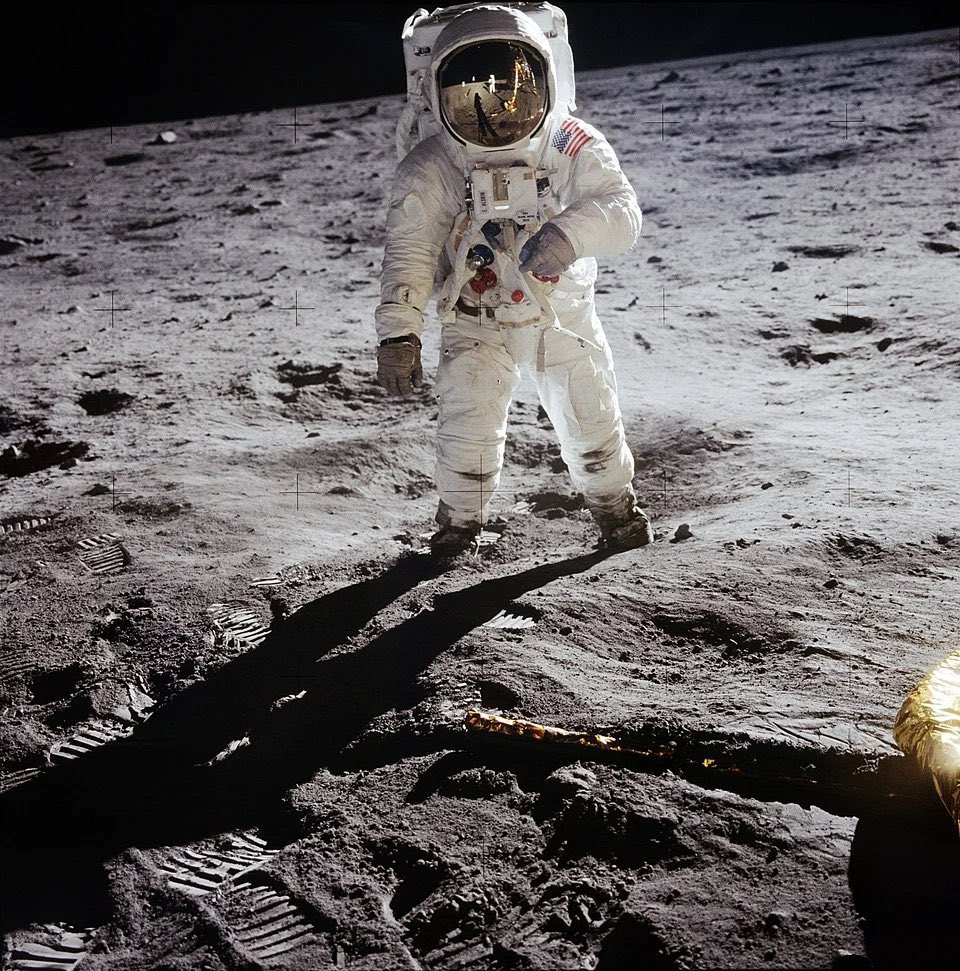
NASA trained astronauts to take photos without being able to see what they were shooting. They bolted a camera to each astronaut’s chest, removed the viewfinder, and handed them pressurized gloves so thick they could barely feel the shutter button. Before each Apollo mission, NASA sent the cameras home with the crew so they could spend weeks practicing how to aim the thing blind. The moonwalk photo of Buzz Aldrin was shot this way. Armstrong aimed from his chest through a tiny metal ring, guessing the framing. He held the camera slightly tilted. The original photo actually cuts off the top of Aldrin’s backpack, so NASA had to rotate and crop the image before releasing it. Armstrong carried the only camera for the entire 2 hours and 31 minutes they spent on the surface. When NASA’s press team went digging for a good photo of Armstrong himself, they found almost nothing. Aldrin grabbed the camera once and took a single shot of him. One photo of the first person to walk on the Moon. The floating astronaut image from 1984 was never planned. Bruce McCandless strapped on a nitrogen-powered jetpack and flew 320 feet from the Space Shuttle with no tether, no cable, nothing connecting him to the ship. Inside the shuttle, pilot Hoot Gibson had no assigned tasks during that window. He picked up a camera. He measured the light three separate times. He verified his focus four times per frame because he knew that if he blew the exposure, the moment was gone. That photo became one of NASA’s most requested images ever. McCandless later said it works because his visor is down and you can’t tell who’s in the suit. Could be anybody. Twelve cameras still sit on the Moon. After each Apollo landing, NASA told the crew to pack the film but leave the camera bodies behind. Moon rocks took priority, and weight limits were brutal. The cameras were lowered to the lunar surface on a clothesline rig and hauled back up the same way, film only. Across six Moon landings, astronauts shot over 18,000 photos, adjusting every setting by hand in a spacesuit. NASA’s headquarters photo team today is four people covering the entire agency. Every image NASA has ever produced is free to use because federal law says government employees can’t copyright their work. Over a million NASA photos sit in the National Archives going back to 1903. Their Instagram has 101 million followers. All of it built by people who had to practice pressing a button wearing gloves they could barely close their fist in.
Anish Moonka tweet media
Ab.@Abiodun0x

No one aura farms like NASA.

English
26
501
7.4K
461.6K
Chris T☆pher retweetledi
Jeremy
Jeremy@ManaByte·
The generation that lived during Apollo watched the landings on TV. The generation that’s living during Artemis think that Apollo never happened and aren’t paying attention because they watched a few idiots on YouTube or TikTok.
English
91
163
1.2K
20.9K
Chris T☆pher retweetledi
Jeremy
Jeremy@ManaByte·
People freaking out about Artemis “losing radio contact for 40 minutes” are basically announcing they have never learned how the Moon works. This is not a malfunction. This is not a crisis. This is not NASA “losing the spacecraft.” This is literally the most predictable part of a lunar mission. When Orion swings behind the Moon, the Moon physically blocks radio signals. Radio waves travel in straight lines. They cannot pass through 2,000 miles of rock. Every Apollo mission had the exact same blackout. Artemis II is doing a lunar flyby, so it gets the same geometry. NASA planned for it. They scheduled it. They briefed it. They published it. They even explained that the blackout lasts about 40 to 50 minutes because the Moon is in the way. During that time, the crew is not “lost.” Orion’s onboard computers keep flying the spacecraft. The astronauts keep working. Mission Control just cannot talk to them because the Moon is blocking the line of sight. This is called the “period of loss,” and it is a normal, expected part of every crewed lunar mission. So no, Artemis won’t “go dark.” It will go behind a giant celestial body that blocks radio waves. That is not a scandal. That is basic physics. If someone thinks this is suspicious, they might want to sit down before learning what happens when the Sun sets.
English
160
773
8.9K
287.9K
Chris T☆pher retweetledi
CBS News
CBS News@CBSNews·
The Artemis II crew may be in space for 10 days – so where will they sleep, eat, workout and go to the bathroom? Here's what it's like when you're living with three other astronauts in a space that is about the size of two mini vans. #space #nasa
English
34
273
1.7K
53.9K