Policy Tensor@policytensor
Some really interesting and counterintuitive results from the game. Let me explain the set up and main results.
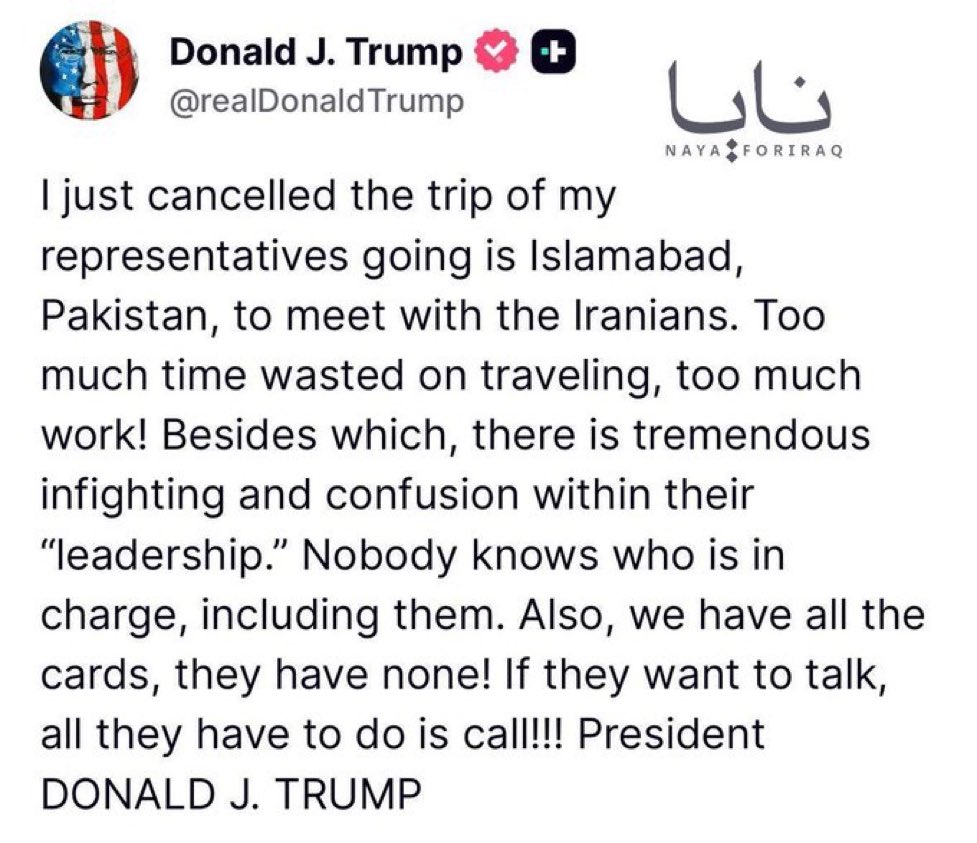
Iran makes the offers; Trump accepts (ending the game with DEAL) or rejects. If he rejects, you get a small prob of WAR, otherwise Iran gets to make another offer.
The source of information asymmetry is that Trump’s type is private and not known to Iran. He can be:
R risk-intolerant, ie prefers DEAL > FROZEN > WAR;
P pain-intolerant, ie prefers DEAL > WAR > FROZEN;
C crazy, ie prefers WAR > FROZEN > DEAL.
Theorem 1 — Two-round collapse. In any perfect Bayesian equilibrium (PBE), Iran makes at most two offers. This emerges bc two rounds are sufficient to recover Trump’s type. If Trump rejects two offers, then Iran knows he’s crazy and walks away.
Theorem 2 — Strategic asymmetry. Type P is strategically hard because he is more willing to run the risk of war. Conversely, type R is strategically soft.
Theorem 3 — Asymmetric rent incidence. In the screening PBE, the entire informational rent accrues to type R, the strategically soft type. This is bc Iran wants to avoid the risk of negotiation failure and must induce type R to accept the first offer that type P would not accept.
Theorem 4 — Probability of war. If Trump is crazy, war is certain. If Trump is of strategically soft (R), war is impossible. If Trump is strategically hard (P), war occurs with positive probability.
I’ll have more to say about this later. Here’s a link for the mathematically-sophisticated. researchgate.net/publication/40…